

Animals Know Something We Don’t
Many animals appear to possess a basic instinct that human societies occasionally lose. Wolves do not follow the loudest wolf. They do not choose the wolf who insults the rest of the pack most creatively or declares himself the greatest hunter every five minutes. Leadership in the wild tends to gravitate toward stability, experience and the ability to hold the group together when things become difficult. A wolf that constantly provokes fights, panics during hunts or behaves like an unregulated emotional volcano does not become the leader. That wolf becomes a liability. Even wolves appear to understand a principle that sometimes escapes human politics: a creature that cannot regulate itself cannot regulate a pack.
Imagine for a moment a wolf whose daily routine resembled certain personalities in modern public life. Every morning, he insults half the pack. By lunchtime, he has wandered into the territory of another pack and started a completely unnecessary fight simply to prove how fearless he is. When he finally returns, he begins bragging and bluffing about a tremendous victory over the other pack, even though the entire episode consisted mostly of noise. On the way back, he mocks the limping wolf in his own pack, because cruelty apparently counts as strength in his private dictionary. In the afternoon, he announces that he is the greatest hunter in the history of wolves despite not catching anything since Tuesday. When convenient, he cherry-picks the rules, selectively interpreting them and stepping over every boundary he himself imposed. By evening, he declares the day’s failed hunt a tremendous success, blames the rabbits for conspiring against him and insists that the pack has never eaten better.
At times, it resembles a foreign policy drafted by elementary school students, yet it is unfolding in the real world as if it came from a dark fantasy land. If such a wolf existed, the pack would not gather respectfully around him and say, “At last, a decisive leader.” The pack would quietly move away and allow him to argue with a tree.
Leadership in the wild is not determined by theatrical confidence or creative insults. It is determined by something much less exciting but far more useful: competence, composure and the ability to maintain cohesion when pressure rises. Survival tends to punish volatility rather efficiently. A pack led by chaos does not remain a pack for long.
The same pattern appears across many social species. Elephant herds tend to follow experienced matriarchs whose memory helps the group navigate droughts and migration routes. Many primate groups stabilise around individuals who reduce conflict rather than inflame it. Even among animals, leadership gravitates toward those capable of holding the group together rather than those addicted to spectacle. In other words, the animal kingdom appears to have solved a leadership problem that human societies occasionally manage to complicate.
Now contrast this with certain moments in human history. Entire populations sometimes become fascinated by individuals whose most visible traits include volatility, theatrical aggression and relentless self-promotion. The louder they shout, the more attention they attract. The more rules they break, the more some observers interpret this as strength. The more unpredictable they behave, the more they appear to dominate the stage. If wolves selected leaders this way, the species would probably have disappeared sometime during the last ice age.
Human beings, however, occasionally do something wolves never do. Every so often, we elevate the loudest personality in the room and call it leadership.
And this curious habit brings us to an old word that deserves to return to the conversation.
Lumpen.
The Word We Forgot
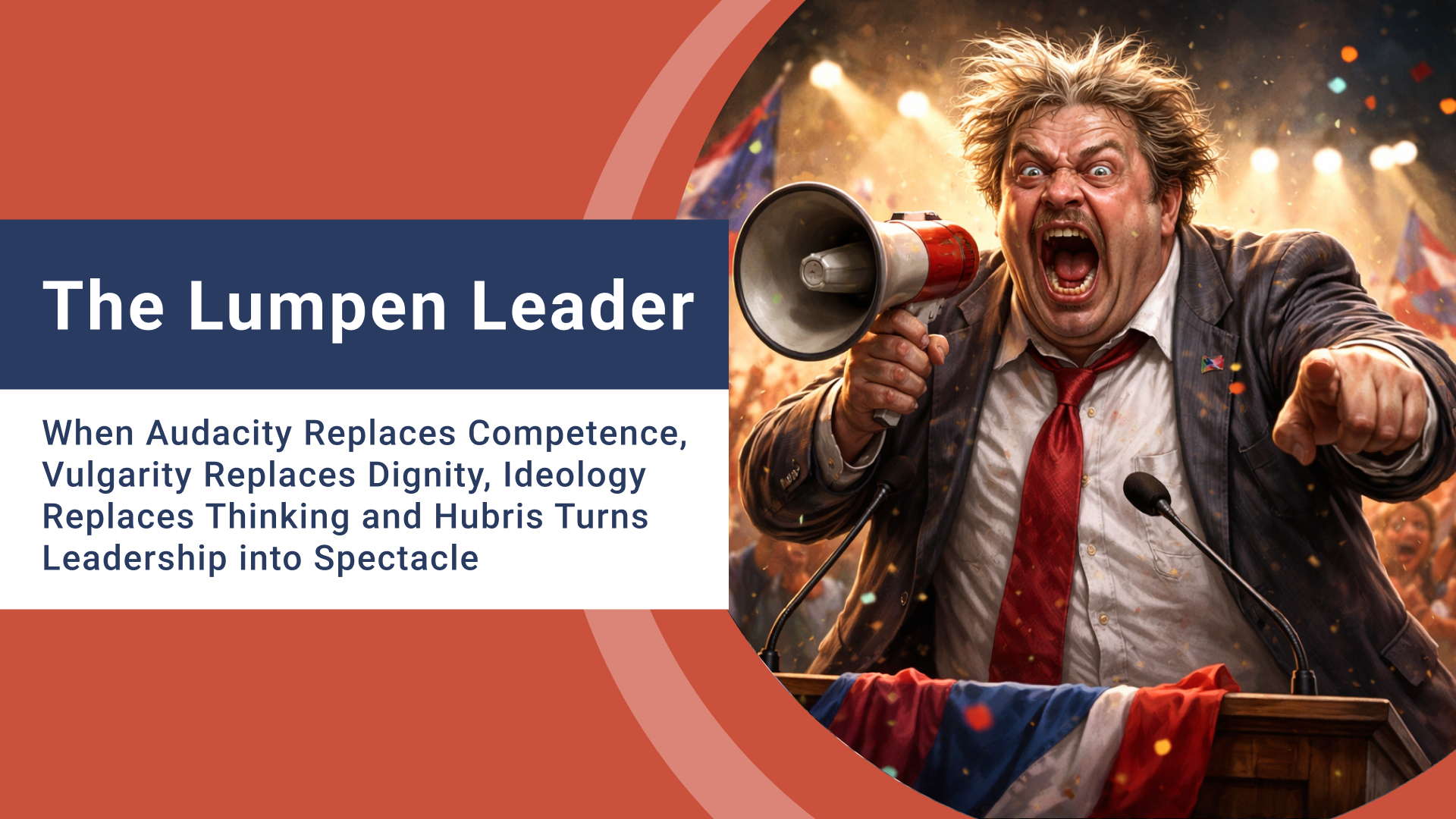
The lumpen leader is the figure in whom audacity replaces competence, vulgarity replaces dignity, ideology replaces thinking and hubris replaces responsibility.
The word lumpen is not commonly heard in everyday English anymore, which is unfortunate because it captures a phenomenon that appears with remarkable regularity in human societies. The word comes from German and refers to something ragged, frayed or degraded. Torn cloth. Worn edges. Something that has lost its structure. It entered political vocabulary through the writings of Karl Marx, who used the phrase lumpenproletariat to describe volatile social elements detached from productive labour and easily manipulated by opportunistic power seekers.
Marx had a very specific class analysis in mind, but the word itself contains a broader descriptive power. It captures a personality type that appears far beyond nineteenth-century political theory. Every society produces individuals whose defining traits include volatility, theatrical aggression, vulgar speech and an astonishing immunity to embarrassment. Under normal circumstances, such personalities remain colourful characters on the margins of civil life. You might encounter them at a loud bar, perhaps during a chaotic family gathering, or occasionally shouting into the internet at three in the morning. What you would not normally do is hand them the steering wheel of a complex institution.
Yet human societies occasionally do exactly that. Sometimes we even give them a podium, a television network and a national audience.
This is where the word lumpen becomes surprisingly useful again. Not as a description of economic class, but as a description of a leadership pathology. The modern lumpen leader is not defined by poverty but by a peculiar mixture of spectacle, audacity, vulgarity and ideological simplicity that begins to masquerade as authority. Instead of the slow accumulation of trust, competence and responsibility, the lumpen leader rises through performance. Politics becomes theatre. Communication becomes provocation. Insults begin to replace argument.
The strange thing about spectacle is that it easily disguises weakness as strength. A person who breaks every norm loudly enough can begin to look courageous. Someone who insults opponents relentlessly can appear decisive. A personality with the emotional regulation of an angry teenager suddenly looks like a fearless warrior. The show becomes so entertaining that the audience forgets to ask whether anything useful is actually being accomplished.
This dynamic was examined in The Ontology of Audacity, where audacity was described not merely as boldness but as something that, when detached from integrity, begins to function as a language of control. Shamelessness creates a peculiar advantage. Most people still operate with internal brakes. They hesitate before exaggerating, they feel embarrassment when they cross certain boundaries, and they consider the consequences of their words. The lumpen personality abandoned those brakes long ago. When the two interact, the shameless individual can appear strangely dominant even when nothing of substance has been accomplished.
Once spectacle becomes the currency of attention, another ingredient quickly enters the stage. In The Ontology of Vulgarity, it was argued that vulgarity lowers the cultural floor of discourse until aggression begins to look authentic. Language that would normally disqualify someone from civil conversation suddenly appears refreshingly honest. Insults become slogans. Crudeness becomes personality. The ability to speak without restraint begins to look like courage.
At this point, something else quietly enters the room. In Disleadership, leadership was described as a condition that can survive even after responsibility disappears. The title remains, the stage remains, the microphone remains, but the underlying commitment to stewardship quietly dissolves. Authority continues performing long after its moral centre has evaporated.
Add ideology to this environment and the situation becomes even more interesting. In Ideocy, the collapse of discernment into ideological slogans was explored. Complexity becomes suspicious. Nuance becomes weakness. Entire societies begin debating reality using the intellectual tools of bumper stickers. The lumpen leader thrives in this environment because governing reality requires patience, while performing outrage requires none.
Finally, hubris completes the mixture. In The Probability of Hubris, it was argued that arrogance becomes structurally unstable when self-image begins drifting away from observable reality. Failure is declared victory. Criticism becomes persecution. The narrative about the leader becomes more powerful than the evidence surrounding him.
Combine audacity, vulgarity, ideological simplicity, disappearing responsibility and expanding hubris and a very particular personality begins to emerge. The figure in whom audacity replaces competence, vulgarity replaces dignity, ideology replaces thinking and hubris replaces responsibility.
In short, the lumpen.
Under normal circumstances, such figures would remain noisy entertainers on the margins of public life. But from time to time, something stranger happens. The crowd begins to treat the performance as leadership.
The Crowd That Claps
At this point, it becomes tempting to blame the lumpen leader alone. After all, the personality profile is not especially mysterious. History has never lacked individuals with theatrical egos, thin skin, dramatic tempers and an endless appetite for attention. Civilisations have been producing such characters with admirable consistency for thousands of years. The more interesting question is not why the lumpen exists. The more interesting question is why crowds sometimes reward him.
The answer begins with the signals by which human beings recognise leadership. Most people do not evaluate leaders through careful examination of competence, responsibility or long-term outcomes. Those are slow signals. They require patience, reflection and sometimes uncomfortable honesty. Spectacle, on the other hand, is an immediate signal. It is loud, visible and emotionally satisfying. A crowd can recognise it instantly, which makes it politically very efficient.
The difficulty is that spectacle often disguises itself as strength. When someone speaks with relentless confidence, many listeners interpret this as competence. When someone attacks opponents aggressively, some observers interpret this as courage. When someone breaks norms publicly, others interpret this as authenticity. It is a fascinating psychological illusion. The behaviours that would normally signal instability in everyday life begin to look like leadership once they are projected onto a large stage.
Imagine a workplace meeting where one participant spends the entire time shouting, insulting colleagues and declaring himself the smartest person in the building. The rest of the room would not quietly conclude that a great leader had emerged. They would conclude that the human resources department needed to intervene immediately. Yet place the same behaviour behind a podium with bright lights and suddenly the interpretation can change. The performance acquires drama, the drama attracts attention, and attention quietly begins to resemble authority.
This is precisely where the dynamic explored in The Ontology of Audacity begins interacting with crowd psychology. Audacity functions as a behavioural asymmetry. Most people still operate with internal brakes. They hesitate before making outrageous claims or publicly humiliating others. The lumpen personality does not hesitate at all. The absence of restraint can look like fearlessness when placed next to people who still possess basic social inhibitions.
Vulgarity reinforces the illusion. As described in The Ontology of Vulgarity, degrading the tone of discourse lowers expectations across the entire environment. Language that once signalled poor judgement begins to appear refreshingly direct. Insults begin to sound like honesty. Crudeness begins to resemble authenticity. The cultural floor drops low enough that behaviour which would once have been disqualifying suddenly appears impressive.
Then ideology enters the stage, bringing with it the condition described in Ideocy. When ideological certainty replaces discernment, complex realities become uncomfortable. Nuance disappears. Entire populations begin interpreting the world through emotionally satisfying narratives rather than careful reasoning. In such environments, the lumpen leader enjoys a remarkable advantage. Governing complexity requires patience and thought. Performing ideological certainty requires only volume.
Meanwhile, the phenomenon described in Disleadership quietly stabilises the arrangement. Authority can remain visible long after responsibility disappears. The stage remains intact even when stewardship evaporates. Titles continue functioning while the substance behind them quietly dissolves.
Finally, hubris locks the system into place. As explored in The Probability of Hubris, the gap between self-image and reality can expand until correction becomes extremely difficult. Criticism is interpreted as persecution. Evidence becomes conspiracy. Success is declared loudly enough that the declaration itself begins to function as proof.
When these dynamics interact, something remarkable happens. Audacity attracts attention. Attention amplifies spectacle. Spectacle rewards vulgarity. Vulgarity energises ideological loyalty. Ideology protects hubris from correction. The entire system begins reinforcing the performance.
At that point, the lumpen leader no longer requires competence.
The show is enough.
And the crowd keeps watching.
When the Show Becomes the System
Once the performance begins to function as leadership, something even stranger starts to happen. The spectacle does not merely entertain the crowd. Gradually, it begins replacing the very mechanisms by which leadership is supposed to operate. What began as a dramatic personality dominating the stage slowly transforms into a governing style. The theatre expands until it begins to look like the system itself.
The lumpen leader instinctively understands something about modern attention economies. Attention is power. Whoever dominates attention often dominates perception, and whoever dominates perception can influence reality for a surprisingly long time. The formula is not complicated. Create conflict, provoke outrage, insult opponents, declare victory and repeat the cycle before anyone has time to examine the consequences. The rhythm of spectacle becomes more important than the substance of decisions.
In such an environment, leadership mutates into a continuous performance. Policy becomes secondary. Institutions become props. Communication becomes daily theatre designed to keep the audience emotionally engaged. Every controversy becomes another episode. Every insult becomes a headline. Every reaction becomes fuel for the next performance. Governance quietly drifts toward spectacle management.
The curious irony is that the lumpen leader often thrives precisely where serious leadership would struggle. Real leadership requires restraint. It requires the discipline to think before speaking, the patience to navigate complex realities and the humility to acknowledge limits. None of these qualities generate dramatic applause. Calm judgment rarely trends on social media. Responsible decisions often look boring when compared to theatrical outrage.
The lumpen leader resolves this problem by eliminating the quiet parts altogether.
Instead of navigating complexity, reality is simplified into emotionally satisfying narratives. Instead of acknowledging uncertainty, absolute certainty is declared about everything. Instead of admitting mistakes, failure is reinterpreted as victory through sheer repetition. If something goes wrong, blame is redirected toward enemies, conspirators or disloyal insiders. Reality becomes something that can be negotiated through volume.
This is precisely where the condition described in Disleadership becomes visible. Leadership as stewardship quietly disappears while authority as performance remains. The office continues functioning, the title still carries weight, the cameras remain pointed at the stage, but the responsibility that once justified the position begins dissolving beneath the surface. Authority becomes theatrical rather than custodial.
At the same time, the mechanisms described in Ideocy continue to lubricate the environment. Ideological certainty replaces careful reasoning. Nuance becomes suspicious. Loyalty to the narrative becomes more important than examining outcomes. In such conditions, the leader no longer needs to explain complicated realities. The narrative itself becomes sufficient.
Vulgarity also continues performing a useful function within the spectacle. As argued in The Ontology of Vulgarity, lowering the cultural tone of discourse gradually normalises behaviour that would once have been unacceptable. Once insults become routine, restraint begins to look weak. Once mockery becomes common, seriousness begins to look suspicious. The cultural environment slowly shifts downward until even basic dignity begins to appear unnecessary.
Audacity ensures the stage remains electrified. The pattern examined in The Ontology of Audacity becomes increasingly visible. Gall expands the boundaries of acceptable behaviour. Yesterday’s scandal becomes today’s normal behaviour. Each escalation creates a new reference point, making the next escalation easier.
Above all of this floats the architecture of hubris. As explored in The Probability of Hubris, when the gap between self-image and observable reality widens, the leader’s internal narrative begins to dominate external feedback. Loyal supporters reinforce the mythology. Critics amplify the drama through constant reaction. The leader becomes the central character in a story that increasingly exists within the performance itself.
At this stage, the distinction between leadership and theatre begins to collapse. The show is no longer distracting from governance. The show is governance. And the lumpen leader stands at the centre of the stage, convinced that the applause proves everything is working perfectly.
When Reality Walks Back Into the Room
Spectacle can dominate attention for a remarkably long time, but it eventually encounters a stubborn and deeply inconvenient opponent. Reality.
Reality does not care very much about slogans, applause or theatrical confidence. It has a habit of quietly continuing its work regardless of how loudly someone declares victory. Economies respond to decisions rather than speeches. Institutions weaken if they are treated like stage props. Social trust deteriorates when language becomes permanently degraded. Reality has a rather irritating quality from the perspective of theatrical leadership. It refuses to adjust itself to the narrative.
For a while, the performance can obscure this tension. Audacity captures headlines. Vulgarity energises supporters. Ideological certainty simplifies complex problems into emotionally satisfying stories. Hubris constructs a psychological fortress around the leader’s self-image. The stage lights remain bright, the microphones remain active and the audience remains entertained. Within the theatre, everything appears magnificent.
Outside the theatre, something else is happening.
This is precisely the structural tension described in The Probability of Hubris. When the distance between self-image and actual outcomes becomes too large, systems begin developing hidden fractures. The leader’s narrative insists that everything is working perfectly, while the environment quietly accumulates evidence to the contrary. Institutions strain under contradictory directives. Policies designed for applause produce consequences that applause cannot resolve. The gap between theatre and reality begins widening.
At first, the signs appear small and easily dismissed. A company led by spectacle rather than competence begins losing its most capable people. They leave quietly, often without dramatic confrontation, simply recognising that the stage has replaced serious work. Decisions made for attention rather than judgment begin generating confusion further down the system. Meetings become longer while clarity becomes shorter.
In political systems, the process can take longer because large structures absorb stress slowly. But the mechanism remains the same. Economic consequences accumulate. Institutional credibility erodes. International relationships grow cautious. The gap between the narrative presented on stage and the observable outcomes in the real world gradually becomes difficult to ignore.
Ironically, the very qualities that elevated the lumpen leader often make correction harder. Hubris discourages self-reflection. Audacity escalates conflict rather than resolving it. Vulgarity keeps discourse degraded and emotionally charged. Ideological loyalty discourages honest evaluation. The performance intensifies precisely at the moment when calm judgement would be most valuable.
The leader doubles down on the show. More conflict. More certainty. More declarations of victory. But something subtle begins shifting in the audience.
The performance that once felt electrifying starts to feel repetitive. The insults that once sounded refreshing begin to sound predictable. The slogans that once felt powerful begin requiring increasingly elaborate explanations. The crowd slowly realises that entertainment and leadership may not be the same thing after all. Reality has a habit of doing this. It quietly walks back into the room and switches on the lights.
Under brighter light, theatrical confidence begins to look less impressive. Audacity begins to resemble recklessness. Vulgarity begins to appear crude rather than authentic. Ideological certainty begins to feel strangely shallow when confronted with real consequences.
This is the moment when the crowd begins asking the question that should probably have been asked much earlier.
Why did we give the microphone to this person in the first place?
Civilisation Is Not a Talent Show
Once that question begins circulating, another uncomfortable realisation often follows. Leadership was never meant to be entertainment.
Civilisation is not a talent show. It is not a reality television competition in which the loudest personality wins the audience. It is not a wrestling match in which theatrical aggression determines authority. Leadership exists for a far less glamorous reason. It exists to steward complex systems, to hold together fragile institutions and to guide collective decisions through uncertainty. None of these tasks produce particularly dramatic applause, which may explain why they sometimes lose the competition against spectacle.
The lumpen leader thrives precisely because spectacle is seductive. Spectacle is fast. It is emotional. It is entertaining. It simplifies complicated realities into stories that feel satisfying. There are heroes and villains, loyal supporters and enemies, dramatic victories and permanent conspiracies. The crowd always knows who to cheer for. In comparison, real leadership can appear disappointingly calm. Responsible leaders speak cautiously because they recognise complexity. They acknowledge uncertainty because reality is rarely simple. They sometimes refuse applause because the right decision is not always the popular one.
None of this plays well in a theatre.
This is why the phenomenon described in Disleadership becomes so important. When leadership loses its connection to responsibility, the position becomes vulnerable to personalities that excel at performance rather than stewardship. Authority becomes a spotlight rather than a duty. The title remains impressive, the cameras remain pointed at the stage, but the underlying purpose of the role quietly evaporates.
Once this transformation occurs the selection criteria begin to invert. The qualities that normally disqualify someone from leadership start functioning as advantages within the spectacle economy. Audacity replaces prudence. Vulgarity replaces dignity. Ideological certainty replaces careful thinking. Hubris replaces humility. Each of these traits would normally raise serious questions about a person’s suitability to guide anything more complicated than a heated argument. Yet on the theatrical stage of public attention, they generate applause.
The lumpen leader understands the mechanics of applause far better than the mechanics of governance. He knows how to provoke outrage. He knows how to dominate attention. He knows how to transform every criticism into another episode of the show. Opponents react, supporters react, the media reacts and the stage grows larger with each reaction. The spectacle becomes self-sustaining.
Meanwhile, the quiet disciplines that sustain functioning societies begin eroding in the background. Institutional norms weaken. Language becomes harsher. Public trust deteriorates. Competence becomes less visible because competence rarely shouts. The system begins producing more noise but less stability.
And yet the phenomenon persists because it reveals something uncomfortable about human psychology. Crowds are not merely victims of spectacle. They are participants in it. The audience that complains about the noise often continues watching the performance. The citizens who criticise vulgarity sometimes repeat the slogans. The observers who recognise instability remain captivated by the drama.
The lumpen leader does not appear in isolation. He appears in environments where spectacle has become more attractive than stewardship.
Which means removing the performer is rarely enough. Another performer will eventually appear if the audience still demands the show. The deeper question, therefore, returns to the crowd. What kind of leadership does a society actually recognise?
If stability looks boring, humility looks weak, discipline looks slow and thoughtful judgment looks timid, then the stage will always reward the loudest personality in the room. But if leadership once again becomes associated with responsibility, competence and restraint, something interesting begins to happen.
The stage grows quieter.
And the work grows more serious.
The Lumpen Mirror
At this point, it would be easy to conclude the story with a comforting moral lesson about bad leaders. It would certainly make the narrative simpler. The personality profile of the lumpen leader is easy to recognise once the pattern is visible. Volatility masquerading as courage, vulgarity presented as honesty, ideological certainty replacing thought, audacity mistaken for strength and an expanding sphere of hubris floating comfortably above reality. The caricature almost writes itself. But stopping the analysis there would miss the more uncomfortable part of the phenomenon. The lumpen leader is not merely a political accident. He is also a mirror.
Every society produces individuals with theatrical egos and unstable temperaments. Human personality has never lacked loud characters, attention seekers or self-declared geniuses. The difference between societies lies not in whether such personalities exist but in how close they are allowed to approach real authority. Healthy systems develop filters. Institutions, norms and cultural expectations gradually steer leadership toward individuals capable of discipline, responsibility and restraint. The loud character remains a loud character, but the system quietly prevents him from becoming the captain of the ship.
The lumpen leader appears when those filters weaken.
This is where the dynamic explored in Ideocy becomes particularly relevant. When ideological loyalty replaces discernment, societies begin rewarding emotional alignment rather than careful thinking. Complex problems are compressed into slogans. Entire populations begin arguing about reality with the intellectual depth of a sports rivalry. The loudest voice begins to sound like the clearest one simply because it dominates the conversation.
Audacity then amplifies the distortion. As explored in The Ontology of Audacity, shamelessness creates a peculiar asymmetry in social interaction. Most individuals still operate with internal brakes. They feel hesitation before exaggerating, embarrassment before humiliating others and caution before making outrageous claims. The lumpen personality abandoned those brakes long ago. When such a personality confronts a more restrained opponent, the absence of inhibition can look like strength, even when it is simply recklessness.
Vulgarity completes the illusion. In The Ontology of Vulgarity, it was argued that degrading the tone of discourse lowers the cultural floor until behaviour that once looked crude begins to appear authentic. When language becomes coarse enough, aggression begins to resemble honesty and dignity begins to look artificial. The environment gradually shifts until theatrical bluntness begins receiving more attention than thoughtful speech.
Hubris then locks the entire structure into place. The drift between self-image and reality examined in The Probability of Hubris creates a psychological feedback loop in which the leader’s narrative becomes increasingly insulated from correction. Loyal supporters reinforce the mythology while critics unintentionally amplify the spectacle through constant reaction. The performance becomes the centre of gravity around which the entire political conversation rotates.
Seen from this perspective, the lumpen phenomenon becomes less mysterious and more diagnostic. It reveals something about the environment that produced it. The crowd that cheers audacity has already begun confusing noise with courage. The audience that applauds vulgarity has already lowered its expectations for dignity. The public that rewards ideological certainty has already grown impatient with complexity.
The lumpen leader simply steps onto a stage that was prepared long before he arrived.
In that sense, the phenomenon is not only about leadership. It is about cultural discernment. Societies that value competence, responsibility and restraint rarely elevate theatrical volatility to positions of authority. Societies that become addicted to spectacle, however, eventually produce performers perfectly suited to satisfy that appetite.
Which brings us back to wolves.
Wolves do not follow the loudest wolf. Elephants do not entrust the herd to the most dramatic animal in the savannah. Even primates, with all their social complexity, rarely hand leadership to the individual most addicted to chaos.
Human beings, occasionally, do exactly that.
And when they do, the word lumpen becomes remarkably useful again.
When the Pack Forgets How to Choose
Once the pattern becomes visible, another slightly uncomfortable realisation begins to surface. The lumpen leader is not simply an individual failure. It is a selection failure.
Leadership is never a solitary act. No one becomes a leader in isolation. Leadership exists only when a group recognises authority and chooses to follow it. Even the most theatrical personality still requires an audience willing to interpret the performance as leadership. In that sense, the lumpen phenomenon tells us something deeper about the cultural environment in which it appears. The pack has not merely chosen poorly. The pack has forgotten how to choose.
Human societies normally possess a number of subtle mechanisms that filter leadership. Experience matters. Reputation matters. Demonstrated competence matters. Institutions matter. Individuals gradually accumulate trust through behaviour over time, and that accumulated trust often determines who receives authority when responsibility becomes serious. In healthy systems, these mechanisms operate quietly in the background like the immune system of a civilisation. They do not prevent every mistake, but they make it difficult for volatility to rise to the top.
Spectacle weakens those mechanisms.
When attention becomes the dominant currency of public life, the signals that normally indicate competence begin to fade behind the signals that generate visibility. The loudest voice travels furthest. The most provocative statement circulates fastest. The most dramatic personality becomes the most recognisable figure in the room. Recognition slowly begins to substitute for credibility.
At this point, the system becomes vulnerable to precisely the type of personality that thrives on attention rather than responsibility. The lumpen leader instinctively understands that outrage is a renewable resource. Every insult produces reaction. Every reaction produces coverage. Every coverage cycle expands the stage. Competence, by contrast, is slow and quiet. Provocation is immediate and viral.
The transformation is not limited to politics. It appears in organisations, media ecosystems and cultural life more broadly. A manager who humiliates colleagues may initially appear decisive because conflict generates visibility. A public commentator who speaks in crude certainties may gain attention because outrage travels faster than nuance. A personality who breaks every convention may appear fearless simply because everyone else is still respecting boundaries.
Over time, the signals begin to invert.
Restraint begins to look weak. Thoughtfulness begins to look indecisive. Humility begins to look insecure. Discipline begins to look dull. Meanwhile, volatility begins to look exciting.
This inversion explains why the lumpen leader can rise despite obvious deficiencies in competence or temperament. The selection criteria have shifted. The crowd is no longer evaluating leadership through the qualities required to steward complex systems. Instead, it is evaluating leadership through the qualities required to dominate attention. The two skill sets are not the same.
A person who excels at governing may appear cautious, measured and occasionally boring. A person who excels at spectacle may appear bold, fearless and endlessly entertaining. One builds functioning institutions. The other builds an audience. The danger arises when societies begin confusing the two.
In such moments, the leadership arena begins to resemble a competitive stage rather than a serious process of stewardship. Applause becomes a metric of success. Outrage becomes a strategy. The spectacle becomes addictive both for the performer and the audience.
Eventually, the environment begins producing exactly the type of leader it rewards. The lumpen leader is therefore not an anomaly. He is the logical product of a culture that has gradually replaced discernment with spectacle. The pack did not suddenly become foolish. The pack slowly forgot what leadership was for. And when that memory fades, the loudest wolf in the forest begins to look strangely impressive.
The Narcissistic Engine of the Lumpen
There is another layer beneath the behaviour of the lumpen leader that deserves attention. The theatrical aggression, the relentless need for attention, the bullying, the distortion of reality and the inability to tolerate criticism are not merely personality quirks. They follow a psychological pattern that has long been recognised in clinical literature under the concept of malignant narcissism.
Malignant narcissism refers to a dangerous configuration of personality traits in which grandiosity merges with aggression, paranoia and antisocial tendencies. Such individuals do not merely seek admiration; they seek domination. The world becomes a stage for their self-importance, criticism becomes an intolerable threat and loyalty must be demanded rather than earned. Empathy diminishes, accountability evaporates and power becomes a mirror in which the leader endlessly admires his own reflection.
At this point, the lumpen leader begins to make more sense. The audacity, the vulgarity, the theatrical certainty and the perpetual conflict are not accidental. They are behavioural expressions of a personality that requires attention and dominance to sustain itself.
Yet the deeper problem is not only psychological. It is systemic.
In an earlier article titled The System Is Us, I argued that unstable and destructive leaders rarely appear in isolation. They emerge within environments that reward them. As that article observed:
“Leaders emerge who are unstable, inauthentic and unaccountable, yet they are continuously sustained. This is not the failure of the system. This is the system we sustain.”
This insight is uncomfortable because it shifts the focus away from the individual alone. The lumpen leader does not rise purely through personal ambition. He rises through amplification. Media ecosystems reward spectacle. Social networks reward outrage. Crowds reward theatrical confidence. Each reaction, whether supportive or outraged, keeps the spotlight firmly fixed on the stage.
The system does not merely tolerate the lumpen. The system circulates him.
This is why the phenomenon persists even when the leader’s behaviour appears obviously erratic or destructive. The performance itself becomes the engine of attention. The more outrageous the behaviour, the more attention it generates. The more attention it generates, the more central the personality becomes to the narrative. Malignant narcissism provides the fuel. Spectacle provides the stage. And the crowd, often unintentionally, provides the applause.
The animal kingdom again offers a quiet contrast. In a wolf pack or elephant herd, individuals who consistently destabilise the group rarely rise to leadership. Stability is valued because survival depends on it.
Human societies, however, occasionally elevate the individual most addicted to chaos.
And then wonder why the system begins to resemble the personality at the top.
When the Lights Come Back On
Eventually, every spectacle encounters a quiet and rather inconvenient opponent. Reality.
Reality has a stubborn personality. It does not negotiate very well with slogans, applause or theatrical confidence. Crops still fail if they are planted poorly. Economies still respond to reckless decisions. Institutions still weaken if they are treated like stage props. Reality, unlike an audience, does not clap. It simply waits.
For a while, the performance can mask this tension. Audacity dominates headlines. Vulgarity energises supporters. Ideological slogans compress complicated realities into emotionally satisfying narratives. Hubris constructs a psychological fortress in which every criticism appears as persecution and every failure can be reinterpreted as success. The theatre continues operating with great enthusiasm.
Behind the curtain, the system continues absorbing consequences.
This is the instability described in The Probability of Hubris. When the distance between the leader’s self-image and observable outcomes grows too large, the structure becomes fragile. Inside the theatre, the narrative insists that everything is magnificent. Outside the theatre, the system quietly accumulates evidence to the contrary. Institutions strain under contradictory signals. Policies designed for applause begin producing costs that applause cannot erase.
At first, the signs are subtle. A company led by spectacle rather than competence begins losing its most capable people. They leave quietly, recognising that the stage has replaced serious work. Decisions made for attention rather than judgment begin creating confusion further down the system. Meetings become louder while clarity becomes thinner.
Political systems often absorb the strain longer because large institutions possess inertia. But the pattern remains recognisable. Economic consequences accumulate slowly. Institutional credibility erodes gradually. Allies become cautious. Opponents become opportunistic. The distance between the theatrical narrative and the lived reality of citizens begins widening.
Ironically, the same qualities that elevated the lumpen leader often make correction more difficult. Hubris discourages self-reflection. Audacity escalates conflict instead of resolving it. Vulgarity keeps discourse emotionally charged. Ideological loyalty discourages honest evaluation. The performance intensifies precisely when calm judgement is most needed.
The leader doubles down on the show. More outrage. More declarations of victory. More dramatic enemies.
But something subtle begins changing in the audience. The performance that once felt electrifying begins to feel repetitive. The insults that once sounded refreshing begin to sound predictable. The slogans that once felt powerful begin requiring increasingly creative explanations. The crowd slowly realises that entertainment and leadership may not be the same thing after all.
Reality has a habit of doing this. It quietly walks back into the room and switches on the lights.
Under brighter light, theatrical confidence begins to look less impressive. Audacity begins to resemble recklessness rather than courage. Vulgarity begins to appear crude rather than authentic. Ideological certainty begins to sound shallow when confronted with consequences.
And sooner or later, someone in the crowd asks the question that should probably have been asked much earlier.
Why did we give the microphone to this person in the first place?
The Quiet Return of Leadership
When that question begins circulating, something important starts happening beneath the surface of the spectacle. Discernment slowly returns.
Discernment is not dramatic. It does not shout, trend on social media or generate viral applause. It is the quiet ability to distinguish between performance and substance, between volume and competence, between theatrical confidence and genuine responsibility. Once this ability begins returning to a society, the entire spectacle begins to look different.
Without the theatre lights, the performance becomes strangely unimpressive.
Audacity without integrity starts looking reckless rather than courageous. Vulgarity begins to appear crude rather than authentic. Ideological slogans begin to sound thin when compared to complex realities. Hubris begins to resemble fragility rather than strength. The behaviours that once generated applause suddenly begin generating unease.
This is the moment when the environment described in Disleadership begins reversing itself. Authority without responsibility becomes increasingly difficult to sustain once the audience starts expecting results rather than performance. Titles alone no longer guarantee credibility. Positions of power begin requiring something more demanding than theatrical presence.
Responsibility returns as a selection criterion.
This shift changes the entire dynamic of leadership recognition. The personality who thrives purely on spectacle begins losing his greatest advantage. Provocation without substance becomes repetitive. Constant outrage becomes exhausting. The crowd gradually loses interest in the show once the consequences become visible.
Meanwhile, the quieter qualities that sustain functioning systems slowly regain their value. Competence begins to matter again. Discipline begins to look attractive again. Humility stops appearing weak and starts appearing trustworthy. Leaders who think before speaking may not produce daily excitement, but they produce something far more useful: stability.
This transformation rarely happens instantly. Spectacle has a powerful gravitational pull, particularly in environments where attention circulates faster than careful thought. But history repeatedly demonstrates that societies eventually rediscover the difference between leadership and performance because reality eventually forces the comparison. Civilisations cannot function indefinitely as theatre productions. Systems must operate. Institutions must endure beyond individual personalities. Decisions must produce outcomes rather than applause. When those practical realities begin reasserting themselves, the environment slowly begins filtering leadership differently. And once that filtering begins again, the lumpen personality gradually loses proximity to real authority.
The character who once dominated the stage does not necessarily disappear. Such personalities will always exist. But their natural place returns to the margins of serious leadership. They remain entertainers, provocateurs or dramatic commentators rather than stewards of complex systems.
The microphone remains available to anyone who wishes to shout.
Authority, however, begins migrating elsewhere.
The Word That Helps Us See
This is precisely why the old word lumpen deserves to return to our vocabulary. Not as a casual insult thrown across partisan divides, and not as a relic of nineteenth century political theory, but as a diagnostic lens. It allows us to describe a particular leadership pathology that emerges when spectacle replaces stewardship.
The lumpen leader is not simply rude, eccentric or controversial. Those things have always existed in public life. What distinguishes the lumpen phenomenon is the convergence of several structural dynamics that together create a powerful illusion. Audacity begins replacing competence. Vulgarity begins replacing dignity. Ideology begins replacing thinking. Responsibility quietly disappears while authority remains. Hubris expands until the leader’s self-image becomes detached from the consequences of his actions.
Each of these dynamics has been explored elsewhere. In The Ontology of Audacity, it was argued that shamelessness can become a language of control when it detaches from integrity. In The Ontology of Vulgarity, the degradation of discourse was examined as a cultural shift in which crudeness begins to look authentic simply because the floor of dignity has been lowered. In Ideocy, ideological certainty was described as the moment when slogans replace discernment and complexity collapses into emotionally satisfying narratives. In Disleadership, the strange condition was explored in which authority survives even after responsibility evaporates. And in The Probability of Hubris, the instability that emerges when self-image drifts away from observable reality was examined.
When these forces converge within a single personality, the result is remarkably predictable. The leader no longer governs through competence or responsibility but through spectacle. Attention becomes the primary currency of authority. Outrage becomes a strategy. Conflict becomes a renewable resource. The stage expands while the substance of leadership quietly shrinks.
Seen through this lens, the lumpen leader is not simply an individual anomaly. He is the visible surface of a deeper cultural condition. He emerges where spectacle has become more valuable than stewardship, where attention circulates faster than discernment and where crowds begin confusing theatrical dominance with real authority.
The usefulness of the word lies precisely here. It allows us to name the pattern without reducing the analysis to partisan outrage. The problem is not merely that one individual behaved badly. The problem is that an entire environment rewarded the performance.
And once we recognise the pattern, the analogy that opened this discussion returns with sharper clarity. Wolves do not follow the loudest wolf. Elephants do not entrust the herd to the most dramatic animal in the savannah. Even primates rarely elevate the individual most addicted to chaos. The animal kingdom, it seems, has a rather practical understanding of leadership.
Human societies occasionally forget.
When they do, the lumpen steps onto the stage, the crowd applauds the spectacle and civilisation learns once again that noise is not the same thing as strength. The good news is that the remedy is neither mysterious nor complicated.
It is simply the return of discernment.
A Slightly Embarrassing Lesson from Wolves
If one steps back from the entire discussion, the irony becomes difficult to ignore. Civilisations spend centuries constructing institutions, educational systems and cultural norms designed to identify responsible leadership. We develop constitutions, professional standards, governance structures and ethical frameworks precisely because leadership carries consequences that extend far beyond the personality of the individual occupying the position. Yet every so often, despite all this accumulated sophistication, societies find themselves captivated by individuals whose primary skill lies not in stewardship but in spectacle.
This is why the word lumpen proves so useful. It reminds us that the problem is not simply bad behaviour. The problem is a deeper inversion in how leadership signals are interpreted. In environments saturated with attention-driven communication, spectacle begins to overshadow competence. Provocation travels faster than prudence. Dramatic confidence becomes easier to recognise than thoughtful judgement. The personality who dominates the stage appears stronger than the one quietly navigating complexity, even when the opposite is true.
The lumpen leader thrives precisely in this environment. Audacity generates attention. Vulgarity energises audiences by appearing unfiltered and authentic. Ideological certainty simplifies complicated realities into emotionally satisfying narratives. Hubris shields the personality from correction. Meanwhile, the phenomenon described earlier as disleadership allows authority to remain visible even after responsibility has quietly disappeared. The result is a curious inversion in which theatrical volatility begins functioning as a leadership signal.
Yet the entire arrangement rests on a fragile misunderstanding. Noise is not strength. Volume is not competence. Attention is not authority. The fact that a personality can dominate the stage does not mean that personality can guide a civilisation. It only means the individual understands how the stage works. Eventually, reality restores the distinction.
Institutions must function. Systems must remain stable. Decisions must produce consequences that extend beyond applause. When societies rediscover these practical requirements, the spectacle begins to lose its power. The leader who performs strength begins to look strangely thin when compared with the leader who quietly practices responsibility. At that point, the animal kingdom begins to look surprisingly wise again.
Wolves do not debate leadership endlessly. They do not reward the wolf who produces the most dramatic speech. They do not elevate the wolf most addicted to chaos simply because he dominates attention. Stability, competence and the ability to maintain cohesion quietly determine who leads.
Human beings, despite possessing vastly greater cognitive capacities, occasionally manage to forget this simple evolutionary lesson.
And when we do, the loudest wolf in the forest suddenly begins to look very impressive.
Until the lights come back on.
The Loudest Wolf
In the end, the story returns to a surprisingly simple observation. Leadership is not about who can dominate the stage. It is about who can carry responsibility without collapsing under it. That difference may appear subtle during moments of spectacle, but over time it becomes decisive.
The lumpen leader thrives in environments where attention has replaced discernment as the dominant signal of authority. In such environments, the qualities that normally disqualify someone from leadership suddenly begin functioning as advantages. Audacity appears courageous simply because it ignores restraint. Vulgarity appears authentic simply because it abandons dignity. Ideological certainty appears strong simply because it eliminates complexity. Hubris appears confident simply because it refuses correction.
For a while, this combination can produce a remarkably powerful performance. The stage grows larger, the audience becomes emotionally invested and the leader appears increasingly dominant within the theatre of attention. The louder the voice, the greater the impression of strength. The more dramatic the conflict, the more attention the performance attracts. Yet the entire illusion rests on a fragile foundation.
Civilisations are not governed through theatre alone. Systems must function. Institutions must endure. Decisions must produce outcomes that extend far beyond the emotional rhythms of a crowd. When those practical realities begin asserting themselves, the difference between performance and stewardship becomes impossible to ignore.
This is the moment when the old word introduced earlier proves useful again. The lumpen leader is not simply a controversial personality. He is the figure in whom audacity replaces competence, vulgarity replaces dignity, ideology replaces thinking and hubris replaces responsibility. He governs through spectacle because spectacle is the only form of authority he truly understands.
Once a society recognises this pattern, something interesting happens. The stage begins shrinking. The applause becomes quieter. Attention slowly migrates away from theatrical conflict and toward practical competence. The personality who once dominated every conversation begins looking strangely unimpressive when compared with the quieter discipline required to guide complex systems. Leadership returns to its original meaning. Not entertaining the crowd. But guiding the pack.
And at that point, the final irony becomes unavoidable. Wolves never had this problem in the first place. They do not reward the wolf who shouts the loudest, insults the rest of the pack most creatively or declares himself the greatest hunter every five minutes. Stability, experience and the ability to hold the group together quietly determine who leads. Human societies occasionally forget this. When they do, the loudest wolf suddenly looks like a leader.
Until the pack remembers how to choose.
The Lumpen Archetype
At this point, it may be useful to pause and look directly at the figure that has been slowly emerging throughout this discussion. The lumpen leader is not merely loud, controversial or unconventional. Those qualities have appeared in many leaders throughout history without necessarily producing dysfunction. The lumpen archetype represents something more specific: a convergence of behavioural patterns that together produce a particularly unstable form of leadership.
In the context of this work, the term lumpen refers to a particular leadership archetype.
A lumpen leader is an individual who rises to authority primarily through spectacle rather than stewardship. Audacity replaces competence as the primary signal of power. Vulgarity replaces dignity in discourse. Ideological certainty replaces careful thinking. Hubris replaces humility, and attention becomes the currency through which authority is maintained. The lumpen leader often appears dominant, decisive and fearless, yet beneath the theatrical confidence lies a deeper instability: an inability to regulate the self, to engage honestly with reality or to steward the collective responsibly.
In short, the lumpen leader is not merely incompetent.
The lumpen leader is a personality structure that requires spectacle to sustain authority.
This distinction matters because it separates the concept from ordinary political criticism. Many political leaders make mistakes, hold controversial views or communicate bluntly. The lumpen archetype is different. It emerges when several behavioural dynamics converge within a single personality: theatrical aggression, compulsive self-promotion, chronic blame shifting, humiliation of opponents, distortion of reality and an endless appetite for attention.
The lumpen personality thrives on spectacle. Conflict becomes a renewable resource because outrage feeds the performance. The louder the environment becomes, the more comfortable the lumpen leader appears.
Such personalities rarely regulate themselves well. They provoke unnecessary confrontations, distort reality when outcomes become inconvenient and often humiliate others as a display of dominance. The pattern is familiar: exaggerated self-praise, constant blame shifting, theatrical aggression and a relentless need to remain at the centre of attention. In earlier articles, we explored different dimensions of this pattern. Audacity becomes a language of control. Vulgarity lowers the floor of discourse. Ideology compresses complex realities into slogans. Hubris expands until self-image detaches from observable consequences. Disleadership allows authority to survive even when responsibility quietly disappears.
Seen together, these dynamics form the behavioural landscape of the lumpen leader.
Within the Being discourse, these behaviours can be understood through a simpler lens: they are expressions of a particular way of being. The Being Framework suggests that leadership does not begin with titles or roles but with the qualities through which a person relates to reality and to others. Awareness, responsibility, accountability, courage, integrity and care, just to name a few, are not abstract virtues. They are capacities that shape how a leader interprets information, makes decisions and treats people.
The lumpen archetype reflects a breakdown in many of these capacities. Awareness becomes distorted because the leader cannot tolerate information that threatens the ego. Responsibility is displaced because failures must always belong to someone else. Humility disappears because superiority has become part of the identity structure. Integrity weakens because consistency with reality becomes less important than maintaining the performance.
In practical terms, the leader’s way of being begins generating predictable consequences.
Volatility replaces composure.
Domination replaces stewardship.
Attention replaces responsibility.
At this point, another concept becomes relevant: bad faith.
Bad faith does not simply mean dishonesty. It describes a deeper condition in which individuals abandon their responsibility to relate honestly with reality. The person may begin believing their own distortions, or deliberately maintain narratives that protect their image even when the evidence contradicts them. Either way, the relationship with truth weakens.
When bad faith combines with ill intention, the consequences become even more serious. Ill intention does not merely involve personal ambition. It involves a willingness to manipulate, deceive or harm others in order to preserve power or status. The leader may claim loyalty to the group, the nation or the organisation, yet the behaviour repeatedly places the ego above the well-being of the system.
This is where the lumpen archetype becomes dangerous.
The personality structure itself becomes incompatible with responsible leadership. The louder the performance grows, the further the leader drifts from the disciplines required to guide complex systems. The spectacle intensifies while stewardship quietly disappears. And yet the most important insight remains the one introduced earlier: such figures rarely rise alone. They rise where environments reward spectacle more than responsibility. Which means the final question is not only about the leader.
It is about the crowd.
The Price Others Pay for the Lumpen Leader
The lumpen leader may appear entertaining from a distance. The speeches are theatrical. The insults are creative. The promises are dramatic. The conflicts provide an endless stream of headlines. For a while, the spectacle can feel almost amusing, like watching a particularly loud reality television show.
The problem is that leadership is not theatre. The consequences of leadership decisions are not fictional. They are carried by institutions, societies and millions of people who must live with the results long after the applause fades.
The first cost appears within institutions themselves. Systems built on rules, procedures and professional responsibility gradually begin to erode when leadership is dominated by spectacle. Competence becomes secondary to loyalty. Expertise becomes inconvenient when it contradicts the leader’s narrative. Officials learn that accuracy is less valuable than affirmation. Over time, institutions that once functioned as stabilising structures begin bending themselves around the personality of the leader.
The second cost appears in the social fabric. When vulgarity and humiliation become normalised at the top, they rarely remain confined there. Public discourse begins drifting downward. Political opponents become enemies rather than rivals. Disagreement becomes betrayal. Citizens learn that ridicule travels faster than argument and that cruelty attracts more attention than restraint. The tone of the entire environment begins shifting toward aggression.
There is also a cost to international stability. Foreign policy guided by spectacle often resembles improvisation rather than strategy. Alliances become unpredictable. Conflicts escalate unnecessarily. Provocations replace diplomacy. Other nations must then adapt to the volatility, sometimes cautiously, sometimes opportunistically.
The economic consequences can also be substantial. Markets do not respond well to theatrical instability. Investors and institutions prefer predictability over impulsiveness. Policies announced for applause rather than coherence tend to produce uncertainty. Over time, the cost of volatility is absorbed by citizens through weakened institutions, disrupted markets and reduced trust in governance.
Finally, there is the psychological cost. Behaviour at the top of a system often spreads downward. When leaders model arrogance, humiliation and contempt, those patterns quietly legitimise themselves across the culture. Supporters imitate the tone. Opponents respond in kind. The result is not merely political disagreement but a broader erosion of civility and trust.
The irony is that the lumpen leader rarely carries the heaviest burden of these consequences. The costs are distributed across society. Institutions absorb the strain. Citizens absorb the uncertainty. Allies absorb the unpredictability. Future generations absorb the long-term damage.
The spectacle may belong to the leader.
The consequences belong to everyone else.
What To Do in the Face of the Lumpen Leader
At this point, the reader may reasonably ask a practical question. If the lumpen leader represents such a destructive pattern, what should individuals or societies actually do when confronted with one?
The first response is surprisingly simple, though not always easy: resist the seduction of the spectacle. The lumpen leader thrives on attention. Every provocation, every insult and every theatrical confrontation expands the stage on which the performance unfolds. Outrage may feel justified, but it often feeds the very dynamic that keeps the spectacle alive. One of the most effective responses is not emotional escalation but disciplined attention. Refuse to confuse noise with strength.
The second response is to restore the standards by which leadership is judged. Spectacle becomes powerful when societies quietly lower their expectations of what leadership should look like. Competence begins to appear boring, humility begins to appear weak and restraint begins to appear indecisive. Reversing this drift requires reaffirming the qualities that actually sustain functioning systems: responsibility, composure, integrity and the ability to steward institutions rather than dominate them.
The third response lies at the level of personal being. Leadership environments are shaped not only by those who hold power but also by those who respond to it. Within the Being discourse, this begins with cultivating a heightened sensitivity to recognise the pattern itself. Over time, societies can become desensitised to behaviours that once would have been immediately recognised as instability, manipulation or bad faith. Discernment, therefore, becomes essential. It means seeing through spectacle rather than becoming absorbed by it.
This is where the Metacontent discourse becomes relevant in simple terms. What we perceive is not only the behaviour in front of us but the interpretive lenses through which we make sense of it. The lumpen leader often attempts to control those lenses by framing every event as victory, betrayal or persecution. Strengthening our capacity for sense-making allows individuals to see through these narratives rather than unconsciously inheriting them.
Yet recognition alone is not sufficient. Once the pattern becomes visible, the next discipline is expanding our capacity to remain steady in the presence of it. Volatile leadership environments tend to pull people into reactive cycles of outrage, fear or tribal loyalty. The task here is different. It is the capacity to remain composed, to evaluate claims carefully and to resist the emotional contagion that the spectacle tries to generate.
There is also a deeper discipline required: the refusal to mirror the behaviour one seeks to resist. The lumpen leader often pulls entire environments into cycles of humiliation, outrage and retaliation. When opponents respond with the same tone, the culture gradually begins resembling the leader it claims to reject. Maintaining composure in such environments is not weakness. It is a form of resistance against the spread of the same pathology.
Finally, societies must remember that leadership is ultimately a collective choice. Even the most theatrical personality cannot sustain authority without an environment that rewards the performance. When citizens, institutions and communities begin valuing responsibility over spectacle, the stage on which the lumpen leader thrives gradually becomes smaller.
The wolf pack rarely needs to debate this question for very long. The group instinctively understands that survival requires stability.
Human societies occasionally take longer to remember.
Epilogue
Civilisations rarely collapse because they lack intelligence. They collapse because they occasionally confuse spectacle with strength. The lumpen leader thrives in that confusion, feeding on attention while slowly eroding the disciplines that make leadership meaningful. Yet the same societies that elevate such figures also possess the capacity to correct themselves. The moment discernment returns, the theatre loses its power. Audacity without integrity begins to look reckless, vulgarity begins to look crude, and ideological certainty begins to sound strangely thin. When that moment arrives, leadership quietly returns to its original purpose: not dominating the stage, but stewarding the future.