
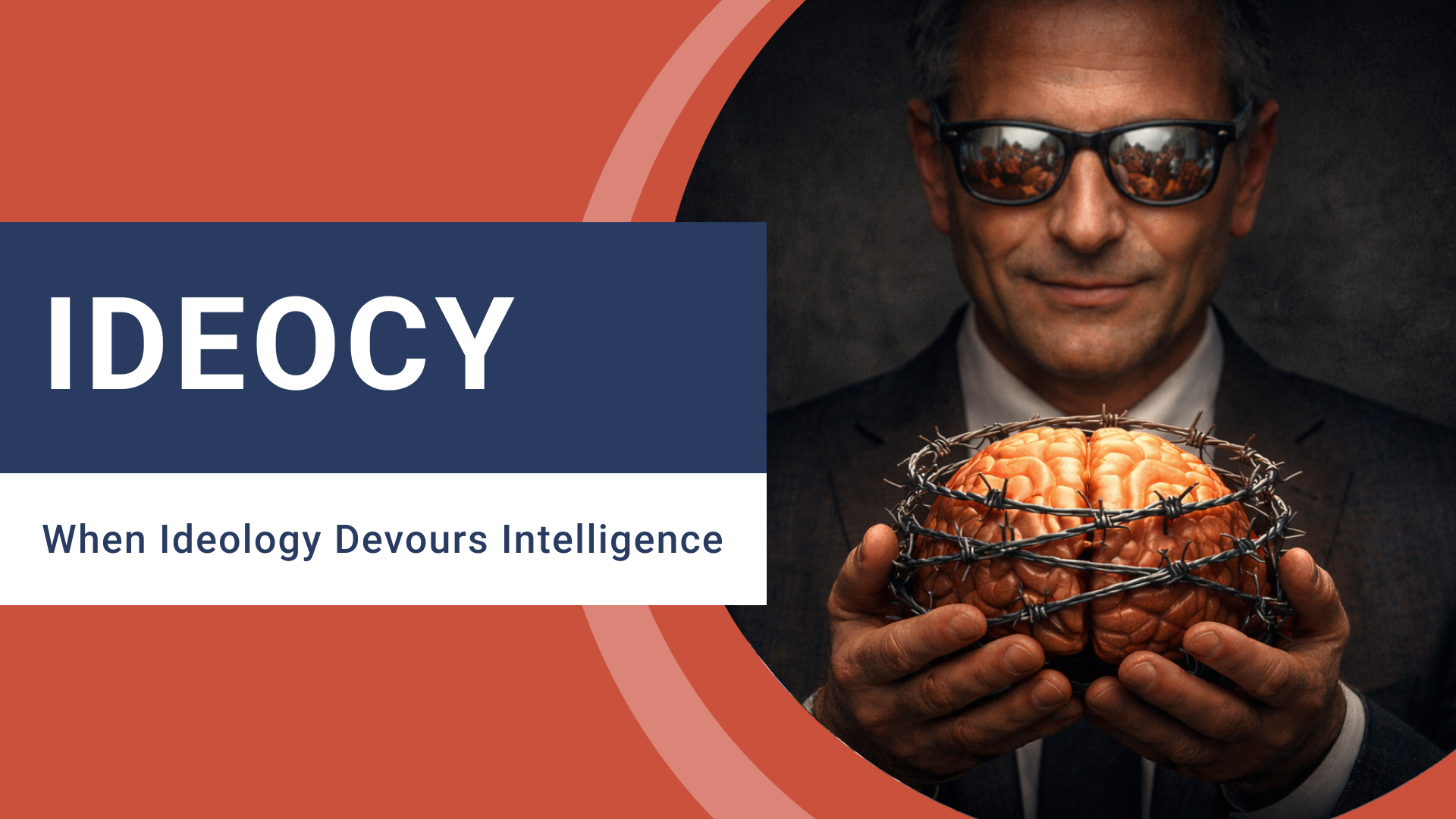

Background - The Illusion of a Rational Civilisation
We are told that we live in the most rational period in human history. We have advanced sciences, complex economic models, intelligence assessments, behavioural research, data analytics, artificial intelligence, and institutions designed to simulate outcomes before decisions are made. We measure risk, calculate probabilities, and publish white papers explaining why what we are about to do is necessary, proportional, strategic, and justified.
We have never had more access to information. We have never had more education. We have never had more tools for analysis. Entire professions exist solely to ensure that policy, war, economics, and diplomacy are not guided by impulse but by reason. We call this progress. We call this maturity.
And yet, if we step back from the language and watch the behaviour, the picture becomes uncomfortable. The public sphere operates on outrage cycles. Policy announcements are calibrated to emotion as much as to evidence. Collective reactions are instant, polarised, and morally theatrical. The speed of reaction has increased. The depth of reflection has not.
We insist we are rational actors, yet our collective decisions often resemble reflexes rather than deliberations. We escalate while calling it deterrence. We celebrate destruction while calling it justice. We chant moral slogans while ignoring human cost. We punish nuance and reward certainty.
Every camp has its experts. Every camp has its statistics. Every camp has its historical grievances and strategic arguments. And yet the overall pattern is not one of disciplined rationality. It is one of escalating certainty.
The strange thing about our age is not that we lack intelligence. It is that intelligence is everywhere. The strange thing is that intelligence does not seem to be producing proportionate wisdom. The more sophisticated our tools become, the more refined our justifications become. But refinement of justification is not the same thing as refinement of judgement.
We have confused being informed with being rational. We have confused access to data with depth of understanding. We have confused moral intensity with moral clarity.
The result is a civilisation that speaks the language of reason while behaving with the volatility of wounded identity. A civilisation that prides itself on analysis yet repeatedly moves in cycles of retaliation, spectacle, and symbolic dominance.
We believe we are rational because we can explain ourselves. But the ability to explain a decision does not prove the decision emerged from clarity. It only proves we are good at constructing narratives after the fact.
This is the tension of our time. We think we are governed by reason. We are not. We are governed by something far more unstable, far more emotional, and far more contagious.
If idiocy is the absence of intelligence, what we are witnessing is something else entirely. It is not the lack of intellect. It is intellect captured by identity. It is reasoning in service of pre-committed loyalty. It is analysis constrained by narrative.
It is not idiocy. It is ideocy.
Introduction - When Intelligence Becomes an Accomplice
Idiocy is easy to recognise. It is loud, careless, and often harmless in its smallness. It lacks information. It lacks training. It lacks exposure. We forgive it because it does not know better.
Ideocy is different. Ideocy is educated. It is articulate. It is well briefed. It can cite history, invoke law, reference trauma, quote scripture, and draft strategic doctrine. It is not the absence of intelligence. It is intelligence conscripted into loyalty.
In ideocy, the mind does not stop functioning. It stops questioning the frame within which it functions. The boundaries of thought are drawn by ideology, and everything inside those boundaries is debated passionately, rigorously, and often brilliantly. What is never examined is the boundary itself.
This is why ideocy feels rational from the inside. Every decision has an explanation. Every escalation has a justification. Every retaliation has precedent. Every cruelty is contextualised. Every celebration is reframed as resilience. We do not act without reasons. We act with too many reasons, all carefully selected to support what we already decided to believe.
The tragedy is not that one group is irrational while another is enlightened. The tragedy is that all sides claim reason as their ally. Each believes it is the sober adult in a room full of extremists. Each is convinced that its violence is measured, its outrage justified, its silence strategic, its celebration symbolic.
Ideocy thrives where certainty outpaces humility. It thrives where identity becomes sacred and doubt becomes betrayal. It thrives where the moral high ground is occupied so firmly that no one thinks to check whether the ground itself is stable.
We say we are rational actors. We publish strategies. We run simulations. We forecast consequences. And then we cheer when destruction aligns with our narrative. We rationalise suffering if it serves our side. We dismiss complexity if it threatens coherence. We reduce human lives to variables in an argument about honour, deterrence, or destiny.
This is not stupidity in the conventional sense. It is far more dangerous. Stupidity makes mistakes out of ignorance. Ideocy makes mistakes out of devotion.
And devotion, when armed with intelligence and stripped of authentic awareness, produces chains of decisions that look strategic in isolation but catastrophic in accumulation.
If we are honest, the problem is not that the world lacks smart people. The problem is that smart people, in sufficient numbers, have surrendered their discernment to narratives that reward outrage, punish nuance, and sanctify retaliation.
The world is not burning because no one understands the stakes. It is burning because too many understand only their side of them.
Etymology and Construction of Ideocy - The Birth of a Word
Idiocy is an old word. It refers to the absence of intelligence, the lack of capacity to understand, the failure to grasp. But what we are witnessing today is not the absence of intelligence. It is intelligence in uniform.
The word ideocy is constructed deliberately. It fuses ideology with idiocy. Not to insult, but to diagnose. Not to mock intelligence, but to expose its captivity. Ideology comes from idea and logos, a system of structured thought, a coherent framework for interpreting reality. In its healthy form, ideology is inevitable. Human beings require frameworks to navigate complexity. Idiocy, by contrast, signals deficiency. It implies the mind is not functioning properly.
Ideocy is neither of these in isolation. It is what happens when ideology consumes intelligence to the point that thinking becomes defensive rather than exploratory. The mind still operates, but only inside a pre-approved boundary. Logic is used not to seek truth, but to protect identity. The distinction matters. Idiocy lacks capacity. Ideocy misuses capacity. Idiocy is ignorance. Ideocy is devotion without examination.
The pronunciation is different for a reason. Idiocy begins with a blunt short sound. Ideocy begins with idea. It signals that this phenomenon is not about conventional stupidity. It is about thought captured by doctrine. In ideocy, people can argue brilliantly and still be deeply wrong. They can analyse accurately and still participate in catastrophe. They can appear rational while accelerating irrational outcomes.
The danger of ideocy is precisely that it feels intelligent. It allows individuals and entire societies to congratulate themselves for their reasoning while never questioning the frame within which that reasoning operates. It is stupidity armed with spreadsheets, fury dressed as principle, retaliation explained as inevitability. Once ideology fuses with identity, and identity fuses with moral superiority, ideocy becomes contagious. And unlike ordinary stupidity, it scales.
Ontologically, ideocy is not a deficit of intelligence but a distortion in the orientation of intelligence. Idiocy reflects a limitation or absence of cognitive capacity. Ideocy, by contrast, occurs when cognitive capacity remains intact, often highly developed, yet is subordinated to identity and pre-committed narrative. In this condition, reasoning does not cease to function, but its allegiance shifts. Intelligence becomes instrumental rather than exploratory, protective rather than truth-seeking. It is not ignorance of content but captivity of consciousness, where cognition operates efficiently within a closed frame and no longer examines the frame itself.
For example, imagine a highly educated professional who can analyse geopolitical risk, evaluate policy trade-offs, and model economic impact with precision. When conflict escalates, they can articulate historical context, legal arguments, and strategic necessity fluently. Yet when evidence emerges that their own side has acted disproportionately, their analysis subtly shifts. They reinterpret the facts as unavoidable, contextual, or strategically necessary, while condemning identical behaviour from the opposing side as barbaric or irrational. Their intelligence has not diminished. Their reasoning is still sharp. What has changed is its allegiance. It now protects identity rather than interrogating truth. That is not idiocy. It is ideocy.
Consider a senior executive who prides themselves on data-driven decision-making. They demand evidence from their team, challenge assumptions, and insist on rigour. Yet when a project they personally championed begins to fail, they reinterpret the data to defend it, downplay contradictory signals, and question critics’ motives. The same analytical standards they apply to others are relaxed when their own identity is at stake. Intelligence remains. Integrity shifts. That is ideocy at a smaller scale.
The Performance of Rationality
One of the most sophisticated illusions of our age is the performance of rationality. We no longer shout before we justify. We justify first. We cite precedents, doctrines, security concerns, historical grievances, existential threats, and moral duties. We hold panels. We publish analyses. We produce diagrams of cause and effect. We simulate scenarios that prove the inevitability of what we are about to do.
It looks disciplined. It sounds measured. It feels responsible.
But performance is not the same as presence.
In ideocy, rationality becomes theatrical. The arguments are polished, yet the outcome is predetermined. The conclusion is sacred. The analysis exists to defend it. We do not reason toward decisions. We reason around them.
Every escalation is called necessary. Every refusal to de-escalate is called principled. Every hardline position is framed as strength. Every expression of doubt is framed as weakness. We claim to be navigating complexity, yet we reduce the moral landscape into binary categories that fit neatly into our ideological comfort.
What makes this phenomenon dangerous is that it is collective. Entire populations become fluent in the language of strategic inevitability. People who would carefully assess risk in their personal lives suddenly abandon proportion when it comes to national pride, retaliation, or symbolic victory. The same individual who would weigh costs and benefits before making a business decision may cheer irreversible decisions when they are wrapped in the flag of belonging.
We do not notice the contradiction because ideology offers coherence. It simplifies. It tells us who is right, who is wrong, who deserves empathy, and who deserves consequence. Once the frame is set, intelligence goes to work efficiently inside it. Experts refine the argument. Commentators amplify it. Crowds internalise it. And slowly, what began as a narrative becomes a reflex.
This is where ideocy reveals its architecture. It does not remove reason. It redirects it. It does not silence intelligence. It assigns it a task. The task is not to seek truth. The task is to protect identity.
When identity is under threat, proportion collapses. When identity is exalted, scrutiny weakens. When identity is wounded, retaliation feels like therapy. And because retaliation can be rationalised, it feels responsible.
We say we are thinking strategically. In reality, we are defending psychological territory. We say we are acting for security. Often, we are acting to restore pride. We say we are defending justice. Frequently, we are defending narrative coherence.
Ideocy flourishes not where people lack information, but where they lack authentic awareness of their own motivations. We do not see how deeply we need our side to be right. We do not see how much we crave moral superiority. We do not see how quickly we accept suffering if it confirms our story.
The performance of rationality allows us to look composed while participating in cycles that are anything but rational. And because everyone is performing, the mirror never feels necessary. Each side points to the other as evidence of irrationality, reinforcing the conviction that it alone remains sane.
Collectively, we move further from reason while congratulating ourselves for being reasonable.
Collective Certainty and the Theatre of Moral Superiority
There is something almost beautiful about collective certainty. It moves with confidence. It chants in rhythm. It posts in synchrony. It explains itself with absolute conviction. It does not hesitate. It does not blush. It does not doubt.
Certainty is efficient. Doubt is exhausting.
In ideocy, doubt is treated as contamination. Nuance becomes suspicious. Complexity becomes an inconvenience. The crowd prefers clarity, even if that clarity is built on selective blindness. It is far more comforting to know who the villain is than to admit that reality refuses such tidy casting.
And so we perform.
We perform outrage.
We perform solidarity.
We perform resistance.
We perform righteousness.
We film ourselves doing it.
There is a peculiar modern ritual in which suffering becomes background scenery for moral exhibition. Bombardment becomes a hashtag. Escalation becomes commentary. Tragedy becomes content. We do not merely react. We curate our reaction. The world burns and we angle the camera.
If this were pure cruelty, it would at least be honest. What makes it darker is that we believe we are being virtuous. We call our anger justice. We call our vengeance balance. We call our indifference pragmatism. We call our celebration resilience.
When destruction harms the other side, it becomes proof of strength. When destruction harms our side, it becomes proof of injustice. The same act changes moral colour depending on who suffers. We are not confused. We are consistent within our frame.
And that consistency feels like rationality.
This is the genius of ideocy. It does not make people feel foolish. It makes them feel morally elevated. It gives them the sweet intoxication of being on the right side of history, even when history is currently being written in smoke.
Crowds gather not only to protest but to affirm belonging. There is energy in shared outrage. There is a strange joy in collective hostility. It bonds people. It simplifies identity. It offers a clear line between us and them. In moments of conflict, moral superiority becomes a form of entertainment.
We laugh at the other side’s hypocrisy while blind to our own. We dissect their propaganda while reposting ours. We condemn their excess while excusing ours as necessary. Everyone sees the absurdity across the line. No one sees the absurdity in the mirror.
Dark comedy writes itself. Civilisations armed with advanced technology behave like wounded tribes with broadband. We have satellites in orbit and slogans in our throats. We have predictive models and impulsive reactions. We have access to global suffering and the emotional maturity of a rivalry.
The most unsettling part is that we genuinely believe we are rational participants in a complex world. We believe our cheering is justified, our silence strategic, our escalation measured. We believe we are thinking.
In truth, we are synchronising.
And synchronised certainty, when combined with power, is far more dangerous than ordinary stupidity.
The Chain Reaction of Justified Decisions
Ideocy rarely announces itself with madness. It begins with something that sounds reasonable.
A defensive measure.
A symbolic response.
A proportional strike.
A necessary statement.
A clarifying position.
Each step has its logic. Each move has its footnote. Each decision is framed as constrained, reluctant, unavoidable.
No one wakes up intending to accelerate catastrophe. They wake up intending to respond. To protect. To correct. To deter. To restore balance. The language is calm. The tone is firm. The briefings are meticulous.
And then the chain begins.
One justified decision invites another justified decision. One escalation invites a counter-escalation that is equally justified. One retaliation demands a response that cannot appear weak. Every move is defended as rational within its immediate frame. The problem is not the single step. The problem is the sequence.
Ideocy operates in accumulation.
It is the steady stacking of reasonable arguments that, when viewed together, reveal an unreasonable trajectory. But no one views them together. Each side focuses on the latest act. Each side frames itself as reactive. No one claims authorship of the spiral.
The brilliance of ideocy is that it distributes responsibility. If everyone is reacting, no one is initiating. If everyone is defending, no one is aggressing. If everyone is justified, no one is accountable.
We convince ourselves that we are navigating complexity when we are simply accelerating it.
And here is the darker layer. The crowd does not merely observe this chain. It fuels it. Applause hardens positions. Celebration rewards severity. Silence signals approval. Outrage demands firmness. Leaders respond to pressure. Pressure is amplified by identity. Identity is inflamed by narrative.
A missile is not launched in isolation. It is launched in an ecosystem of approval.
Meanwhile, the same individuals who would demand careful deliberation before signing a contract demand immediate action when pride is involved. We are cautious with money. We are reckless with vengeance. We negotiate discounts with precision. We negotiate escalation with emotion.
We claim to be rational because we can articulate the logic of each step. Yet we rarely ask whether the entire direction makes sense. Intelligence becomes local. Judgement becomes fragmented. Strategy becomes reactive choreography.
And still, every side insists it is acting responsibly.
This is where ideocy becomes tragic rather than merely absurd. The decisions are not made by fools. They are made by people who believe they are defending order. The supporters are not ignorant. They are convinced they are protecting dignity.
The chain continues because no link appears irrational on its own. It is only when we step back that the pattern becomes visible. But stepping back requires something ideocy does not tolerate well.
Humility.
The Collapse of Authentic Awareness
At the heart of ideocy is not ignorance. It is the collapse of authentic awareness.
Authentic awareness is the uncomfortable capacity to see oneself as part of the problem. It is the ability to recognise that one’s own side is capable of excess, blindness, and cruelty. It is the discipline of asking not only what the other has done wrong, but what we are becoming in response.
Ideocy cannot tolerate this.
Ideology provides clarity by narrowing the frame. Authentic awareness widens it. Ideology says, this is who we are and this is who they are. Authentic awareness asks, what are we refusing to see about ourselves?
That question is destabilising. It weakens the comfort of moral superiority. It complicates the story. It threatens unity. And so it is avoided.
Without authentic awareness, identity becomes armour. Armour protects, but it also numbs. We stop feeling the full weight of consequences when those consequences serve our narrative. We interpret suffering selectively. We grieve selectively. We celebrate selectively.
We become capable of holding two contradictory positions without discomfort. We can condemn violence and applaud it in the same breath, provided the victims change. We can preach humanity while rationalising dehumanisation. We can speak of peace while endorsing escalation.
The mind adapts quickly when protected by ideology. It learns to reinterpret anything that threatens coherence. Civilian casualties become unfortunate collateral. Aggression becomes preemption. Celebration becomes resilience. Silence becomes strategic patience.
This is not stupidity. It is adaptation in service of identity.
And once identity becomes sacred, truth becomes negotiable.
The absence of authentic awareness produces a peculiar blindness. We can analyse the failures of others with precision. We can dissect their propaganda, expose their hypocrisy, mock their contradictions. Yet when the same patterns appear in our own camp, we suddenly become generous interpreters.
We call it context.
Authentic awareness demands symmetry. It asks us to apply the same moral lens to ourselves that we apply to others. Ideocy refuses symmetry. It thrives on asymmetry. Our violence is defensive. Theirs is barbaric. Our anger is righteous. Theirs is fanatic. Our crowd is passionate. Theirs is dangerous.
The deeper tragedy is that we believe we are being principled. We believe our refusal to question ourselves is strength. We mistake self-certainty for integrity.
But integrity without self-examination is merely stubbornness with a moral vocabulary.
When authentic awareness collapses, decision-making deteriorates quietly. Not because intelligence disappears, but because it is no longer anchored to truth. It is anchored to loyalty.
And loyalty, when detached from conscience, is capable of extraordinary destruction.
The Crowd That Dances
There is a moment in every conflict when something breaks quietly inside a society. Not a building. Not a border. Something deeper.
It is the moment when suffering becomes spectacle.
When news of bombardment reaches the streets and the streets respond with choreography. When destruction elsewhere becomes affirmation here. When pain, filtered through ideology, is reinterpreted as proof that our side is strong, justified, vindicated.
We do not see the bodies. We see the symbolism.
This is where ideocy becomes almost surreal. Human beings who love their own families, who fear for their own children, who would tremble at the thought of harm arriving at their own door, suddenly detach from the identical suffering of others because narrative has reassigned moral weight.
It is not that empathy disappears. It is that empathy becomes selective.
We grieve horizontally. We celebrate vertically.
We are horrified when tragedy touches our circle. We are animated when tragedy touches theirs. The same event that would devastate us if reversed can exhilarate us when it confirms our storyline.
And we call this awareness. We call this political consciousness. We call this resistance. We call this patriotism.
The crowd that dances is not uniquely evil. It is uniquely certain. It believes it understands the context fully. It believes that celebration is justified because the other side deserves consequence. It believes that complexity has already been settled.
Dark comedy almost writes itself. A civilisation capable of engineering precision weaponry struggles to engineer moral proportion. A society that prides itself on strategic thinking cannot manage emotional regulation when identity is provoked.
We watch videos of destruction with commentary. We replay footage. We share clips. We react with emojis. We debate angles of impact. Somewhere in the background, human beings bleed. But the foreground is narrative.
The crowd that dances is not a separate species. It is us, under the right conditions. It is what happens when belonging outruns conscience. It is what happens when outrage becomes communal currency. It is what happens when ideology trains perception to convert tragedy into validation.
And while we mock the other crowd for its barbarity, we wait for our own moment to celebrate.
This is the symmetry ideocy refuses to acknowledge. Every side believes its reactions are qualitatively different. Every side believes its excesses are exceptions. Every side believes its cheering is symbolic, not literal.
Meanwhile, the chain of justified decisions continues to tighten.
The most unsettling thought is not that some people are irrational. It is that under ideological pressure, most of us are.
We Are Not as Rational as We Think
The most uncomfortable truth is not that governments miscalculate or that crowds overreact. It is that we, collectively, are nowhere near as rational as we imagine ourselves to be.
We like to picture humanity as having evolved beyond tribal reflex. We tell ourselves that education, exposure, and global connectivity have refined us. We believe that because we can debate policy, read analysis, and articulate arguments, we are thinking clearly.
But articulation is not the same as clarity. Explanation is not the same as examination.
We can defend a position passionately without ever questioning the emotional need beneath it. We can quote history without noticing how selectively we are using it. We can demand proportionality while secretly craving vindication.
Rationality requires more than intelligence. It requires restraint. It requires the capacity to tolerate discomfort. It requires the discipline to pause when our side appears victorious and ask whether victory came at a cost that corrodes us from within.
Ideocy bypasses that pause.
It rewards speed over reflection. It rewards certainty over humility. It rewards alignment over authenticity. It trains us to respond instantly, to choose sides quickly, to feel intensely and to broadcast that feeling publicly.
We are not irrational in the sense of being incapable of logic. We are irrational in the sense of being unable to see how deeply our logic is shaped by loyalty.
This is why ideocy spreads so easily. It flatters us. It tells us we are the reasonable ones. It assures us that our conclusions are not driven by emotion but by principle. It frames doubt as weakness and introspection as betrayal.
Under its influence, even sophisticated societies drift into patterns that resemble playground dynamics, only with higher stakes. We retaliate to avoid looking weak. We escalate to avoid appearing passive. We justify harm because we cannot afford to seem indecisive.
And all the while, we insist that we are acting strategically.
The tragedy is not that reason is absent. It is that reason is subordinated. It becomes a servant to identity rather than a guide to truth.
If we were genuinely rational, we would be slower. We would be more cautious with power. We would be more symmetrical in our moral judgements. We would resist the intoxication of collective certainty.
Instead, we accelerate.
We accelerate because it feels strong. We accelerate because the crowd approves. We accelerate because hesitation looks like weakness.
And then we wonder how we arrived at a place where every side claims rational justification while the world edges closer to irreversible damage.
Perhaps the better question is not whether others are rational.
Perhaps the question is whether we are willing to confront how far we are from it.
Intelligence Without Integrity
There was a time when stupidity meant the absence of knowledge. Now it often means the absence of integrity in the use of knowledge.
We do not suffer from a shortage of analysis. We suffer from analysis untethered from conscience.
The modern world is full of intelligent actors who can model consequences with extraordinary precision. They can estimate collateral impact, forecast retaliation patterns, simulate economic disruption, and calculate political fallout. The spreadsheets are sophisticated. The projections are thorough.
And yet, the fundamental question often goes untouched.
Should we?
Ideocy is what happens when the question of capability replaces the question of wisdom. If something can be justified, it is treated as permissible. If something can be defended rhetorically, it is treated as responsible. If something can be framed as necessary, it becomes inevitable.
The language shifts subtly. From possibility to necessity. From choice to obligation. From agency to inevitability.
No one feels reckless. Everyone feels compelled.
This is where intelligence becomes dangerous. Not because it miscalculates, but because it obeys. It obeys the ideological frame. It refines it. It strengthens it. It makes it sound coherent.
Integrity would interrupt this process. Integrity would ask whether the frame itself is distorted. Integrity would resist the easy applause of one’s own camp. Integrity would risk unpopularity for proportion.
But integrity is costly. It isolates. It complicates alliances. It slows momentum. It introduces doubt into rooms that prefer clarity.
Ideocy prefers momentum.
When intelligence operates without integrity, it becomes an amplifier. It amplifies fear. It amplifies pride. It amplifies grievance. It amplifies retaliation.
We end up with highly competent systems executing deeply questionable trajectories.
And the crowd, watching from a safe distance, contributes its own layer. It rewards firmness. It mocks hesitation. It elevates leaders who appear decisive, even if decisiveness accelerates harm. It confuses volume with courage.
In such an ecosystem, authentic awareness feels almost subversive. To question one’s own side is seen as betrayal. To acknowledge complexity is seen as weakness. To refuse celebration in the face of destruction is seen as disloyalty.
So we adapt. We align. We participate.
And ideocy deepens, not because we lack intelligence, but because we lack the discipline to anchor that intelligence in something more stable than identity.
The irony is almost cruel. We pride ourselves on being the most educated generation in history, yet we repeatedly demonstrate how fragile our rationality becomes when our tribe is involved.
The problem is not that we do not know enough. The problem is that we do not examine enough.
Until that changes, ideocy will keep masquerading as reason, and we will keep applauding ourselves for our rationality as the world grows visibly less so.
Beyond Ideocy - A Failure of Sense-Making
At its core, ideocy is not merely a political problem. It is a breakdown in sense-making.
Human beings do not act directly on events. We act on our interpretation of events. We construct frames, narratives, and explanatory models that tell us what is happening, who is responsible, and what must be done. These frames operate beneath the surface of debate. They determine what feels obvious and what feels unthinkable. When sense-making becomes rigid, intelligence operates efficiently inside a distorted map. We may analyse with precision, yet our starting assumptions remain unexamined. We argue brilliantly, yet the frame itself is protected from scrutiny.
This is where ideocy takes root. Not in the absence of information, but in the failure to question the structure through which information is filtered. Intelligence does not correct distortion when the frame is sacred. It refines it.
Meaning-making compounds the problem. We do not merely interpret events. We assign value to them. We decide what matters, who matters, and which losses are tolerable. When identity fuses with meaning, retaliation can feel noble. Escalation can feel necessary. Celebration can feel justified. The moral weight of suffering shifts depending on which story we inhabit.
As I explore more extensively in Meta-content, the quality of our interpretations determines the trajectory of our decisions. When we fail to examine the deeper layers shaping our perception, we do not become neutral. We become unconsciously loyal to whatever narrative already holds emotional authority.
If there is an antidote to ideocy, it is not greater access to data or even information. It is deeper awareness of the frames through which we interpret data. It is the discipline to question our own narrative before condemning another’s. It is the courage to apply the same moral calculus to ourselves that we demand from others.
Civilisations do not fracture for lack of intelligence. They fracture when intelligence operates inside unquestioned maps.
Conclusion - The Mirror We Avoid
It would be comforting to end by identifying the guilty. To name a regime, a superpower, a faction, a crowd. To isolate ideocy as something that belongs to them.
But that would be ideocy again.
The temptation to externalise the problem is precisely how it survives. As long as stupidity belongs to the other side, we remain innocent. As long as irrationality is always across the border, across the aisle, across the sect, across the ideology, we never have to confront how quickly we participate.
The mirror is the only uncomfortable ending available.
Ideocy does not begin with missiles. It begins with certainty. It begins with the quiet satisfaction of believing that our side is uniquely justified. It begins when we laugh at the blindness of others while refusing to inspect our own.
It begins when we celebrate destruction because it aligns with our grievance. It begins when we excuse cruelty because it serves our narrative. It begins when we silence doubt because doubt complicates unity.
We wish we were rational. We speak as if we are rational. We build institutions that assume we are rational.
But collectively, we behave as if identity is stronger than truth, loyalty more sacred than integrity, and retaliation more satisfying than restraint.
The darkest irony is that ideocy often feels like courage. It feels like standing firm. It feels like refusing to bend. It feels like moral clarity.
In reality, it is often the surrender of independent judgment to collective emotion.
If we were truly rational, we would fear our own certainty as much as we fear our opponent’s aggression. We would examine our celebrations as carefully as we examine their excesses. We would apply the same moral calculus to ourselves that we demand of others.
We would recognise that intelligence without authentic awareness is not progress. It is acceleration without direction.
Until then, we will continue to explain ourselves brilliantly while behaving predictably. We will continue to defend each link in the chain while ignoring where the chain leads. We will continue to call ourselves reasonable while the world moves in patterns that suggest otherwise.
Ideocy is not the absence of intelligence. It is intelligence divorced from integrity and intoxicated by belonging.
And unless we recover the discipline of authentic awareness, we will keep mistaking our collective reflex for rational civilisation.
The tragedy is not that we are incapable of reason.
It is that we are far more capable than we are willing.