

Background: The Cultural Celebration of Autonomy
We live in an era that glorifies independence. Be your own boss. Think for yourself. Trust no authority. Challenge the system. Stay sovereign. Autonomy is framed as maturity, resistance as intelligence and questioning leadership as critical thinking. To be clear, autonomy matters. Sovereignty matters. Freedom matters. These are not trivial virtues. They are civilisational achievements.
Yet something subtle has crept in beneath this celebration. A pattern that looks like empowerment on the surface but quietly erodes coherence underneath. It is the pattern of resisting leadership while refusing to embody leadership. It sounds principled. It feels morally justified. It appears sophisticated. But across relationships, organisations, partnerships and societies, it produces fragmentation rather than strength.
This is not healthy scepticism. It is not constructive dissent. It is not principled courage. It is a posture that destabilises without building, critiques without carrying and questions without committing. It is becoming culturally normal, and because it is normal, it is rarely examined.
Introduction: The Pattern of Disleadership
There is a recurring pattern that plays out in subtle but destructive ways. A person resists being led. They question direction, criticise decisions and highlight flaws. They insist things should be done differently. Yet when the moment arrives to step forward, to stabilise direction or to carry responsibility, they retreat. They do not lead. Not themselves with discipline. Not others with clarity. Not the system they critique with ownership.
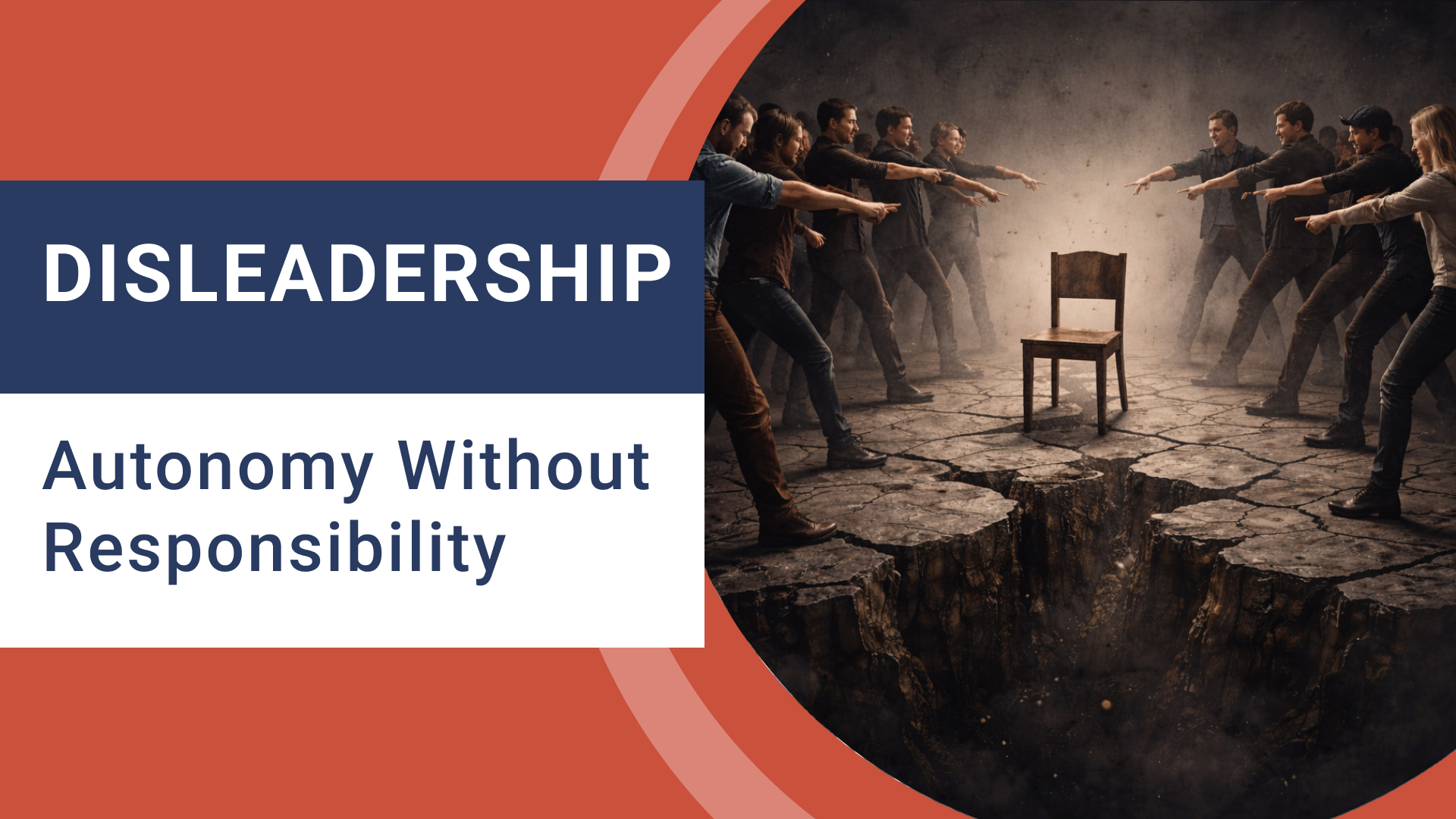
They destabilise authority while offering no alternative structure. They undermine direction while demanding better outcomes. They challenge the leader while avoiding the burden of leadership. This is disleadership.
Disleadership is not disagreement, nor is it the refusal to comply with something unethical. It is the consistent pattern of resisting leadership, undermining leadership and refusing leadership at the same time. It often hides beneath the language of independence. “I just value my freedom.” “I don’t follow blindly.” “I won’t be controlled.” But when autonomy becomes a reflexive rejection of structure rather than an integrated capacity to co-create structure, something fractures.
The individual pulls the rug from under their own feet. They reject the very guidance that could refine them, resist the very partnership that could elevate them and sabotage the very coherence they claim to desire. And they do so in the name of empowerment.
This pattern is not rare. It appears in intimate relationships, business partnerships, executive teams, political parties and entire societies. To understand its full ramifications, we must first examine how it manifests in concrete, everyday domains.
The Two Distortions of Leadership
Disleadership does not arise randomly. It often develops in response to leadership that was never properly integrated in the first place.
Leadership, at its healthiest, aligns authority with responsibility and strengthens autonomy alongside accountability. When that integration fails, distortion follows.
Two recurring distortions tend to appear.
On one end sits overprotective leadership. Here, the leader assumes excessive responsibility in the name of care. They cushion discomfort, absorb consequences and pre-empt difficulty. Friction is reduced, but so is growth. What appears as support gradually becomes containment.
In this structure, authority remains, and responsibility remains, but it is monopolised. Participants are not required to carry weight. Autonomy is tolerated, yet never strengthened through consequence. The leader carries too much; others carry too little. Harmony may appear intact, yet the internal architecture of self-governance remains underdeveloped.
On the other end sits overbearing leadership. Authority tightens rather than stabilises. Direction becomes imposition. Monitoring replaces trust. Alignment is secured through pressure rather than integration. Order is preserved, but vitality diminishes.
In this structure, authority remains, but responsibility becomes externally enforced rather than internally owned. Autonomy is suppressed, initiative shrinks and compliance replaces commitment. Individuals function within the system, yet their internal capacity for leadership does not mature.
Both distortions fracture the developmental alignment between autonomy and responsibility.
In the overprotective model, responsibility is weakened and autonomy remains fragile because it has not been tested. In the overbearing model, autonomy is suppressed and responsibility is experienced as control rather than stewardship. In both cases, the integration required for mature leadership fails to form.
This is where disleadership begins to take root.
When authority is exercised without developing autonomy, individuals later assert independence without having cultivated responsibility. When authority is experienced as domination rather than stewardship, individuals later resist direction reflexively. In each case, autonomy and responsibility have been separated rather than integrated.
Disleadership is often the adult residue of this earlier misintegration. It is autonomy asserted without the internalised responsibility that should accompany it. When autonomy and responsibility do not mature together, resistance without stewardship becomes predictable.
True leadership does not overprotect and does not overcontrol. It aligns authority with responsibility while simultaneously strengthening autonomy and accountability in others. It develops capacity rather than dependency. It establishes clarity without suffocation. Where that integration is present, disleadership finds little soil in which to grow. Where it is absent, destabilisation becomes almost inevitable.
Ontological Distinction: Disleadership as a Fracture of Alignment
Leadership, at the level of Being, is not a role or position. It is an integrated posture toward coherence. It is the alignment of autonomy with responsibility in service of relational order. It is the capacity to stabilise direction without domination and to be guided without diminishment.
Disleadership emerges when that integration fractures.
Disleadership, as coined here, is the ontological posture in which autonomy is asserted while responsibility for shared coherence is withheld. It is the patterned misalignment between self-governance and relational accountability that destabilises direction without assuming stewardship.
Put simply, disleadership is the desire for the freedom to question and resist without the burden of carrying and stabilising what is criticised. It is standing inside a system, identifying its flaws, yet stepping back when it is time to hold it together.
It is influence without ownership. Voice without weight. Autonomy without accountability.
It is the refusal to be led and the refusal to lead at the same time.
Within the architecture of Being, this represents a misintegration between autonomy and responsibility. Autonomy remains active, but responsibility is selectively embodied. Authority is questioned, yet alternative authority is not carried. Coherence is evaluated, but not sustained.
The individual remains inside the benefits of shared order while positioning themselves outside its burden.
This is not passivity. It is partial participation. The disleader engages cognitively yet withdraws ontologically. They exercise agency in resistance while suspending agency in stewardship.
At a deeper level, this reflects a collapse of internal leadership. Self-governance becomes conditional. Commitment becomes negotiable. Direction shifts with comfort. Autonomy is preserved as identity, but continuity is weakened as practice.
Disleadership is therefore a breakdown in the relational contract between self and system. It is the erosion of coherence that occurs when autonomy has not matured into accountable integration.
Where autonomy and responsibility converge, leadership emerges. Where authority operates without responsibility, tyranny arises. Where autonomy operates without responsibility, disleadership spreads.
In every case, the removal of responsibility from agency fractures coherence.
Disleadership in Intimate Relationships
In intimate relationships, disleadership rarely announces itself loudly. It appears as subtle resistance. One partner questions decisions, second-guesses direction and challenges tone or timing. They resist being guided, even gently. Suggestions are interpreted as control. Structure is interpreted as dominance. Initiative from the other is experienced as intrusion.
Yet when responsibility for emotional climate arises, they hesitate. They avoid initiating difficult conversations. They do not stabilise shared direction. They complain about how things feel but do not create a new standard for how things should be handled. They critique the dynamic while contributing no coherent alternative.
Over time, this produces exhaustion in the other partner. Leadership in a relationship is not dictatorship; it is the willingness to hold stability, clarity and direction when things become uncertain. If one partner consistently resists that stabilising force while refusing to embody it themselves, the relationship becomes structurally fragile.
Disleadership in intimacy erodes trust quietly. The leading partner feels unsupported. The resisting partner feels misunderstood. Both feel unseen. What could have become partnership becomes tension. What could have matured into shared sovereignty deteriorates into subtle power struggle.
In the name of autonomy, connection weakens.
The Myth of Performative Independence
Modern culture often celebrates a particular identity claim: “I am independent.” Sometimes it appears as “an independent woman.” Sometimes as “a sovereign man.” Sometimes simply as “I answer to no one.”
At face value, independence is strength. The ability to stand alone, make decisions and resist coercion is a developmental achievement. But there is a subtle distortion that frequently hides beneath the label.
Performative independence feels powerful. It carries the emotional charge of self-determination. It signals freedom from outdated norms, oppressive expectations and inherited roles. Yet in close relationships, the test of independence is not whether one can reject external pressure. It is whether one can honour chosen commitments.
A person may declare autonomy while simultaneously resisting any structure that binds them to their own negotiated principles. Boundaries are asserted, but agreements are treated as flexible. Commitments are made, but revised when inconvenient. Decisions are justified as “staying true to myself,” even when they contradict prior clarity.
This is not sovereignty. It is instability disguised as empowerment.
True independence includes self-governance. Self-governance includes consistency. When principles are self-selected and consciously negotiated, maturity requires staying aligned with them, especially when emotional states fluctuate. Freedom does not mean the perpetual right to rewrite commitments without consequence.
In intimate relationships, this becomes especially visible. One partner asserts boundaries and autonomy, yet expects stability, loyalty and predictability from the other. They resist constraint while benefiting from the structure created by their partner’s commitment. They speak of authenticity but change direction whenever discomfort arises.
Over time, this erodes trust.
Trust depends not merely on intention but on reliability. When “freedom” becomes the licence to override agreements, relationships destabilise. The partner who honours commitments begins to feel exposed. The partner who prioritises emotional autonomy begins to feel justified. Both feel righteous. Neither sees the structural imbalance forming.
Independence without self-discipline collapses into disleadership. It resists being led, resists shared structure and resists the internal leadership required to remain consistent.
The myth is that independence means answering to no one. The reality is that mature independence means answering to one’s word.
Without that, autonomy becomes volatility.
Disleadership in Business Partnerships
In business partnerships, disleadership is more visible and more costly. A co-founder questions strategic decisions, critiques execution and highlights risks. They are often intelligent and perceptive. They can see flaws others miss. They position themselves as the rational counterweight to bold leadership.
But when it is time to take ownership of direction, they hesitate. They resist final calls. They avoid committing fully to a path. They prefer commentary over carriage. Influence over accountability. Voice-over burden.
They may say they are protecting the business. They may frame their resistance as prudence. Yet without someone stabilising direction and without both partners willing to alternate between leading and being led, the venture drifts.
Every serious partnership requires dynamic leadership. Sometimes one partner carries the vision while the other supports execution. At other times, roles reverse. This rhythm demands maturity. It requires the humility to follow when appropriate and the courage to lead when necessary.
Disleadership breaks that rhythm. Meetings become debates without decisions. Strategy becomes analysis without action. Momentum stalls. Resentment grows.
Eventually, one of two things happens. Either one partner assumes full authority and the other becomes marginalised, or the partnership fractures entirely. In both cases, what was lost was not talent or intelligence. It was the shared willingness to co-lead and to be led in turn.
Disleadership in Teams and Organisations
Within teams and organisations, disleadership becomes systemic. An employee or executive resists direction from leadership. They question strategy publicly or privately. They interpret decisions through suspicion rather than alignment. They may frame their stance as independent thinking or principled dissent.
Again, dissent is not the problem. Mature organisations require challenge. But disleadership does not stop at challenge. It lingers in chronic resistance. It withholds commitment after decisions are made. It destabilises alignment in corridors, side conversations and subtle signals of disengagement.
The disleader may say, “I just don’t agree,” yet offers no structured alternative. They do not volunteer to own the outcome. They do not take responsibility for execution. They critique the captain while refusing the helm.
This creates organisational drag. Trust weakens vertically and horizontally. Leaders feel undermined. Teams sense ambiguity. Execution slows. Psychological safety is misinterpreted as the right to remain non-committal. Accountability becomes diluted.
Over time, high-capacity leaders either centralise control to compensate for instability or burn out from carrying disproportionate responsibility. Meanwhile, those operating from disleadership reinforce their belief that leadership is flawed, unaware that their own posture contributes to the dysfunction.
In the name of independence, coherence erodes.
Disleadership in Political Parties and Society
At the societal level, disleadership becomes more complex because it operates in both directions.
On one side, citizens resist authority reflexively. They distrust institutions, question motives and assume hidden agendas. Some of that scepticism is justified. Political leadership has often failed ethically and structurally. But when distrust becomes permanent and participation declines, critique turns into disengagement. Citizens amplify outrage but withdraw from responsibility. They condemn the system yet avoid disciplined civic contribution. They destabilise rhetorically while remaining passive structurally.
On the other side, political leaders themselves can embody disleadership toward their citizens.
A political leader becomes a disleader when they seek power without stewardship. When they amplify division to consolidate control. When they react to public anxiety rather than stabilise it. When they speak of unity but govern through fragmentation. When they chase short-term optics instead of long-term coherence.
Some leaders overprotect, cushioning citizens with promises, subsidies and symbolic gestures that erode resilience and personal agency. Others overcontrol, tightening authority, expanding surveillance or suppressing dissent under the banner of order. In both cases, citizens are not strengthened. They are either made dependent or made fearful.
This is disleadership at scale.
Leadership without integrity creates mistrust. Mistrust breeds resistance. Resistance fuels further control. Control deepens mistrust. The cycle feeds itself.
When citizens operate from chronic suspicion and leaders operate from insecurity or dominance, coherence collapses. Each side justifies its posture by pointing to the other’s failure. Citizens say leadership is corrupt. Leaders say citizens are ungovernable. Both may contain partial truth. Neither addresses the systemic misintegration.
Disleadership in politics is not only about the absence of good leaders. It is about the breakdown of the relational contract between leadership and community.
When leadership is not integrated, it fails to strengthen agency. When citizenship is not integrated, it fails to carry responsibility. The result is volatility disguised as democracy or rigidity disguised as stability.
Neither produces coherence.
The Deeper Ramifications: The Loss of Partnership and the Rise of Cynicism
Across all these domains, the most significant loss is partnership. Great ideas do not materialise in isolation. Families require coordinated leadership. Children require aligned adults. Businesses require shared ownership of direction. Movements require disciplined collaboration. Civilisations require citizens who can both question and construct.
Disleadership quietly disqualifies a person from high-level partnership. Strong partners look for stability, shared responsibility and the capacity to alternate between leading and being led. When someone persistently resists structure yet avoids ownership, trust weakens. Over time, capable collaborators withdraw. What remains is either isolation or relationships built on low standards.
The tragedy is that the individual often interprets this outcome as further proof that others are unreliable. They do not see that their resistance to shared leadership contributed to the breakdown. Instead, they project. “No one is competent.” “No one has integrity.” “No one leads properly.” The pattern repeats across contexts, reinforcing their internal narrative.
Beneath this projection lies shadow. Past experiences of misused authority, betrayal or domination can produce a deep mistrust of leadership. If early exemplars of healthy authority were absent, leadership itself becomes associated with threat. Integrity may be valued privately, even passionately pursued, yet when another person steps into leadership with clarity and responsibility, it triggers suspicion rather than relief.
Over time, scepticism hardens. Doubt becomes default. Cynicism feels intelligent. Pessimism appears realistic. The person believes they are protecting themselves from deception, yet they are simultaneously closing themselves off from growth, refinement and meaningful collaboration.
Disleadership gradually produces unworkability. Decisions stall. Relationships strain. Opportunities pass. The world feels increasingly broken, yet the individual’s posture contributes to that very fragmentation.
If this pattern is to be interrupted, autonomy must mature into something deeper than resistance. It must integrate responsibility, discernment and the capacity for shared direction.
Ontological Layer: Disleadership as a Breakdown of Being
Disleadership is not merely behavioural. It is ontological. It is a distortion in how one positions oneself in relation to authority, responsibility and coherence.
Within your Being Framework, leadership is not a role. It is an expression of Being. It emerges from clarity of intention, stability of identity and integrity of action. It is the capacity to hold direction in the presence of uncertainty. It is the willingness to carry weight without collapsing or dominating.
Disleadership represents a breakdown in that structure.
It is the fragmentation between what one claims to value and how one operationalises those values relationally. A person may value integrity, autonomy and justice. Yet if those values manifest as chronic destabilisation, suspicion and refusal to commit, the internal architecture of Being is misaligned.
This misalignment has consequences.
When Authentic Awareness is weak, the person cannot distinguish between legitimate ethical concern and projected mistrust. When capacity is underdeveloped, the individual cannot tolerate being guided without interpreting it as diminishment. When shadow is unexamined, authority triggers defensiveness rather than discernment.
In systemic terms, disleadership contributes to what you would call erosion of coherence. Coherence is not sameness. It is alignment between intention, structure and action. Where disleadership spreads, coherence thins. Communication becomes noise. Direction becomes contested. Energy disperses.
At scale, this feeds systemic fragility.
When participants in a system lack the ontological strength to alternate between leading and being led, the system compensates. It either hardens into authoritarian centralisation or disintegrates into decentralised chaos. Both are reactions to the same developmental gap.
The deeper invitation, then, is not behavioural correction but ontological strengthening. The work is not simply to “be more cooperative.” It is to cultivate the inner architecture that allows autonomy and alignment to coexist.
This is where your work sits.
Not as ideology. Not as moral preaching. But as developmental scaffolding. A pathway from reactive autonomy to integrated leadership. From fragmentation to coherence. From disleadership to mature agency.
The Architecture of Responsibility and Sovereignty
If disleadership represents a fracture, we must clarify what has fractured.
The instability we have been describing is not merely behavioural. It is structural. It sits at the level of Being. To understand it fully, we must distinguish clearly between responsibility and sovereignty, and how their misintegration produces disleadership.
Within the Being Framework, responsibility is not about blame or fault. It is about causation, ownership and the power to respond. It defines whether a person stands as the primary cause in their life or collapses into reaction, avoidance or control.
Responsibility is being the primary cause of the matters in your life, regardless of their source. It is the extent to which you choose to respond rather than react to them. Responsibility is distinguished by how you honour the autonomy that you have as a human being and is considered the power to influence the affairs, outcomes and consequences you are faced with. Responsibility is not about blaming or determining whose fault it is. Instead, it is to intentionally choose, own, cause and bring about outcomes that matter, work and produce results while also being answerable for the impact and consequences.
A healthy relationship with responsibility indicates that you have the power to influence the circumstances you find yourself in and/or cause. Others may consider you capable of appropriately responding to matters, which is a prerequisite to producing and bringing to fruition effective results. You fully accept ownership of both outcomes and consequences and have the capacity to make informed, uncoerced decisions. You are unquestionably the active agent in your life.
An unhealthy relationship with responsibility indicates that you may often be stuck, experience a loss of power, and are a victim of circumstances. You frequently experience being disarmed, as though you have no choice in influencing outcomes and there is an inevitability about your future. You may be inclined to self-sabotage and make repetitive complaints without seeking, putting forward and implementing solutions. You frequently make excuses for your lack of accomplishments while abdicating or avoiding consequences. You may be considered ineffective in consistently fulfilling the promises you make and producing intended results. You are a passive victim in your life. Alternatively, you may live life from the viewpoint of being the sole cause of matters and exert your will onto your surroundings and others or be over-responsible and attempt to control all matters all the time. You may also expect that matters should always go your way.
Responsibility, properly understood, is the honouring of one’s autonomy through ownership of outcomes and consequences. It is the willingness to carry weight rather than merely comment on it. Without responsibility, autonomy becomes rhetoric. With it, autonomy becomes agency.
Sovereignty, as articulated within the Authentic Sustainability Framework, deepens this further. Sovereignty is not rebellion, nor is it submission. It is coherent authorship. It is the structural capacity to act from inner clarity rather than external compulsion or reactive identity.
Sovereignty is the structural capacity for coherent authorship – in an individual, a collective or any manufactured system. It is neither defiance nor submission, but the integrity of acting from inner clarity rather than external compulsion, fear or inherited conditioning. Sovereignty integrates what is often described as freedom, liberty, autonomy or agency – but grounds them in coherence and authorship rather than indulgence or resistance. Where agency is the capacity to act and make choices, autonomy is the independence from external control, and authorship is the responsibility of shaping one’s own path. Sovereignty holds these together, expressing not just the ability to choose, but the capacity to do so with integrity, clarity and coherence. In people, sovereignty expresses itself as inner authorship: the ability to act and respond in alignment with one’s deeper truth. In organisations, institutions, cultures and societies, it is decision-making rooted in shared ethical principles and coherence rather than reaction, reputation or metrics of conformity. Sovereignty is what makes meaningful self-governance possible – where freedom is exercised with discernment and choice arises from clarity rather than impulse or rebellion.
A healthy relationship with sovereignty indicates that you move through life with grounded agency and authorship. You can distinguish between your truth and others’ projections – between what arises from authentic awareness and what is imposed by others’ fears, expectations or distortions – and between your values and external agendas. You neither collapse into conformity nor react compulsively against it. Instead, you remain responsive, principled and intact – able to engage with others while staying connected to yourself. You adjust course when clarity demands it, not when pressure coerces you. In manufactured systems, healthy sovereignty shows up in institutions and cultures that remain agile without abandoning their core values. They uphold ethical autonomy without isolating themselves, and sustain liberty, not as indulgence, but as a disciplined space where integrity guides action.
An unhealthy relationship with sovereignty indicates that you are either passively dependent or performatively rebellious. On one side, you may defer choices, echo others’ opinions or collapse into blame, giving away your authorship. On the other side, you may mistake rigidity or withdrawal for strength – resisting not from clarity, but from unprocessed wounds or reactive identity. This distortion can also lead to being excessively reactionary, mistaking rebellion for freedom. In larger systems, unhealthy sovereignty shows up as erratic policy, brittle governance or moral grandstanding. What is lost is not only power, but coherence. Without sovereignty, no system – human or institutional – can sustain itself. It eventually defaults to either excessive control or collapse.
When sovereignty is healthy, autonomy is grounded in clarity and coherence. When responsibility is healthy, agency is anchored in ownership and consequence.
Disleadership now becomes precise.
It is sovereignty claimed without responsibility embodied. It is autonomy asserted without stewardship of shared coherence. It is authorship declared while accountability is withheld.
Where responsibility collapses, autonomy becomes volatility. Where sovereignty distorts, rebellion masquerades as strength. Where both fail to integrate, systems fragment.
Disleadership is therefore not simply resistance. It is the architectural separation of sovereignty from responsibility within the structure of Being.
Toward Integration: From Disleadership to Mature Autonomy
The solution is not blind obedience. It is not submission to weak leadership. It is not compliance with corruption. The solution is the integration of autonomy and responsibility. Autonomy without responsibility fragments systems. Responsibility without autonomy suffocates individuals. Mature agency requires both.
From within your broader body of work, this shift begins with capacity. Capacity is not mere skill. It is ontological readiness. It is the ability to be led without ego collapse and to lead without domination. Many people can critique leadership. Fewer can carry leadership. Fewer still can alternate between the two without defensiveness. Developing this capacity requires discipline, humility and internal stability.
Authentic Awareness is central here. One must ask: am I resisting because this leadership lacks integrity, or because leadership itself activates unresolved shadow within me? This is not about silencing discernment. It is about refining it. Without Authentic Awareness, suspicion masquerades as intelligence. With it, one can differentiate between legitimate ethical concern and reflexive distrust.
Shadow integration follows. Early experiences of misuse of authority often imprint deeply. If leadership once equalled humiliation, control or abandonment, the nervous system may react before conscious evaluation occurs. Until these experiences are examined, resistance remains automatic. The person believes they are protecting sovereignty, yet they are defending an old wound.
Self-leadership must also be reclaimed. Before destabilising external authority, one must ask whether one is leading oneself with clarity. Are commitments honoured? Is direction stabilised internally? Is responsibility assumed when things falter? Without self-leadership, resistance to others becomes hollow.
Finally, partnership must be reframed. Being led at times does not diminish sovereignty. It expands it. In a mature partnership, leadership is dynamic. At times one carries vision while the other supports execution. At other times the roles reverse. Shared direction strengthens agency rather than weakening it.
When autonomy matures in this way, disleadership dissolves. The individual can question without destabilising, dissent without disengaging and critique while still committing. Trust can be rebuilt. Integrity can be co-created. Systems become workable again.
True sovereignty is not the refusal to be led. It is the capacity to discern when to lead, when to follow and when to co-create direction. Without that integration, autonomy collapses into isolation. With it, autonomy becomes a civilisational asset rather than a destabilising force.
Sharpened Frame: The Intelligent Saboteur
Disleadership rarely looks foolish. In fact, it often looks intelligent.
The disleader is articulate. Analytical. Perceptive. They can deconstruct arguments quickly. They detect flaws before others do. They are rarely naive. This is precisely why the pattern is dangerous. It does not operate from ignorance. It operates from sophistication without responsibility.
They do not shout. They subtly destabilise. A raised eyebrow in a meeting. A strategic “I’m not convinced.” A quiet withdrawal of commitment after consensus has been reached. They maintain plausible deniability. They can always say they were simply asking questions.
But questions without ownership become erosion.
The intelligent saboteur does not intend to sabotage. That is what makes the pattern insidious. They believe they are protecting standards. Guarding autonomy. Preserving independence. Yet their posture slowly drains energy from every system they enter.
They rarely build something durable with others because durability requires surrender at times. Not surrender of integrity, but surrender of ego. Surrender of the need to always remain unbound.
High-level partnership demands the capacity to say, “For this season, I will support your lead.” That sentence is almost impossible for someone operating from disleadership. It feels like diminishment. It feels like loss of sovereignty. It feels unsafe.
So they remain structurally unattached.
They orbit projects rather than anchor them. They critique relationships rather than stabilise them. They speak of vision yet hesitate to commit to collective direction.
Over time, they gather evidence that systems fail. Leaders disappoint. Institutions fracture. They interpret this as confirmation of their worldview. They do not see their own contribution to the instability.
And this is the turning point.
Because at some stage, one must ask a ruthless question: across relationships, teams and ventures, is leadership consistently flawed, or is my posture contributing to the breakdown?
That question requires courage. It destabilises the moral high ground. It removes the comfort of permanent critique. It demands developmental growth rather than intellectual superiority.
Your work does not condemn autonomy. It matures it. It does not silence dissent. It disciplines it. It does not demand obedience. It demands coherence.
The difference is enormous.
Self-Reflection: Where Does Disleadership Operate in You?
Before you diagnose it in others, examine it in yourself.
Where do you consistently resist direction? In which relationships, partnerships or systems do you question leadership yet avoid carrying responsibility? Do you challenge decisions but withdraw when it is time to stabilise outcomes? Do you critique structure while declining to build structure?
Ask yourself honestly: when you say you value freedom, does that freedom include responsibility? When you say you reject poor leadership, are you prepared to embody better leadership? Or does your resistance protect you from the burden of being accountable?
Consider your history. Did early experiences with authority shape your reflexes? Are you responding to the present moment or reacting to past wounds? Is your scepticism rooted in discernment or in unresolved distrust?
Examine your partnerships. Have strong collaborators drifted away? Have opportunities narrowed? Have you interpreted repeated breakdowns as evidence of others’ incompetence without investigating your own posture within the dynamic?
True integrity requires more than valuing principles privately. It requires operationalising them relationally. Leadership is not only about standing at the front. It is also about supporting direction when direction is sound. It is about strengthening coherence rather than subtly eroding it.
If autonomy in you has become reflexive resistance, the work is integration. Strengthen your capacity to be led without shrinking. Strengthen your capacity to lead without dominating. Strengthen your discernment so that trust is neither naive nor impossible.
The question is not whether leadership in the world is imperfect. It is. The deeper question is whether your posture contributes to coherence or to fragmentation.
That answer determines whether your autonomy becomes constructive leadership or quiet disleadership.
Closing: The Choice Between Fragmentation and Coherence
Every system eventually reveals the posture of its participants. Relationships reveal it. Businesses reveal it. Communities reveal it. Nations reveal it. When fragmentation spreads, we often look upward and blame leadership. Sometimes that blame is justified. Often it is incomplete.
Systems decay not only because leaders fail but because participants operate from disleadership. When too many people resist direction yet refuse responsibility, coherence collapses. Authority centralises in reaction or dissolves into chaos. Trust erodes. Cynicism normalises. Workability declines.
Disleadership feels sophisticated because it speaks the language of autonomy. It feels morally elevated because it resists control. It feels intelligent because it questions authority. But without the complementary capacity to stabilise, build and co-create, it becomes corrosive.
The world does not need blind followers. It does not need authoritarian dominance. It needs integrated agents. Individuals who can discern with clarity, challenge with integrity and commit with responsibility. Individuals who can alternate between leading and being led without ego disturbance.
This is a developmental shift. It requires moving beyond reactive autonomy into mature sovereignty. It requires strengthening internal leadership so that external leadership can be evaluated soberly rather than reflexively rejected. It requires the courage to carry burden rather than merely critique it.
In the end, the question is simple yet confronting. Do you strengthen coherence wherever you stand, or do you subtly erode it while believing you are defending freedom?
Civilisations are shaped not only by the quality of their leaders but by the posture of their participants. When autonomy integrates with responsibility, leadership multiplies. When autonomy devolves into resistance, disleadership spreads.
The future of any system depends on which posture prevails.