
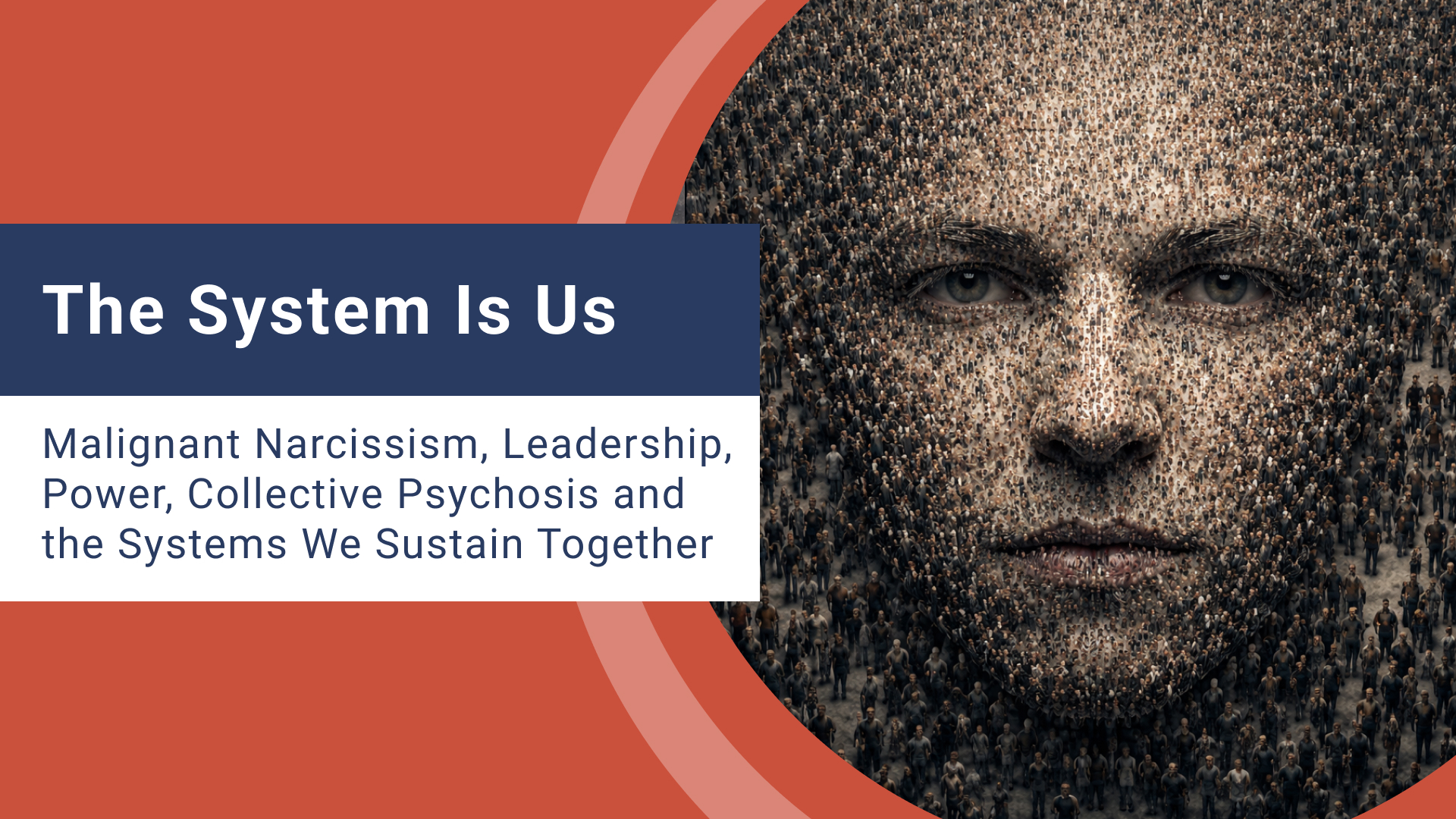

Tyranny is not an individual failure
Across different regions, systems, and nations, the same pattern keeps surfacing. Leaders rise who are unstable, inauthentic, and unaccountable. Their shadows run the show. They insult openly, distort reality without hesitation, provoke escalation, and polarise relentlessly. They attract protest and condemnation, and yet they are sustained.
Some are voted in deliberately. Some are defended aggressively. Some are tolerated quietly. Others are maintained through silence, passivity, fatigue, and resignation. Tyranny and disintegration do not survive on force alone. It survives through participation, accommodation, and withdrawal.
This is where the conversation becomes deeply uncomfortable.
Because tyranny is not contained in the individual who occupies a leadership position. Removing or replacing that figure does not restore integrity. The problem does not live only in regimes, executives, elites, or inner circles of power. It lives across the entire system. In those who support actively. In those who comply professionally. In those who adapt silently. In those who retreat into passivity while privately disapproving.
This is not the failure of the system. This is the system. And we are the ones who are responsible for reforming it, addressing it, fixing it, and sustaining it.
As long as there is an external enemy to blame, the burden remains light. Responsibility can be outsourced. Moral clarity can be performed without cost. But the moment that external enemy is set aside, the mental framework that made this tolerable begins to collapse.
A void appears.
Most people rush to fill it with new explanations, new villains, and familiar narratives. But if that void is held rather than avoided, something else becomes possible. Awareness begins. Authenticity becomes unavoidable. Reality is encountered directly rather than filtered through convenience. Responsibility emerges not as duty or obligation, but as response ability. The capacity to be a primary cause in how one meets the matters life brings, regardless of where those matters originate.
This is not about heroism. It is about integrity. Choosing participation over avoidance. Choosing responsibility over victimhood. Choosing to respond appropriately rather than perform outrage. Choosing to restore integrity from the bottom up through how we see, how we relate, and how we act.
This article is not about blaming leaders, defending systems, or choosing sides. It is about patterns. About how tyranny is produced, sustained, and normalised. About why changing faces does not heal structures. And about what it would take, at the level of being, to interrupt this cycle rather than repeat it.
What follows traces that pattern from emergence to sustainment, and then back to its root.
From Unease to Voice - When confusion learns how to speak
At some point, the unease stops staying quiet. Not because it has been understood, but because it has become too heavy to carry internally. Confusion looks for an exit. Frustration looks for language. What emerges is not careful thought, but expression.
The voice that forms is rough and unpolished. Emotionally charged. Impulsive. It does not weigh words, it throws them. It simplifies because it must. Nuance feels like betrayal when life already feels like an insult. The language is blunt and binary. Us and them. Cause and enemy. Right and wrong. It does not ask questions. It declares answers. Not because the answers are true, but because certainty feels like oxygen.
Others hear it and recognise something familiar. Not wisdom, but recognition. They recognise their own irritation, their own sense of being overlooked, their own private resentment now spoken aloud without restraint. The voice says what many felt but never articulated, and that alone gives it power.
This is how resonance forms. Not through depth, but through alignment. Not through insight, but through emotional accuracy. The words land not because they explain reality, but because they echo it. The voice grows louder as more people hear themselves reflected in it. Each response reinforces the speaker. Each cheer sharpens the tone. What began as expression turns into performance. What began as frustration turns into identity.
Still, nothing has been imposed. The movement is bottom-up. The energy does not originate in authority. The so-called leader does not manufacture the disorder. He gives it a mouth. And once confusion has learned how to speak, it rarely chooses restraint.
When the Crowd Roars - Democracy as amplifier, not safeguard
Once the voice finds its echo, escalation is fast. What was private frustration becomes collective sound. Applause swells. Numbers grow. Volume replaces verification. The roar itself begins to feel like evidence. If so many agree, it must be right. If it moves the crowd, it must be true.
This is where a dangerous confusion takes hold. Democratic process is mistaken for psychological health. Popularity is mistaken for legitimacy. Emotional resonance is mistaken for authenticity. A mechanism designed to aggregate preference becomes an amplifier of unresolved inner disorder.
The crowd does not ask whether the narrative is accurate. It asks whether it feels right, whether it relieves tension, whether it restores dignity by assigning blame and promising restoration. The louder the response, the more the voice hardens. Correction becomes hostility. Dissent becomes betrayal. Complexity becomes sabotage. The speaker learns quickly that escalation is rewarded and restraint is punished. The crowd trains the voice as much as the voice shapes the crowd.
This is the moment where innocence is still claimed. The process was followed. The outcome was chosen. Procedurally, that may be true. But procedure cannot substitute for maturity. It cannot repair a collapse in sense-making. It cannot compensate for compromised authenticity.
Democracy can select. It cannot heal.
When a population is sufficiently disoriented, humiliated, and desperate for coherence, democratic mechanisms do not filter pathology. They magnify it. They turn internal disorder into external authority. Power takes a face not because it seized control, but because it was handed the microphone.
The Nature of These Leaders - Unstable, unpolished, demented and operating in bad faith
Once power takes a face, its qualities become difficult to ignore. These figures are rarely refined or internally coherent. Their speech is erratic, impulsive, and emotionally charged. Contradictions appear openly and are left unresolved. Precision is absent. Restraint is absent. What remains is force of assertion, often mistaken for strength.
In reality, this is instability wearing confidence as a costume. Emotional volatility is common. Sudden shifts from certainty to grievance, from dominance to victimhood. Reality is not engaged with patiently or honestly. It is bent around impulse. Facts are not integrated. They are selected, discarded, or weaponised depending on what serves the moment.
At times, behaviour crosses into what can only be described as demented. Not as a medical diagnosis, but as a collapse of proportion, judgment, and orientation to reality. Reactions become detached from consequence. Escalation replaces deliberation. The internal compass fails, and external domination becomes the substitute.
This is where bad faith must be named clearly. Bad faith here does not mean ignorance or confusion. It means knowing distortion. Saying what one knows is false while understanding it is false. Manipulating reality deliberately, not accidentally. Truth becomes optional when it interferes with power, image, or control.
Ill intention does not always present as overt cruelty. More often it appears as indifference to harm. A readiness to sacrifice others for advantage. A comfort with humiliation, punishment, or coercion when it secures loyalty or silence. In some cases, there is unmistakable enjoyment of domination itself.
These figures are not corrigible in the usual sense. Exposure does not produce reflection. Criticism does not generate humility. Constraint is experienced as persecution. Accountability is reframed as attack. Yet none of this explains scale. These traits describe how harm is enacted, not how it becomes viable.
To understand that, the focus must shift again, away from the face of power and toward the pattern that sustains it.
Malignant Narcissism - A name for the pattern without hiding behind diagnosis
To understand the pattern taking shape, a term is needed that describes the structure of this behaviour without collapsing into insult or amateur diagnosis. Malignant narcissism serves that purpose.
It is not a formal category in the DSM (Diagnostic and Statistical Manual of Mental Disorders). That fact is often used to dismiss it. It should not be. Some of the most useful concepts for understanding power, violence, and tyranny are descriptive rather than clinical. They exist to illuminate patterns, not to medicalise or excuse them. The concept is most clearly articulated by Erich Fromm, who used it to describe a destructive configuration that becomes dangerous when paired with authority and mass identification.
In simple terms, malignant narcissism is not vanity taken too far. It is a fusion of four elements. First, grandiosity. A belief in exceptionalism and entitlement, not as quiet confidence but as destiny. The self is experienced as above limits, above rules, above correction. Second, paranoia. The world is divided into loyalists and enemies. Disagreement is treated as hostility. Neutrality becomes suspicious. Complexity feels threatening. Third, lack of conscience. There is little genuine remorse. Harm is minimised, denied, or rationalised. Responsibility is displaced outward. Fourth, sadism. Often subtle, sometimes overt. There is gratification in humiliating, punishing, or breaking others. Control becomes an end in itself, not merely a means.
This configuration explains why such figures appear immune to exposure. Contradiction does not produce reflection. Criticism does not lead to humility. Escalation replaces learning. Power, once acquired, is clung to with disproportionate aggression. The more reality resists, the more force is applied.
But this must be stated clearly. Malignant narcissism does not create tyranny on its own. It explains how harm is enacted, not how it is enabled. A person with this configuration can shout into the void indefinitely unless something responds, rewards, amplifies, or protects the behaviour.
Stopping here would return us to the same comforting narrative that the problem lives inside one individual. It does not. The real danger begins when this configuration encounters a collective ready to carry it.
Psychopathy - Why we recognise it, react to it and refuse to own it
Psychopathy is another word people rush to use and just as quickly push away. Like malignant narcissism, it is treated as something alien. Something external. Something that belongs to a defective individual who can be isolated, condemned, or removed so the rest of us can feel clean.
This framing is false.
Psychopathy describes a pattern of relating to reality and to others marked by emotional detachment, lack of remorse, instrumental use of people, and a shallow relationship to consequence. It is not always violent. It is often calm, procedural, and efficient. In positions of power, it thrives not through chaos but through administration.
What matters here is not diagnosis. It is function.
Psychopathic tendencies allow harm to be executed without internal friction. They allow suffering to be abstracted. They allow destruction to be justified as necessary, inevitable, or irrelevant. They allow cruelty to be sanitised through distance, language, and delegation.
When psychopathy converges with malignant narcissism, the configuration becomes especially dangerous. Grandiosity supplies entitlement. Paranoia supplies enemies. Lack of conscience removes restraint. Sadism supplies motivation. Psychopathy supplies emotional insulation. Together, they can wage war, suppress populations, or devastate societies without hesitation.
But psychopathy does not scale because one person has it.
It scales because others make room for it.
If we look closely at public reactions to malignant narcissistic and psychopathic leaders, a pattern emerges. People rush to condemn the individual as if he were an infection that arrived from elsewhere. Something we did not produce and do not recognise in ourselves.
This rush to scapegoat is revealing.
It allows people to disown the very tendencies that sustain the system. Admiration for ruthlessness. Tolerance for dehumanising language. Acceptance of collateral damage when it promises safety, victory, or order. Silence framed as neutrality. Inactivity framed as victimhood.
Psychopathy does not live only in the one who commands. It lives in those who cheer cruelty as strength. In those who excuse harm as realism. In those who execute orders while suspending judgment. In those who remain silent and then describe themselves as powerless.
This does not mean everyone is psychopathic. It means psychopathic functioning is distributed. It becomes social when empathy is dismissed as weakness, conscience is framed as naïve, and responsibility is endlessly deferred upward.
As long as psychopathy is treated as something we point at but never examine, it remains available. As long as it is externalised rather than recognised, it can be enacted again by different figures under different symbols.
Blaming the individual feels satisfying. It feels moral. It feels safe. It is also how we avoid the harder recognition that the structure we condemn at the top survives through support, participation, silence, passivity, and refusal to see ourselves in the pattern.
Democracy - The luxury watch we keep in the drawer
At this point, the conversation must be slowed, not softened.
This is not a debate about democracy versus non democracy. Not about ballots, boxes, or procedures. Those are mechanics. This conversation is pre-political. It is existential. It is about human patterns and lived experience.
Some societies say they have democracy. Others say they do not. Some take voting seriously. Others treat it loosely or cynically. These differences matter at a technical level, but they do not touch the core issue.
If a tyrannical leader is emerging on the surface, regardless of the system label, it is confronting for a reason. We are giving rise to it. We are sustaining it. Some actively. Some silently. Some through participation. Some through passivity.
Much of this happens through an unhealthy relationship with qualities that sound virtuous but rot when misused. Tolerance without boundaries becomes avoidance. Patience without discernment becomes paralysis. Adaptability without spine becomes compliance. Surrender without awareness becomes abdication. These are failures of modulation. When these qualities lose proportion, they stop protecting life and start protecting dysfunction.
Nowhere is this clearer than in how democracy itself is treated.
Democracy today resembles a luxury Rolex watch. Whether it is the best watch or not is beside the point. What it has is brand awareness. Everyone recognises it, even those who know nothing about watches. Few models. A small number of references that everyone can name.
And this is exactly how democracy is used.
We take it out for special occasions. Elections. Summits. Official meetings. International forums. We put it on, show it off, admire it publicly. Then we put it back in the drawer.
It is too precious for daily use. Too valuable to scratch. Too delicate to expose to real friction. It requires servicing. It does not even keep time as accurately as simpler, more modern quartz counterparts. Yet we treat it as sacred.
Democracy becomes an accessory, not a practice. A symbol, not a discipline. A performance, not a way of being. We protect it from reality rather than use it inside reality.
Meanwhile, other societies are more ideologically honest. They say what they believe. They do not pretend to be something they are not. This honesty does not make them healthy, but the dishonesty elsewhere makes dysfunction harder to see. The label becomes the shield.
As long as we can say we are democratic, we assume the work is done. As long as the watch is polished in the drawer, we believe time is being kept.
But democracy does not fail only when it is removed. It fails when it is reduced to a luxury item.
And here is the uncomfortable truth. The so-called dictator is not the cause of this failure. He is the emergence of it. He is upstream in origin and downstream in appearance. Produced by society, then sustained through continuous exchange between top and bottom. Flattery from below. Control from above. Participation and silence woven together.
It takes both sides to sustain such dysfunction. Those who command and those who accommodate. Those who act and those who adapt. Those who cheer and those who quietly learn to live with it.
This is not about systems on paper. It is about how humans live inside them.
Power - Let’s stop pretending
Let’s stop pretending there are external systems that sit above human power as first-layer realities. There is no international law in the way gravity exists. There is no rule-based order that imposes itself regardless of will. There is no territorial integrity that enforces itself by principle alone.
What exists, in its truest sense, is power.
And power does what it has always done.
Power is a reality. Our opinions are irrelevant to it. Empires do not disappear like mist evaporating. They rebrand. They change language. They update symbols. But they move for the same reasons they always have.
Resources. Oil. Gas. Minerals. Trade routes. Expansion. Influence. Dominance.
Power seeks more power. Power for the sake of power. Not because it is evil, but because that is its nature.
In our era, this pursuit is wrapped in refined language. Diplomacy. Democracy. Security. Stability. Sustainability. These are the words spoken. But beneath them, the movement is familiar. Capture resources. Secure leverage. Control pathways. Expand reach. Shape outcomes.
This is not confined to geopolitics.
The same pattern exists in families, organisations, corporations, academic institutions, media ecosystems, governments, and regimes. Wherever there is hierarchy, there is power. Wherever there is power, there is the drive to preserve and expand it. The scale changes. The logic does not.
International law, in theory, assumes sovereign states. Equal states. Independent states. In theory, this should apply to all. In practice, it only applies when powerful states choose to recognise it. When it suits them, it is law. When it does not, it is ignored, reinterpreted, or changed.
Borders are crossed. Governments are removed. People are killed. Then legality is explained after the fact. Narratives are constructed. Justifications are issued. Procedures are retrofitted. The story is cleaned up once the outcome is secured.
This is not hypocrisy layered onto an otherwise functional system. This is the system.
And it persists not only because of those who wield power openly, but because of those who insist on pretending that power is not what it is. Because pretending allows comfort. Because pretending preserves identity. Because pretending avoids responsibility.
As long as we cling to the fantasy that systems restrain power by principle alone, we remain disoriented. As long as we confuse language with reality, we remain manipulable. And as long as we insist that violations are anomalies rather than expressions of structure, we will continue to be shocked by outcomes that were entirely predictable.
This is not the failure of the system.
This is the system.
Being - The source of power
Power is often spoken about as if it were an inherently negative phenomenon. Something possessed by elites, monopolised by institutions, or exercised only through domination. This framing is comforting because it allows distance. It allows people to see power as something external, something other, something they can oppose without having to locate it within themselves.
But power is not a moral category. It is a reality.
Power exists wherever there is agency, capacity, and influence. And that means it does not belong exclusively to any group, class, or institution. We all have power. The difference is not who has it, but who recognises it, acknowledges it, and acts upon it consciously.
This is one of the core arguments developed in my book Being - The Source of Power, where the subtitle deliberately names power not as something to be feared, but as something to be understood and embodied. Power is the capacity to affect outcomes, to shape direction, to respond rather than merely react. It exists in how we speak, what we tolerate, what we legitimise, what we withdraw from, and what we participate in.
Most people underestimate their power not because they lack it, but because they have been taught to dissociate from it. To see themselves as small, constrained, or dependent. To outsource agency to leaders, systems, or narratives. This is not humility. It is abdication.
The encouragement in Being is not toward domination, control, or coercion. It is toward robustness. Toward becoming capable enough to engage reality without denial, distortion, or fragility. Toward recognising one’s capacity to influence situations, relationships, and systems from wherever one stands.
Naivety is not innocence. It is fragility. And unclaimed power does not disappear. It is simply exercised by those who are more willing to recognise and wield it.
To become more powerful in this sense is not to become tyrannical. It is to become less manipulable. Less dependent on illusions. Less likely to participate unconsciously in systems that one privately resents or publicly condemns. It is to move from passivity into response ability.
This is why the source of power is not located in offices, titles, or institutions. It is located in how we are being. In how honestly we engage reality. In how willing we are to take responsibility for our participation, rather than hiding behind naivety or outsourcing agency.
Power does not belong to the few.
It belongs to those who are willing to acknowledge it and use it with awareness.
Collective Psychosis - When the majority dissociates from reality
I first introduced this idea in the Being book, almost in passing, in parentheses. At the time, it did not need expansion. Here, it does.
Collective psychosis is not madness in the cinematic sense. It is not people running in the streets or losing basic functionality. It is far more subtle and far more dangerous.
It is the collective dissociation from reality.
It occurs when a large enough group loses its grounded relationship with authentic awareness. When perception is no longer regulated by reality, but by fear, identity, narrative, and emotional relief. When distortion becomes normal and clarity feels threatening.
In collective psychosis, people are not lying to one another. They are lying together.
Reality is no longer engaged with directly. It is filtered, reframed, sanitised, weaponised, or avoided. Contradictions are tolerated without tension. Obvious incoherence is absorbed without resistance. Escalation feels normal. Degradation feels justified. Harm feels distant.
This is not confined to leaders. It is not confined to institutions. It is not confined to supporters.
All parties are inside it.
The one at the top operates within a distorted reality where entitlement replaces accountability and domination replaces orientation. The crowd that cheers operates within a distorted reality where emotional resonance replaces truth. The institutions operate within a distorted reality where procedure replaces conscience. The silent majority operates within a distorted reality where adaptation replaces responsibility.
Different roles. Same dissociation.
This is why facts alone no longer correct anything. This is why exposure does not lead to reflection. This is why contradiction hardens positions rather than softening them. In a state of collective psychosis, reality is not denied aggressively. It is ignored functionally.
Authentic awareness collapses first. When people can no longer tolerate seeing what is actually happening, they reach for narratives that preserve coherence at any cost. Sense-making degrades. Responsibility evaporates. The system begins to float, untethered from reality, sustained only by repetition and mutual reinforcement.
This is how entire societies participate in patterns they claim to oppose.
The tyrant believes his own distortions.
The supporter defends them.
The administrator operationalises them.
The silent observer adapts to them.
All experience themselves as rational within the shared delusion.
Collective psychosis does not require everyone to agree. It only requires enough people to stop insisting on reality. Once that threshold is crossed, distortion becomes self-sustaining. Those who speak clearly sound extreme. Those who refuse participation appear dangerous. Those who point to reality are treated as the problem.
This is why the issue cannot be reduced to leadership failure, moral corruption, or system design alone. It is an existential breakdown. A failure of authentic awareness at scale. A collapse in how human beings collectively relate to reality itself.
Until that relationship is restored, every other intervention remains cosmetic.
The False Comfort of Blame - Why focusing on the leader alone is cowardice
Once the pattern becomes visible, there is a strong temptation to stop thinking. Blame offers relief. It concentrates anxiety into a single target. It allows outrage to feel productive. It delivers moral clarity without the burden of implication.
This is why so much attention is fixed on the figure at the centre. Not because condemnation is wrong, but because it is incomplete. When everything is located in the leader, the collective is spared. The crowd remains innocent. Institutions fade into the background. Silence is rebranded as prudence. Inaction is reframed as realism.
This move is comforting, and it is evasive.
Blame without depth functions as avoidance. It allows people to feel righteous while remaining unchanged. Critique becomes performance. Moral certainty replaces responsibility. The louder the condemnation, the less pressure there is to examine how such figures are enabled, defended, obeyed, and normalised.
This is how cycles persist. A figure is elevated, denounced, removed, or collapses. There is a moment of relief. A belief that the danger has passed. Yet the same conditions quietly remain intact. Sense-making is still shallow. Authenticity is still compromised. Responsibility is still deferred. The stage is reset. The script is unchanged.
Focusing on the leader alone is not just analytically weak. It is ethically evasive. It refuses to ask how destructive authority becomes viable in the first place. It avoids recognising that tyranny does not arrive fully formed. It is assembled gradually through alignment, tolerance, accommodation, and resignation.
This is not an argument against accountability. It is an argument against stopping there. As long as blame replaces understanding, the underlying machinery remains untouched. As long as outrage substitutes for maturation, the pattern remains available. And as long as people believe that removing the face removes the problem, they will continue to be surprised by its return.
To move beyond this, the focus must widen. Not away from harm, but toward the network of participation that allows harm to become durable.
The Distributed Tyrant - How tyranny lives beyond the tyrant
Tyranny is not contained in one body. It does not reside only in the one who speaks the loudest or commands the most. It is distributed across a system of roles that feel ordinary, justified, and often invisible to those inhabiting them.
There are those who cheer. They amplify the voice, defend the behaviour, excuse the excesses. Their loyalty is loud, and for that reason it attracts attention. It is easy to point to them and declare the problem identified.
But cheering is only one function.
There are those who justify. They translate incoherence into respectability. They soften language, contextualise aggression, reframe distortion. They provide intellectual cover, procedural legitimacy, and moral insulation. They may not believe fully, but they comply fluently.
There are those who execute. They carry out directives, apply rules, enforce outcomes. They tell themselves they are only doing their job. Responsibility is pushed upward or outward. Harm becomes abstract, a byproduct, a necessity.
And then there are those who normalise. They do not shout or justify or enforce. They adapt. They lower expectations. They accept the situation as reality. They wait it out. They learn how to live around the damage.
This group is often treated as neutral. It is not. Silence stabilises. Passivity consolidates. Resignation sustains. Tyranny does not require universal enthusiasm. It requires sufficient acquiescence. It survives less on fanaticism than on fatigue, less on belief than on compliance, less on hatred than on avoidance.
This is why the tyrant appears larger than life. He is not powerful on his own. He is powerful because many people carry parts of the structure for him, often without recognising themselves as participants. Tyranny is not an event. It is a process. And processes persist when enough people decide not to interrupt them.
The Second Blind Spot - The respectable crowd who did nothing
Up to this point, it is still possible to keep the problem at a distance. To locate it in the cheering crowd, the fanatics, the loud loyalists. Even when that recognition is uncomfortable, it preserves one last refuge of innocence.
The respectable majority.
Those who did not chant. Those who did not cheer. Those who did not participate directly in the madness. The people who disapproved quietly, felt uneasy privately, and then carried on.
This is the second blind spot, and it is the more dangerous one.
These are the people who saw enough to feel discomfort, but not enough to act. Who recognised that something was wrong, but not wrong enough to justify friction, risk, or loss. Who accepted the situation as unfortunate but inevitable, and adjusted themselves accordingly.
They are often educated, measured, civil. They value stability. They distrust extremes. They pride themselves on moderation. Silence feels like maturity. Adaptation feels like wisdom. Waiting feels like realism.
But this posture is not neutral. It is functional.
By treating reality as fixed, they remove pressure from the system. By choosing silence, they allow escalation to continue unchallenged. By prioritising comfort, safety, or career over responsibility, they convert personal caution into structural support.
This is how tyranny becomes normal. Not through hysteria alone, but through accommodation. Not through blind belief, but through quiet resignation. Fanaticism is volatile. Resignation is stable.
This is why systems depend more on the passive than on the extreme. Extremes draw attention. Passivity sustains continuity. History rarely names these people as villains. It barely names them at all. Yet no tyrannical system survives without them.
The pattern is now complete. The figure at the centre. The crowd that roars. The institutions that comply. And the majority that adapts. Different roles, same structure.
And this is why the line does not run between them and us. It runs through us.
This Is Not About Bad People - Why moral sorting fails
At this point, the pull toward moral sorting becomes strong. To divide the world into sane and insane, good and evil, enlightened and corrupted. To believe tyranny belongs to defective people rather than ordinary humans under pressure. This temptation must be resisted, not out of kindness, but out of accuracy.
This is not about bad people. It is about what happens to human beings when key capacities fail at scale.
Under sustained uncertainty, humiliation, fear, and cognitive overload, people regress. They simplify. They outsource judgment. They cling to narratives that restore dignity, agency, or belonging, even when those narratives distort reality. This is not clinical pathology. It is human vulnerability.
The danger lies in pretending otherwise. When tyranny is framed as the work of monsters, everyone else is absolved. Reflection stops. Learning stops. The same conditions quietly rebuild themselves.
The tyrant outside is rarely foreign to the society that produces him. He resonates because he expresses something unresolved in the collective psyche. Aggression mirrors suppressed rage. Grandiosity compensates for humiliation. Paranoia echoes widespread mistrust. Domination externalises a loss of control already felt within.
This does not mean responsibility is equal or harm evenly distributed. Power is asymmetrical and consequences are real. But participation is broader than most narratives allow. The crowd that roars is not uniquely evil. The crowd that complies is not uniquely weak. The crowd that stays silent is not uniquely innocent. They are variations of the same response to disorientation and fear.
This is why moral sorting fails. It replaces understanding with identity. It turns analysis into accusation. It encourages virtue performance rather than capacity development. And in doing so, it reproduces the very conditions it claims to oppose.
If the pattern is human, the response must be human as well. Not punitive. Not purifying. Developmental. That requires moving beyond blame and into responsibility.
The Root Failure - Sense-making, authenticity, responsibility
If tyranny is not an anomaly and not the property of a few pathological individuals, then the failure lies deeper than leadership, policy, or ideology. It lies in the collapse of foundational human capacities. Three failures recur together. When they weaken at scale, destructive power does not just become possible. It becomes likely.
The first is sense-making. Sense-making is the capacity to interpret reality without collapsing it into slogans, enemies, or fantasies of control. It is how people distinguish signal from noise, causation from coincidence, explanation from emotional relief. When sense-making deteriorates, complexity becomes intolerable. Ambiguity feels threatening. People stop asking whether something is true and start asking whether it feels right. Narratives are chosen for their capacity to soothe anxiety, not for their accuracy. Loud simplifications outperform careful explanations. Certainty replaces understanding. What emerges is conviction without comprehension.
The second failure is authenticity. Authenticity here does not mean self-expression or honesty as performance. It means authentic awareness. A truthful relationship with reality, including one’s own distortions. It is the ability to notice when fear, resentment, pride, or humiliation are shaping perception. It is the willingness to remain with discomfort rather than escape into borrowed narratives. When authenticity collapses, people outsource perception. They adopt interpretations that protect identity, justify avoidance, or preserve belonging. Self-deception becomes normal. Collective self-deception becomes invisible. This is how bad faith spreads far beyond leaders, not always through explicit lies, but through tolerated distortion and deliberate looking away.
The third failure is responsibility. Responsibility only becomes possible once reality is seen clearly enough. Responsibility is not guilt. It is response ability. The capacity to act in alignment with what one understands to be true. That action may be confrontational or restrained, public or quiet, but it is deliberate. When responsibility is deferred, people tell themselves that nothing they do matters, that outcomes are inevitable, that someone else will intervene. Silence becomes a choice. Compliance becomes a choice. Adaptation becomes a choice, even when framed as necessity.
These failures reinforce one another. Without sense-making, authenticity collapses. Without authenticity, responsibility is avoided. Without responsibility, distortion stabilises. This closed loop is what allows tyrannical patterns to reproduce without requiring villains or conspiracies. It only requires neglected capacities.
Ways of Being Are Upstream
At this point it becomes clear that what we are dealing with is not primarily a failure of systems, policies, or rules. It is a failure of being.
Ways of being precede outcomes. They shape how reality is perceived, how information is filtered, how discomfort is handled, and how responsibility is either owned or avoided. Long before a vote is cast or a leader is elevated, a society has already revealed how it relates to truth, power, and itself.
Leadership is downstream of this. It reflects what is tolerated, rewarded, excused, and normalised. This is why replacing figures such as ‘the leader’ or the ‘ruling elites’ without changing ways of being produces only cosmetic change. The pattern simply reconstitutes itself through a new personality, new directors, new government, a new regime, a new party, a new tone, a new promise.
Within the Being Framework, responsibility, awareness, and authenticity are not moral aspirations or abstract ideals. They are functional performance qualities. They sit among a broader set of 31 qualities that shape how human beings engage with life and act within it. These include foundational performance qualities such as responsibility, commitment, assertiveness, proactivity, courage, care, and self-regulation. These qualities determine whether a person can act coherently under pressure, sustain integrity over time, and respond to reality without collapsing into avoidance or reactivity.
These qualities are explored in depth in Being and Human Being, where the focus is on individual and collective performance, agency, and the capacity to engage life deliberately rather than defensively.
Alongside this, there is a second set of qualities addressed within the Authentic Sustainability Framework, developed and articulated in Sustainabilism. This framework explores a further 16 qualities that are essential for systemic coherence and long-term viability. These include trust, sovereignty, adaptability, patience, tolerance, proportionality, and the capacity to hold tension without resorting to domination, collapse, or denial.
These qualities are not about efficiency or optimisation. They govern how systems remain whole over time, how power is held without corruption, and how societies adapt without disintegrating into either rigidity or chaos.
[Link to Sustainabilism]
When these qualities are underdeveloped, people default to reactivity, outsourcing, and simplification. They seek certainty instead of coherence. They choose relief over accuracy. They adapt to dysfunction rather than interrupt it. Under these conditions, destructive leadership does not need to be imposed. It becomes viable, even attractive.
Voting, for example, is not a cause. It is an expression. It reveals accumulated ways of being, how people relate to fear, authority, uncertainty, and responsibility. Change the mechanism without maturing the underlying capacities and the same dynamics will reappear through different channels.
This is not an argument for perfection. It is an argument for leverage. If ways of being mature, different leaders become possible. If they remain stagnant, no structural reform will hold. The work that matters most happens upstream, where perception forms and responsibility is decided, long before power takes a public face.
Conclusion - Why tyrants keep returning
Tyrants do not appear out of nowhere. They are produced.
They emerge from societies struggling to make sense of reality, unwilling to face distortion, and hesitant to own responsibility. They are amplified by crowds seeking relief, stabilised by institutions seeking continuity, and sustained by a majority that adapts rather than interrupts.
This is why the same pattern keeps returning. Different faces. Different slogans. Different justifications. The structure remains intact.
War is not only waged with weapons. It is waged at the level of perception, at the level of distortion, at the level of abdicated responsibility. Long before violence becomes visible, reality has already been bent, empathy dulled, and conscience outsourced.
As long as sense-making remains shallow, authenticity compromised, and responsibility deferred, destructive leadership will remain available. Not because people desire tyranny, but because the capacities required to prevent it are underdeveloped.
No system can compensate for immature ways of being. No procedure can replace awareness. No rule can substitute for responsibility. Democracy itself cannot protect what is treated as a symbol rather than a practice.
The question, then, is not how to remove tyrants. It is how we keep assembling them.
Until that question is faced honestly, history will continue to repeat itself. Not as fate, not as inevitability, but as unfinished learning.
And that learning does not begin at the podium.
It begins with how we see, how we distort, and how we respond when reality becomes uncomfortable.