
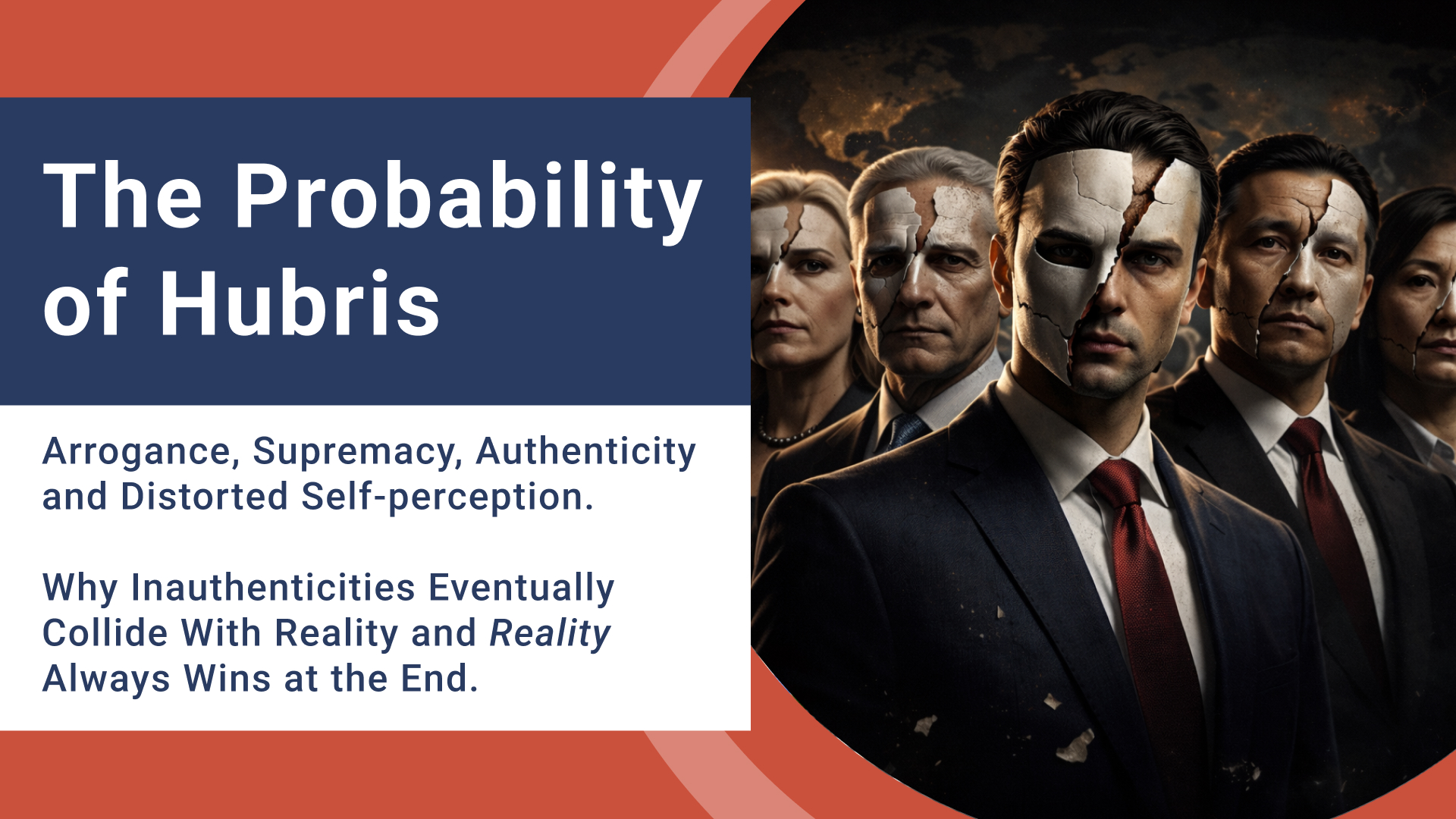

Hubris is often the unseen impediment to what we most desire to achieve, a shadow of pride stretching across the path of our own becoming.
When Supremacy Becomes a Distortion of the Self
Discussions about arrogance, supremacy, and hubris usually begin with moral judgment. Religious traditions condemn pride as a vice. Ethical frameworks praise humility as a virtue. Leadership literature repeatedly warns that arrogance precedes downfall. Yet these explanations, while not incorrect, often remain incomplete.
Before arrogance becomes a moral issue, it is first a distortion in how individuals and systems relate to reality.
Individuals, institutions, and even entire societies construct narratives about themselves. These narratives form the foundation of identity. They shape how events are interpreted, how actions are justified, and how challenges are approached. When these narratives remain grounded in reality, they provide stability. When they drift into exaggeration, exceptionalism, or self-glorification, they begin to introduce fragility.
Supremacy rarely emerges suddenly. It develops gradually as a gap forms between how an entity sees itself and what reality actually reflects back. At the individual level, this may appear as inflated confidence, entitlement, or a belief in one's exceptional status. At the institutional level, it may manifest as ideological certainty or claims of moral superiority. At the civilisational level, it can take the form of narratives of historical inevitability or assertions of unique righteousness.
In the short term, such narratives can be powerful. They mobilise support, create cohesion, and project strength. Yet they also introduce a dangerous distortion. When identity becomes disconnected from reality, decision-making increasingly relies on self-reinforcing narratives rather than accurate perception.
This distortion becomes especially consequential in leadership. Leaders do not merely act as individuals. Their self-perception influences entire systems. When leaders adopt exaggerated self-images, the consequences extend far beyond personal credibility. Their interpretations shape strategies, policies, alliances, and conflicts that affect millions.
For this reason, the problem of hubris is not simply a question of character. It is a question of structural alignment between identity and reality. Understanding how this misalignment forms, how it persists, and why it eventually reveals itself is therefore not merely philosophical. It is central to leadership, governance, and the stability of complex systems.
To examine this dynamic more precisely, we must first understand how identity itself is structured.
Authenticity, Awareness, and the Architecture of the Self
If supremacy and hubris emerge from distorted self-perception, the natural question becomes how such distortions form and why they are often sustained for long periods of time.
To examine this more precisely, it is useful to move beyond moral language and instead look at the structure of identity and expression.
Within the Being Framework, authenticity is not treated as a personality trait or a cultural preference. It is understood as a condition of alignment. Authenticity exists when the different layers through which a human being relates to themselves and the world remain coherent with one another.
One way to examine this coherence is through what is described in BEING as the Authenticity Quadrant (Tashvir, 2021). This quadrant illustrates four interconnected conversations that shape human identity and expression.

The quadrant identifies four distinct but interrelated domains through which individuals relate to themselves and the world: self-image, persona, beliefs, and opinions. Each represents a different form of conversation through which identity is constructed, expressed, and interpreted.
When these domains remain broadly aligned with reality, authenticity emerges naturally. A person's internal narrative, public expression, interpretation of the world, and observable actions reinforce one another.
When they drift apart, distortion begins to accumulate.
A person may develop a self-image that exceeds their actual conduct. A persona may be carefully constructed to project an image that conceals weakness or uncertainty. Beliefs may evolve not as tools for understanding reality but as mechanisms for protecting identity. Opinions may become expressions of allegiance rather than reflections of truth.
Over time, an entire identity structure can form around narratives that are only partially grounded in reality.
The Being Framework, therefore, treats authenticity not merely as honesty in speech but as structural integrity across these domains of identity.
Yet even authenticity itself depends on a deeper capacity. In the Metacontent discourse, this deeper capacity is described as Authentic Awareness.
Authentic Awareness refers to the ability to perceive reality with progressively fewer distortions. It operates across three domains of experience. In the objective domain, it involves aligning perception with empirical facts. In the intersubjective domain, it involves recognising social constructs for what they are rather than mistaking them for absolute truths. In the subjective domain, it involves recognising one's own biases, pride, and psychological defence mechanisms.
Without authentic awareness, the gap between identity and reality can grow unnoticed.
And when that gap expands within individuals, leaders, institutions, or societies, supremacy and hubris can begin to appear not as deliberate deception but as systematic self-misunderstanding.
To understand why such distortions eventually collapse, we must examine authenticity itself more precisely.
Authenticity as Alignment With Reality
To understand why supremacy and hubris eventually collapse, we must examine the concept of authenticity more precisely.
As discussed, within the Being Framework, authenticity is not treated as a social preference or a personality trait. It is a structural relationship with reality.
The Ontological Distinction of Authenticity
Authenticity is how you relate to the reality of matters in life. It is the extent to which you are accurate and rigorous in perceiving what is real and what is not. It is also how sensitive and diligent you are to the validity of the knowledge you perceive. Authenticity is paramount for you to carefully consider that your conception of reality – including your beliefs and opinions – is congruent with how things are. When you are being authentic, you are compelled to express your Unique Being – what is there for you to express – while being consistent with who you say you are for others and who you say you are for yourself. It is the congruence or alignment of your self-image – who you know yourself to be – and your persona – who you choose to project to others.
A healthy relationship with authenticity indicates that you take the time to thoughtfully consider your beliefs and opinions, as the validity and accuracy of your conception of matters is important to you. You mostly experience yourself as being true to yourself and others. Others may consider you genuine, distinct and trustworthy, and that your actions are consistent with who and how you are and what you communicate.
An unhealthy relationship with authenticity indicates that there may be no solid foundation for your beliefs and opinions and how you choose to examine reality, and you are often lenient and fickle with how you express your views and the truth. You may consider yourself to be fake or an imposter and often question your own abilities. Others may consider you to be someone who lacks sincerity and often acts inconsistently with who you say you are. You are frequently uncomfortable with being yourself and being with yourself. Alternatively, you may be righteous, opinionated, biased or prejudiced, considering your ‘truth’ to be the only truth, and may be unwilling to give up being ‘right’.
Reference: Tashvir, A. (2021). BEING (p. 250). Engenesis Publications.
Authenticity, therefore, functions not only as a personal virtue but also as a structural safeguard against the gradual drift between identity and reality.
To understand how this drift forms, it is useful to examine the four conversations that shape identity more closely.
The Four Conversations That Shape Identity
Every human being lives inside a set of ongoing conversations that shape how they see themselves and how they move through the world. These conversations rarely occur only in words. They operate through interpretation, narrative, justification, and behaviour.
When these conversations remain coherent, a person's presence carries stability. When they drift apart, distortion begins to accumulate.
The first conversation is self-image.
Self-image is the narrative we carry about who we are. It forms through memory, culture, praise, criticism, and the interpretations we construct about our own experiences. Self-image is not inherently problematic. In fact, it is necessary. Without some internal narrative, we would struggle to maintain continuity in our identity.
Problems arise when the self-image becomes exaggerated, defensive, or detached from reality. When a person begins to see themselves as uniquely exceptional, uniquely righteous, or uniquely entitled, the internal narrative stops serving awareness and begins serving self-protection.
The second conversation is persona.
Persona is the image we present to others. Human beings naturally manage impressions. Social life requires some degree of presentation and signalling. We adapt tone, language, and posture depending on context.
However, persona becomes dangerous when it evolves into performance. When the gap between who someone claims to be and who they actually are grows wide, the persona becomes a mask that must constantly be maintained.
The third conversation involves beliefs.
Beliefs are the conversations we have with ourselves about the world. They shape how we interpret events and organise complex realities into understandable patterns. Yet beliefs can also become tools of justification. When a person's self-image becomes inflated, beliefs may evolve to protect that image rather than challenge it.
The fourth conversation involves opinions.
Opinions are the conversations we have with the world about the world. They are the interpretations and positions we publicly express about events, systems, and other actors. When identity becomes inflated, opinions may begin to serve identity rather than truth.
Yet even these four conversations do not exist in isolation.
They are constantly interacting with reality.
Reality is not a narrative. It is the field of consequences that responds to behaviour. Decisions generate outcomes. Actions produce effects. Systems react to pressures regardless of the stories people tell about themselves.
Reality carries a quiet but persistent authority because it does not rely on persuasion.
When self-image, persona, beliefs, opinions, and observable outcomes remain broadly aligned, authenticity emerges naturally. The story we hold about ourselves, the way we present ourselves, the interpretations we adopt, and the consequences our actions produce remain coherent. When they drift apart, instability begins to form.
A person may believe themselves to be wise while their actions repeatedly produce destructive outcomes. A leader may project confidence while decisions reveal confusion. An institution may claim moral authority while its conduct undermines the very values it proclaims. For a time, such contradictions can remain hidden. But as interactions accumulate and consequences unfold, reality slowly begins to speak.
The Illusion of Control
One of the reasons distorted self-images can survive for long periods is that human beings possess a real ability to influence perception.
We can manage impressions.
We can shape narratives.
We can emphasise certain signals and conceal others.
In this sense, social life can occasionally resemble a game of cards. People read each other, posture strategically, and sometimes bluff. Confidence can influence how others interpret events. Authority can amplify one's narrative. A well-crafted persona can create the appearance of competence, righteousness, or strength.
Because of this, individuals and institutions may begin to believe that perception itself can be controlled indefinitely. But this belief rests on a misunderstanding.
Life is not a closed table where the same players remain indefinitely and the same information circulates between a limited number of observers. Reality is an open system. New interactions constantly occur. New observers appear. New variables enter the field. Over time, the number of interactions grows beyond anyone's ability to manage perception completely.
Each decision creates consequences that interact with other systems. Each statement generates interpretations that travel beyond the speaker's control. Each action produces data that becomes visible to different audiences.
In the short term, a carefully managed persona can shape how events are interpreted. In the longer term, however, patterns begin to emerge. And patterns are difficult to hide.
This is where the illusion of control begins to weaken. What once appeared manageable becomes increasingly complex. The effort required to maintain a distorted image grows larger with every interaction. The problem is not merely moral. It is structural.
The more a person's self-image and persona diverge from reality, the more energy must be spent maintaining the illusion. Each inconsistency must be explained. Each contradiction must be managed. Each failure must be reframed. Eventually, the system becomes unstable.
Not because reality is actively seeking to expose deception, but because reality accumulates evidence faster than narratives can contain it.
The Mathematics of Exposure
When the gap between self-image, persona, and reality widens, the problem gradually shifts from psychology to probability. In the short term, inconsistencies can remain hidden. A misleading statement may pass unnoticed, a contradiction may remain unexplored, and a carefully constructed persona may continue to function because the number of interactions through which reality can test the narrative is still limited. At early stages, perception can often be shaped by confidence, authority, or reputation. Observers may lack sufficient information to evaluate whether the narrative being presented is accurate.
However, every interaction introduces new information into the system. Each decision generates outcomes, each statement creates an opportunity for comparison between words and actions, and each observable consequence becomes a potential signal that others can interpret. As these interactions accumulate across time, the informational field surrounding the narrative begins to expand. What once appeared coherent begins to encounter increasing opportunities for contradiction.
This dynamic is not merely philosophical. It reflects a probabilistic structure governing how narratives interact with reality over time. In the article “The Exposure Probability Model (EPM)”, this structure is examined more formally. The model explains why inauthentic narratives and distorted personas become progressively harder to sustain as interactions accumulate. The more frequently a narrative encounters observable reality, the greater the probability that inconsistencies between the projected story and the consequences of behaviour will eventually become visible.
The principle is straightforward. Narratives can shape perception temporarily, but reality accumulates evidence indefinitely. With every additional interaction, the number of opportunities for comparison between narrative and consequence increases. Over time, the likelihood that someone will notice inconsistencies rises. The likelihood that multiple observers will compare experiences rises. The likelihood that patterns begin to emerge rises as well.
This is why what appears to be a sudden collapse of credibility is rarely sudden at all. In most cases, the collapse represents the moment when accumulated contradictions become too visible to ignore. The persona may have been sustained for years through reputation, authority, or careful narrative management, but the underlying field of interactions has quietly been producing signals that eventually converge.
The same logic explains why individuals or institutions that rely heavily on manipulation or exaggeration often change environments frequently. Moving to new organisations, communities, or audiences effectively resets the statistical field by reducing the number of accumulated interactions through which reality can be compared with the narrative. Stability, on the other hand, allows interactions to accumulate, patterns to emerge, and observers to develop a clearer picture of the relationship between identity and consequence.
From this perspective, the stability of an inauthentic persona is not merely a psychological matter but a structural one. As interactions multiply and outcomes accumulate, the probability that contradictions will become visible steadily increases. The Exposure Probability Model provides a conceptual lens through which this process can be understood: distorted narratives can persist for a time, but the expanding field of consequences eventually produces enough evidence to challenge the story. In such conditions, exposure becomes less a matter of chance and increasingly a matter of time.
The Probability of Exposure - Why Inauthentic Personas Become Structurally Unstable
Hubris is often described in moral terms. Arrogance is condemned as a vice and humility is praised as a virtue. Yet the collapse of distorted self-images can also be understood through a structural lens.
When an individual, leader, institution, or nation projects a persona that diverges significantly from reality, the challenge is not only ethical. It is structural and probabilistic. The larger the gap between what is projected and what actually exists, the more information must be managed, explained, defended, or concealed. As interactions accumulate across time, the probability that contradictions between narrative and consequence will become visible steadily increases.
This dynamic is examined more formally in the article The Exposure Probability Model (EPM), where the relationship between narrative distortion and exposure risk is analysed as a structural phenomenon. The model does not attempt to predict specific events. Rather, it illustrates why inauthentic personas, whether in individuals, leaders, or institutions, tend to become increasingly unstable as interactions accumulate.
The Variables of Exposure
The Exposure Probability Model identifies several variables that shape the likelihood that contradictions between narrative and reality will eventually become visible.
Distortion (D) refers to the gap between reality and the projected persona. When the difference between what is claimed and what actually exists becomes large, the system must expend increasing effort maintaining coherence between narrative and outcomes.
Interactions (N) refer to the number of engagements through which the narrative interacts with reality. Every decision, statement, policy, conversation, or measurable outcome represents an interaction through which the narrative may be tested.
Visibility (V) refers to the scale of observation surrounding those interactions. A private individual may operate under relatively low visibility. Leaders, institutions, and nations operate under much higher levels of observation.
Adaptive Correction (A) refers to the ability of a person or system to revise behaviour when reality contradicts its narrative. Authentic self-reflection, humility, and accountability allow distortions to be corrected before they accumulate.
These variables interact in ways that determine whether a projected persona remains stable or gradually becomes fragile.
A Conceptual Exposure Model
In the original Exposure Probability Model (EPM) presented in the earlier article, the relationship between these variables can be expressed conceptually as:
R = (D × N × V) / A
Where:
R represents the risk of exposure
D represents the distortion between persona and reality
N represents the number of interactions across time
V represents visibility or scale of observation
A represents adaptive correction
The model illustrates a simple structural reality. When distortion grows larger, more inconsistencies must be managed. As interactions increase, the number of opportunities for contradiction expands. When visibility increases, more observers encounter those interactions. If adaptive correction is weak, distortions remain uncorrected and continue to accumulate.
Consider a corporate executive who consistently portrays themselves as an exceptional strategist. Early successes reinforce this narrative. Yet over time, several projects fail and internal decisions begin producing unintended consequences.
At first, the narrative may remain intact because the number of interactions is still limited and visibility remains relatively low. Failures can be attributed to external circumstances or reframed as temporary setbacks.
However, as more decisions accumulate, employees begin comparing outcomes across different projects. Investors examine performance data. Competitors observe strategic missteps. The number of interactions grows and visibility expands.
If the executive refuses to revise their behaviour or reassess their assumptions, adaptive correction remains low. Under these conditions, the probability that contradictions between narrative and reality will become visible steadily increases.
The persona may survive for a time, but the underlying structural instability grows with each interaction.
The Expanded Exposure Probability Model
The original model explains why distortion becomes increasingly fragile as interactions accumulate. However, a further refinement reveals an additional factor that significantly influences the probability of exposure: observer capacity.
In the expanded Exposure Probability Model, this additional variable is introduced as Observer Capacity (C).
The expanded expression can therefore be represented as:
R = (D × N × V × C) / A
Where C represents the ability of observers to detect and interpret patterns between narrative and reality.
Visibility alone does not guarantee exposure. Interactions may occur in highly visible environments while still remaining misunderstood if observers lack the ability to recognise inconsistencies across time. Observer capacity refers to the analytical ability, experience, and perspective required to identify patterns within complex systems.
At this point, another structural factor becomes relevant: the broader crisis of sense-making that characterises many contemporary institutions and societies. The ability of observers to detect contradictions between narrative and reality does not depend solely on access to information. It also depends on the quality of the conceptual frameworks through which that information is interpreted. In the book Metacontent, this problem is examined as a systemic deficiency in how individuals and systems develop conceptions of reality. When sense-making remains shallow or fragmented, observers may encounter large volumes of data and information without recognising the patterns that connect them.
Distortions therefore persist not because evidence is absent, but because the interpretive structures required to make sense of that evidence remain underdeveloped. To address this, the Metacontent discourse introduces the Nested Theory of Sense-Making, a structured model describing how human beings progressively construct deeper and more coherent conceptions of the realities they encounter. Through the development of cognitive maps, stories, mental models, perspectives, and domain awareness, individuals gradually refine their capacity to interpret complex systems with increasing accuracy. This developmental process ultimately supports what is described as Authentic Awareness, the ability to perceive objective realities, social constructs, and subjective interpretations with progressively fewer distortions. In the context of the Exposure Probability Model, this means that observer capacity is not merely a matter of intelligence or access to information. It is fundamentally shaped by the depth and coherence of the sense-making structures through which reality is interpreted.
Consider a political leader who consistently portrays themselves as uniquely capable of managing a nation’s economy. Over time, several economic indicators begin to deteriorate. Policy decisions produce unintended consequences, and outcomes increasingly contradict the narrative being projected.
In an environment where observer capacity is limited, these contradictions may remain difficult for the broader public to interpret. Supporters may continue to repeat the original narrative, attributing negative outcomes to external forces or temporary conditions.
However, economists, policy analysts, investigative journalists, and institutional observers possess greater capacity to analyse patterns across time. They begin comparing policy decisions with economic outcomes, tracing cause-and-effect relationships that contradict the leader’s narrative.
As these observers publish analyses and interpretations, the informational environment changes. Patterns that were previously difficult to recognise become visible to a wider audience. What once appeared as isolated events begins to reveal a consistent pattern of misalignment between narrative and reality.
Observer capacity, therefore, accelerates the probability that contradictions will be detected.
The Accumulation of Contradictions
In reality, contradictions rarely accumulate in a simple linear fashion. Each new statement or action does not exist in isolation. It must remain consistent with prior statements, prior decisions, and prior outcomes. As interactions accumulate, observers begin comparing events across time.
The informational web surrounding the narrative grows rapidly.
This creates a structural challenge for distorted identities. Maintaining an illusion requires ensuring that new actions remain consistent with an expanding history of prior claims and outcomes. As the number of interactions increases, this coordination becomes increasingly complex.
For a time, the narrative may continue to hold. Authority, reputation, and institutional support may reinforce the persona. Yet as inconsistencies accumulate, the probability that observers will detect patterns rises sharply.
What initially appeared manageable gradually becomes structurally unstable.
Why Power Does Not Eliminate the Risk
Power can delay exposure, but it rarely eliminates the underlying dynamic. Influence can shape narratives. Institutions may control information flows. Supporters may reinforce the story that the system prefers to tell about itself. These mechanisms can preserve a persona for a time.
Yet power also increases visibility. Leaders generate more decisions, more statements, and more consequences. Each action expands the field of interactions through which reality can test the narrative.
More observers appear.
More outcomes accumulate.
More evidence enters the system.
The same influence that amplifies authority also amplifies the number of interactions through which contradictions may emerge.
Authenticity as Structural Stability
This is where authenticity becomes more than a personal virtue.
Within the Being Framework, authenticity reduces distortion between persona and reality while increasing the system’s capacity for adaptive correction. When individuals or institutions remain open to revising their behaviour in response to reality, distortions are corrected before they accumulate into structural instability.
In structural terms, authenticity lowers distortion and strengthens adaptive correction. The system becomes more stable because it adjusts before contradictions accumulate beyond its ability to manage them.
By contrast, systems that defend their self-image at all costs gradually accumulate inconsistencies that eventually overwhelm the narrative.
When the Model Becomes Visible in Practice
The dynamics described by the Exposure Probability Model can be observed across many domains of human life.
A corporate executive may repeatedly claim strategic brilliance while a series of failed decisions quietly erode the credibility of that narrative. A political leader may portray themselves as uniquely capable while policy outcomes gradually contradict that claim. A person may exaggerate their achievements among new acquaintances, while long-standing communities eventually recognise the inconsistencies.
In each case, the pattern is similar. Distortion requires explanation. Explanation requires coordination. Coordination becomes increasingly difficult as interactions accumulate across time.
Eventually, the narrative must either adapt to reality or collapse under the weight of accumulated contradictions.
When Leadership Amplifies the Gap
The dynamics described so far exist in everyday life, but leadership magnifies them significantly.
A private individual may interact with dozens of people. A leader interacts with hundreds, thousands, sometimes millions. Their words travel further. Their decisions generate wider consequences. Their narratives are tested against larger fields of reality. This amplification changes the stakes.
A leader whose self-image, persona, beliefs, and actions remain aligned tends to become more stable as their influence grows. Their decisions may still face criticism, but the underlying coherence of their conduct allows observers to detect consistency over time. Trust grows not because the leader is flawless but because their actions remain intelligible. The opposite dynamic occurs when a leader's identity structure is built on exaggeration or illusion.
A grand persona may project confidence and strength. A narrative of superiority may mobilise supporters. Claims of righteousness may silence critique for a time. Yet every expansion of influence also expands the number of interactions through which reality can respond.
More observers appear.
More outcomes accumulate.
More consequences become visible.
If decisions consistently contradict the narrative that surrounds the leader, the gap between story and reality becomes increasingly difficult to maintain. This is why hubris has historically appeared so often before institutional or political crises. It is not because arrogance carries a mystical punishment. It is because exaggerated self-images tend to produce distorted decisions. Distorted decisions create consequences that gradually undermine the very narrative that justified them. Leadership, therefore, carries a unique vulnerability. The same amplification that magnifies influence also magnifies exposure.
In the early stages, power can strengthen the persona. In the later stages, the accumulated evidence of reality begins to challenge it. What once appeared as confidence may begin to look like misjudgement. What once appeared as certainty may begin to look like rigidity. And when this shift occurs, the collapse of narrative can be surprisingly rapid.
When Reality Washes the Persona Away
Reality rarely confronts narratives through argument. It does not debate ideology or challenge self-images in words. Instead, it appears through consequences.
Economic outcomes reveal flawed assumptions. Strategic decisions produce results that cannot be hidden. Institutional failures expose structural weaknesses that rhetoric once concealed.
For a time, these signals may be ignored or reframed. Narratives can be adjusted to absorb individual setbacks. Failures may be blamed on external forces, misfortune, or betrayal. Supporters may continue to repeat the original story because it provides psychological comfort and social cohesion.
Yet the accumulation of consequences eventually reaches a threshold.
When outcomes repeatedly contradict the narrative being projected, observers begin to reassess what they are witnessing. Confidence that once appeared convincing begins to look rehearsed. Certainty begins to resemble stubbornness. Authority begins to appear disconnected from reality. The persona that once held influence starts to lose its coherence.
This moment is rarely dramatic at first. It often begins quietly. Small doubts emerge in places where certainty once existed. Questions begin to circulate among those who previously remained silent. Signals that were once interpreted as strength are reconsidered under a different light.
What becomes visible in these moments is not a sudden transformation but a long-standing misalignment. The gap between self-image, persona, and reality had existed for some time. The difference is that reality has now accumulated enough evidence to make the gap difficult to ignore. When this occurs the carefully constructed persona begins to dissolve.
Narratives that once seemed powerful lose their persuasive force because the surrounding evidence no longer supports them. The story may still be repeated, but it no longer commands the same authority.
In such moments, the underlying structure of leadership becomes visible. What remains is not the narrative that once surrounded the leader but the consequences their decisions have produced.
The Quiet Discipline of Authentic Leadership
If supremacy and hubris grow out of distorted self-perception, the question becomes how leaders prevent this distortion from taking hold. The answer is not humiliation, nor the rejection of confidence or ambition. Leadership requires conviction, decisiveness, and the ability to act under uncertainty. The challenge is not strength of identity but the discipline of continually confronting reality.
Within the Being Framework, this discipline is grounded in authenticity.
Authenticity is not merely about honesty in speech or transparency in behaviour. It is about maintaining alignment between the inner narrative of the self, the persona presented to others, the beliefs that guide interpretation, and the consequences that reality produces. This alignment requires ongoing self-examination. Leaders must repeatedly test whether the stories they tell about themselves are still consistent with what reality is revealing.
This is where Authentic Awareness becomes essential.
Authentic awareness allows a person to recognise signals that challenge their self-image. It allows them to see where pride may be distorting perception, where certainty may be masking insecurity, or where narratives are protecting identity rather than serving truth. Without this capacity, leaders easily become prisoners of their own mythology.
Supporters may reinforce the persona. Institutions may reward the narrative. Success may strengthen the belief that the leader's interpretation of reality is correct. Yet authentic leadership requires a willingness to let reality revise identity. When leaders maintain this discipline, confidence becomes grounded rather than inflated. Authority becomes stable rather than theatrical. Influence becomes sustainable because it is not dependent on maintaining a fragile illusion. The paradox is that genuine authority grows stronger when leaders remain open to correction.
In such conditions, the gap between self-image, persona, and reality remains narrow. Decisions may still be imperfect, but the system retains the capacity to adapt before distortions become catastrophic. Authenticity, therefore, functions not merely as a personal virtue but as a structural safeguard for leadership. It prevents the slow drift from confidence into supremacy and from conviction into hubris.
The Lesson for Systems, Nations, and Civilisations
The dynamics described here do not belong only to individuals. They appear in organisations, institutions, and nations as well.
Groups, like individuals, construct narratives about themselves. These narratives shape identity, justify decisions, and mobilise support. A nation may begin to see itself as uniquely righteous. An institution may imagine itself as indispensable. A movement may frame its cause as unquestionably just.
Such narratives can produce cohesion and resolve. They can unify populations and strengthen collective confidence. For a time, they may even appear to confirm themselves through success. But the same structural risk remains.
When collective self-image drifts away from reality, the decisions that follow begin to rely more on narrative than on accurate perception. Actions are justified through stories of inevitability or righteousness rather than through sober evaluation of consequences. For a period, this distortion may remain invisible.
Power can reinforce the narrative. Alliances can amplify it. Critics may be dismissed as disloyal or uninformed. Within such environments, the collective persona of a system becomes increasingly insulated from corrective signals. Yet reality continues to respond.
Strategic miscalculations produce unintended consequences. Actions generate reactions from other actors within the system. Outcomes begin to contradict the narratives that once appeared unquestionable. As consequences accumulate, the gap between narrative and reality becomes harder to sustain.
At first, the response is often defensive. Narratives become louder. Certainties become stronger. Opponents are portrayed as irrational or illegitimate. The system doubles down on the very self-image that created the distortion. But reality does not negotiate with narratives.
Over time, the consequences continue to accumulate until observers begin to recognise the underlying misalignment. What once appeared as strength begins to resemble overconfidence. What once appeared as certainty begins to resemble blindness.
History contains many such moments where systems built upon exaggerated self-images eventually encountered the limits of their own narratives. Not because one side was entirely virtuous and the other entirely flawed, but because distorted perception inevitably produces decisions that reality eventually corrects. For leaders and societies alike, the lesson remains the same.
Authenticity is not weakness.
Awareness is not hesitation.
And humility before reality is not surrender.
They are the disciplines that prevent power from drifting into supremacy and confidence from collapsing into hubris. When self-image, persona, belief, and reality remain aligned, leadership becomes stable and sustainable. When they diverge, reality eventually restores the balance.
Closing Reflection - Reality Requires Fewer Variables Than Illusion
Hubris is often treated as a moral defect. Pride is condemned, arrogance is criticised, and humility is prescribed as the corrective. Yet beneath these moral descriptions lies a simpler structural truth. Supremacy usually begins with a distorted relationship with the self.
A narrative forms about who we are. That narrative gradually hardens into identity. Persona emerges to project that identity outward. Beliefs evolve to defend it. Over time, an entire architecture of meaning can form around a story that is only partially grounded in reality. For a while, such structures may appear stable. Perception can be managed. Narratives can be repeated. Power can reinforce the image that a person, an institution, or a nation wishes to project.
But life does not operate solely in the realm of narrative. Reality operates through consequences. Actions generate outcomes. Decisions interact with forces beyond anyone’s control. Each event produces information that gradually accumulates across time. As this accumulation grows, the gap between narrative and reality becomes increasingly difficult to maintain.
Illusions require constant maintenance. Each contradiction demands explanation. Each inconsistency must be managed. Each failure must be reframed to preserve the story.
Truth requires far less effort.
Reality simply continues to reveal what actions produce. For this reason, the collapse of distorted self-images rarely begins with moral awakening. It begins when the field of consequences produces enough evidence to challenge the narrative that once held authority. In such moments, supremacy loses its power not because humility suddenly prevails, but because reality has quietly rendered the illusion unsustainable.
For leaders, the lesson is therefore profound.
Authenticity is not merely a virtue.
It is a structural advantage.
When self-image, persona, beliefs, and reality remain aligned, leadership rests on stable ground. Decisions may still involve uncertainty and risk, but the system retains its capacity to learn and adapt.
When these domains drift apart, confidence gradually transforms into hubris, and hubris eventually meets the corrective force of reality.
Not through argument.
Not through ideology.
Through consequences.