

Background: The Strange Tone of Our Time
Across the world today, one cannot help but notice a disturbing tone creeping into public life. Events that once would have been treated with gravity are increasingly met with mockery, celebration, or theatrical outrage. Authoritarian regimes justify the killing of civilians while simultaneously claiming moral legitimacy. In other contexts, the assassination of political leaders is celebrated with dancing and cheering in the streets. In yet other places, even the act of mourning a dead figure, however controversial that figure may have been, becomes grounds for condemnation or suspicion.
Political actors accuse one another of tyranny while frequently bending, stretching, or quietly stepping over the very legal frameworks they themselves helped design. Whether or not such accusations are justified in every case is often beside the point. In deeply polarised environments, many actors begin to appear tyrannical in the eyes of their opponents, and this perception alone is enough to intensify hostility and mutual contempt.
Government leaders publicly ridicule and insult rivals as if politics were a playground confrontation rather than a matter of civilisational responsibility. Politicians are kidnapped or targeted for violence. Others operate with the appearance of impunity, reinforcing the perception that rules apply unevenly depending on power and allegiance. Entire populations watch these events unfold not with reflection or restraint, but with cheering, slogans, and tribal applause. Internal political conflicts amplify the same pattern, as opposing factions increasingly treat one another less as adversaries in debate and more as enemies in a symbolic war.
The phenomenon is not confined to one nation, ideology, or political camp. It appears across regimes, movements, and cultures. The tone is strikingly similar whether it emerges from state officials, political activists, media personalities, or online communities. Human suffering becomes a prop in narrative warfare. Images of destroyed neighbourhoods circulate across screens. One can see mothers running through smoke carrying children in their arms, the injured being pulled from rubble and civilians caught in explosions. Yet even these scenes are quickly absorbed into competing narratives about blame, legitimacy, and victory.
Death becomes a symbolic triumph for one side or another. Moral language is deployed theatrically rather than thoughtfully. Even when the stakes involve war, life, and human dignity, the manner in which these matters are discussed often resembles the emotional volatility of a kindergarten playground.
Many explanations are commonly offered. Some attribute this atmosphere to polarisation. Others blame social media, propaganda, ideological extremism, or the erosion of institutional trust. Terms such as multiculturalism are invoked either as explanations or as targets of criticism, often without clarity about what they actually mean. Each of these factors may play some role. Yet none of them adequately explains the deeper shift we are witnessing.
What has changed is not only the structure of communication or the intensity of political disagreement. Something more fundamental has altered in the way individuals and societies encounter reality itself.
What we are observing is a broader drift toward vulgarity. Yet vulgarity here does not refer simply to crude language, offensive humour, or breaches of etiquette. Those are only surface expressions. The phenomenon unfolding before us appears far more profound. It concerns the way events occur for us, the depth with which we perceive reality, and the seriousness with which human life is treated.
To understand the strange tone of our time, vulgarity must therefore be examined not merely as a social behaviour but as a deeper condition affecting how reality itself is experienced and interpreted.
Why This Matters
At first glance, the phenomena described in the previous section may appear to be little more than the deterioration of public manners. One might be tempted to dismiss them as the inevitable excesses of social media, partisan politics, or the emotional volatility of an age of instant communication. Yet the consequences of this shift reach far beyond etiquette.
When vulgarity becomes normalised in public discourse, it gradually reshapes how societies process reality itself. Events involving war, suffering, and death are no longer encountered with the seriousness they demand. Instead, they are absorbed into a cycle of emotional reaction, narrative framing, and symbolic victory. Human lives become statistics to be deployed in arguments. Tragedies are interpreted primarily through the lens of ideological alignment. Public responses increasingly resemble spectator behaviour rather than civic responsibility.
This shift has profound implications for how societies make sense of the world. When the tone of discourse becomes vulgar, reflection gives way to reaction. Careful examination of complex realities is replaced by simplified narratives designed to mobilise loyalty or outrage. The result is not merely disagreement, which is natural in pluralistic societies, but a gradual erosion of the very capacities required for responsible judgment.
In such an environment, moral language also begins to lose its substance. Words such as justice, freedom, security, and human rights continue to circulate in public discourse, yet their function changes. Rather than guiding ethical reflection, they are often used as rhetorical instruments within narrative battles. The language of morality remains visible, but its depth is hollowed out.
The consequences extend into governance and international relations. When leaders operate within a vulgarised public environment, they too become drawn into performative gestures designed to satisfy audiences rather than address reality responsibly. Diplomatic language becomes theatrical. Political communication becomes increasingly combative. Complex geopolitical situations are compressed into emotionally satisfying slogans.
Over time, societies exposed to this pattern begin to lose their ability to distinguish between serious engagement with reality and the spectacle of political performance. The public sphere becomes saturated with emotional noise while genuine understanding becomes increasingly difficult to sustain.
For this reason, the phenomenon we are describing is not a minor cultural irritation. It represents a deeper disturbance in how individuals and societies relate to reality, responsibility, and meaning. Understanding this disturbance requires moving beyond moral complaints about behaviour and examining the deeper structure from which vulgarity emerges.
Beyond Manners: Why Vulgarity Is Not a Moral Category
At this point, it is important to clarify what this article is not attempting to do. The aim is not to deliver another moral lecture about civility, politeness, or appropriate public behaviour. History shows that societies have often been capable of speaking in refined language while committing acts of immense brutality. Courtesy and etiquette, while valuable in their place, are not reliable indicators of moral seriousness or intellectual depth.
A person may use coarse language and still possess a profound respect for life, truth, and human dignity. Conversely, a person may speak in polished diplomatic terms while participating in narratives that trivialise suffering or manipulate reality. Vulgarity, therefore, cannot be reduced to profanity, humour, irreverence, or breaches of social decorum.
What concerns us here is something far deeper. Vulgarity describes a mode of relating to reality. It emerges when the depth with which individuals and societies encounter events begins to collapse. Complex human realities are compressed into simplified emotional frames. Tragedies become symbolic victories for one side or another. The dignity of human life becomes secondary to the satisfaction of narrative alignment.
Seen in this light, vulgarity is not merely behavioural. It is phenomenological. It concerns the way the world shows up for us and the manner in which events are interpreted, processed, and responded to. When vulgarity dominates perception, reality begins to appear as a stage for performance rather than a field requiring understanding and responsibility.
This shift helps explain why contemporary public discourse can oscillate so quickly between celebration, outrage, and ridicule, even in response to events involving immense human cost. The issue is not simply emotional volatility. It reflects a deeper loss of depth in perception itself.
For this reason, the question we must explore is not whether certain behaviours are polite or impolite. The more fundamental question is this: what kind of relationship with reality allows vulgarity to emerge and spread across societies?
The Ontology of Vulgarity
If vulgarity is not merely a matter of manners, then we must ask what it actually is. The answer lies deeper than behaviour or language. Vulgarity reflects a transformation in the way reality itself is encountered.
At this point, it is important to clarify what is meant by the word vulgarity as it is discussed here. In common usage, vulgarity is associated with crude language, offensive humour, or breaches of etiquette. That is not the sense in which the term is used in this article. A person may speak roughly and yet encounter reality with seriousness and care, while another may use refined language and still participate in interpretations that trivialise suffering or instrumentalise tragedy. The phenomenon under examination, therefore, cannot be reduced to manners or tone. It concerns the way reality itself is encountered.
In the context of this discussion, vulgarity refers to a particular ontological posture toward events and human life. It emerges when the gravity of reality is no longer experienced in proportion to the significance of what is occurring. The loss is not merely moral but perceptual. Tragedy, conflict, and human suffering remain real, yet the way they appear to us becomes flattened and superficial.
As the term is used here, vulgarity refers to the condition in which the depth of reality collapses into surface reaction, and events of profound human significance are encountered primarily as spectacle, emotional stimulus, or narrative utility.
Put simply, vulgarity occurs when tragedy is no longer encountered as tragedy but as something to react to, display, or consume. The event itself may remain grave, yet the mode of perception surrounding it becomes shallow. Death becomes symbolic ammunition in narrative battles. Human suffering becomes visual material in ideological competition. Moral language continues to circulate, but it functions less as a guide for ethical reflection and more as a signal of allegiance within competing camps.
Under these conditions, the seriousness required to engage with complex realities begins to erode. What remains is a public atmosphere in which reactions intensify while understanding diminishes.
Ontology concerns the way beings and events appear within our experience of the world. When vulgarity dominates this field, the world itself begins to appear differently. Instead of presenting itself as a complex and meaningful reality demanding careful engagement, it appears as a sequence of symbolic triggers designed to provoke reaction.
The result is a form of perception in which seriousness disappears. War becomes theatre. Leadership becomes performance. Moral language becomes part of narrative competition rather than an expression of ethical responsibility.
Seen from this perspective, vulgarity is not simply a behavioural problem but a distortion in the relationship between human beings and reality itself. It represents a degradation in the depth through which events are perceived, interpreted, and responded to. When this degradation spreads across societies, it reshapes the tone of entire civilisations.
The Phenomenology of Vulgar Reality
If ontology concerns the nature of our relationship with reality, phenomenology concerns how that reality appears to us in lived experience. When vulgarity takes hold, the world begins to occur in a very particular way.
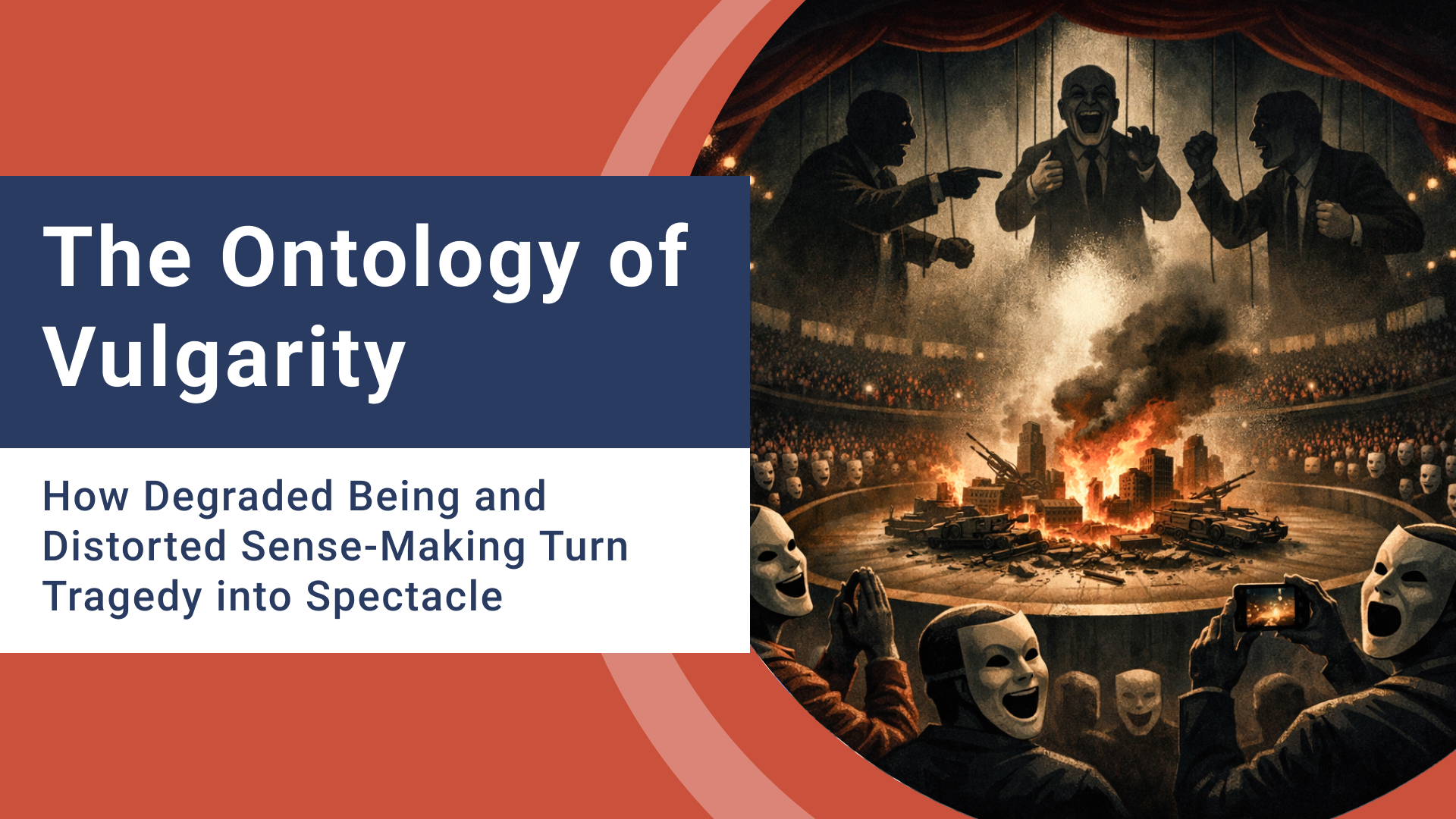
Events lose their depth and begin to appear primarily as spectacle. A complex geopolitical conflict is experienced not as a tragic and dangerous situation involving human lives, history, and responsibility, but as a sequence of emotionally charged moments to be reacted to, shared, and commented upon. Images of destruction circulate rapidly while reflection becomes secondary to immediate interpretation.
At the same time, reality is quickly compressed into narrative frames. Rather than examining events in their complexity, individuals are drawn toward simplified moral stories in which one side represents righteousness and the other embodies villainy. Once such narratives take hold, new information is rarely encountered with openness. It is instead filtered through pre-existing loyalties and ideological commitments.
A third feature of vulgar perception is the rise of performative outrage. Emotional displays become central to public engagement with events. Anger, ridicule, celebration, and indignation are not simply spontaneous reactions; they increasingly function as signals of group belonging. To react with restraint or uncertainty may even appear suspicious in environments where emotional intensity has become the currency of public discourse.
In such conditions, tragedy is gradually transformed. Events involving profound human suffering are no longer experienced primarily as occasions for grief, reflection, or ethical responsibility. They become moments within an ongoing narrative competition in which different groups struggle to assert the moral superiority of their position.
This phenomenological shift explains the strange tone observed in contemporary geopolitics. The same event may be treated as a moment of mourning by some, a strategic victory by others, and a symbolic spectacle by distant audiences who experience the conflict primarily through screens and commentary.
When vulgarity dominates perception in this way, the world begins to resemble a stage more than a shared human reality. Events are experienced less as matters demanding careful understanding and more as opportunities for reaction, positioning, and narrative reinforcement.
Vulgarity and the Crisis of Sense-Making
The phenomenon described above cannot be understood without examining its relationship with sense-making. Human beings do not encounter events in a purely neutral way. What we perceive is always shaped by the intellectual structures through which we interpret reality. In the Metacontent discourse, these structures include our cognitive maps, narratives, mental models, and paradigms. They form the intellectual substrate through which events are understood.
When these sense-making capacities weaken, the depth of interpretation begins to collapse. Complex events are no longer explored through inquiry or reflection. Instead, they are quickly absorbed into simplified explanatory frames that confirm pre-existing beliefs. Nuance becomes inconvenient, ambiguity becomes intolerable, and competing interpretations are treated as threats rather than invitations to understanding.
This is where vulgarity and distorted sense-making begin to reinforce one another. When individuals interpret reality through shallow narratives, events are stripped of their complexity and moral gravity. Human suffering becomes a tool within ideological argumentation. The world is no longer approached as something to be understood but as something to be categorised and judged as quickly as possible.
At the same time, vulgar discourse further erodes the capacity for serious sense-making. When public environments reward emotional reaction over careful reasoning, individuals gradually lose the patience required to examine complex realities. Simplified interpretations circulate faster, gain greater visibility, and become socially reinforced through repetition.
A reinforcing cycle, therefore, begins to emerge. Distorted sense-making produces vulgar interpretations of events, and vulgar discourse further degrades the intellectual capacities required for deeper understanding. Over time, this cycle begins to reshape public discourse itself, replacing inquiry with reaction and reflection with narrative alignment.
Within such an environment, the deeper structures of understanding described in the Metacontent framework become increasingly rare. Instead of moving from immediate perception toward more sophisticated layers of interpretation, societies become trapped at the most superficial level of response. Events are encountered only through the narrow frames of emotional reaction and ideological loyalty.
The result is not merely disagreement or political division. It is a gradual collapse in the very capacity through which societies make sense of the world.
Vulgarity and the Degradation of Being
The crisis described above does not arise from distorted sense-making alone. Beneath our intellectual interpretations lies something even more fundamental: our way of being. Human beings do not merely think about the world; we encounter it through the qualities of our character, our emotional posture, and the depth of awareness with which we engage reality.
Within the Being Framework, qualities such as awareness, humility, responsibility, courage, care, and integrity shape how reality appears to us. When these qualities are cultivated and embodied, individuals are capable of approaching events with depth, restraint, and ethical seriousness. Tragedy is encountered as tragedy. Complexity is recognised rather than denied. Human life retains its dignity even in the midst of conflict.
However, when these qualities remain underdeveloped or distorted, the way reality appears also changes. Shadows of Being, such as arrogance, resentment, indifference, insecurity, and performative righteousness, begin to dominate perception. Events are no longer encountered with openness or care but with defensiveness, hostility, or the desire for symbolic victory.
In such conditions, vulgarity emerges almost naturally. When resentment shapes perception, the suffering of opponents becomes a source of satisfaction. When arrogance dominates, complex realities are reduced to simplistic moral judgments. When insecurity seeks validation, public displays of outrage become a way to signal belonging and loyalty to a group.
Just as distorted sense-making feeds vulgar discourse, the degradation of Being reinforces the same pattern. Individuals who lack depth of awareness are more easily captured by simplified narratives. Those narratives in turn encourage further expressions of resentment, mockery, and dehumanisation.
The result is another reinforcing cycle. Unpolished Being produces vulgar perception and reaction. Vulgar environments then strengthen the shadows of Being that generated those reactions in the first place. Over time, this cycle spreads beyond individuals and begins to shape the tone of entire communities, institutions, and political cultures.
Seen through this lens, vulgarity is not simply a matter of communication style or political rhetoric. It reflects deeper disturbances in how individuals cultivate and embody their relationship with reality. When those disturbances become widespread, the effects extend far beyond language or behaviour. They begin to reshape the moral and psychological atmosphere of societies themselves.
The Collapse of Meaning
When vulgarity penetrates both sense-making and Being, the next consequence is not merely confusion or hostility. Something deeper begins to erode. Meaning itself starts to collapse.
Meaning does not arise automatically from events. It emerges through the way human beings interpret, value, and respond to what occurs in the world. It depends on our capacity to recognise significance, to hold space for tragedy, to distinguish between what is trivial and what carries profound human weight. When this capacity weakens, the connection between events and their moral or existential significance begins to dissolve.
In a vulgarised environment, events are stripped of their deeper context and reduced to immediate emotional triggers. A bombing, an assassination, or the killing of civilians may briefly provoke outrage or celebration, yet the response rarely develops into sustained reflection about human dignity, responsibility, or the long-term consequences of violence. Instead, the event quickly becomes absorbed into the endless circulation of commentary, reaction, and narrative reinforcement.
As this pattern repeats itself, the language of meaning remains visible but gradually loses its substance. Words such as justice, freedom, security, resistance, or civilisation continue to appear in public discourse, yet they are increasingly detached from the deeper moral realities they once attempted to express. These terms begin to function primarily as symbols of group identity rather than as invitations to careful ethical consideration.
When meaning collapses in this way, societies do not necessarily become silent about values. On the contrary, they often speak about values more frequently and with greater emotional intensity. Yet the relationship between those words and lived ethical responsibility becomes fragile. Moral language becomes easier to manipulate, easier to weaponise, and easier to empty of its original depth.
This collapse of meaning creates fertile ground for manipulation. When individuals no longer experience events through deeper layers of significance, they become more susceptible to narratives that offer quick emotional clarity. Simplified stories provide the illusion of understanding while bypassing the difficult work of confronting complex realities.
Over time, a paradox emerges. Public discourse becomes saturated with moral claims, yet genuine moral seriousness becomes increasingly rare. The world remains full of words about justice and humanity, but the experiential connection between those words and the dignity of human life begins to fade.
It is within this hollowed moral landscape that vulgarity thrives most easily.
The Civilisational Costs
When vulgarity spreads across public discourse, distorted sense-making, and degraded ways of being, its consequences do not remain confined to rhetoric or media culture. Over time, the effects begin to shape institutions, leadership, and the broader direction of societies.
One of the first casualties is trust. When public language becomes saturated with theatrical outrage, selective morality, and narrative manipulation, people gradually lose confidence that moral claims reflect genuine ethical commitment. Governments speak about justice while overlooking atrocities committed by allies. Movements speak about human dignity while celebrating the humiliation or death of their opponents. As these contradictions accumulate, moral language begins to sound hollow.
Another cost emerges in the erosion of seriousness in leadership. Leaders increasingly operate within environments where attention is driven by spectacle and emotional reaction. In such conditions, political communication begins to prioritise symbolic gestures, insults, and performative strength rather than careful judgement. Complex geopolitical realities are compressed into simplified narratives designed to energise domestic audiences rather than address the underlying causes of conflict.
This environment also creates fertile ground for propaganda and manipulation. When societies lose the patience required for deep sense-making, emotionally powerful narratives spread rapidly and face little resistance. Images and slogans travel faster than careful analysis. Public opinion becomes more volatile, reacting intensely to symbolic events while often ignoring deeper structural realities.
The consequences extend even further. Vulgarised discourse gradually normalises dehumanisation. When the suffering of others is routinely interpreted through ideological lenses, entire populations can be reduced to abstractions. Civilian casualties become statistics. Human tragedy becomes a strategic talking point. Over time, the moral imagination required to recognise the humanity of those outside one's own group begins to weaken.
At a civilisational level, this erosion of depth produces a fragile and reactive public sphere. Societies become increasingly polarised, not only in their political positions but in their capacity to engage with reality itself. Dialogue becomes difficult because participants inhabit entirely different narrative worlds. Institutions struggle to maintain legitimacy because trust has been weakened. Public discourse becomes louder yet increasingly less capable of producing genuine understanding.
In such an environment, the risk is not merely political instability but a gradual deterioration of the moral and intellectual capacities that sustain a healthy civilisation. When vulgarity becomes normalised, societies may continue to function on the surface, yet the deeper foundations of responsible judgement, ethical seriousness, and shared human meaning begin to erode.
Reclaiming Depth
If vulgarity is rooted in the degradation of sense-making and the erosion of Being, then its remedy cannot be found in calls for politeness, political correctness or superficial civility. Demanding better manners may change the tone of language temporarily, but it does little to address the deeper structures that produce vulgarity in the first place.
What must be restored is depth.
At the level of sense-making, this requires a renewed commitment to intellectual seriousness. Events must be approached with the patience required to examine complexity rather than immediately collapsing them into ideological narratives. It requires the willingness to question one's own assumptions, to recognise the limits of one's knowledge, and to remain open to interpretations that challenge one's existing worldview. Without this discipline, societies remain trapped in cycles of reactive interpretation where reality is continually simplified to fit pre-existing stories.
At the level of Being, the restoration of depth requires the cultivation of qualities that allow reality to appear in its full significance. Awareness enables individuals to perceive events beyond immediate emotional reaction. Humility allows one to recognise that complex realities cannot be reduced to simple moral certainties. Responsibility encourages restraint in the face of tragedy and discourages the impulse to treat human suffering as symbolic victory.
These qualities are not abstract virtues. They shape how reality itself appears to us. When awareness and humility are present, the suffering of others cannot easily be trivialised. When responsibility is embodied, political events cannot easily be reduced to theatre. The world regains its gravity.
Equally important is the restoration of meaning-making. Societies must recover the capacity to connect events with deeper ethical and human significance. This requires spaces for reflection, dialogue, and contemplation that stand in contrast to the constant pressure of immediate reaction. Without such spaces, meaning continues to erode, leaving behind only the noise of competing narratives.
The challenge is therefore not merely cultural or political. It is civilisational. A society that wishes to resist vulgarity must cultivate citizens capable of depth in perception, seriousness in judgement, and responsibility in action.
Only when these capacities are strengthened can reality begin to appear once again as something more than spectacle. Only then can public discourse recover the dignity required to engage with the complexity and gravity of the human condition.
Concluding Reflection: A Mirror Held to Our Time
The vulgarity increasingly visible in contemporary geopolitics is often interpreted as a failure of leadership, a by-product of polarisation, or the inevitable consequence of a media environment driven by attention and outrage. While these explanations capture part of the picture, they remain incomplete. What we are witnessing is not merely a breakdown in civility but a deeper disturbance in the relationship between human beings and reality itself.
When depth disappears from our ways of being and our processes of sense-making, the world begins to appear differently. Events that once demanded reflection are consumed as spectacle. Human suffering becomes a symbol within narrative battles. Moral language continues to circulate, yet its connection to genuine ethical seriousness weakens. In such conditions, vulgarity does not feel like a deviation. It begins to feel normal.
This is why the phenomenon cannot be dismissed as a temporary cultural trend or the excesses of political rivalry. It reveals something about the state of our civilisational posture. The tone with which societies respond to tragedy, conflict, and human loss reflects the depth or shallowness of their relationship with meaning itself.
Recognising this does not require moral superiority or ideological alignment. It requires the willingness to observe the atmosphere of our time with clarity. The celebrations of death, the theatrical displays of outrage, the reduction of complex human realities to slogans and spectacles, these are signals of a deeper erosion taking place beneath the surface of public life.
Whether this erosion continues or is gradually reversed depends not only on political structures but on the capacities cultivated within individuals and communities. The recovery of depth in Being, seriousness in sense-making, and responsibility in meaning-making is not merely a philosophical aspiration. It is a condition for preserving the dignity of public life itself.
A civilisation that loses its ability to encounter reality with depth risks turning even its most tragic moments into entertainment. A civilisation that restores that depth, however slowly, may still recover the seriousness required to face the complexities of the human condition.
Yet recognising the drift toward vulgarity should not lead us into despair or cynicism. Diagnosis is not a declaration of defeat. It is a reminder of responsibility. Systems do not float above us like distant machinery. They are built from our words, our reactions, our silences, and the small permissions we grant ourselves each day. What we call “the system” is, in truth, a vast mirror assembled from countless individual reflections.
When the tone of public life coarsens, it is tempting to imagine that vulgarity belongs to others: to regimes, to leaders, to political tribes somewhere far away. But vulgarity rarely arrives as a conquering army. It seeps quietly through the cracks of everyday perception. It enters when we allow tragedy to become entertainment, when we turn suffering into a talking point, when we reduce human lives to pieces on the chessboard of our preferred narratives. Civilisations do not lose their depth overnight. They lose it grain by grain, reaction by reaction, applause by applause.
Yet the reverse is also true. Just as vulgarity spreads through countless small acts of shallowness, depth spreads through countless acts of seriousness. Every time a person refuses to celebrate destruction, refuses to dehumanise an opponent, refuses to flatten a complex reality into a convenient slogan, a small boundary is restored around the dignity of human life. These gestures rarely make headlines. They do not trend, and they do not produce applause. But they are the quiet architecture upon which any enduring civilisation is built.
Humanity has always stood at this fragile intersection between spectacle and seriousness. The same species that fills arenas to watch destruction also writes poetry, builds institutions of justice, and risks its own safety to rescue strangers from rubble. Our history is not a straight line toward wisdom, nor a descent into barbarism. It is a continual struggle between the gravity of reality and the temptation to trivialise it.
If there is reason for optimism, it lies precisely here. Systems are not immovable monuments carved into the earth. They are living structures sustained by human choices. The atmosphere of our age, however loud and volatile it may appear, ultimately rests upon the integrity of individuals who refuse to surrender their depth of perception.
For when enough people insist on encountering reality with seriousness, the theatre begins to lose its audience. The spectacle dims. And the gravity of the human condition, fragile, difficult, and profoundly shared, quietly reasserts itself at the centre of our common life.