

When Silence Is No Longer Appropriate
This is not written in anger. It is written because silence is no longer appropriate. There are moments when restraint in speech is a virtue, and there are moments when restraint becomes a form of avoidance. This is not a reaction to a single statement, nor is it driven by allegiance to any side. It is a response to something that has become increasingly visible, something that can no longer be overlooked without consequence.
We are witnessing a shift in how power is spoken about and exercised. Words that carry the weight of destruction are being used with a disturbing ease, as though they refer to outcomes that can be contained, managed, or justified without remainder. When the language of obliteration becomes operational, when timelines are attached to devastation, and when such expressions are delivered with certainty rather than hesitation, something deeper than strategy is being revealed. This is not merely about what is being said. It is about what is no longer being held.
Disleadership and the Drift of Power
What is being revealed is not simply poor judgment or excessive rhetoric. It is a pattern that has been present for some time, now becoming harder to conceal. In earlier work, I referred to this as disleadership, not as a provocation, but as a necessary distinction. Disleadership is not the absence of leadership. It is the presence of authority without the depth, restraint, and responsibility that give leadership its legitimacy. It is what emerges when power is exercised without the capacity to hold its consequences.
In disleadership, language begins to drift. Words no longer serve understanding. They begin to prepare the ground for action that has already bypassed reflection. Force is framed as clarity. Escalation is presented as decisiveness. The complexity of human reality is reduced to something that can be acted upon without pause. What appears as strength is often the appearance of control in the absence of deeper coherence.
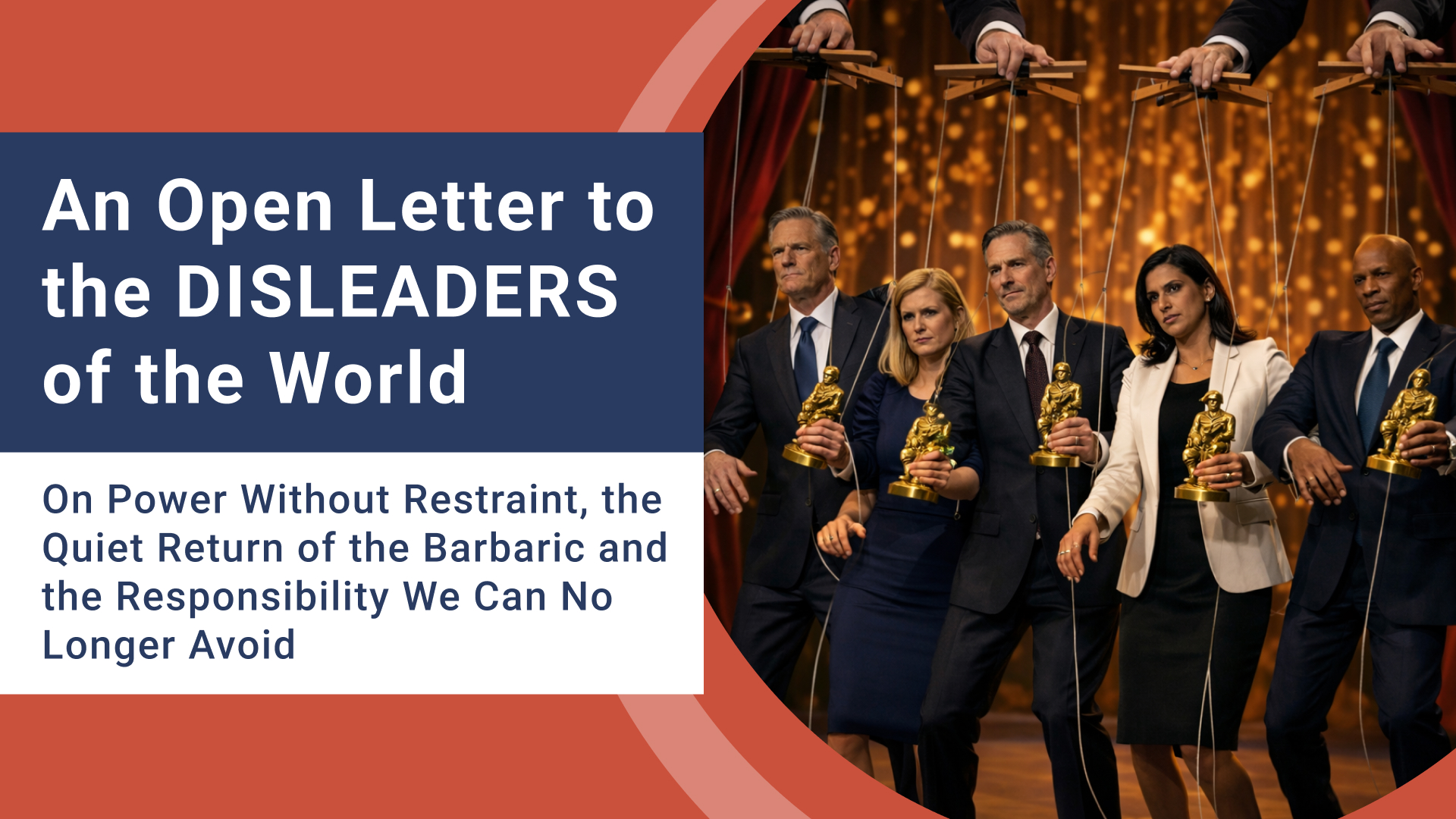
This pattern does not stand alone. It is sustained, often quietly, by those who justify it, normalise it, or choose not to confront it. Disleadership extends beyond those who speak from positions of power. It includes those who lend that power legitimacy through endorsement, rationalisation, or silence. In this way, what appears to be an isolated moment reveals itself as part of a much wider condition, one that reaches far beyond any single leader or event.
The Quiet Return of the Barbaric
We often imagine barbarism as something distant, something belonging to a less developed past, something we have already moved beyond. We associate it with disorder, with a lack of structure, with the absence of refinement. Yet what is emerging before us points to a different form altogether, one that is far more subtle and, for that reason, far more dangerous.
Barbaric is not the absence of sophistication. It is the absence of humanity in the presence of power. It is what remains when the ability to act is no longer matched by the willingness to fully hold the human weight of that action. It is the moment where destruction can be spoken of with clarity, planned with precision, and justified with language that gives the appearance of necessity, while the depth of what is being enacted is no longer truly faced.
This form of barbarism does not arrive as chaos. It arrives organised, articulated, and often defended. It does not reject systems. It operates through them. It does not lack intelligence. It functions with it. That is what makes it difficult to recognise, and even more difficult to challenge. The surface appears controlled, even rational, while something essential has already been lost beneath it.
To call this barbaric is not to insult. It is to name a condition in which the human dimension has receded from the exercise of power. And when that happens, no level of advancement, no strength of institution, and no sophistication of language can compensate for what is missing.
When Capacity Falls Behind Power
This condition does not emerge in isolation. It follows a pattern that is deeply human. When we are faced with complexity that exceeds our ability to process it, we rarely remain with it. We simplify. When uncertainty becomes difficult to hold, we move quickly toward certainty, even if that certainty is premature. And when neither simplification nor certainty can stabilise the situation, there is a tendency to reach for force, not because it is right, but because it is immediate.
In these moments, something essential is bypassed. The space required for reflection, for restraint, and for the full weight of consequence to be felt is shortened or removed altogether. Decisions become narrower. Language becomes sharper. Action becomes faster. What appears on the surface as decisiveness may, in fact, be the result of an inability to remain with what has not yet been understood.
This is not a failure of intelligence. It is a limitation of capacity. The ability to hold tension, to remain present with uncertainty, and to act without collapsing into reaction is not evenly developed. When that capacity is absent, power does not disappear. It continues to act, but without the depth required to guide it. And when power moves without that depth, the outcomes it produces begin to reflect that absence.
What we are witnessing is not only a matter of leadership. It is a reflection of how human beings, individually and collectively, respond when the demands of reality exceed the level of Being from which they are operating.
When Leadership Becomes Lumpen
What begins as disleadership does not remain abstract. Over time, it takes form. It becomes visible in a particular kind of figure, one that has appeared across different systems and moments in history. In earlier work, I described this as the lumpen leader, not as a caricature, but as an archetype that emerges when spectacle replaces stewardship and performance begins to stand in for responsibility.
The lumpen leader is not defined by a lack of authority. On the contrary, they often hold significant power. What distinguishes them is the way in which that power is carried. Audacity begins to replace competence. Certainty replaces careful thinking. Visibility becomes more important than depth. The projection of strength overtakes the discipline required to sustain it. Leadership is no longer oriented toward holding complexity or navigating consequence. It becomes oriented toward dominance, reaction, and the maintenance of image.
This is not a new phenomenon. It has been explored in more detail in the articulation of the lumpen leader as a recurring pattern within modern systems of power, where the signals of leadership remain intact while their substance quietly erodes. What we are now witnessing is not its emergence, but its normalisation.
In such figures, language becomes sharper, but not deeper. Decisions become faster, but not wiser. What appears as decisiveness may, in fact, be the absence of the capacity required to remain with what has not yet been understood. The signals of leadership remain, but their meaning begins to hollow out.
This is where the connection to the barbaric becomes clear. The lumpen leader is not primitive. They are often highly visible, articulate, and institutionally positioned. Yet within that visibility, the human weight of action begins to recede. The ability to speak of destruction, to justify it, and to proceed without pause is not a sign of strength. It is the expression of power that is no longer anchored in humanity.
And this archetype does not stand alone. It is sustained by systems that reward spectacle, by audiences that respond to certainty over depth, and by environments in which reflection is experienced as weakness. In this way, the rise of the lumpen leader is not an anomaly. It is a reflection of a broader condition, one in which the signals of leadership have been quietly replaced.
The danger is not that such leaders exist. It is that they begin to look familiar, and eventually, acceptable.
The Quiet Return of the Barbaric
We often imagine barbaric as something distant, something belonging to a less developed past, something we have already moved beyond. We associate it with disorder, with a lack of structure, with the absence of refinement. Yet what is emerging before us points to a different form altogether, one that is far more subtle and, for that reason, far more dangerous.
Barbaric is not the absence of sophistication. It is the absence of humanity in the presence of power. It is what remains when the ability to act is no longer matched by the willingness to fully hold the human weight of that action. It is the moment where destruction can be spoken of with clarity, planned with precision, and justified with language that gives the appearance of necessity, while the depth of what is being enacted is no longer truly faced.
This form of barbaric does not arrive as chaos. It arrives organised, articulated, and often defended. It does not reject systems. It operates through them. It does not lack intelligence. It functions with it. That is what makes it difficult to recognise, and even more difficult to challenge. The surface appears controlled, even rational, while something essential has already been lost beneath it.
To call this barbaric is not to insult. It is to name a condition in which the human dimension has receded from the exercise of power. And when that happens, no level of advancement, no strength of institution, and no sophistication of language can compensate for what is missing.
When Thinking Collapses
There is another pattern that must be named, because without it, what we are witnessing cannot be fully understood. It does not present itself as ignorance, nor as a lack of intelligence. It often appears in those who are informed, articulate, and confident in their positions. Yet something essential is missing. Not information, not language, but the capacity to remain with complexity long enough for understanding to take shape.
This is what I have previously described as ideocy.
Ideocy is not stupidity in the conventional sense. It is what happens when thinking collapses into reflex. The movement from perception to conclusion becomes immediate, bypassing the space where examination, structuring, and integration are meant to occur. The mind no longer engages with what is in front of it as something to be understood. It engages with it as something to be resolved. In this state, the goal is not coherence. It is closure.
Complexity becomes uncomfortable. Ambiguity becomes something to eliminate. Contradictions are not explored, but dismissed. And so the mind reaches for what is available rather than what is accurate. Labels take the place of analysis. Reaction takes the place of inquiry. Familiar narratives are imposed, not because they are true, but because they are ready.
This is why ideocy so often appears through dismissal. Words are used not to deepen understanding, but to end it. A label is applied, a position is taken, and the process stops there. What appears as certainty is often nothing more than the avoidance of engagement.
Speed plays a central role in this. The time between encountering something and forming a position on it becomes shorter and shorter. This immediacy is often mistaken for clarity. In reality, it reflects an inability to remain with what has not yet been resolved. Where genuine thinking requires time, tension, and the willingness to sit with not knowing, ideocy seeks immediate resolution. It cannot tolerate the unfinished.
This pattern does not belong to individuals alone. It is reinforced by the environments we operate within. Systems that reward reaction over reflection, visibility over depth, and certainty over understanding do not merely permit ideocy. They amplify it. Over time, the very signals of thinking become inverted. Those who pause appear uncertain. Those who react appear decisive.
The consequences are not abstract. At a personal level, it limits the ability to engage with reality in a meaningful way. At a collective level, it degrades discourse. Complex issues are flattened. Dialogue becomes performance. Disagreement no longer refines understanding. It hardens positions.
This is where its connection to what we are witnessing becomes clear. When thinking collapses, the space required for restraint collapses with it. When that space disappears, the threshold for action lowers. And when action is no longer held within that depth, it begins to take on a different character.
To name ideocy is not to condemn. It is to recognise a condition that, if left unexamined, will continue to shape how we see, how we decide, and how we act.
The Line That Cannot Be Crossed Unseen
There comes a point where restraint is no longer a matter of preference. It becomes the final remaining signal of civilisation. Not restraint as hesitation, and not restraint as weakness, but restraint as the capacity to recognise that what is at stake cannot be reduced to strategy alone. When that restraint is absent, something fundamental has already been compromised, regardless of how the situation is framed or justified.
To those who hold power, and to those who stand beside it, this is not a question of strength or victory. It is a question of what you are normalising in the very act of acting. Each decision you make does more than produce an outcome. It sets the standard by which future decisions will be made. And once the threshold for what can be said and done is lowered, it rarely returns to where it once was.
And to those who observe, interpret, and justify, this is not a distant matter. Silence, rationalisation, and selective attention do not sit outside the pattern. They participate in it. What is allowed to pass without reflection gradually becomes what is accepted, and what is accepted becomes what is repeated.
There are moments in history where the measure of a society is not found in its declarations, but in what it is willing to permit, excuse, or ignore. This is one of those moments.
What This Moment Will Reveal
History does not remember only what was done. It remembers the level of humanity from which it was done. It remembers whether power was exercised with awareness or without it, whether decisions were carried with the weight they demanded or reduced to something more convenient to execute. In this sense, the true record of an era is not written in outcomes alone, but in the quality of Being that shaped those outcomes.
There are moments that pass and are absorbed into the flow of time, and there are moments that define it. Moments where what is chosen becomes a reference point, not only for those directly involved, but for generations that follow. What is decided, what is justified, and what is allowed in such moments does not remain contained. It extends. It echoes. It becomes part of the structure through which future actions are understood and enacted.
This is not a call for perfection, nor is it an appeal to idealism. It is a reminder that the exercise of power, at any level, carries with it a responsibility that cannot be delegated or deferred. And when that responsibility is not met with the depth it requires, the consequences do not remain isolated to a single place or time.
This is one of those moments.
And what is chosen now will not only shape what happens next. It will reveal, with a clarity that cannot be undone, who we have been willing to become.
A Final Word
To those who hold power, you stand at a threshold that cannot be crossed without leaving a mark that time will not erase. You may speak in the language of strategy, of necessity, of control, but beneath every word lies a deeper question that cannot be silenced. Not what you can do, but what you are willing to become in the doing. Power does not reveal itself in moments of ease. It reveals itself in the choices made when restraint is possible, yet not chosen. You may command outcomes, but you do not command the meaning those outcomes will carry. That meaning will outlive you.
There are victories that diminish those who claim them. There are decisions that succeed in form and fail in essence. And there are moments, rare and irreversible, where what is done becomes a mirror that no future narrative can distort. This is such a moment. And in such moments, history does not ask for justification. It asks for measure.
And to those who are asked to carry out what is decided, to those whose bodies and lives are placed in the path of consequence, this must also be said. There are moments in a life that do not end when they are over. They return, quietly, in memory, in reflection, in the stillness that follows action. In those moments, what remains is not the command that was given, but the relationship you carry with what you have done.
You may not always choose the circumstances in which you act. But there is always a deeper line that only you can see, and only you can cross. No authority can walk that line for you. No justification can fully carry it on your behalf. And no outcome can undo the weight of what is known, once it is known.
To stand in such a position is not simple. It asks for more than obedience. It asks for a kind of awareness that does not disappear under pressure. Not to resist for the sake of resisting, but not to surrender what cannot be restored once it is given away. Because there are actions that pass, and there are actions that remain. And the difference between them is not always decided in the moment they are carried out, but in the life that follows.
And to those who do not stand in positions of power, do not mistake your place in this for distance. The tone of an era is not set by leaders alone. It is sustained, resisted, or transformed by the many. Every act of attention, every refusal to collapse into certainty, every willingness to remain with what is difficult to hold, preserves something that cannot be manufactured once lost.
You are not powerless in the face of what unfolds. The standard you accept becomes the standard that remains. The depth you bring to how you see, how you speak, and how you respond shapes the space within which power operates. Where reflection is maintained, something human remains possible.
The future is not only written in decisions. It is written in the level of Being from which those decisions are made.