

When pressure sharpens, and when it doesn’t
I was a night-before person at school. An essay could sit around for weeks without attracting anything resembling urgency and then, as the deadline became unavoidable, suddenly acquire my complete attention. Perhaps you know the phenomenon. The exam that finally gets studied for when there are no days left to waste, the presentation that somehow comes together the night before, or the piece of work that has occupied a line on the to-do list for three weeks and is suddenly completed in three hours because tomorrow has arrived.
We often tell these stories as evidence that we work well under pressure, and sometimes we do. Pressure can concentrate attention, mobilise energy and strip away competing priorities. The approaching board meeting gets the paper written. The crisis clears the diary. Friday becomes wonderfully clarifying when Friday is no longer negotiable. There is nothing inherently wrong with pressure, and leadership would be a strange career choice for anyone hoping to avoid it entirely.
The difficulty is that we can turn this occasional human capacity into something approaching a performance paradigm. If pressure helped me produce the essay, perhaps more pressure will make me perform even better. If I have repeatedly demonstrated that I can carry a great deal, my capacity to do so can become part of my professional identity. The bigger the role, the more people, money, risk, ambiguity and consequence I am expected to absorb. Being able to handle pressure becomes part of what competence looks like.
There is a difference between pressure focusing our attention and pressure imprisoning it. The quality of our attention can change somewhere between too little demand to mobilise us and more demand than we can effectively hold. We may still be concentrating extraordinarily hard, perhaps harder than ever, but the field within which that attention can move has narrowed. The question is whether we notice when we cross that line.
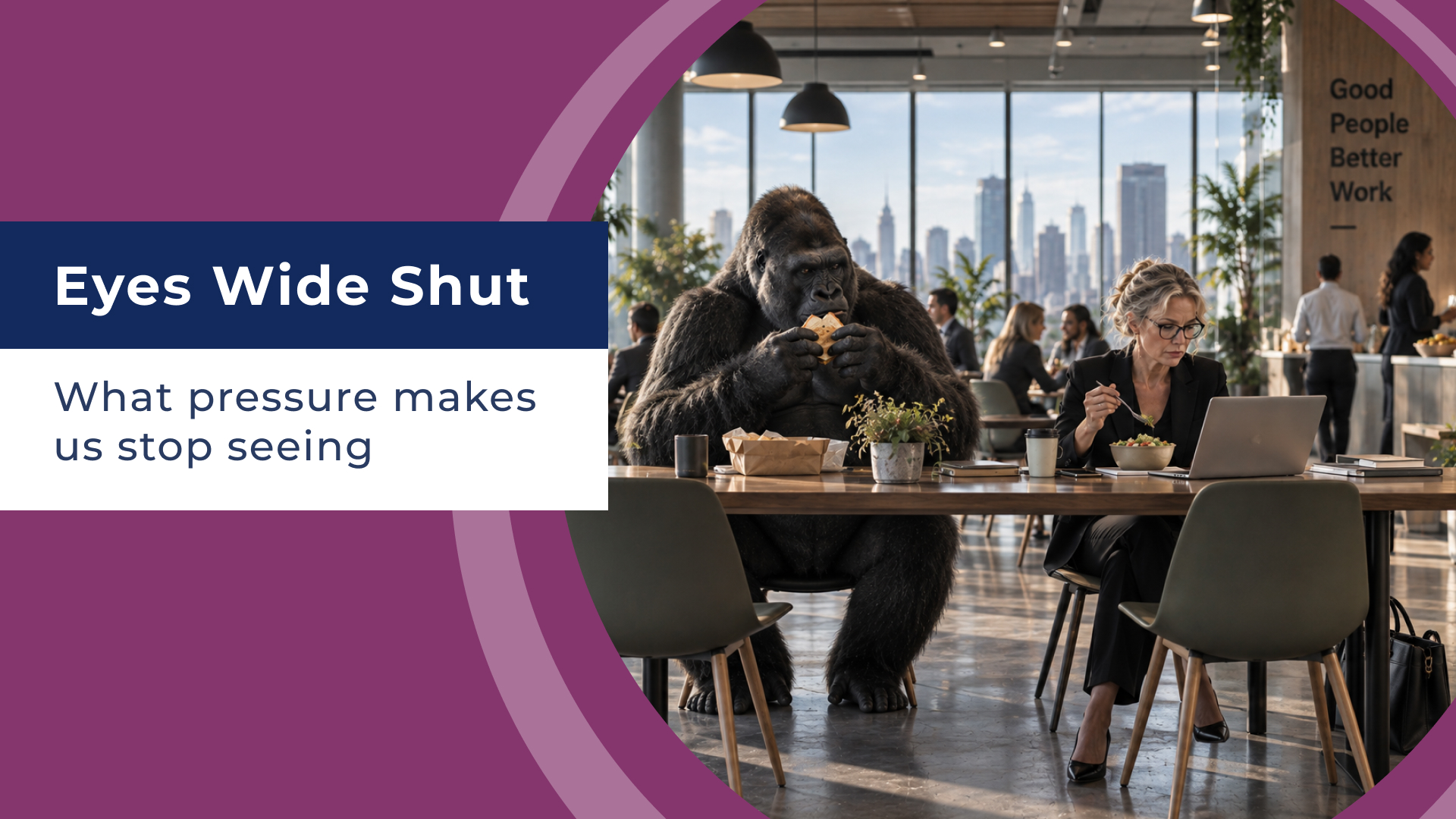
There is a famous demonstration of selective attention involving people passing basketballs. Viewers are asked to concentrate on the action and count the number of passes made by one group. While they are doing so, a person dressed as a gorilla walks directly through the middle of the scene. The gorilla is not hidden, yet many people concentrating on the assigned task fail to notice it.
I know because I was one of them. It took me three viewings before I saw the gorilla, and once you have seen it, missing it seems almost impossible. But that is precisely what makes the demonstration so compelling. My eyes were open. Nothing obstructed my view. I wasn’t distracted or failing to concentrate; the opposite was true. I was concentrating so hard on the thing I had been told to attend to that something enormous failed to enter my awareness.
Sometimes we miss what matters not because we aren’t paying attention, but because we are paying too much attention to something else. Put that inside an organisation and the implications become more interesting. A leader can be intensely focused on a target, a deadline, a failing programme or an approaching board meeting while something else changes in plain sight. Someone says something whose significance doesn’t quite register. A reliable person becomes unusually quiet. A relationship begins to deteriorate. Information that doesn’t fit the immediate priority is heard but not absorbed. The leader’s attention isn’t wandering. It may simply have become too narrow to accommodate anything else. The gorilla doesn’t need to be hidden for us not to see it. Sometimes we are simply counting the passes.
What does pressure do to you?
This is where fear and anxiety enter the performance equation. Ashkan Tashvir makes a useful distinction in Human Being: fear has an object, something particular that we perceive as a danger or threat, while anxiety is more anticipatory, associated with uncertainty, perceived risk and what might happen next. Neither needs to disappear for us to function well. What matters is our capacity to experience them while remaining able to discern what is happening and take appropriate action.
Now place that inside a senior leadership role. Something may already be wrong: the programme is failing, the numbers aren’t where they should be, a critical person might leave or confidence in the work is slipping. Anxiety quickly supplies the possible futures. The target might be missed. More people could leave. The board might lose confidence. The issue could become public. Meanwhile, the actual job has not gone anywhere. People still need decisions, resources need managing, performance needs attention and the team needs enough confidence to continue functioning.
We call this “a lot of pressure”, but that benign phrase can disguise the experience of the human being inside it. Fear draws attention towards perceived threats. Anxiety expands the range of possible threats. Responsibility keeps demanding action in the present. Eventually the issue is not simply how much work there is to do, but what happens to you while you are trying to do it.
Think about yourself under real pressure, not ordinary busyness but the kind where something consequential feels uncertain and several people need something from you at once. What happens to you? Fight, flight and freeze have become so embedded in popular language that it is easy to glide past what they can look like in capable, high-functioning adults. Senior leaders rarely have the luxury of visibly running away or becoming completely immobile. They still have to turn up on Monday morning.
Does fight feel familiar to you? Pressure makes you faster, more decisive and more controlling. You shorten timeframes, ask for more information, intervene more quickly and take decisions back from others. Complexity begins to feel like obstruction. You may experience yourself as lifting the pace and restoring clarity while the people around you experience something closer to don’t bring me anything that slows this down. The response may work for a while; sometimes decisive intervention is exactly what is needed. The risk is not fight itself, but failing to notice when urgency has begun determining what you are willing or able to hear.
Maybe you take flight, although nobody watching would describe it that way. You become extraordinarily productive. The diary fills, emails disappear, operational problems get solved and you work later or start earlier. Familiar activity offers something uncertainty cannot: the reassuring experience of competence. If I don’t know how to repair a deteriorating executive relationship, I can certainly clear forty emails. If the strategic decision feels impossibly consequential, there are plenty of operational problems whose answers I already know. Activity can become somewhere to go when the thing that frightens us feels too difficult to approach directly.
Or perhaps you recognise freeze, which may be the most difficult response to recognise in high-functioning people because it rarely looks like doing nothing. You continue attending meetings, answering emails, producing papers, approving expenditure and talking to people. You may be working harder than anyone around you. Around one consequential thing, however, movement has stopped. The conversation doesn’t happen. The decision remains open. Another piece of information is requested, even though nobody is quite sure what information would finally be enough.
This is what I think of as highly functional freeze: working harder than ever while becoming progressively less able to approach the thing that most requires our attention. There can even be a peculiar comfort in leaving something unresolved. A decision we haven’t made remains open. A conversation we haven’t had hasn’t yet changed the relationship. A choice we haven’t made still contains several possible futures. Uncertainty is uncomfortable, but after a while it is also familiar, and familiar discomfort can sometimes feel safer than unfamiliar consequence.
Most of us probably don’t belong neatly to one response. Under enough pressure we can move between all three, controlling what we can, escaping into what we know and stalling around what we cannot resolve. The unresolved thing then becomes more consequential because time has passed, increasing the pressure and sending us around again. From the outside this can look like poor prioritisation, indecision or excessive control. From the inside it can feel like trying to keep twenty balls in the air while somebody keeps throwing us more.
So rather than asking which type you are, there may be a more useful question: where do you go when pressure begins to exceed your capacity to hold uncertainty? Do you tighten your grip, disappear into activity or become strangely motionless around the very thing that matters? What happens to the breadth of your attention as you do?
Throughout all of this, you may remain convinced you are seeing perfectly well. You are reading the papers, watching the numbers, attending the meetings and asking the questions. You are still counting every pass. The problem is not that you have stopped functioning. It is that pressure may have changed what functioning allows you to see.
The pressure we transmit
For leaders, that matters for another reason. Pressure doesn’t remain neatly contained inside the person experiencing it. Our responses to pressure alter the environment around us, and our attention teaches other people what is safe, useful and worthwhile to bring to us.
If I fight, you learn quickly whether challenge will be experienced as useful information or resistance. If I take flight into activity, you may discover that I am available for almost anything except the thing we actually need to discuss. If I freeze around a decision, an entire system can begin organising itself around my inability to make it. People wait, develop workarounds, postpone their own decisions or expend energy trying to predict what I will eventually do.
None of this requires a leader to shout, panic or visibly unravel. In fact, the more senior and capable we become, the more sophisticated our pressure responses can look. Control can resemble rigour. Flight can resemble extraordinary productivity. Freeze can resemble appropriate caution. Our coping strategies often wear the clothes of our competence, which is precisely what can make them difficult for us to recognise.
There is another, more literal dimension to this question of seeing. Consultants often talk about the importance of being visible: you have to be in front of people, walking around town, having conversations, reminding people through your presence that you exist and might be able to help. But visibility works in both directions. Being where people can see us also puts us where we can see them. The unplanned conversation, the hesitation after a meeting, the person who catches us on the way out, the thing somebody mentions over coffee because we happened to be there: much of what matters in human systems is discovered through encounters we could not have scheduled because we did not know in advance what there was to discover.
Pressure can quietly remove those encounters. We become efficient. We move from meeting to meeting, close the office door, shorten the conversation, eat lunch at the laptop and protect the blocks of time required to get things done. All entirely understandable. But in becoming more efficient with our attention, we may also reduce our exposure to the peripheral information from which understanding often comes. We cannot notice what we are no longer present to see.
Attention, then, is relational. If you come into my office to tell me something and sense that my attention is elsewhere, you adjust. You shorten what you were going to say, decide it can wait or perhaps don’t return. If you introduce complexity into a meeting and it barely registers because everyone is focused on the deadline, you learn something about what is currently hearable. These small adjustments accumulate. People become more selective about what they bring, when they bring it and how much of the truth they think the system can tolerate.
This is one of the ways individual pressure becomes a human-systems problem. The organisation begins adapting around the leader’s field of attention. Information is simplified. Difficult messages arrive later. People solve around bottlenecks or stop raising things they have learned will not receive attention. Eventually the leader may genuinely not know what they are missing, because the people around them have become increasingly skilled at not bringing it.
There is an uncomfortable paradox here. The harder I focus on performance, the more I may inadvertently create conditions that deprive me of information necessary for performance. If my anxiety about delivery produces more urgency and control, people may become more cautious about introducing inconvenient information. I receive a cleaner picture, become reassured that my increased focus is working and concentrate harder. The spreadsheet may look increasingly orderly while the human system producing the numbers becomes progressively harder to see.
This is why support, trust, communication and psychological safety matter under pressure, not simply because they make work more pleasant, but because they help preserve the flow of information when the stakes are high. A leader who can remain available to information that complicates the picture is not being less performance-focused. They may be protecting the organisation’s capacity to perceive reality while there is still time to respond to it.
Perhaps that gives us another way of examining our own pressure response. It is worth asking not only What does pressure do to me?, but What does my pressure teach other people to do around me? What gets louder when I am under strain, and what gets quieter? Who comes closer, who withdraws and what information has become harder to bring into the room? The gorilla, in other words, is no longer simply something I fail to notice. Under enough pressure, I can inadvertently create a system that learns to keep gorillas outside my field of vision.
Eyes wide shut
Perhaps, then, the most useful challenge to “I work better under pressure” isn’t to declare it wrong. Maybe you do. Pressure can mobilise us, deadlines can focus us and human beings are capable of extraordinary things when circumstances demand them. The aim isn’t to remove pressure from leadership, which would be neither possible nor particularly desirable. The question is what happens to our field of vision as the pressure rises.
At what point does useful focus imprison our attention? When does urgency become fight, productive activity become flight, or appropriate caution become a highly functional freeze? When does our ability to concentrate on what matters begin diminishing our capacity to perceive what else matters? The threshold is unlikely to announce itself neatly. There may be no collapse, dramatic breakdown or moment when someone says, “I can no longer cope.” A leader can remain highly functional, highly regarded and extraordinarily busy while their field of attention is getting smaller.
Awareness matters before crisis does. We can notice when interruption becomes unusually irritating, when the same consequential issue keeps circling without movement, or when our attention repeatedly retreats towards familiar territory. We can notice when people appear to be saying things we are only half hearing, when our calendar is overflowing but the conversation that matters most is still absent, or when someone close to us finally says that they have been trying to tell us something for weeks. These are not necessarily signs that we cannot handle pressure. They may be signs that pressure is changing how we handle reality.
This may be the leadership work underneath performance under pressure: not becoming infinitely capable of absorbing more, but recognising what pressure does to our attention before our attention becomes the thing that limits us. Sometimes seeing more requires concentrating harder. Sometimes it requires looking up. We need enough awareness to recognise our own patterns while we are inside them, and enough openness to notice when our version of reality may have become narrower than the one other people are trying to show us.
The basketball experiment has stayed with me because I did not miss the gorilla through carelessness. I missed it while concentrating. My eyes were open. I was paying attention. I was doing exactly what I had been asked to do. Something enormous still walked straight past me.
So the next time you find yourself carrying a great deal, perhaps the question is not only How much pressure am I under? or How well am I coping with it? Ask something harder: What might be right in front of me that pressure is making me unable to see?
Sometimes the greatest risk to performance is not that we stop looking. It is that we keep looking, working, concentrating and performing, while our field of vision grows smaller around us. Eyes wide shut.
Dr Jordan Marijana Alexander is an executive advisor, human systems strategist and writer exploring how identity, place, culture and living systems shape participation in the modern world. She works alongside leaders, boards and organisations navigating complex questions of leadership, change and participation, and is the co-founder of RelateAble.Global. If this article has raised questions, sparked reflection or highlighted a decision you’re carrying, you’re invited to book a confidential conversation. You can follow DrJMA on LinkedIn and Engenesis for ongoing essays, reflections and research exploring leadership, identity, belonging and participation.