

The auction
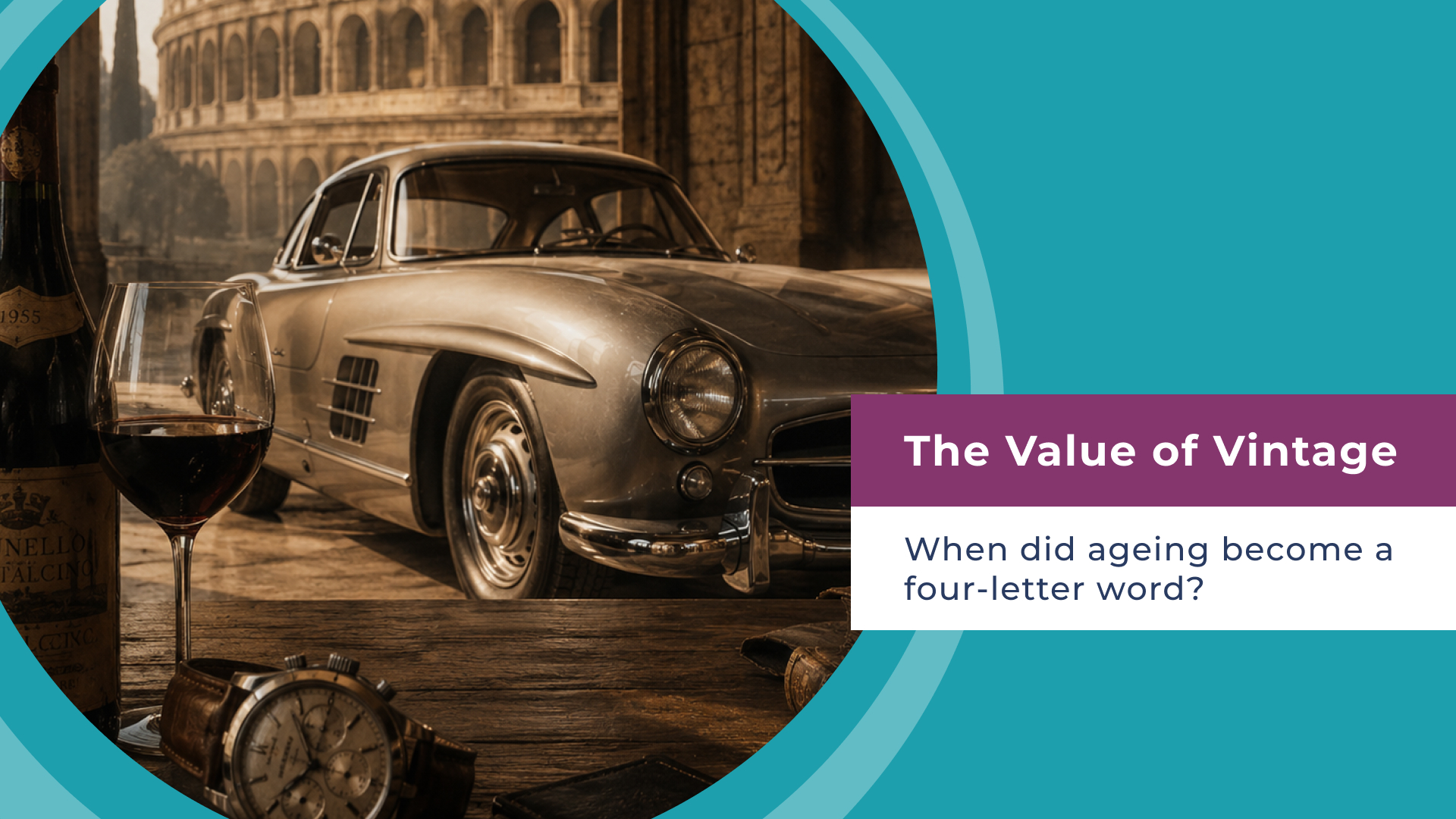
In 2022, someone paid US$143 million for a 1955 Mercedes-Benz 300 SLR Uhlenhaut Coupé. Not bad for a car approaching seventy. For that price, its new owner could have bought a fleet of extraordinarily good modern cars, each safer, more efficient and considerably easier to find parts for. But nobody bidding on the Mercedes was confused about what they were buying. Its age wasn’t a defect to overlook; it was part of its value, alongside its rarity, craftsmanship, provenance, history and the extraordinary fact that it had survived.
We understand this perfectly well when it comes to things. We admire the patina on old furniture and the craftsmanship of antique watches. We cellar certain wines precisely because we expect time to do something interesting to them. We travel across continents to stand in front of paintings and buildings created hundreds, sometimes thousands, of years before we were born. On my last visit to Rome, I stood once again beneath the Colosseum. Almost two thousand years old, partially ruined and spectacularly inefficient by contemporary building standards, it still draws millions of people each year. Nobody stands before it and suggests it might be time to replace it with something more modern. Its age is part of what draws us there.
Of course, age alone doesn’t make something valuable. Nobody from Sotheby’s has shown any interest in my old gutters. A broken window doesn’t become more desirable because nobody got around to replacing it for forty years, and leave a cheap bottle of wine in the cupboard for long enough and you may simply acquire a very old bottle of cheap wine. Vintage is not the same thing as old. What time adds matters, but so does what was there to begin with, what has happened since and what remains. The distinction becomes more interesting when we turn from objects to people. We have developed remarkably sophisticated ways of recognising what time can add to a car, painting or building. We seem considerably less certain about what time adds to a human being.
I first began to understand this many years ago through a woman I worked with. She was my PA, excellent at her job and enormously capable, and she was approaching her fiftieth birthday. I was in my thirties. One day she said something about turning fifty and what it might mean for her career prospects. If she needed another job, she worried her options would be narrowing. I remember scoffing, not at her, but at the idea. Don’t be ridiculous. You’re fabulous. Anyone would be lucky to have you. I meant it. From where I stood in my thirties, her concern made absolutely no sense. I could see everything she had accumulated: competence, judgement, reliability, relationships and knowledge. Why would any of that suddenly become worth less simply because the number attached to her age had changed?
I understand that conversation differently now. She wasn’t questioning her value at all. She understood something about how the world might value it that I hadn’t yet lived long enough to see. Why does age increase the value of some things and diminish the perceived value of others?
A safe pair of hands
My PA, it turns out, wasn’t imagining it. Age discrimination can be difficult to see. It can arrive disguised in more acceptable language: overqualified, not quite the right fit, looking for someone with more energy, concerned about adaptability. For women, age can intersect with gender in particularly complicated ways. What I saw in my colleague was everything she had accumulated. What she could already see was that the very thing that had allowed her to accumulate it—time—might eventually count against her.
There is something peculiar about this because, for much of our working lives, we are told that experience matters. So we accumulate it. We acquire qualifications, take on difficult assignments, learn industries and organisations, make mistakes and recover from them. Hopefully, we become better at recognising what matters and what merely looks important. Yet somewhere along the line, the asset can begin to depreciate. Experience becomes set in your ways. Confidence becomes too senior. Institutional memory becomes old school. Expertise can acquire an expiry date when the person carrying it no longer resembles our image of the future.
This is becoming a rather consequential contradiction. In 2024, there were around 830 million people aged 65 and over worldwide; by 2054, the United Nations projects there will be approximately 1.7 billion. We can describe this entirely in the familiar language of ageing populations, dependency ratios, pensions, healthcare costs and workforce participation, all of which are real concerns. There is another way to look at precisely the same demographic shift: we may also be living through one of the greatest accumulations of human experience in history.
The human population itself is becoming vintage.
The question is what we do with it. I caught a glimpse of this during COVID, when I was working in and around New Zealand’s public-service response. Suddenly we were facing circumstances for which nobody had a reliable playbook. Decisions had to be made quickly, consequences were enormous and much of what we thought we knew about how organisations operated was being rewritten in real time. Yet amid all that novelty, I noticed something fascinating: we started calling some of the old hands back. Former chief executives, seasoned public servants, people who had been around the machinery of government for decades. We describe these individuals with that wonderfully unglamorous expression: a safe pair of hands.
These people didn’t have thirty years’ experience managing COVID. Nobody did. So what exactly were we calling them back for? I don’t think it was answers. It was judgement: pattern recognition, proportion, relationships, the capacity to distinguish signal from noise, knowing when something required immediate action and when everybody might benefit from ten minutes to think. Perhaps, above all, it was calm. We weren’t calling them back because they knew what would happen. We were calling them back because they knew how to be when nobody knew what would happen.
This may be one of the less visible gifts of experience. Someone who has lived through enough crises knows that the first version of events is rarely the whole story, that apparently immovable positions can soften overnight, and that frightened people sometimes sound angry. They may have learned that the loudest problem isn’t necessarily the most important one and that a room becoming louder is rarely improved by adding another loud voice. Experience does not make the unprecedented precedented, but it can give us a larger internal library against which to make sense of what is unfolding. Sometimes what that library gives us isn’t an answer at all, but proportion.
Experience has a shadow side. This is where the vintage analogy becomes layered. The patterns that allow us to recognise what we have seen before can also prevent us from seeing what is genuinely new. I’ve seen this before is useful right up until the moment we haven’t. Experience can create perspective, but it can also create rigidity. Thirty years of experience can represent thirty years of learning or, as the old observation goes, the same year repeated thirty times. Which is why age itself tells us surprisingly little. Some things improve with time, while others deteriorate. Some simply get older. Human beings are no exception. Time alone does not turn an ordinary object into an antique any more than birthdays automatically turn experience into wisdom.
Becoming an elder
If birthdays don’t automatically turn experience into wisdom, what does? Chip Conley offers one contemporary answer. He was 52 when, after decades in hospitality, he joined Airbnb and found himself working alongside founders and colleagues considerably younger than him. He brought experience they didn’t have while they brought technological fluency. Conley described himself as a “modern elder”, an idea he explores in Wisdom at Work—someone who can be both mentor and intern, able to offer what he knew without pretending there was nothing left for him to learn. I like that idea because it challenges two rather unhelpful versions of ageing. In one, the older person becomes the font of wisdom, dispensing lessons accumulated over decades to grateful younger recipients. In the other, the older person tries desperately to remain relevant by demonstrating that they can still keep up. Neither leaves much room for genuine exchange. Perhaps wisdom begins in being able to recognise the value of what we know without becoming threatened by what we don’t.
Growing up, I remember being told to respect your elders. It wasn’t really presented as a suggestion. On both the Croatian and Ukrainian sides of my family, being older carried a standing of its own. Nobody asked for evidence that an elder had lived an exemplary life, built a successful business or kept sufficiently abreast of contemporary thinking. My Babushka didn’t need to prove her relevance before her life experience was accorded value. The years themselves were evidence that she had seen and carried things I had not. They were older. You were younger. Respect followed. Full stop.
I sometimes say respect your elders to my own children now and receive the kind of sideways look that tells me the cultural transmission may not have been entirely successful. Their instinct is much more contemporary and individualistic: Why? What has someone done to earn my respect? And, to be fair, there is something important in that challenge. Age does not make someone right, kind, insightful or wise. History gives us plenty of reasons to be wary of authority granted simply because someone has occupied the earth for longer. I wonder whether something has been lost in the exchange. In challenging the idea that older people should automatically command authority, have we also weakened the idea that growing older carries a particular social role? Perhaps we have become less certain about what an elder is for.
Te Ao Māori (the Māori worldview) offers a deeper conception of eldership. Kaumātua (elders) have traditionally held important responsibilities within whānau (families and extended family networks), hapū (kinship groups) and iwi as carriers of whakapapa and knowledge, guardians of tikanga (customs and cultural practices), leaders, teachers and nurturers of younger generations. Age matters, but chronological age alone does not create the role. There must also be knowledge, relationship, responsibility and something worth passing on. The distinction suggests that becoming older and becoming an elder are not quite the same thing. Older is something that happens to us. Wisdom is something we may develop. Eldership is something we practise in relationship with others. An elder isn’t simply someone who has been here longer. There is something being carried, cared for and interpreted, and there are others for whom that accumulated knowledge might matter.
A whakataukī (proverb) associated with kaumātua captures one dimension of this beautifully: Ka haere mātātahi ka noho mātāpūputu — “Youth rushes in where age deliberates.” I don’t read that as an argument that youth is foolish and age inherently wise. We need both. We need people willing to rush towards possibilities the rest of us have learned to dismiss, and people who have lived long enough to wonder what happens next. The older ‘safe pair of hands’ in the COVID team sat next to the younger social media stars translating clear messages to the public. Healthy human systems create enough relationships between generations for one to provoke, temper and strengthen the other.
The idea also makes me think differently about the people I have encountered throughout my own life. Who were my elders? Not simply the oldest people I knew, nor necessarily the most successful. I think of people whose presence somehow enlarged my view. People who could offer perspective without needing me to agree with them, who carried stories I would otherwise never have known, or who seemed less interested in demonstrating what they knew than in helping me discover what I might know for myself. Some were older. Some weren’t particularly old at all.
As I approach a different season of my own life, the question has begun to turn around. It is no longer only who are my elders? It is also: for whom might I eventually become one? What have I learned that is worth carrying forward? What have I mistaken for wisdom simply because I’ve believed it for a long time? What might I need to relinquish so that experience remains useful rather than becoming a defence against change? Perhaps those are questions worth asking long before anyone regards us as old.
A few years ago, I found myself talking to a stonemason in a Wellington bar. Our conversation drifted towards older buildings, and he began pointing out details I had walked past hundreds of times without really seeing: hand-carved stone, ornate plaster ceilings, decorative scotias, craftsmanship tucked quietly into corners. He told me he was “one of the last” practising particular techniques that had once been commonplace. There is something haunting about knowledge disappearing before we have realised it is endangered. We tend to imagine knowledge as information, which makes us believe it can always be captured: write the manual, record the process, upload the files. Some of it can. But knowing how to do something isn’t always the same as knowing when. A recipe can record the ingredients without capturing the hand that knows from touch whether the dough needs more flour. A policy file can preserve a decision without preserving the relationships and judgement that made it possible. Some knowledge is documented. Some knowledge is carried.
I’m not suggesting we preserve everything simply because it is old. Some traditions deserve to disappear. Some accumulated experience is little more than accumulated prejudice, and “we’ve always done it this way” can be wisdom or nonsense. The task isn’t to preserve the past. It is to know what the past contains that the future might need. Perhaps that is one of the responsibilities of an elder: not guarding the old world from change, but helping the next one inherit what is worth carrying.
There is another reason I think becoming an elder has become complicated. For all our fascination with vintage, we seem remarkably uncomfortable with the evidence of time on ourselves. We admire weathered stone, the grain in old timber and the rings of a tree. We pay more for the right patina on leather. I’ve written elsewhere about our curious relationship with stretch marks and the way we celebrate nature’s markings almost everywhere except on our own bodies. Wrinkles and grey hair are seldom celebrated.
I rather like Helen Mirren’s refusal to embrace the language of “ageing gracefully”. Now in her eighties, she has also questioned that peculiar compliment of being told someone looks good for their age. The qualifier gives the game away. Why should looking younger be the measure of whether we are ageing successfully? There is nothing wrong with wanting to look good, feel strong, remain curious or reinvent ourselves, but I wonder about our favourite reassurance that sixty is the new forty. Perhaps it is. But what, exactly, was wrong with sixty?
Maybe we need better vintage role models. Not people who astonish us because they somehow manage not to look their age, but people who show us interesting ways of being their age. Anthony Hopkins interests me for that reason. At 88, after one of the most celebrated acting careers of his generation, he is releasing his first album as a composer, drawing on music written across decades. What appeals to me isn’t the familiar story of an elderly man heroically refusing to retire. It is that he is still becoming. His contribution has not ended, nor does it have to remain in the form for which the world already knows him.
Becoming an elder doesn’t require becoming less alive, ambitious, adventurous or interested in what comes next. Nor does it require pretending that age brings no losses or limitations. It asks something subtler: whether we can inhabit the years we have accumulated rather than continually trying to disown them, carrying forward what is useful, remaining open to what is new and allowing our contribution to change shape. Which leaves me with a question I hadn’t expected when I began thinking about vintage cars: if everyone is trying to stay young, who is becoming an elder?
What turns experience into wisdom?
I am no longer convinced by the reassurance that age is “just a number”. Of course a number cannot tell us whether someone is curious, capable, relevant, wise or anything else worth knowing about them. But age represents something real. It represents time, and time matters.
Time changes us. It changes our bodies and our relationships, brings beginnings and endings, closes some possibilities and opens others. It gives us enough distance to laugh at things that once seemed catastrophic and enough experience, if we are paying attention, to recognise patterns when they appear again. It introduces us to consequences, including those of our own decisions. It gives us opportunities to discover that we were wrong, that other people see the world differently, and that some of the things we once knew with absolute certainty were considerably more complicated than we imagined.
None of that guarantees wisdom. We can accumulate experiences without examining them, repeat the same patterns for decades and become more certain rather than more discerning. Perhaps what turns experience into wisdom is not simply having lived, but having remained sufficiently awake to what living has been teaching us. Reflection, curiosity and humility matter, as does the willingness to let new knowledge alter old conclusions rather than using experience to defend them.
Maybe there is another ingredient too. Much of what we call wisdom seems to acquire its fullest value when it becomes available beyond ourselves. The lesson learned the hard way that allows someone else to avoid the same mistake. The story that keeps a piece of family or cultural history alive. The craft passed from one pair of hands to another. The leader whose accumulated judgement creates space for somebody younger to take a risk. The elder who can offer perspective without requiring the next generation to reproduce their choices.
Wisdom may be what we learn to see because of experience. Eldership is what becomes possible when what we have learned no longer needs to belong only to us. Which raises a more personal question: who makes you want to grow older well? And eventually, what might it mean to become that person for someone else? Not an oracle, someone with all the answers, or the person insisting they should be listened to simply because they have been around longer. An elder in the more demanding sense: someone still learning and still contributing, carrying what is worth carrying and increasingly willing to give away what it took a lifetime to learn.
Which takes us back to that US$143 million Mercedes. We know that not everything old is valuable. Time alone does not turn an ordinary object into an antique, any more than birthdays automatically turn experience into wisdom. Value emerges from something more complicated: what something has survived, the story it carries, the craftsmanship embedded within it, its rarity, its provenance and what it can still contribute. Humans aren’t so different.
The question isn’t how to stay young enough to remain relevant. It is what we are doing with everything it has taken us a lifetime to learn. Ageing asks us neither to deny the years nor assume they have automatically made us wiser. It asks us to become increasingly intentional about what we are making of them.
The value of vintage was never age itself. It is what becomes possible with time.
Dr Jordan Marijana Alexander is a writer, executive advisor and human systems strategist exploring how identity, place, culture and living systems shape participation in the modern world. She works alongside leaders, boards and organisations navigating complex questions of leadership, change and participation, and is the co-founder of RelateAble.Global. If this article has raised questions, sparked reflection or highlighted a decision you’re carrying, you’re invited to book a confidential conversation. You can follow DrJMA on LinkedIn and Engenesis for ongoing essays, reflections and research exploring leadership, identity, belonging and participation.