
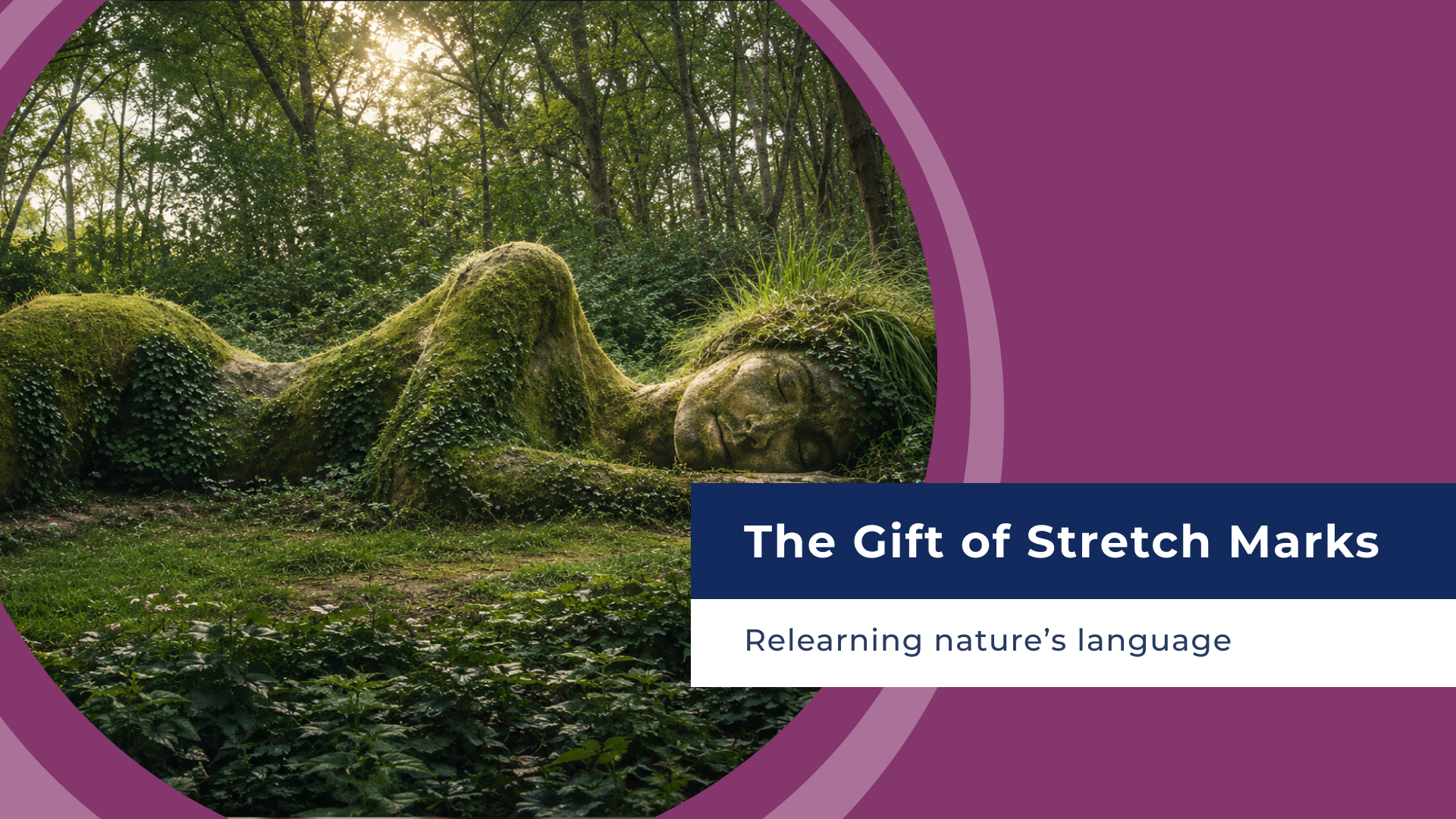

It is natural to mark time
Why do human beings trust culture’s reading of nature more than nature itself?
Nature has always kept time by leaving marks. A tree records its years in rings hidden beneath its bark. Rivers carve their histories into valleys. Wind shapes dunes. Glaciers leave moraines across mountain landscapes. Layers of rock record pressure, upheaval and time. Every landscape bears the traces of the life it has lived, and we rarely mistake those marks for failure. We read them as evidence. They tell us where water once flowed, where the earth shifted, where drought lingered and where fire passed through. We understand instinctively that landscapes are not diminished by their history. They are made legible by it.
Imagine suggesting that a tree surgeon remove the rings from the trunk of an ancient oak because they reveal its age. Or that a gardener prunes away the weathered stem of a rose simply because it no longer resembles the bloom of spring. We would never stand before the Grand Canyon lamenting the erosion that created it, nor wish the river had left no trace of its passing. The suggestion feels absurd because nature has never understood its marks as imperfections. They are simply the visible record of becoming. We admire the rosebud. We celebrate the bloom. We rarely mourn the rosehip that follows. Each season belongs to the life of the rose. We understand instinctively that time has not diminished it. Time has simply continued.
Human bodies belong to nature too. Like every living landscape, they carry the traces of the life they have lived. Skin stretches. Bones become denser in response to load. Hands develop callouses through years of work. Freckles emerge beneath summer skies. Hair curls or falls straight according to inherited biology. Fingerprints form before we are born and remain uniquely our own. My father carried the olive skin of the Croatian coast. My daughters inherited the lighter complexion of their Ukrainian great-grandmother. Long before culture assigned meaning to any of these differences, biology was simply responding to ancestry, geography and the environments in which life unfolded.
The body is continually adapting to participation. It responds to gravity, sunlight, movement, pregnancy, illness, labour, nourishment and age. Every adaptation leaves evidence. Nature is not trying to create perfection. It is trying to sustain life. Somewhere along the way, however, we began reading the body differently. The body does not apologise for becoming. People do.
Relearning nature’s language
The question reaches far beyond our bodies. We do not stand before an ancient oak and lament the rings hidden within its trunk. We do not wish the river had left no trace of its passing, or imagine that the weathered face of a cliff would somehow be improved if erosion had never occurred. We understand instinctively that these marks are not mistakes. They are the visible evidence of participation in life. They tell us where water flowed, where pressure accumulated, where seasons changed and where time quietly did its work.
Yet when those same processes unfold within the human body, we often tell a remarkably different story. Consider the same woman described in two different ways. She carried two children. Her skin stretched to make room for lives that had never before existed. Her body reorganised itself around growth. Fine silver lines remained long after the children no longer needed to be carried. Her hair gradually silvered too. Wrinkles gathered gently around her eyes from decades of laughter, grief, sunlight and ordinary afternoons. Her hands became rough through gardening, cooking and work. Her body recorded, faithfully and without apology, the life she had lived.
Now read the same woman again. She should tone her stomach. She should tighten her skin. She should colour her hair. She should soften the wrinkles around her eyes. She should hide the stretch marks. She should look younger. Nothing about the woman has changed. Only the language. One account describes biology. The other describes judgement.
Civilisation has done something far more remarkable than changing our bodies. It has changed the way we read them. We have become so fluent in society’s language that we rarely notice we are translating nature into something else. Interpretation slowly hardens into truth, and before long we forget there was ever another way of seeing.
Stretch marks are not uniquely female. Teenage boys develop stretch marks during rapid growth spurts. Athletes acquire them as muscle develops. Weightlifters, bodybuilders and people whose bodies change rapidly often carry the same silver lines. The biology is remarkably democratic. The interpretation is not. A stretch mark is simply collagen reorganising after the skin has been asked to expand more quickly than it comfortably can. During adolescence, pregnancy, periods of rapid growth or changing weight, tiny tears occur beneath the surface as the body responds to life asking more of it than yesterday. Healing follows. Fine silver lines remain. Biology has never regarded them as flaws. They are simply one of nature's ordinary records of growth.
Nature leaves evidence. Culture assigns value. Markets learn to monetise the gap between the two. Once evidence becomes something to judge rather than something to understand, an entire economy can be built upon convincing us that the ordinary traces of living should be softened, corrected, concealed or erased. The body gradually ceases to be experienced as a living landscape and becomes an endless project of improvement. That thought stayed with me after a conversation with my younger sister.
The inheritance of genes and meaning
A few years ago, I found myself standing in front of the bathroom mirror, absent-mindedly gathering the loose skin around my stomach into my hands.
“Maybe I should just get a tummy tuck,” I said. “Get rid of these stretch marks.”
My younger sister looked at me. Then she began to cry. She had never had children. Life had unfolded differently for her.
“I would give anything,” she whispered, “to have them.”
Nothing about my body changed at that moment. Only the meaning of the lines I had been holding. To me they had become flaws. To her they were evidence of a life she had longed to live. The stretch marks had not changed. The story surrounding them had.
The conversation stayed with me because it exposed something far larger than two sisters standing in front of a mirror. If the same stretch marks could represent failure to one woman and blessing to another, then the stretch marks themselves could not possibly be where the problem resided. Neither could the mirror. The question had to lie somewhere deeper. Where had either of us learned our version of the story?
Very few of us arrive at the mirror alone. Long before we consciously evaluate our own bodies, we have been learning how bodies are meant to be read. We overhear conversations. We watch adults criticise themselves in passing. We absorb magazine covers, films, advertisements and social media feeds. We notice who receives compliments, who is teased, who is admired and who is encouraged to change. Meaning accumulates slowly, almost invisibly, until it begins to feel like reality itself.
One of the most sobering findings from Dove’s global research on body confidence is that a mother's relationship with her own body strongly influences the relationship her daughter is likely to develop with hers. Daughters inherit far more than eye colour, freckles or the texture of their hair. They inherit ways of seeing. When mothers apologise for wrinkles, criticise their stomachs or avoid photographs because they dislike what they see, those interpretations become part of the environment in which a daughter learns to understand her own body.
The inheritance is rarely genetic. It is relational. Perhaps this is how culture reproduces itself. Not through grand declarations, but through thousands of ordinary moments around bathroom mirrors, changing rooms, family dinners and passing comments that seem too small to matter. Meaning travels so gently from one generation to the next that eventually nobody remembers who first wrote the story.
When I was little, I loved climbing into my Babushka’s lap. Her skin fascinated me. The softness of it. The folds that moved when she laughed. I used to poke at her breasts because they seemed to have a life of their own. She would laugh, gently push my hands away and I would dissolve into giggles. Not once did it occur to me that her body was something to judge or improve. To me it was simply my grandmother’s body. Warm. Familiar. Alive. I encountered her body with curiosity rather than comparison. I sometimes wonder when that changed. Not her body. Mine.
Returning
The invitation is not to love every mark our bodies carry. Love can feel like too large a leap when we have spent decades learning another language. The invitation is something quieter: Curiosity. What if we began reading our bodies with the same generosity we instinctively extend to the rest of nature?
When we walk through an old forest, we do not ask why one tree grew taller than another. We do not criticise a river for changing course after a flood or wish the weather had left no trace upon the mountains. We understand that every mark tells us something about the relationship between a living landscape and the life it has lived. The landscape is not separate from its history. It is its history made visible.
Our bodies deserve the same curiosity. A callous tells the story of repetition. Strong bones tell the story of movement. Stretch marks tell the story of growth. Scars tell the story of healing. Grey hair tells the story of time. Wrinkles tell the story of a face that has smiled, frowned, worried, laughed and loved. Every mark is evidence that life happened here. That does not mean every mark carries a happy story. Some speak of illness, violence, grief or profound loss. Nature records those too. Reading the body as a landscape is not an invitation to romanticise suffering. It is an invitation to recognise that even painful chapters belong to the whole story. Erasing the evidence would not erase what happened. It would simply silence one of the ways the body remembers.
This is why children often see bodies differently. Before they inherit our interpretations, they encounter bodies as places rather than projects. They notice warmth before wrinkles, softness before sagging and laughter before lines. They have not yet learned to confuse evidence with imperfection. Somewhere along the way, many of us stopped witnessing our bodies and began managing them instead. We became editors rather than readers, correcting what nature had merely recorded. We learned to stand before the mirror searching for deviations from an ideal instead of evidence of a life. The body, however, never changed its language. Only ours did.
As I have lived with this inquiry, I have found myself returning to one simple thought. We seem remarkably willing to trust culture’s interpretation of nature while distrusting nature itself. We believe the magazine before we believe biology. We believe the advertisement before we believe the body that has faithfully carried us through every ordinary and extraordinary chapter of our lives. We become fluent in the language of correction while slowly forgetting the language of participation. Nature has never apologised for becoming itself. The oak does not apologise for its rings. The river does not apologise for changing course. The mountain does not apologise for weathering. The rose does not apologise when the bloom gives way to seed. Every living thing participates in time, and time leaves its mark. We recognise those marks as evidence of life everywhere except, it seems, upon ourselves.
It seems we have forgotten how to read. Not the language of magazines or mirrors, but the older language spoken by living systems. A language in which wrinkles are seasons, scars are survival, callouses are devotion and stretch marks are simply one of nature’s many ways of recording growth. A language that does not ask whether a body has remained untouched by life, but whether it has participated in it.
One day, every one of us will return to the earth. In that moment, nature will ask nothing of the smoothness of our skin, the firmness of our bodies or the success with which we managed to conceal the ordinary evidence of living. Those questions belong to culture. Nature asks something simpler: Did you live? Did you love? Did you participate?
The body has always belonged to nature. It was only our interpretation that wandered. To remember nature’s language is to discover that we never stopped belonging.
Dr Jordan Marijana Alexander is a writer, executive advisor and human systems strategist exploring how identity, place, culture and living systems shape participation in the modern world. She is the co-founder of RelateAble.Global. If this article has raised questions, sparked reflection, or highlighted something you’re navigating as a leader or in your personal life, you’re invited to book a conversation to explore it further. You can follow DrJMA on LinkedIn and Engenesis for ongoing insights, research, and practical resources.