
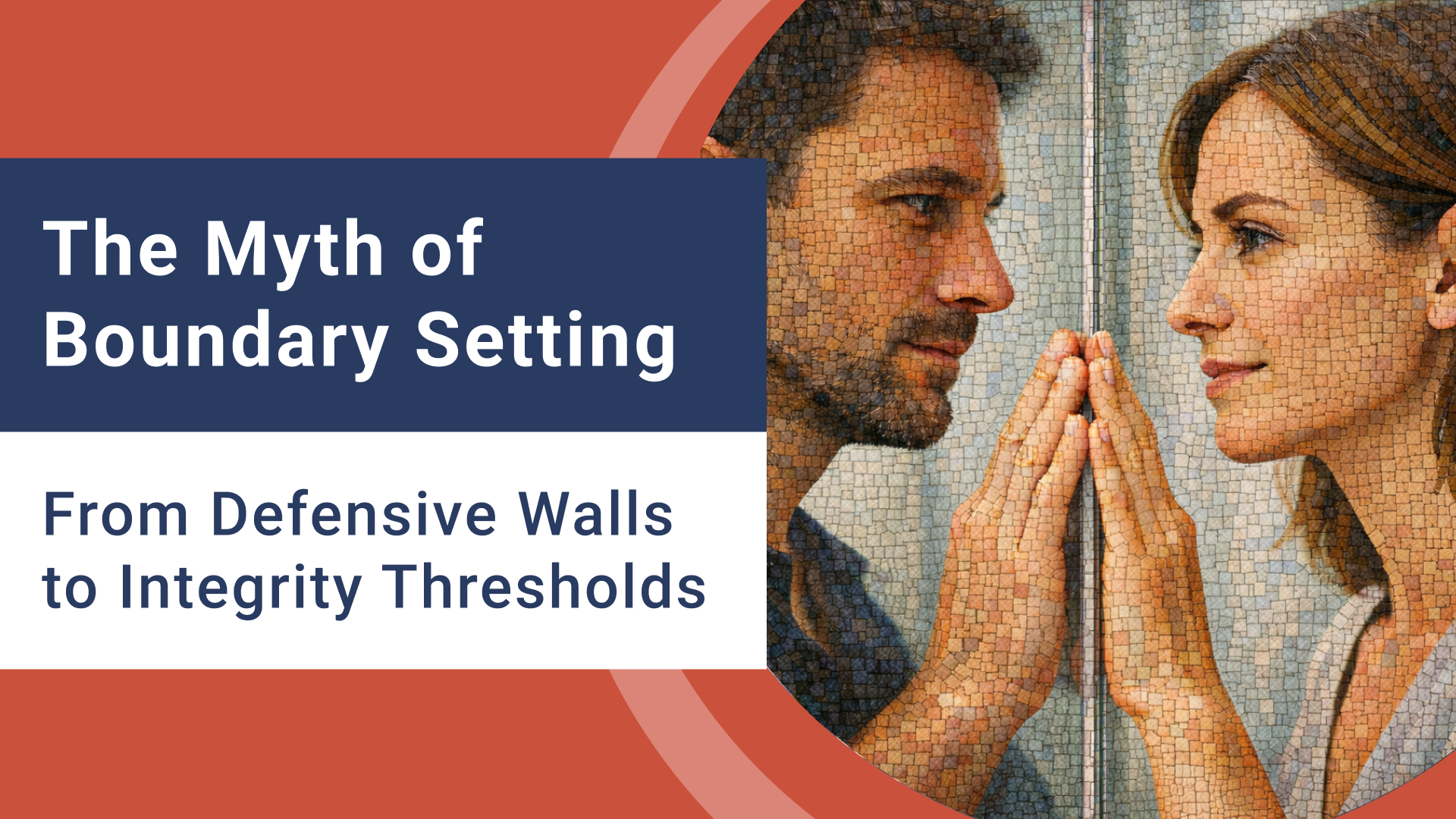

Background - How Boundary Culture Became the Default Language of Intimacy
The modern emphasis on boundaries did not emerge out of nowhere. It emerged from pain. It emerged from generations of enmeshment, emotional manipulation, codependency, unspoken resentment and relationships where people lost themselves in the name of love. Many grew up in homes where there was no psychological space. Privacy was violated. Individuality was suppressed. Emotional coercion was normalised. For many, learning to say no was revolutionary. Learning to identify one’s limits felt like survival. In that context, boundaries were not fashionable advice. They were necessary correction.
Psychology, particularly in the late twentieth century, responded to this dysfunction. Therapeutic language entered mainstream culture. Concepts like self-care, emotional regulation and personal limits became tools of empowerment. For individuals who had been chronically overrun, the language of boundaries restored dignity. It gave people permission to protect themselves. It offered structure where chaos once ruled.
Then something shifted.
What began as a corrective gradually became a doctrine. The nuance faded. Boundary setting moved from clinical necessity to cultural slogan. Social media amplified it. Short phrases replaced long processes. Protect your energy. Cut them off. You owe no one access. Distance yourself from anything that disturbs your peace. These statements contain partial truth. But partial truths, when absolutised, become distortions.
In partnership and particularly in intimacy, this distortion becomes more visible. People enter relationships carrying a heightened alertness. They scan for red flags before they cultivate green fields. They establish defensive limits before trust has had a chance to grow. Conversations about vulnerability are often preceded by disclaimers about personal space and emotional safety. There is nothing inherently wrong with clarity. But when clarity is driven primarily by fear of being hurt rather than the courage to connect, something subtle begins to erode.
Many today genuinely want closeness. They want devotion, partnership, shared growth and emotional transparency. Yet they are also deeply influenced by a cultural atmosphere that equates self-protection with strength. The result is relational hesitation. Two people approach each other carefully, each committed to preserving autonomy, each unwilling to risk losing ground. Intimacy becomes negotiated rather than discovered.
This creates a quiet dilemma. If defensive limits are constantly reinforced, intimacy struggles to deepen. If they are absent entirely, dysfunction returns. The conversation, therefore, cannot remain simplistic. We must ask what kind of being is establishing the limit. We must ask whether it arises from integrity or insecurity, from clarity or accumulated resentment, from wisdom or unprocessed fear.
The topic matters because intimacy is not a decorative luxury in human life. It is foundational. Our capacity to form deep bonds influences psychological stability, family health, societal cohesion and even civilisational trust. When intimacy becomes rare, isolation increases. When isolation increases, suspicion grows. When suspicion grows, connection weakens. A culture that overcorrects toward self-protection may unknowingly weaken its capacity for deep relational bonds.
This is why the discussion cannot stay at the level of behavioural advice. It must move deeper into ontology. It must examine who we are being when we speak the language of boundaries. Only then can we understand whether our limits are serving intimacy or slowly replacing it.
Introduction - Beyond the Noise of Modern Relationship Advice
The conversation around boundaries has become loud. Podcasts repeat it. Therapists emphasise it. Influencers package it into slogans. Friends advise it over coffee. It has become one of the dominant languages of modern relationships. If something feels uncomfortable, set a boundary. If someone disappoints you, reinforce a boundary. If you feel overwhelmed, create distance. The formula appears simple and empowering.
And yet something about the simplicity should make us pause.
Intimacy is not a technical project. It is not a compliance structure. It is not a legal negotiation between two self-contained individuals managing risk. Intimacy is a movement toward shared interiority. It is the gradual allowing of another person into spaces that are normally private, fragile and unfinished. It is exposure that grows through trust, not through constant surveillance of personal limits.
So we must ask an uncomfortable question. Have we mistaken a corrective tool for a relational philosophy? Have we elevated boundary setting to such a degree that it quietly undermines the very depth we claim to seek?
This article does not dismiss the need for limits. It examines the myth that limits alone can produce healthy intimacy. It moves beyond slogans to explore the ontological posture behind them. It asks whether what we call maturity is sometimes refined defensiveness. It asks whether what we celebrate as empowerment may in fact be fear of erosion.
We will examine why boundary culture emerged, why it resonates and why in intimate partnerships, it often produces guarded proximity rather than genuine closeness. We will challenge sentimental romanticism while also challenging defensive individualism. We will explore where real romance truly resides and how an integrated human being can hold clarity without collapsing into fear-driven distance.
If intimacy feels rare today, it is not because people lack desire. It is because they lack integration. Without integration, boundaries become armour. With integration, limits become expressions of integrity.
What follows is an invitation to examine the difference.
When Boundaries Become Armour
The real issue is not whether limits exist. Every human being has psychological, emotional and moral limits. These are part of our structure. The problem begins when limits are managed from fragmentation rather than integration.
In many intimate relationships today, what is called a boundary is often a reaction. It is formed after disappointment, after betrayal, after repeated misunderstanding. It carries emotional residue. It is not simply clarity. It is accumulated memory seeking protection. When this happens, the limit is no longer a neutral expression of self-knowledge. It becomes armour.
Armour has a function. It protects. But it also prevents touch. In intimacy, touch is not merely physical. It is psychological permeability. It is the ability to be influenced, to be corrected, to be confronted, to be softened, to be seen in contradiction and still remain present. Armour resists influence. It resists discomfort. It resists the risk that another human being might alter us.
This is where the paradox deepens. Intimacy requires influence. Two lives begin to overlap. Perspectives are challenged. Habits are exposed. Blind spots are revealed. Growth becomes mutual. None of this can occur if both individuals are primarily organised around self-protection. Many couples today remain together yet psychologically distant. They negotiate space carefully. They state expectations precisely. They manage conflict with rehearsed phrases. Everything appears mature on the surface. Yet something is missing. There is limited surrender, limited emotional risk and limited willingness to sit inside discomfort without retreating into personal territory.
This does not mean limits are inherently opposed to intimacy. It means limits arising from fear will always restrict depth. A reactive boundary says I will not let you hurt me again. An integrated limit says I will not participate in what violates my integrity. The difference is subtle but profound. The first posture is organised around self-preservation. The second is organised around alignment.
In the first posture, the person remains guarded even when no immediate threat exists. In the second, the person remains open but clear. Openness is not weakness. It is strength grounded in self-definition. True intimacy does not require the absence of limits. It requires the presence of a stable self. When the self is unstable, defensive boundaries multiply. When the self is grounded, limits simplify and become expressions of integrity.
A polished being does not need to constantly declare limits. Their clarity is embodied. Their ‘no’ is calm. Their yes is deliberate. Their vulnerability is chosen, not extracted. They can soften without dissolving and stand firm without hardening. Real romance emerges in the meeting of two integrated beings who are willing to lower unnecessary guards while retaining coherence. The question is not whether limits exist. The question is whether we are hiding behind them.
The False Dilemma Between Closeness and Self-Protection
At this stage the debate often collapses into a false choice. Either we dissolve limits in the name of love and risk losing ourselves, or we defend ourselves in the name of self-respect and risk losing intimacy. This binary has shaped much of modern relational advice. It presents closeness and self-protection as opposing forces, as though one must weaken for the other to survive.
But the framing itself is flawed.
The real problem is not that intimacy threatens the self. The real problem is that many individuals enter intimacy without a formed self. When identity is unstable, closeness feels dangerous. When values are unclear, influence feels like invasion. When self-worth is fragile, disagreement feels like rejection. In such conditions, defensive boundaries become urgent because the person has no internal structure strong enough to remain intact under pressure. In that state, intimacy is experienced as erosion.
The person then retreats. Limits tighten. Protective language becomes rehearsed. Nothing is allowed to penetrate too deeply. What appears as maturity may in fact be fear of fragmentation.
On the other side are those who abandon limits entirely. They merge quickly. They overexpose. They overgive. They equate intensity with depth. They call enmeshment devotion. They collapse their identity into the relationship and later feel resentment when they realise they have disappeared. Both patterns are forms of instability. One hides behind walls. The other dissolves into fusion. Neither is intimacy.
Intimacy requires something far more demanding. It requires a stable centre. A person who knows what they value, who has examined their shadows, who can tolerate discomfort without immediate defence, who can be influenced without losing coherence, who can say no without aggression and say yes without fear. Such a person does not experience closeness as threat. They experience it as expansion.
This is where the seeming contradiction dissolves. Intimacy and clarity are not enemies. Intimacy and integrity are not opposites. In fact, the deeper the integrity, the deeper the intimacy can go, because integrity provides the structure within which vulnerability becomes safe rather than chaotic.
The dilemma, therefore, is not whether to choose limits or closeness. The dilemma is whether we are willing to do the internal work required to hold both without fragmentation. Without that work, defensive boundaries multiply. With that work, limits become expressions of integrity and closeness deepens into trust. This is not sentimental romance. It is disciplined romance, built through exposure, responsibility and mutual refinement.
How an Integrated Being Holds Clarity and Permeability
If we move beyond slogans, we arrive at a more demanding question. What kind of human being can sustain intimacy without collapsing into fear or fusion. The answer does not lie in better techniques. It lies in integration.
An integrated person has done the work of self-definition. They know what they stand for. Their values are not improvised in the moment. Their sense of worth is not dependent on constant validation. Their identity is not built on performance. Because of this internal coherence, they do not experience closeness as a threat to survival.
This changes everything.
When such a person enters intimacy, they are not negotiating for safety. They are participating in shared growth. They are not scanning obsessively for violations, nor are they blind to patterns. They can recognise dysfunction without panic. They can tolerate discomfort without retreat. They can remain present in conflict without weaponising distance.
In this posture, what we previously called boundaries are no longer defensive structures. They become expressions of integrity.
At this point it becomes necessary to examine the language itself. The word boundary carries a metaphor that quietly shapes the psyche. A boundary suggests a border, a fence, a perimeter. It implies territory to defend and intrusion to prevent. Even when used with healthy intention, the imagery is architectural and defensive. It frames intimacy as a space where protection must remain primary.
Language is not neutral. When relational maturity is constantly framed through boundaries, the underlying posture becomes containment. The conversation shifts from alignment to defence. Instead of asking what do I stand for, we ask where do I draw the line. Instead of examining coherence, we negotiate territory.
The problem is not the existence of limits. Every integrated person has them. The problem is the metaphor organising those limits.
A more precise expression is integrity threshold. An integrity threshold is the point at which alignment with one’s values, identity and moral coherence would be compromised. It is not a wall designed to keep others out. It is an internal reference point that preserves alignment while allowing permeability.
When a boundary is crossed, it feels like intrusion. When an integrity threshold is crossed, it feels like misalignment. The distinction is subtle but profound. Boundary language often carries emotional charge and can become reactive or territorial. Integrity threshold language is principled. It arises from clarity rather than fear. It does not accuse. It clarifies.
An integrity threshold does not shrink intimacy. It refines it. It allows two people to remain open while maintaining coherence. It invites influence without surrendering self-definition. It enables closeness without dissolving values.
When limits are grounded in integrity rather than fear, they no longer function as armour. They function as structure. And structure is what allows depth to grow safely rather than chaotically.
The real task, then, is not to perfect boundary language. It is to cultivate integrity strong enough that your thresholds are clear without becoming walls.
Why This Matters Beyond the Couple
It would be easy to leave this discussion within the private sphere of romantic partnership. But the implications extend far beyond two individuals. The way we understand intimacy shapes how we understand trust. The way we understand trust shapes how we build families, teams, institutions and societies.
If a culture increasingly organises itself around defensive self-preservation, it slowly loses the capacity for deep relational bonds. People become careful before they become committed. They remain alert before they become devoted. They keep emotional exits available at all times. This does not only affect marriages. It affects friendships, business partnerships, communities and civic life.
Trust requires risk. Without risk, there is no depth. Without depth, relationships remain functional but thin. Functional but fragile.
When intimacy becomes rare, suspicion rises. When suspicion rises, control increases. When control increases, connection weakens. Over time, the social consequences become visible. Higher isolation. Lower tolerance for disagreement. Quick disengagement. Disposable relationships. Emotional minimalism disguised as self-respect.
The issue is therefore not sentimental. It is structural.
A society that teaches individuals to prioritise constant self-protection without equal emphasis on integration will produce relational shallowness. And relational shallowness eventually produces systemic fragility. Teams struggle to collaborate deeply. Leaders struggle to inspire trust. Families struggle to transmit stability across generations.
Intimacy, properly understood, is not weakness. It is the training ground for trust. And trust is foundational to any durable system.
This is why the absolutisation of defensive boundaries must be examined carefully. Not because limits are wrong, but because overemphasis on defence can slowly erode the courage required for genuine connection.
If we want stronger partnerships, stronger families and stronger institutions, we cannot merely teach people to protect themselves. We must cultivate individuals whose integrity thresholds are clear enough to allow closeness without fear.
The health of a civilisation is quietly reflected in the depth of its bonds.
The Manufactured Script of Modern Intimacy
There is another layer to this conversation that cannot be ignored. The dominant narrative around relationships does not simply emerge organically. It is reinforced, amplified and packaged in respectable language. Under banners such as egalitarianism, empowerment, emotional intelligence and healthy masculinity or femininity, a particular script is often promoted. Men are told what they must suppress in order to be acceptable. Women are told what they must demand in order to be strong. Advertising, popular psychology and coaching culture repeat these scripts until they appear self-evident.
The problem is not equality. The problem is simplification.
When complex human dynamics are reduced to ideological templates, intimacy becomes politicised. Partners no longer meet as individuals with unique histories, values and temperaments. They meet as representatives of categories. Expectations are imported from social media more than discovered through lived interaction. People begin to measure each other against abstract standards rather than engage in real dialogue.
This environment produces performance rather than presence.
Many of the loudest voices in relationship culture do not aim at depth. Depth is slow and difficult. It requires introspection, responsibility and discomfort. What circulates more easily is relief. Quick validation. Clear narratives in which one side is empowered and the other corrected. The result is an industry that often soothes symptoms while leaving foundations untouched.
Some life coaches, influencers and even professionals build reputations around reinforcing grievance rather than resolving it. They provide language that feels strong but avoids the harder task of integration. Identity is affirmed before shadow is examined. Limits are enforced without equal emphasis on self-refinement. The cycle becomes predictable. Individuals feel temporarily empowered, yet relational patterns remain unchanged. Disappointment returns. More defensive language is adopted. More content is consumed. The structure beneath the dysfunction remains intact.
The harsh truth is that much of the dominant discourse benefits from maintaining tension. A market thrives on dissatisfaction. A culture of perpetual grievance generates engagement. Deep integration, by contrast, is quiet. It reduces drama. It reduces dependency on external validation. It reduces the need for constant ideological reinforcement. An integrated partnership is far less profitable than a reactive one.
If we genuinely care about intimacy, we must resist the temptation to outsource our relational philosophy to trending narratives. We must question the scripts handed to us about what a modern man should be, what a modern woman should demand and how power should be negotiated. Not to reject equality, but to restore depth.
Intimacy cannot be engineered through ideology. It cannot be sustained by marketing. It cannot be healed by slogans. It requires two individuals willing to step outside manufactured scripts and encounter each other without borrowed narratives. Anything less becomes performance, and performance, no matter how progressive its language, cannot substitute for genuine connection.
Conclusion - The Courage to Risk Depth
At the heart of this conversation lies a demanding truth. Intimacy is not sustained by technique. It is sustained by character. It is not protected by slogans. It is protected by integrity.
Limits, when grounded in clarity, serve relationships. But when defensive language becomes the dominant framework of intimacy, it quietly reveals something unresolved beneath the surface. It reveals fear of erosion, fear of repetition and fear of loss of control. These fears are human. They deserve understanding. Yet if they remain unexamined, they shape relationships more than love does.
The real question is not whether you have boundaries. The real question is what organises them. Is it fear or alignment? Is it resentment or self-knowledge? Is it avoidance or maturity?
Romantic culture often swings between two extremes. On one side, fantasy. On the other, fortification. The first promises eternal fusion without effort. The second promises emotional safety without vulnerability. Neither produces depth.
Depth demands courage. It demands the courage to remain open without being naive. The courage to state truth without aggression. The courage to be influenced without dissolving. The courage to confront without abandoning. The courage to stay when growth is possible and to leave only when integrity requires it.
This kind of intimacy is rare not because it is impossible, but because it requires integration. It requires two individuals willing to refine themselves as much as they refine each other. It requires clarity strong enough to remain permeable and integrity stable enough to sustain exposure.
Grounded being does not hide behind walls. It knows its integrity thresholds and remains open within them.
The myth is not that limits exist. The myth is that defensive limits alone can produce healthy intimacy.
They cannot.
Only integration can do that.
And integration is slow, demanding and deeply human. It is cultivated through self-examination, responsibility, shadow work and the willingness to tolerate discomfort without retreating into armour. When that work is done, thresholds become calm. They are present but not performative. They protect without imprisoning. They clarify without isolating.
Real romance does not live in sentimentality. It lives in disciplined openness.
And disciplined openness is one of the highest forms of strength.