

Background - The Crisis of Sense-Making in an Increasingly Polarised World
One of the most under-recognised problems of our time is not merely political disagreement, economic inequality, or cultural conflict. Beneath many of these visible tensions lies a deeper issue: a crisis of sense-making.
Human beings constantly interpret reality. We interpret events, people, groups, institutions, and ideas. These interpretations shape our judgments, our policies, our social relationships, and ultimately the architecture of our societies.
When sense-making functions well, individuals and communities can navigate complexity with nuance and responsibility. Differences can be explored without immediately collapsing into hostility. Data can inform understanding rather than reinforce preconceived narratives. Institutions can make decisions that reflect a layered understanding of reality. But when sense-making begins to deteriorate, something very different happens.
Reality becomes simplified into narratives that are easier to consume but less accurate. Complex human groups are reduced to symbolic labels. Data is interpreted through ideological filters rather than careful inquiry. Public discourse begins to operate through slogans rather than understanding. In such conditions, disagreements do not simply remain intellectual disagreements. They quickly become identity conflicts.
The result is a steady rise in polarisation. Societies begin to divide into camps that interpret the same reality in radically different ways. Each group becomes increasingly convinced that the other is not merely mistaken, but fundamentally illegitimate. When sense-making weakens, suspicion replaces curiosity. Narratives replace investigation. Moral outrage replaces intellectual humility.
This is not simply a philosophical concern. It has profound practical consequences.
Policies begin to emerge from distorted interpretations of reality. Communities are categorised through broad generalisations. Entire populations may be treated as monolithic groups rather than complex collections of individuals. Over time, these dynamics can contribute to social fragmentation, mistrust in institutions, and the radicalisation of public discourse.
The economic consequences are also significant. When policy decisions are driven by simplified narratives rather than accurate understanding, regulatory frameworks can become distorted. Markets may respond to fear-driven assumptions. Trust, which is a foundational element of economic cooperation, begins to erode.
In this environment, even well-intentioned initiatives can produce unintended harm because they are built upon incomplete or distorted interpretations of reality.
The crisis of sense-making, therefore, matters far beyond academic debate. It directly affects the stability of societies, the legitimacy of institutions, and the sustainability of economic systems.
Understanding how this crisis manifests is one of the essential intellectual challenges of our time.
Introduction - What This Article Will Examine
This article explores one of the subtle but powerful mechanisms through which the crisis of sense-making manifests in modern societies: the normalisation of generalisations.
Generalisations appear harmless on the surface. They are often used as shortcuts in everyday language, media commentary, political discourse, and even academic research. They allow complex realities to be summarised quickly and communicated efficiently.
But when these simplifications become habitual, they begin to shape how people understand entire populations, belief systems, and institutions.
We begin speaking about groups as if they were singular actors.
“Christians believe this.”
“Muslims think that.”
“Conservatives always do this.”
“Leftists want that.” “White people behave like this.”
“Black communities do that.”
In reality, none of these groups are monolithic. Each contains enormous diversity in beliefs, motivations, values, experiences, and behaviours. Yet the language of generalisation quietly transforms them into symbolic entities that appear coherent and unified.
This article will examine how this habit of thinking contributes to distortions in both public discourse and intellectual inquiry. We will explore how the same tendency appears not only in popular culture and political rhetoric but also in the interpretation of statistics and empirical research. The authority of numbers often gives the impression that data provides direct access to objective truth. Yet statistical interpretation is rarely free from assumptions, frameworks, and biases.
Particular attention will be given to the problem known in statistics as the lurking variable. Hidden or unobserved factors frequently influence the patterns we observe in data. When these variables are ignored, correlations may be interpreted as causal relationships, reinforcing misleading narratives about entire groups or communities.
The consequences of these interpretive errors do not remain confined to academic debate. Intellectual narratives travel. They influence policy decisions, shape public perceptions, and ultimately affect how societies organise power, rights, regulation, and opportunity.
Over time, simplified interpretations of reality can contribute to polarisation, institutional mistrust, social fragmentation, and economic distortion. To better understand these dynamics, the article will draw on the Metacontent discourse and the Nested Theory of Sense-Making, frameworks that examine how human beings construct meaning through layered structures of interpretation.
From this perspective, the issue is not merely the misuse of language or statistics. It reflects a deeper challenge: how individuals and societies develop the intellectual capacity to interpret complex realities responsibly.
The article will ultimately argue that cultivating Authentic Awareness is essential not only for intellectual clarity but also for the long-term stability and sustainability of our societies, institutions, and economies. By examining the mechanisms behind generalisations and statistical misinterpretations, we can begin to understand how seemingly small distortions in interpretation can cascade into large-scale consequences.
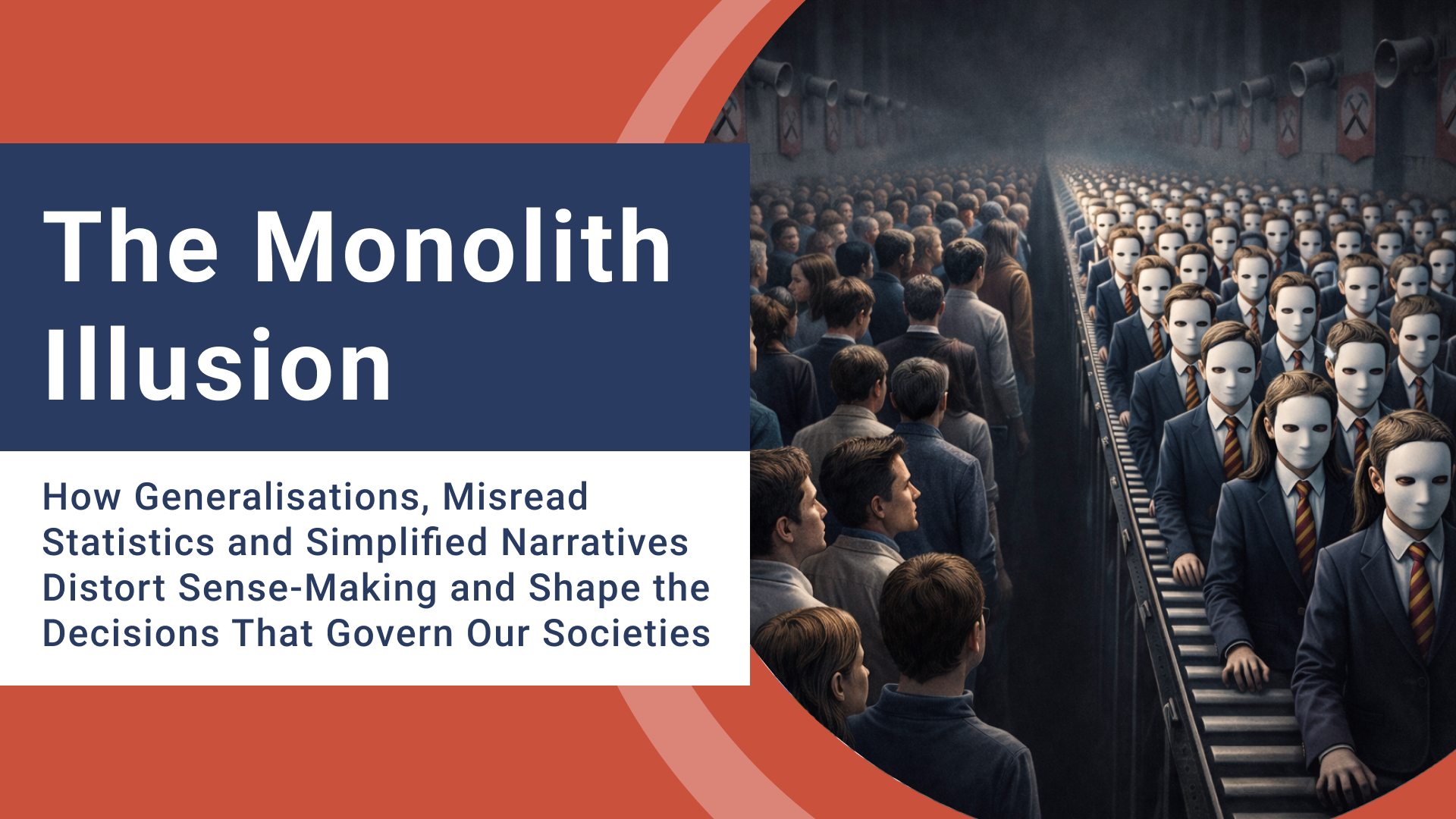
The Monolith Illusion
The normalisation of generalisations is one of the most subtle yet powerful distortions shaping contemporary discourse. It appears in everyday conversations, media commentary, political rhetoric, and even within academic and statistical analysis. What begins as a linguistic shortcut gradually becomes a cognitive habit, and that habit slowly reshapes how individuals and societies interpret reality. Over time, complex human populations are reduced to simplified categories that appear coherent, unified, and predictable. The moment this reduction occurs, understanding begins to drift away from reality.
Consider how frequently we speak about groups as if they were singular actors. We say Jews believe something, Muslims behave in a certain way, Christians support a particular moral stance, conservatives oppose a policy, leftists promote another agenda, white people think in a certain way, or black communities share a unified political perspective. The language itself suggests coherence and uniformity. It quietly implies that within these categories exists a shared psychology, a shared intention, and a shared pattern of behaviour. Yet the reality is far more complex. These groups contain immense internal diversity across culture, education, socio-economic background, geography, personal experience, and interpretation of belief systems. What the label captures is not a unified community but a broad and heterogeneous population whose internal differences often exceed the differences between groups themselves.
The intellectual problem arises when these broad identity labels are unconsciously treated as explanatory categories. Instead of asking what specific factors are shaping behaviour in particular contexts, discourse begins to assume that the identity category itself provides the explanation. In doing so, the complexity of human reality is replaced by symbolic representations that are easier to process but less accurate. These symbolic representations become building blocks for narratives. Narratives then become lenses through which data, events, and policies are interpreted.
An interesting irony emerges in political discourse. Many individuals who criticise identity politics often rely on the same structure of thinking when it suits their narrative. Commentators on the political right may criticise identity-based frameworks while simultaneously speaking about “the left,” “liberals,” “Muslims,” or “elites” as if these were unified actors. Similarly, segments of the political left may critique stereotyping while frequently referring to “white people,” “capitalists,” or “conservatives” as if they represent coherent psychological groups. In both cases, the disagreement occurs within the same cognitive framework: the assumption that broad identity categories represent monolithic entities.
This pattern becomes even more complicated when statistical reasoning enters the conversation. Numbers carry a powerful aura of authority. When data is presented in the form of charts, percentages, or correlations, it often creates the impression that we are dealing with objective facts that stand independently of interpretation. Yet statistical analysis does not operate in a vacuum. Data must be collected, selected, structured, and interpreted by researchers who inevitably bring assumptions, conceptual frameworks, and methodological choices into the process. The idea that empirical research provides direct, unmediated access to ultimate truth is, therefore, misleading. Science is one of the most powerful tools humanity has developed for understanding reality, but it remains a human enterprise operating within conceptual and methodological boundaries.
One of the most important challenges in statistical interpretation is the problem known as the lurking variable. A lurking variable refers to a hidden or unobserved factor that influences the relationship between variables being studied. When such variables are not accounted for, correlations may appear meaningful while the actual causal mechanisms remain misunderstood. For example, a dataset might reveal a correlation between demographic characteristics and crime rates. If this correlation is interpreted superficially, it may appear to suggest that identity itself explains the pattern. However, deeper investigation may reveal other variables at play, such as economic opportunity, educational infrastructure, historical segregation patterns, urban design, policing strategies, or intergenerational poverty. Once these additional factors are considered, the interpretation of the data can change dramatically. Without careful analysis, statistical correlations can easily reinforce narratives that simplify complex realities and unintentionally legitimise stereotypes.
The consequences of these interpretive shortcuts do not remain confined to intellectual debates or academic journals. Ideas travel beyond intellectual forums and shape real-world structures. When simplified narratives become widely accepted, they influence policy design, institutional frameworks, and regulatory decisions. Entire communities may become subject to broad assumptions that affect rights, opportunities, and representation. Over time, these dynamics can contribute to deeper social consequences, including increased polarisation, marginalisation of groups, disenfranchisement of youth, radicalisation of individuals, and growing mistrust toward institutions. Policies built upon distorted interpretations of reality can generate cycles of over-regulation, economic distortion, and institutional fragility. In extreme cases, misinterpretations about identity, behaviour, or cultural difference can escalate tensions that feed into broader conflicts or security concerns.
What begins as an intellectual simplification can therefore cascade into large-scale societal consequences. When narratives replace careful investigation and generalisations replace nuanced understanding, the very capacity of a society to interpret reality responsibly begins to weaken. This is precisely where the broader crisis of sense-making becomes visible. Human beings rely on layered interpretive frameworks to understand the world around them. When those frameworks become shallow or distorted, simplified explanations rush in to fill the vacuum.
From the perspective of the Metacontent discourse and the Nested Theory of Sense-Making, these distortions occur because individuals and societies operate through layers of interpretation rather than direct access to reality. Our abductive assumptions, cognitive maps, stories, mental models, perspectives, and disciplinary paradigms all shape how we interpret events and data. When these layers remain unexamined, generalisations become cognitively attractive because they reduce complexity. However, they do so at the cost of accuracy.
Addressing this challenge requires more than better data or more sophisticated statistical techniques. It requires cultivating Authentic Awareness, the capacity to perceive reality with progressively less distortion. Authentic Awareness allows individuals to recognise the difference between observable phenomena, interpretive narratives, and ideological framing. It enables societies to engage with complexity rather than collapsing it into symbolic categories. This capacity is not only intellectually valuable but also essential for the stability and sustainability of institutions, organisations, and economic systems.
In an increasingly interconnected and polarised world, the ability to interpret reality responsibly has become a civilisational competence. Without it, even well-intentioned initiatives may be built upon distorted foundations. With it, societies gain the capacity to navigate complexity with greater wisdom, humility, and resilience.
Diversity Within Societies: The Myth of the Uniform Nation
Another layer of the monolith illusion appears when people assume that societies themselves are internally uniform. Many individuals like to imagine that their society has a coherent and standardised set of norms, beliefs, and values. This assumption can be comforting because it suggests cultural clarity and social stability. Yet this picture rarely reflects reality. No society has ever been truly uniform. Every society contains a wide spectrum of perspectives, values, and worldviews that coexist within the same geographical space. Two people living next door to each other may interpret the world in radically different ways. They may share the same language, the same institutions, and the same national identity, yet their beliefs about politics, religion, morality, economics, and social life may diverge dramatically.
In fact, it is often possible for two individuals living on different continents to share more intellectual or ideological common ground with each other than with their own neighbours. A person who holds a particular worldview in one part of the world may find far more resonance with someone thousands of kilometres away who shares that orientation than with people who live in the same street but interpret reality through entirely different frameworks. Human societies, therefore, cannot be understood as cohesive blocks of shared thinking. They are complex ecosystems composed of overlapping communities, belief systems, and interpretive frameworks that continuously interact with one another.
This complexity becomes even more visible when observing how people relate to political and social systems across the world. There are individuals living under restrictive systems who deeply admire open societies and aspire to the freedoms they represent. At the same time, there are individuals living in open societies who strongly criticise those very systems and advocate for models that resemble structures found elsewhere. Citizens born and raised within the same city may support fundamentally different visions of how society should function. Some may favour strong centralised control of economic and social life, while others emphasise individual autonomy and decentralised institutions. These differences are not minor variations within a shared worldview. They can represent radically different interpretations of reality that coexist within the same society.
A particularly revealing example of this distortion can be observed in how migrants are described in public discourse. When individuals migrate from countries that are widely perceived as having Muslim-majority populations, their national, cultural, and historical identities often disappear in the language used to describe them. People arriving from places as diverse as Indonesia, Malaysia, Turkey, Pakistan, Iran, and many other societies may suddenly be grouped under a single label and referred to simply as “Muslim migrants.” The enormous differences between these countries, their cultures, languages, political histories, and internal diversity are quietly erased. By contrast, when migrants arrive from many parts of Europe, South America, or other regions historically associated with Christianity, they are rarely described as “Christian migrants.” Instead, they are identified by nationality or place of origin. They are Italian, Polish, Brazilian, Argentinian, Spanish, or French. Their identities remain geographically and culturally specific rather than religiously generalised. The asymmetry is striking. In one case, individuals are reduced to a broad religious category that implies a unified identity, while in the other case, the diversity of national and cultural background is preserved. This contrast reveals how easily generalisations reshape perception. Entire populations that are internally diverse become framed as singular entities, not because reality demands it, but because simplified narratives make them easier to categorise.
Part of the reason this occurs lies in the natural tendency of the human mind to simplify complexity. Human cognition evolved to recognise patterns quickly, allowing individuals to make rapid judgments about their environment. Categorisation helps reduce cognitive effort by grouping large amounts of information into manageable structures. While this capacity is useful for navigating everyday life, it can easily lead to oversimplification when applied to complex social realities. The mind begins to treat categories as explanations rather than descriptive tools. Once this happens, labels such as religious identity, nationality, ethnicity, or political orientation start functioning as shortcuts for understanding human behaviour. Over time, these shortcuts become embedded within public discourse, media narratives, and institutional thinking.
The result is a subtle but powerful distortion. Societies that are internally diverse begin to appear homogeneous. Individuals whose beliefs and experiences vary widely become perceived as representatives of unified collective identities. When this perception spreads through public discourse, it reinforces the illusion that human communities operate as monolithic actors rather than dynamic networks of individuals with different perspectives and aspirations. Recognising the diversity that exists within societies is therefore essential for restoring nuance to our understanding of human communities. Without this recognition, generalisations continue to replace inquiry, and simplified narratives gradually shape how entire populations are perceived.
The Statistical Authority Illusion
One of the most powerful forces reinforcing the habit of generalisation is the authority granted to statistics. In modern societies, numbers carry a unique persuasive power. When a claim is supported by data, charts, percentages, or regression models, it immediately acquires the appearance of objectivity. The presence of numbers gives the impression that the conclusion presented is not merely an opinion but a factual representation of reality. Yet this perception often obscures an important truth: statistics do not speak for themselves. They are interpreted, structured, and narrated by human beings operating within particular conceptual frameworks.
Every statistical study involves a sequence of decisions that shape the final outcome. Researchers decide which variables to measure, which populations to include or exclude, which time frames to analyse, which models to apply, and which interpretations to emphasise. Each of these decisions influences how the final results are presented and understood. Even when researchers operate with intellectual honesty and methodological rigour, the process is never entirely neutral. Human judgment inevitably mediates the transformation of raw data into meaningful conclusions.
This does not mean that science or statistical inquiry is unreliable. On the contrary, statistical reasoning is one of the most powerful tools available for identifying patterns within complex systems. However, its strength lies in disciplined interpretation rather than blind acceptance. When statistics are treated as unquestionable truth rather than structured interpretations, they can unintentionally reinforce narratives that oversimplify reality.
The authority of numbers can therefore create a subtle form of intellectual complacency. Once a claim is accompanied by quantitative evidence, many readers assume that the matter has been settled. The possibility that the interpretation itself may be incomplete, selective, or influenced by hidden variables often receives far less attention. In such cases, statistics cease to function as tools for exploration and instead become instruments that validate pre-existing narratives.
This dynamic becomes particularly problematic when statistical findings are applied to large human populations. When correlations appear between demographic categories and particular outcomes, the temptation arises to interpret those correlations as inherent characteristics of the group itself. Yet human societies are extraordinarily complex systems shaped by multiple overlapping factors, including economic structures, historical conditions, educational opportunities, cultural practices, political environments, and institutional frameworks. When statistical correlations are interpreted without carefully considering these layers of context, the results can easily be misread as evidence supporting simplistic generalisations.
In many public debates, the distinction between correlation and causation becomes blurred. A pattern observed in the data may suggest a relationship between two variables, but that relationship does not automatically reveal the underlying mechanisms responsible for it. Without careful investigation, correlations can be mistaken for explanations. Once this happens, the statistical narrative begins to harden into a perceived truth about entire communities or identity groups.
Over time, these narratives can circulate widely through media commentary, political discourse, and policy discussions. Numbers that originally emerged from specific studies conducted within particular contexts become detached from those contexts and are treated as universal facts. The complexity of the original research disappears, leaving behind simplified conclusions that appear far more definitive than the underlying evidence actually supports.
This is where the statistical authority illusion becomes most dangerous. The language of data can create the impression that generalisations are not merely opinions but scientifically validated facts. When this occurs, intellectual caution often gives way to misplaced certainty. Statistical patterns that should invite deeper investigation instead become tools for reinforcing social narratives about entire populations.
The challenge, therefore, is not to reject statistical reasoning but to approach it with greater epistemic humility. Data can illuminate patterns within reality, but it rarely captures the full complexity of the systems being studied. Without recognising the interpretive layers that shape statistical analysis, societies risk transforming powerful analytical tools into instruments that unintentionally distort the very realities they seek to understand.
The Lurking Variable Problem
One of the most well-known challenges in statistical reasoning is what researchers refer to as the lurking variable problem. A lurking variable is a hidden or unobserved factor that influences the relationship between the variables being studied. When this factor is not recognised or measured, it can create the illusion that one variable directly explains another, even though the true causal structure is far more complex.
This problem is far more common than many people realise. Human societies are layered systems shaped by economic forces, historical conditions, cultural norms, institutional structures, education systems, geography, and countless other variables. When statistical analysis focuses on only a small number of observable factors, it may detect patterns that appear meaningful but actually conceal deeper mechanisms operating beneath the surface.
Consider a common type of public debate in which correlations are presented between demographic characteristics and certain social outcomes. At first glance, the numbers may appear straightforward. A dataset might show a relationship between a particular group identity and crime rates, educational outcomes, health conditions, or economic performance. These correlations are then often interpreted as evidence that the identity category itself explains the pattern.
Yet this interpretation can quickly collapse once deeper layers of context are examined. Economic opportunity, neighbourhood design, educational infrastructure, historical segregation, policing practices, cultural expectations, family structure, labour market access, and migration patterns can all act as influencing variables. Each of these factors may shape outcomes in ways that are invisible within the initial dataset. When these variables remain unexamined, the statistical correlation risks becoming a misleading narrative about the people themselves rather than the conditions in which they live.
The lurking variable problem illustrates a broader epistemic lesson. Statistical relationships rarely exist in isolation. Most observable patterns are the surface expression of deeper causal networks. When these networks remain hidden, the temptation to attribute complex outcomes to simplified identity categories becomes strong. Once this attribution occurs, generalisations begin to form. These generalisations then circulate through media discussions, political arguments, and public perceptions until they solidify into widely accepted beliefs.
Another example often discussed in statistical education involves correlations that appear completely convincing yet are later revealed to be coincidental or mediated by hidden variables. For instance, certain studies have shown strong correlations between seemingly unrelated phenomena such as ice cream consumption and drowning incidents. A superficial interpretation might suggest a causal relationship between the two. In reality, both variables are influenced by a third factor: warmer weather increases both swimming activity and ice cream sales. The hidden variable creates a correlation that disappears once the underlying mechanism is understood.
While such classroom examples appear harmless, similar dynamics occur in far more consequential areas of public life. When hidden variables are ignored in discussions about social behaviour, economic participation, educational attainment, or political preferences, entire communities may become subject to oversimplified explanations that fail to capture the structural forces shaping their circumstances.
The difficulty is that lurking variables are often invisible within the initial scope of research. Identifying them requires deeper inquiry, interdisciplinary thinking, and intellectual humility. Researchers must ask not only what patterns exist within the data, but also what factors may be operating outside the dataset. Without this broader perspective, statistical reasoning can easily drift toward explanations that are numerically supported but conceptually incomplete.
Once these incomplete explanations enter public discourse, they begin to shape how societies interpret reality. The statistical correlation becomes a narrative. The narrative becomes a social assumption. And the assumption gradually influences how institutions, policies, and communities respond to one another.
At this point, the problem is no longer statistical. It becomes a matter of collective sense-making. When societies interpret complex realities through simplified correlations, the resulting narratives can distort understanding and deepen divisions. Recognising the lurking variable problem, therefore, requires more than technical statistical knowledge. It requires a broader awareness of how interpretation operates within human cognition and social discourse.
When Intellectual Errors Become Societal Consequences
What makes these distortions particularly significant is that they rarely remain confined to intellectual conversations or academic environments. The interpretations produced within intellectual discourse gradually travel outward into society. Ideas move from research papers to media commentary, from commentary to political debate, from political debate to policy design, and from policy into the lived experience of communities. What initially appears as an abstract conceptual discussion can eventually reshape institutions, regulations, and social relationships.
When generalisations and misinterpreted statistical narratives enter public discourse, they begin to influence how societies understand themselves. Entire populations may be framed through simplified identities that fail to capture their internal diversity. Groups that are in reality composed of millions of distinct individuals become treated as if they represent unified actors with shared motivations and predictable behaviour. Once such narratives gain traction, they begin to shape public expectations about how those groups should be perceived, regulated, or politically managed.
Policies can emerge from these interpretations. Governments may introduce regulations designed to address perceived patterns of behaviour attributed to particular communities. Institutions may adopt frameworks that categorise populations according to simplified identity assumptions. In some cases, rights and privileges may be redistributed based on these interpretations, while in other cases, entire groups may become subject to suspicion, surveillance, or exclusion.
The consequences of these processes can be wide-ranging. Social polarisation may intensify as communities begin to interpret each other through increasingly rigid narratives. Young people growing up within these environments may experience a sense of disenfranchisement or alienation if they feel they are being judged according to collective labels rather than individual character. Such conditions can create fertile ground for radicalisation, resentment, or the erosion of trust toward institutions that are perceived as unfair or biased.
At the societal level, these dynamics can gradually weaken the legitimacy of governance structures. When policies appear to be built upon oversimplified narratives rather than nuanced understanding, public confidence in institutions begins to decline. Citizens may start to question whether regulatory systems are designed to address real problems or whether they are responding to politically convenient interpretations of reality.
Economic systems are not immune to these effects. Trust plays a foundational role in economic cooperation, investment, and long-term planning. When societies become fragmented by narratives that portray large populations as adversarial or incompatible, economic relationships may become strained. Businesses, labour markets, and regulatory environments can all be affected by policies shaped by distorted interpretations of social behaviour.
In some contexts, these dynamics intersect with migration debates, cultural integration challenges, or security concerns. Simplified narratives about identity and behaviour may intensify tensions between communities and complicate efforts to build social cohesion. The very categories that were initially used to simplify understanding can end up reinforcing the divisions they were meant to explain.
What emerges from this process is a cascade effect. An interpretive shortcut at the level of discourse can gradually produce structural consequences across multiple domains of society. Intellectual errors, therefore, do not remain harmless abstractions. They can influence how power is exercised, how rights are distributed, how communities perceive each other, and how institutions maintain legitimacy.
Understanding this cascade is essential because it reveals why the quality of our sense-making matters. The frameworks through which societies interpret data, identity, and behaviour shape the decisions that govern collective life. When those frameworks become distorted by generalisations, misinterpretations, or incomplete statistical reasoning, the resulting structures can amplify misunderstanding rather than resolve it.
The Crisis of Sense-Making
At this point, the issue reveals itself as something deeper than the misuse of language, statistics, or political rhetoric. What we are witnessing is part of a broader crisis of sense-making. Human beings do not interact with reality directly in a raw and unfiltered form. We interpret the world through layers of assumptions, concepts, narratives, and mental models. These interpretive layers allow us to organise complexity and navigate an otherwise overwhelming reality. Yet when these layers become shallow, distorted, or ideologically rigid, they begin to produce simplified explanations that replace understanding rather than deepen it.
In such conditions, the mind naturally gravitates toward shortcuts. Generalisations become attractive because they reduce cognitive effort. Instead of exploring the complex dynamics shaping human behaviour, identity labels begin to function as explanatory devices. Instead of investigating structural conditions, narratives about groups begin to fill the explanatory vacuum. The result is a form of intellectual compression in which complex realities are forced into simplified conceptual containers.
This compression of reality produces the illusion of clarity while simultaneously reducing accuracy. A narrative that explains the world through broad categories may appear coherent and emotionally satisfying, but coherence is not the same as truth. When these narratives become widely shared, they begin to shape collective perception. Entire societies may come to interpret events through lenses that are structurally incapable of capturing the underlying complexity of what is actually occurring.
The crisis becomes particularly visible in highly polarised environments. As societies divide into ideological camps, each group begins to develop its own interpretive ecosystem. Information that confirms existing narratives is amplified, while evidence that challenges those narratives is often dismissed or ignored. In such environments, the capacity for shared understanding gradually weakens. People may observe the same events yet interpret them through entirely different conceptual frameworks.
The deeper danger is that these interpretive distortions rarely feel like distortions to those operating within them. Each narrative appears internally coherent because it selectively organises information in ways that reinforce itself. Over time, these interpretive structures become self-reinforcing systems that resist correction. When new data appears, it is often absorbed into the existing narrative rather than prompting a reassessment of the underlying framework.
This is why the crisis of sense-making cannot be solved simply by providing more information. Modern societies are already saturated with information. The challenge lies not in the quantity of data but in the intellectual frameworks used to interpret it. Without disciplined methods for examining assumptions, questioning narratives, and recognising the limits of our own interpretive structures, more information can simply lead to more sophisticated forms of misunderstanding.
In this context, the normalisation of generalisations becomes one of the most visible symptoms of a deeper epistemic problem. Simplified identity categories, misinterpreted statistics, and polarised narratives are not isolated phenomena. They are manifestations of weakened sense-making capacity operating at the level of individuals, institutions, and public discourse. When societies lose the ability to engage complexity with intellectual humility and analytical discipline, the interpretive shortcuts that follow begin to shape how reality itself is perceived.
The Binary Illusion: When Polarisation Replaces Reality
One of the most visible symptoms of the current crisis of sense-making is the increasing tendency to interpret social reality through rigid binaries. Public discourse increasingly divides the world into opposing camps: those who are with us and those who are against us. Within this structure, there appears to be little room for ambiguity, nuance, or layered positions. Individuals are often expected to declare their allegiance clearly and unequivocally. Any position that does not fully align with one side risks being interpreted as belonging to the other.
Yet this binary representation of reality is itself an illusion.
Human beings, societies, and systems do not exist in such rigidly divided forms. The world we inhabit is far more complex, layered, and fluid. Individuals frequently hold positions that cannot be reduced to a single ideological camp. A person may support certain policies typically associated with one worldview while simultaneously rejecting other aspects of the same worldview. Communities may share cultural traditions while diverging sharply in their political preferences. Even within a single individual, perspectives may evolve over time as new experiences reshape their understanding of reality.
The insistence on binary alignment, therefore, distorts the complexity of human existence. It compresses a multi-dimensional reality into a flat structure of opposing camps.
It is important to emphasise that this observation is not a normative statement about how the world ought to be. The point is not that societies should be less polarised or that individuals ought to adopt more moderate positions. The argument here operates at a deeper level. It concerns the nature of reality itself.
This is not about what should be.
It is about what is.
Human societies are inherently plural, layered, and internally diverse. Individuals operate within overlapping identities, beliefs, and interpretive frameworks. The attempt to force this complexity into rigid binary categories does not change the underlying reality. It simply obscures it.
Seen through a philosophical lens, this issue belongs to the realm of ontology and phenomenology rather than moral prescription. Ontology concerns the nature of being, the fundamental structure of what exists. Phenomenology examines how reality appears through lived human experience. From both perspectives, the binary framing of social reality fails to capture the actual structure of human existence.
The world we inhabit is not composed of two opposing camps locked in permanent confrontation. It is composed of countless individuals whose beliefs, motivations, and interpretations intersect in complex and often unpredictable ways.
Attempts to deny this complexity often emerge from the psychological comfort offered by clear group boundaries. Binary narratives provide a sense of certainty and belonging. They simplify the cognitive task of interpreting social reality by dividing the world into allies and adversaries.
Yet when societies begin to organise their understanding of reality around such simplified categories, a deeper incongruence emerges. The narratives used to interpret the world become increasingly detached from the complexity of the world itself.
From the perspective of the Being Framework, such detachment represents a form of inauthenticity. Authenticity requires alignment between perception and reality. When interpretive frameworks simplify reality to the point that they no longer correspond to lived experience, the resulting narratives become structurally unstable.
In this sense, the persistence of rigid binary thinking is not merely an intellectual mistake. It reflects an inauthentic relationship with reality itself. Any attempt to ignore or suppress the inherent plurality of human societies does not eliminate that plurality. It simply replaces an authentic engagement with reality with a conceptual structure that cannot sustain the complexity of the world it claims to describe.
Recognising the limitations of binary thinking, therefore, becomes a necessary step in restoring deeper forms of sense-making. Only when societies acknowledge the layered and plural nature of human existence can they begin to develop interpretive frameworks capable of engaging reality with greater fidelity.
Metacontent and the Nested Theory of Sense-Making
To understand why these distortions occur so easily, it is necessary to examine the deeper structure through which human beings interpret reality. Within the Metacontent discourse, the issue is not simply that people misuse language or misinterpret statistics. The deeper issue is that human beings do not interact with reality directly. We engage with reality through layers of metacontent that shape how we perceive, interpret, and make sense of the world.
Content refers to all that exists: events, people, institutions, behaviours, data, cultural practices, and social systems. Yet when human beings encounter this content, they do not experience it in a raw or neutral form. Our minds organise and interpret it through multiple layers of conceptual structures. These layers function as the intellectual substrate of sense-making. They shape what we notice, what we ignore, how we interpret patterns, and how we construct explanations.
The Nested Theory of Sense-Making describes this interpretive architecture as a layered structure. At the most immediate level, individuals operate through abductive assumptions, the initial intuitive impressions that form when we encounter information. These impressions quickly connect to our cognitive maps, the mental representations we use to organise our understanding of reality. From there, the mind constructs stories that explain how events relate to one another. These stories are then supported by mental models that provide frameworks for interpreting patterns within the world.
Beyond these layers lie broader perspectives through which individuals interpret experience. These perspectives are shaped by the domains in which people operate, such as politics, religion, science, economics, or culture. Within each domain, there are also paradigms, specific schools of thought that define what counts as valid knowledge, acceptable explanations, and legitimate methods of inquiry.
When these layers function in a disciplined and reflective manner, they allow individuals to engage with complexity responsibly. However, when these layers remain unexamined or poorly developed, they become vulnerable to distortion. Simplified narratives begin to occupy the space where deeper conceptual structures should exist. Generalisations become appealing because they reduce the cognitive effort required to interpret reality. Statistical patterns are quickly absorbed into pre-existing narratives rather than examined within broader contextual frameworks.
The problem, therefore, is not merely the existence of narratives or categories. Human beings cannot think without them. The challenge arises when these interpretive layers operate unconsciously and remain insulated from critical reflection. When this happens, individuals begin to confuse their narratives about reality with reality itself.
Metacontent discourse, therefore, invites a different level of inquiry. Instead of focusing only on the surface level of arguments or data, it asks a deeper question: what are the conceptual structures through which we are interpreting this information? What assumptions are shaping the way we construct explanations? What stories are organising our perception of events? Which paradigms are defining what counts as valid knowledge?
Without examining these layers, debates about data, identity, or social behaviour often become trapped at the level of competing narratives. Each side attempts to defend its interpretation without recognising that the deeper structure of sense-making itself may be incomplete. The result is a continuous cycle of argument in which new information rarely changes the underlying framework.
Seen through this lens, the widespread use of generalisations is not merely a linguistic habit. It is a symptom of shallow metacontent structures. When the intellectual substrate of sense-making lacks depth, simplified categories rush in to fill the gap. Identity labels, ideological narratives, and selective interpretations of data become substitutes for disciplined inquiry.
Strengthening sense-making, therefore, requires cultivating richer layers of metacontent. Individuals and institutions must develop the capacity to recognise the interpretive frameworks shaping their perception of reality. Only by engaging these deeper layers can societies begin to move beyond simplified narratives and approach complex problems with greater intellectual maturity.
Applying the Nested Theory of Sense-Making to Social Narratives
To understand how generalisations about communities, cultures, or societies take hold, it helps to see how the layers of the Nested Theory of Sense-Making operate in a concrete social situation. When people encounter a statistic, a headline, or a public event involving a particular group, they rarely move directly from observation to understanding. Instead, interpretation travels through several nested layers that progressively transform raw content into meaning.
Before walking through the example, it is useful to briefly re-clarify what each layer represents within the Nested Theory of Sense-Making:

Initial Insight – the immediate snapshot of understanding we form when encountering information for the first time.
Cognitive Map – the internal structure of “what things are” for us; how we categorise and organise reality.
Narrative – the interpretation of events; the stories we tell ourselves or are told by others about what is happening.
Mental Model – our assumptions about how things work; the explanatory logic we use to connect causes and outcomes.
Perspective – the angle from which we examine a situation in order to understand it.
Domain – the field of analysis through which the issue is examined, such as psychology, economics, sociology, geopolitics, religion, or science.
Paradigm within the Domain – the school of thought operating within that field that shapes how problems are framed and explained.
Beneath all seven layers lie the contextual variables that influence interpretation. These are the background conditions shaping how we make sense of reality, including emotional biases, personal interests, historical tensions, economic pressures, and institutional incentives.
At the centre of the process lies initial insight. This is the first cognitive contact with information. A reader sees a headline claiming that a particular group appears disproportionately in a certain statistic, or a video circulates online showing a conflict involving members of a a community. At this stage, the mind forms a quick impression. The reaction is immediate and intuitive rather than analytical. Something about the information appears significant and the mind begins to search for an explanation.
Almost instantly, this insight is placed inside an individual’s cognitive map. A cognitive map is the internal structure through which people organise their understanding of society. It defines what things are for us. Some individuals hold maps that emphasise cultural differences, others emphasise economic inequality, historical injustice, institutional incentives, or policy design. The same piece of information can therefore occupy very different places within different cognitive maps. What appears as evidence of cultural patterns for one person may appear as evidence of systemic conditions for another.
Once information is positioned within a cognitive map, the mind begins constructing narratives. Narratives transform isolated events into stories about what is happening. They are the interpretations we form about events or the stories we are fed through media, political discourse, or social networks. A statistical pattern may become the basis for a narrative about the values of a community, the fairness of institutions, or the failures of policy. Narratives are powerful because they provide coherence. They connect individual events into a storyline that feels meaningful and emotionally persuasive.
These narratives then become stabilised through mental models. Mental models represent our assumptions about how the world works. One mental model may assume that cultural norms strongly shape behaviour. Another may assume that economic structures drive most outcomes. Another may focus on institutional incentives or historical conditions. Each model highlights certain variables while leaving others largely invisible. The interpretation of social reality, therefore, begins to narrow as it passes through the explanatory model we rely on.
Beyond mental models lie perspectives, which are the angles from which individuals examine a situation. Perspectives reflect deeper commitments about human agency, responsibility, power, and social organisation. Two observers may share the same data yet reach entirely different conclusions because they approach the issue from different angles. Someone seeking deeper understanding must therefore maintain the willingness and flexibility to examine a matter from multiple perspectives rather than becoming confined to a single interpretive angle.
Interpretation also takes place within particular domains of knowledge. A social phenomenon can be analysed through the domain of sociology, economics, psychology, geopolitics, religion, cultural studies, or public policy. Each domain brings its own methods, assumptions, and analytical priorities. A sociological explanation may emphasise social structures and group dynamics, while an economic analysis may focus on incentives, labour markets, and resource distribution.
Within each domain, there are also specific paradigms, or schools of thought, that shape how questions are framed and what explanations appear credible. For example, within economics, some paradigms emphasise market forces while others focus on institutional constraints or structural inequality. Within sociology, some schools of thought emphasise cultural reproduction while others focus on power relations or social systems. Even researchers working in the same domain may reach different conclusions because they operate within different paradigms.
Finally, all of these interpretive layers are influenced by contextual variables that often remain outside the immediate analysis. Emotional biases, personal interests, political commitments, historical conflicts, cultural memories, economic pressures, and institutional incentives can all shape how individuals interpret information. These contextual forces act like a background climate influencing the entire sense-making process.
By the time interpretation reaches these outer layers, the original piece of content has travelled a long distance from the initial observation. What began as a headline, statistic, or event has now been filtered through cognitive maps, narratives, mental models, perspectives, domains, paradigms, and contextual influences. At this stage, the interpretation may appear self-evident, even though it is the result of a complex interpretive process.
This layered process explains why public debates about communities or societies often become polarised so quickly. Different groups are not necessarily disagreeing about the initial piece of content. They are interpreting that content through different layers of sense-making. When these deeper layers remain invisible, disagreements appear irreconcilable because each side believes the evidence speaks for itself.
A simple example illustrates how this process unfolds. Imagine a headline reporting that a particular community appears more frequently in a certain economic statistic. One observer’s initial insight may be surprise. Their cognitive map might already emphasise cultural explanations. A narrative then forms, suggesting that this community holds different values. Their mental model may assume that cultural norms strongly shape behaviour. From their perspective, individual responsibility becomes the central explanation. They may approach the issue through the domain of cultural analysis and operate within a paradigm that prioritises cultural reproduction. Meanwhile, contextual variables such as political debates, media framing, or historical tensions reinforce the interpretation. Another observer encountering the same headline may move through the same layers but arrive at an entirely different conclusion because their cognitive map, mental models, perspectives, and paradigms differ.
The Nested Theory of Sense-Making helps reveal that what appears as disagreement about facts is often disagreement about interpretation. By becoming aware of these layers, individuals can examine the structures through which they interpret social reality and begin engaging complex issues with greater intellectual discipline.
For readers interested in exploring this framework more deeply, the Metacontent book develops these layers in detail and provides tools for examining how sense-making structures shape the way individuals, institutions, and societies interpret the world around them.
From Sense-Making to Authentic Awareness
Recognising the layered nature of sense-making is only the first step. The deeper question concerns the quality of the relationship individuals and societies maintain with reality itself. When the layers of interpretation become distorted by unchecked narratives, incomplete models, or ideological commitments, the distance between perception and reality begins to widen. Over time, this gap can shape not only individual beliefs but also the collective narratives through which societies interpret themselves and others.
This is where Authentic Awareness becomes essential. Authentic Awareness refers to the capacity to engage reality with progressively less distortion. It does not imply perfect knowledge or absolute certainty. Rather, it requires an ongoing effort to recognise the limits of our interpretations, to question the narratives we inherit, and to examine the deeper structures through which we make sense of the world.
When societies lose this capacity, distortions in sense-making rarely remain confined to intellectual debates. Narratives formed within media, academia, or political discourse gradually influence institutional decisions, policy design, economic priorities, and social relationships. Generalisations about communities can shape legislation, regulatory frameworks, and public attitudes. Statistical interpretations may influence economic planning, migration policy, education systems, and security strategies. Over time, these interpretations become embedded within institutions and begin influencing the lived realities of millions of people.
The quality of sense-making therefore, has consequences far beyond academic discussion. It influences the stability of societies, the legitimacy of institutions, and the sustainability of economies. When interpretations align more closely with the complexity of reality, societies are better equipped to design policies and institutions that respond effectively to real conditions. When interpretations drift away from reality, decision-making increasingly operates on distorted assumptions.
In this sense, the challenge addressed in this article is not merely intellectual. It concerns the capacity of societies to remain coherent and sustainable in an increasingly complex world. Developing more disciplined forms of sense-making, grounded in frameworks such as the Nested Theory and the broader Meta-content discourse, is therefore not simply a philosophical exercise. It is an essential condition for maintaining institutional integrity, social trust, and long-term societal stability.
Authentic Awareness and the Responsibility of Interpretation
At this point, the question naturally arises: if human beings inevitably interpret reality through layers of narratives, assumptions, and conceptual frameworks, how can we reduce distortion and approach reality more responsibly? The answer does not lie in eliminating interpretation, because interpretation is intrinsic to human cognition. Instead, the challenge is to cultivate a form of awareness that allows individuals to recognise the difference between reality itself and the narratives through which they are interpreting it. This is where the concept of Authentic Awareness becomes essential.
Authentic Awareness refers to the capacity to perceive reality with progressively less distortion. It does not assume that human beings can ever achieve perfect or absolute knowledge. Rather, it recognises that our understanding of reality is always mediated through cognitive structures, cultural influences, and personal experiences. The aim, therefore, is not to eliminate interpretation but to refine it. Authentic Awareness invites individuals to continuously examine the assumptions, narratives, and conceptual frameworks shaping their perception of the world.
This refinement operates across multiple domains of reality. In the domain of objective reality, which includes physical phenomena and empirically measurable events, Authentic Awareness encourages alignment between observation and evidence. It requires intellectual honesty in recognising when empirical data challenges existing beliefs. In the domain of intersubjective reality, which includes social constructs such as institutions, economic systems, legal frameworks, and cultural norms, Authentic Awareness involves recognising that these structures are collectively created rather than naturally fixed. Understanding their constructed nature allows societies to engage with them critically rather than treating them as immutable truths.
In the domain of subjective reality, which includes personal emotions, identities, and psychological experiences, Authentic Awareness requires the willingness to confront self-deception. Individuals often interpret events through emotional filters shaped by pride, fear, resentment, or ideological loyalty. Without the capacity to recognise these distortions, personal narratives can easily become detached from reality. Authentic Awareness, therefore, involves a continuous process of self-examination that allows individuals to recognise when their interpretations are being shaped by internal biases rather than external evidence.
The significance of Authentic Awareness extends far beyond personal development. It has profound implications for the stability of societies and institutions. When individuals and organisations operate with distorted interpretations of reality, the decisions that emerge from those interpretations inevitably carry the same distortions. Policies may be designed around inaccurate assumptions about communities. Economic strategies may be built upon flawed interpretations of social behaviour. Institutional frameworks may respond to perceived threats that are actually products of narrative construction rather than empirical reality.
Over time, these distortions can accumulate and produce systemic consequences. Trust between communities may erode when narratives about identity replace nuanced understanding of individuals. Institutions may lose legitimacy if their decisions appear to be based on ideological narratives rather than careful analysis. Economic systems may experience instability when regulatory frameworks respond to simplified interpretations of complex social dynamics.
Authentic Awareness, therefore, functions not only as an epistemic virtue but also as a civilisational safeguard. It provides the intellectual discipline required to question our own narratives, examine the limits of our knowledge, and approach complex realities with humility. In societies increasingly shaped by rapid information flows, ideological polarisation, and competing narratives, the ability to maintain this discipline becomes essential for maintaining institutional stability and social cohesion.
When individuals and institutions cultivate Authentic Awareness, the temptation to rely on simplistic generalisations begins to weaken. Statistical patterns are examined with greater care, recognising the possibility of hidden variables and structural complexities. Identity categories are understood as descriptive labels rather than explanatory truths. Narratives become provisional frameworks rather than unquestioned certainties.
Such an approach does not eliminate disagreement or conflict, because diverse perspectives are an inevitable feature of pluralistic societies. What it does provide is a more stable foundation for engaging those differences. By grounding interpretation in disciplined awareness rather than ideological certainty, societies gain the capacity to navigate complexity without collapsing into polarisation.
Conclusion: From Simplification to Responsible Sense-Making
The normalisation of generalisations may appear harmless at first glance. They function as convenient shortcuts that allow complex realities to be communicated quickly and efficiently. Yet as this article has explored, these shortcuts can gradually shape how individuals and societies interpret the world. When broad identity categories begin to function as explanatory frameworks, the diversity within human populations disappears behind simplified narratives. Once these narratives become embedded in public discourse, they influence how data is interpreted, how policies are designed, and how communities perceive one another.
The problem becomes even more pronounced when statistical authority enters the conversation. Numbers can create an aura of objectivity that masks the interpretive choices embedded within data collection and analysis. Without careful attention to context, correlations may be interpreted as causal relationships, and patterns within datasets may be presented as definitive explanations of complex social phenomena. The lurking variable problem illustrates how easily hidden factors can shape statistical outcomes while remaining invisible within the initial analysis. When these hidden dynamics are ignored, statistical narratives can unintentionally reinforce generalisations about entire communities.
These interpretive distortions rarely remain confined to intellectual debate. Ideas travel. Narratives formed within academic research, media commentary, and political discourse gradually migrate into institutions and policies. Once embedded in governance frameworks, these narratives influence the distribution of rights, the design of regulatory systems, and the relationships between communities. Over time, simplified interpretations of reality can contribute to social polarisation, institutional mistrust, economic distortions, and the marginalisation of groups whose complexity has been reduced to symbolic labels.
Seen through the lens of the Metacontent discourse and the Nested Theory of Sense-Making, the issue reflects a deeper structural challenge. Human beings interpret reality through layered frameworks that include assumptions, cognitive maps, stories, mental models, perspectives, domains, and paradigms. When these interpretive layers remain shallow or unexamined, simplified narratives become cognitively attractive substitutes for disciplined understanding. Generalisations flourish where deeper conceptual structures are absent.
Addressing this challenge requires more than correcting individual misconceptions. It requires cultivating the intellectual capacity for Authentic Awareness. This capacity allows individuals and institutions to recognise the difference between reality and the narratives through which reality is interpreted. It encourages humility in the face of complexity and discipline in the interpretation of data, identity, and social behaviour. Authentic Awareness does not eliminate disagreement or diversity of interpretation, but it reduces the likelihood that societies will construct entire systems upon distorted assumptions.
In an increasingly interconnected and polarised world, the quality of our sense-making has become a civilisational concern. The stability of institutions, the sustainability of economies, and the cohesion of societies depend on the ability to interpret reality with nuance and responsibility. When generalisations replace inquiry and narratives replace investigation, societies risk building policies and institutions upon fragile intellectual foundations. When sense-making is strengthened through deeper metacontent structures and authentic awareness, the possibility emerges for more resilient institutions, more balanced policies, and more constructive engagement between communities.
The challenge before modern societies is therefore not merely to accumulate more information. It is to develop the intellectual maturity required to interpret that information responsibly. Only by strengthening the structures of sense-making can we move beyond the illusion of the monolith and engage with the complexity of human reality in a way that sustains both understanding and social stability.