
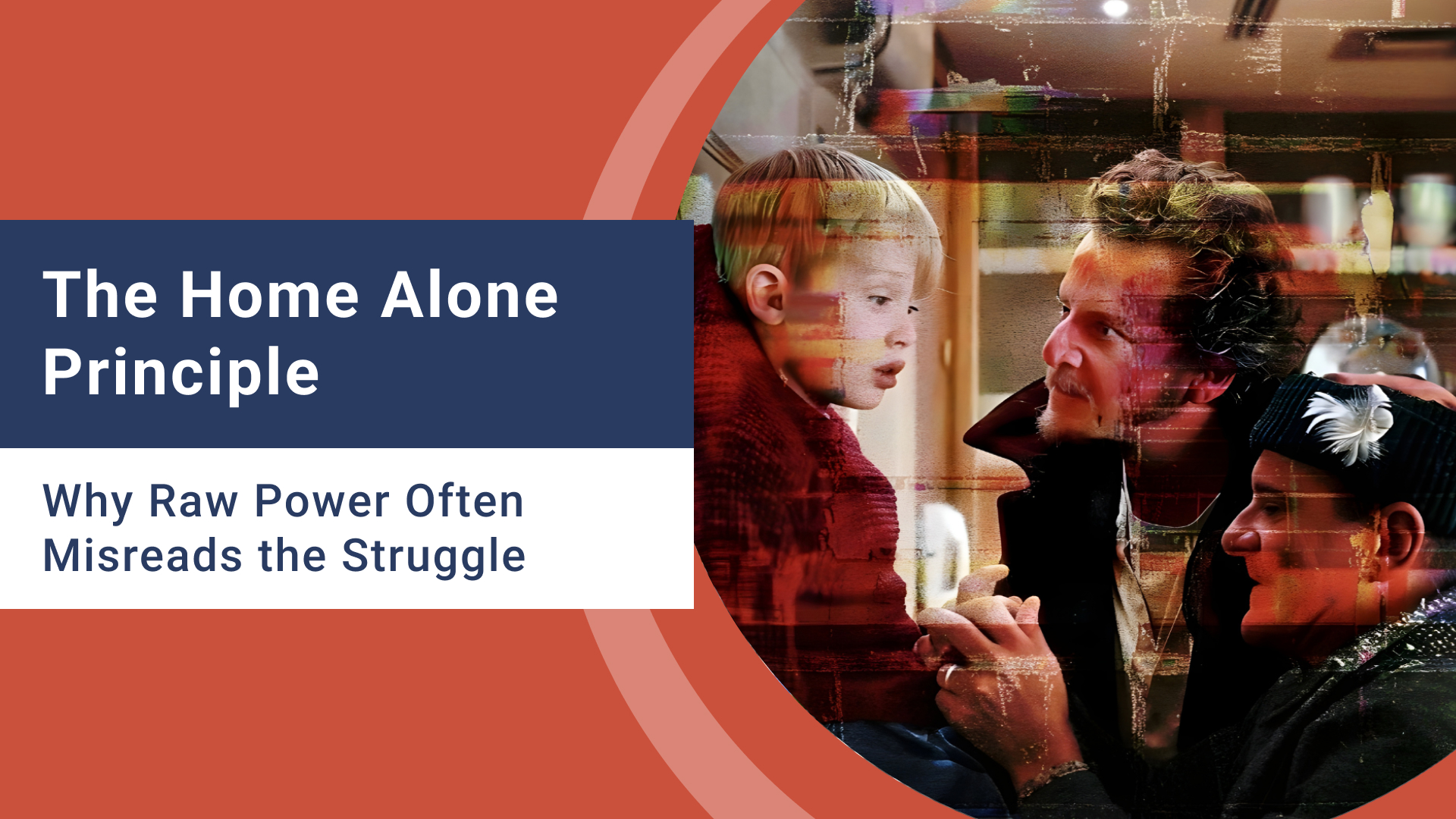

Reality is not a mathematics paper where the largest number wins.
The Night Kevin Was Home Alone
Many people still remember the opening tension of Home Alone. A quiet suburban neighbourhood at Christmas. Lights on the houses, snow outside, families preparing for the holidays. Inside one of those houses is a boy who has accidentally been left behind when his family rushes to the airport. Kevin McCallister is eight years old and suddenly finds himself alone.
At first, the situation looks harmless, even amusing. But the tone quickly changes when Kevin realises that two burglars are planning to break into the house. If someone were to analyse the situation purely as a calculation of power, the outcome would appear obvious. Two grown criminals with experience and physical strength versus a single child. In a simple arithmetic view of the world, the story should end quickly. Yet that is not what happens.
What unfolds instead is a strange reversal. The burglars repeatedly attempt to enter the house, and each time they are met with another trap. They slip on icy stairs, step on nails, burn their hands, and fall into carefully placed obstacles. Kevin never confronts them directly in a physical fight. He does something more interesting. He studies them, anticipates their behaviour, and quietly reshapes the environment around them. The house becomes his strategy.
Objects that appear ordinary suddenly become tools. Paint cans, toys, ropes, and ice are turned into a system of defence. Every time the burglars believe they have the upper hand, they discover that the situation has already been altered in ways they did not expect. The more confident they are, the more clumsy they become. The more they rely on their size and experience, the more those advantages lose their meaning.
What makes the film memorable is not simply the humour of the traps. It is the deeper pattern underneath the comedy. The situation that initially appears hopeless slowly transforms into something entirely different. The boy who seemed powerless becomes the one shaping the events of the night. The burglars who seemed dominant gradually lose control of the situation.
The story is exaggerated for entertainment, but it quietly points to a phenomenon that appears far beyond cinema. In many forms of competition, power is not determined simply by size, resources, or raw strength. Sometimes, the side that appears weaker at the beginning is simply the side that has not yet revealed how the game will actually be played.
The Arithmetic Illusion of Power
Many people unconsciously think about competition the same way they might think about a simple calculation. Larger armies defeat smaller ones. Bigger companies crush smaller competitors. Organisations with more money, more staff, and more resources appear almost impossible to challenge. From this perspective, outcomes seem predictable because power is treated as something that can be measured in straightforward quantities. Yet reality rarely behaves that neatly.
Again and again, situations appear where the smaller actor does not disappear, and sometimes even manages to outperform the larger one. This happens in business, technology, culture, and many other domains of human activity. What initially looks like a mismatch often turns into something more complicated once the struggle begins to unfold.
Consider the rise of Netflix. In its early days, it was a small company mailing DVDs to customers while the dominant force in the market was Blockbuster, a corporate giant with thousands of retail stores across the world. From a purely arithmetic view of competition, the outcome should have been obvious. The giant had brand recognition, infrastructure, capital, and market presence. Yet within a relatively short period, the smaller company reshaped the entire industry while the dominant player vanished.
Something similar happened with Zoom Video Communications. Long before it became widely known, large technology firms such as Microsoft, Cisco, and Google already offered communication platforms and had far greater resources. Yet during a moment of global disruption, a comparatively small company became the tool millions of people relied upon daily.
These examples do not mean that size and resources are irrelevant. They matter, and often they matter greatly. But they are not the whole story. Competition is not merely about how much power one possesses. It is also about how that power is organised, how quickly it can adapt, and how creatively it can respond when the situation begins to change.
Large systems often develop strengths that come with hidden weaknesses. Their scale can slow them down. Their established ways of operating can make them less flexible. Their confidence in their own dominance can blind them to emerging shifts in the environment. Meanwhile, smaller actors often survive precisely because they must constantly adapt. They observe more carefully, move faster, and experiment more boldly.
This is why the simple arithmetic view of competition frequently misleads people. It assumes that the contest will remain static and predictable. In reality, contests evolve. The moment strategies begin to interact with each other, the situation becomes dynamic rather than mechanical. What seemed inevitable at the beginning can slowly unravel as new moves reshape the landscape.
The lesson hidden inside the comedy of Home Alone begins to appear again here. Kevin does not defeat the burglars because he is stronger than them. He wins because he refuses to play the game on their terms. He changes the structure of the situation itself.
What Power Actually Is
The question of power has occupied thinkers for thousands of years. From ancient philosophers to military strategists, from rulers and emperors to modern policymakers, people have tried to understand what power really means and where it actually comes from.
The simplest interpretation treats power as something measurable. More resources, more money, more weapons, more numbers. From that viewpoint, power looks like a quantity that can be compared almost like weight or distance. Yet throughout history, this interpretation has repeatedly proven incomplete.
Many actors with overwhelming resources have failed to achieve their goals, while smaller actors have sometimes reshaped entire systems. Empires have struggled against far smaller opponents. Large organisations have been disrupted by tiny startups. In many areas of life the visible concentration of resources does not always translate into control. This is because power is not only external.
Power also emerges from the capacities of the individuals and groups who are acting within a situation. Awareness is power. Clarity is power. Adaptability is power. Courage is power. The ability to remain calm under pressure is power. The ability to learn faster than others is power. In other words, power often originates in how we are being before it appears in what we are able to do.
This insight sits at the heart of the Being Framework and the work explored in Being: The Source of Power. The framework proposes that action and results are not independent of the inner capacities of the actor. They arise from them. The qualities of being present in individuals and groups shape how situations are perceived, how decisions are made, and how effectively people respond when circumstances change.
When these qualities are developed, power begins to express itself in ways that are not immediately visible. A person who acts with responsibility, proactivity, resilience, and presence can often influence situations far beyond what their raw resources might suggest.
Seen from this perspective, Kevin’s actions in Home Alone begin to make more sense. The traps are not the real source of his advantage. The deeper source lies in how he responds to the situation. He takes responsibility instead of panicking. He prepares instead of waiting. He observes instead of assuming.
The physical tools he uses are secondary. The real power comes from the capacities he brings into the situation. Once those capacities are present, the apparent imbalance between him and the burglars begins to look very different.
Changing the Game
What Kevin does in Home Alone is not simply clever mischief. The deeper point is that he refuses to engage the intruders on the terms they expect. If he had tried to confront them directly, the outcome would have been obvious. Two adults against a child is not a fair contest. Kevin understands this instinctively, so he does something far more intelligent. He changes the structure of the situation.
Instead of relying on strength, he relies on awareness. He observes how the burglars behave, where they step, what they assume about the house, and how confident they are about entering it. Once he understands their pattern, he begins to reshape the environment around them. The house becomes more than a building; it becomes a system of obstacles designed to frustrate them. Every ordinary object becomes a tool. Paint cans, toys, ropes, ice, and stairs are all repurposed into small but effective disruptions.
What makes this effective is not the traps themselves but the mindset behind them. Kevin acts with initiative. He prepares before the intruders arrive. He takes responsibility for the situation rather than waiting helplessly. He experiments, adjusts, and keeps moving forward even when he is frightened. These qualities are not about physical power. They are capacities of being: proactivity, resourcefulness, persistence, courage, and resilience.
Once those qualities are present, something interesting begins to happen. The stronger side slowly becomes the reactive side. The burglars start the night believing they are in control. They assume the house will be easy to enter and the boy easy to intimidate. Yet every step they take pulls them into another unexpected consequence. Their confidence turns into frustration, and their frustration makes them careless. The more they try to impose their advantage, the more the situation slips out of their control.
This dynamic appears far beyond cinema. In many struggles, the side with fewer resources survives not by matching the stronger side directly but by constantly changing the conditions of the contest. They adapt quickly. They exploit blind spots. They transform limitations into creative advantages. Instead of trying to overpower the opponent, they make the opponent’s own assumptions work against them.
When that shift occurs, the balance of power begins to look very different from the simple calculation that existed at the beginning. What once appeared to be a mismatch slowly becomes a contest shaped by intelligence, persistence, and adaptability rather than by size alone.
When Strength Becomes a Weakness
One of the subtle patterns in Home Alone is how the burglars slowly become prisoners of their own assumptions. At the beginning of the night, they are relaxed and confident. They believe they are dealing with a helpless child and an empty house. Their experience tells them the job will be easy. That assumption shapes everything they do.
Yet that confidence becomes the very thing that blinds them.
They stop observing carefully. They repeat the same approach again and again. Each time they walk into another trap, they treat it as bad luck rather than reconsidering the situation itself. Instead of stepping back and reassessing, they keep pushing forward with the same mindset that failed them the previous time. The result is almost comical, but the pattern is recognisable far beyond the film.
Dominant actors often develop habits that make them strong in one environment but fragile in another. Large organisations can rely so heavily on their scale that they struggle to change direction quickly. Powerful institutions sometimes assume their reputation alone will maintain their advantage. Individuals who have been successful for a long time can begin to trust their past formulas even when circumstances have shifted. Strength, in other words, can quietly become rigidity.
The burglars believe their size and experience guarantee success. That belief prevents them from recognising that the environment around them has changed. Every trap Kevin sets is not only a physical obstacle but also a psychological one. It exposes how predictable the intruders have become.
The boy, meanwhile, is forced to stay alert. Because he cannot rely on brute strength, he must rely on something else. He pays attention. He experiments. He remains flexible enough to adjust when something does not work. What appears at first to be a disadvantage slowly becomes a source of adaptability.
This is why the simple arithmetic of power often fails to explain how many contests unfold. Raw strength certainly matters, but it rarely acts alone. It interacts with awareness, perception, confidence, and the ability to adapt when reality refuses to follow expectations. When strength loses the ability to learn, it can slowly transform into its opposite.
The burglars in the film never recognise that their biggest problem is not the traps themselves. Their real problem is the assumption that the boy cannot possibly outthink them.
When Bigger Power Falls Into the Hubris Trap
One of the great dangers of larger power is not only that it can become forceful. It is that it can become self-deceived.
This is where hubris enters the picture. As explored in The Probability of Hubris, arrogance is not merely a moral flaw or an unpleasant personality trait. It is often a structural distortion in how individuals, institutions, and entire systems relate to reality. When self-image, persona, and narrative begin to drift away from consequences, power starts to misread itself. It mistakes projection for truth, scale for control, and confidence for accuracy.
This matters because bigger power usually operates with greater visibility, more interactions, and a stronger need to maintain its narrative. In The Probability of Hubris, this dynamic is examined through the Exposure Probability Model (EPM). The model suggests that the risk of exposure increases as four factors grow: distortion (D) between projection and reality, the number of interactions (N) an actor has with the world, the visibility (V) of those actions, and the capacity of observers (C) to recognise inconsistencies, while adaptive correction (A) represents the ability of the system to adjust when reality pushes back.
The article presents this conceptually as:
R = (D × N × V) / A
and in the expanded version includes observer capacity:
R = (D × N × V × C) / A
In plain terms, the bigger the gap between projection and reality, the more opportunities reality has to expose the contradiction.
This helps explain why dominant actors often become vulnerable precisely where they appear strongest. The heavier they are, the harder they fall. The higher they rise on an inflated image of themselves, the more kinetic force is generated when reality pushes back. Their size does not merely magnify their reach. It magnifies their exposure. Their scale does not merely amplify their power. It amplifies the number of interactions through which that power can be tested. And when visibility is high, every misjudgment, overreach, or contradiction enters a wider field of observation.
In that sense, gravity becomes the hidden enemy of bloated power. A smaller actor can make mistakes and remain partly obscure. A larger actor cannot. The more inflated the persona, the more energy must be spent maintaining it. As The Probability of Hubris puts it, the more self-image and persona diverge from reality, the more effort must go into managing inconsistencies, explaining contradictions, and reframing failures. Eventually, the system becomes unstable, not because reality is moralistic, but because reality accumulates evidence faster than narrative can contain it.
This is exactly the trap larger power often falls into when facing a smaller, more adaptive opponent. It underestimates the other side because it overestimates itself. It believes scale will settle the matter. It assumes superiority where there may only be size. It keeps pushing deeper into the contest, not realising that every additional move can increase friction, contradiction, and exposure. What began as dominance can become a rabbit hole of self-reinforcing error.
That is why the old saying still holds: the bigger you are, the harder you fall. But in structural terms, the deeper truth is even sharper. The bigger you are, the more your distortions cost. The heavier you are, the more gravity turns against you. And the more convinced you are of your own invincibility, the less likely you are to make the adaptive corrections that might have saved you. In asymmetric struggles, this is often where the larger power quietly begins to lose the game.
Knowing Your Terrain (Domain)
Another reason Kevin succeeds in Home Alone is much simpler than the traps themselves. He knows the house.
Every stair, every hallway, every door, every creaking floorboard is familiar to him. The burglars are stepping into someone else’s terrain. They are entering a space they barely understand, while the boy moves through it effortlessly. What looks like a chaotic series of tricks is actually something more structured: Kevin is using the environment that belongs to him.
This principle appears in many forms of competition. Those who understand the terrain they operate in often hold advantages that are not immediately visible. Terrain is not only physical space. It can also mean knowledge of a market, familiarity with a community, mastery of a craft, or a deep understanding of the domain in which a struggle takes place.
In the Nested Theory of Sense-making, this would be recognised as domain recognition. Before any contest unfolds, one must understand what domain they are actually operating in. Many people lose not because they are weaker, but because they unconsciously accept someone else’s definition of the game. They begin playing on rules designed by others, in environments where the other side already holds the advantage.
Kevin does the opposite. He never leaves the house to confront the burglars on neutral ground. He keeps the contest inside a space where he understands every corner and where the intruders remain uncertain. The terms of the encounter quietly shift in his favour because the terrain itself becomes part of his strategy.
There is an old agricultural proverb that captures this insight with surprising simplicity: “The best fertiliser for the farmer’s field is the farmer’s own footsteps.” The saying suggests that the farmer who walks his land regularly, observes it closely, and understands its patterns will naturally cultivate a healthier harvest. Familiarity with one’s own terrain creates awareness that cannot easily be replicated from the outside.
The same logic appears across many areas of life. Entrepreneurs who deeply understand the problem they are solving often outperform larger competitors who view the market only through spreadsheets. Communities that know their own environment can remain resilient even when confronted by forces that appear stronger. Individuals who understand their own capabilities and limitations are far less likely to be manipulated by the expectations of others.
Knowing the terrain does something else as well. It allows a person or organisation to set the terms of the contest rather than merely reacting to someone else’s strategy. Instead of being dragged into battles designed by the stronger side, they quietly reshape the environment so that the strengths they do possess begin to matter more.
Kevin’s traps are funny because they are exaggerated, but the underlying principle is serious. The house becomes his advantage because it is a domain he understands. And once the struggle unfolds on terrain he knows intimately, the apparent imbalance between a child and two adults begins to look far less certain.
The Capacities That Shift the Balance
When people watch Home Alone, the traps usually get the attention. The falling paint cans, icy steps, and improvised obstacles are what make the film memorable. But the traps are only the surface. What actually drives the story is the set of capacities Kevin develops under pressure.
He takes responsibility for the situation instead of waiting for rescue. He prepares in advance. He observes carefully. He adapts quickly when something does not go as planned. Fear is present, but it does not immobilise him. Each of these qualities seems simple on its own, yet together they form a powerful pattern.
Proactivity allows him to act before the burglars fully impose themselves on the house. Resourcefulness turns ordinary objects into strategic tools. Persistence prevents early mistakes from becoming defeat. Courage allows him to keep moving despite uncertainty. Resilience helps him recover quickly when something goes wrong. Freedom of action allows him to remain unpredictable, constantly shifting the conditions of the encounter.
These capacities are rarely discussed when people analyse competition, yet they often determine how contests unfold. Raw power is visible and easy to measure. Capacities of being are quieter but frequently more decisive. They shape how individuals and groups respond when the environment becomes unstable.
This is one of the reasons why underdogs sometimes surprise stronger opponents. When survival depends on adaptation, creativity, and initiative, those capacities tend to grow rapidly. Meanwhile, dominant actors may rely on systems and structures that once worked well but are slower to change. Over time, the difference in agility can begin to matter more than the difference in size.
None of this guarantees victory for the smaller side. Power disparities are real and often overwhelming. Yet the film hints at something that appears repeatedly in the real world: the outcome of a struggle is rarely determined by raw strength alone. Awareness, responsibility, adaptability, and persistence can gradually reshape the field of competition in ways that simple calculations fail to capture.
Kevin’s success is exaggerated for comedy, but the underlying message is surprisingly serious. Sometimes the side that appears weaker at the beginning is simply the side that has learned to develop capacities the stronger side no longer pays attention to.
When the Game Changes
By the end of Home Alone, the balance of power looks completely different from how it appeared at the beginning. Two adults who seemed certain to dominate the situation are reduced to stumbling through a house they no longer understand. The child who seemed vulnerable becomes the one shaping the events of the night.
Nothing magical happened. Kevin did not suddenly become stronger than the intruders. What changed was the structure of the contest itself.
This is where many analyses of competition go wrong. People often focus only on visible quantities such as resources, size, reputation, or numerical strength. Those things matter, but they do not fully determine how struggles unfold. What often matters just as much is who controls the terms of the encounter.
When one side is able to reshape the terrain, redefine the rules, or alter the rhythm of interaction, the entire contest begins to evolve in unexpected ways. The stronger side may still possess greater raw power, but that power becomes harder to apply effectively when the environment no longer behaves as expected.
In many domains of life, this shift appears again and again. Smaller actors sometimes survive by constantly adjusting the structure of the situation rather than confronting the stronger side directly. They move faster, experiment more freely, and remain willing to change their approach when circumstances shift. Instead of meeting force with force, they transform the landscape in which force must operate.
This is why competitions rarely follow the neat predictions people make at the beginning. What appears inevitable from a distance often becomes far less certain once the interaction begins. Every move triggers a response. Every response reshapes the situation. Slowly, the contest becomes less about who started with the greatest power and more about who can continue adapting as the game evolves.
The story of Kevin McCallister exaggerates this dynamic for humour, but it captures a truth that appears in many real struggles. The side that seems weakest at the outset is sometimes the one that quietly learns how to change the game.
Why Adaptation Matters in a Changing World
Another layer of the story in Home Alone is how quickly the situation changes throughout the night. Nothing stays stable for long. Every time the burglars think they have understood what is happening, something shifts. A new obstacle appears. A different path is taken. The environment behaves differently than expected.
Kevin survives not because he controls everything, but because he continues adjusting to what unfolds.
This is an important insight that extends far beyond a Christmas film. In reality, situations rarely remain static. Markets change. Technologies evolve. Political environments shift. Relationships transform. What seemed stable yesterday may behave very differently tomorrow.
In other words, we are almost always operating in conditions of transition.
This is why the idea of sustainability cannot simply mean preserving things exactly as they are. In the work developed in Sustainabilism and the Authentic Sustainability Framework, sustainability is understood differently. A system is sustainable not because it never changes, but because it can continue functioning and adapting while conditions change around it.
One of the key capacities behind this is modulation.
Modulation is the ability to adjust intelligently as the situation evolves. It involves sensing changes early, recalibrating actions, and remaining flexible enough to respond without losing coherence or direction. Systems that lack this capacity often appear strong for a time but become fragile when circumstances shift.
Kevin demonstrates a simple version of modulation throughout the film. He sets traps, observes how the burglars react, and adjusts his approach as the night unfolds. Nothing about his strategy is static. Each move responds to what has just happened.
In many areas of life, the same principle applies. Organisations that can modulate their strategy remain resilient even in volatile environments. Communities that adapt to changing conditions endure longer than those that cling rigidly to past formulas. Individuals who remain attentive to shifting realities are far better equipped to navigate uncertainty.
Sustainability, therefore, is not about freezing a system in place. It is about maintaining the capacity to adjust while remaining grounded in clear principles and understanding.
When modulation is present, power becomes more fluid and adaptive. When it is absent, even very powerful systems can struggle the moment their environment begins to change.
Kevin’s victory in Home Alone is humorous and exaggerated, but it illustrates a serious point. The side that continues adapting often outlasts the side that assumes the situation will remain predictable.
Adaptability: The Capacity That Makes Modulation Possible
In the Authentic Sustainability Framework developed in Sustainabilism, modulation depends on a deeper human capacity: adaptability. While modulation describes the system’s ability to adjust to changing conditions, adaptability refers to the quality within individuals and institutions that makes such adjustment possible.
Below is the distinction of Adaptability in the Authentic Sustainability Framework:
Adaptability is your capacity to recalibrate in response to change without losing coherence. It is not about being agreeable or compliant. Instead, it’s about remaining attuned to context while anchored in your ethical and ontological centre: your deeper sense of truth, coherence and what ultimately matters. Adaptability enables systems – whether personal, relational or institutional – to respond to evolving conditions, not by resisting change, but by shaping it with discernment, intelligence and purpose. It is not softness or passivity, but a generative posture of sustainable responsiveness. Adaptability enables transformation without fragmentation – growth that preserves coherence rather than breaking it apart – and evolution without self-erasure.
A healthy relationship with adaptability indicates that you can shift behaviours, perspectives or strategies in the presence of new information or altered circumstances while remaining true to your values, purpose and Being. You are responsive without being reactive, flexible without being formless. You can evolve in ways that honour continuity, enabling resilience, creativity and sustained relevance. In relationships and leadership, this posture fosters trust and agility without sacrificing coherence.
An unhealthy relationship with adaptability indicates that you fall into one of two extremes. On one side, it shows up as chronic morphing – changing yourself constantly to avoid discomfort, rejection or tension. This people-pleasing collapses coherence and erodes trust, leading to identity diffusion and instability. On the other side, it manifests as rigid resistance – mistaking stubbornness for strength and refusing necessary change even when coherence demands it. In both cases, adaptability is distorted: either abandoning integrity for harmony or clinging to familiar habits or appearances at the cost of evolution. Leaders under this influence become inconsistent, brittle or untrustworthy – not because values are absent, but because their expression lacks continuity.
Sustainabilism (Tashvir, 2025)
Seen through this lens, the story in Home Alone illustrates a simple but powerful example of adaptability in action. Kevin does not follow a fixed script. He observes, adjusts and recalibrates as the situation unfolds. Each move he makes responds to new information about the burglars’ behaviour. His strategy evolves throughout the night, but the underlying intention remains constant: protect the house.
This is precisely what sustainable responsiveness looks like. Adaptability allows action to evolve while coherence remains intact. And in an asymmetric world where situations change rapidly, this capacity often becomes far more decisive than raw power alone.
The Underdog Illusion
What makes Home Alone memorable is not simply that Kevin wins the night. It is how the story slowly dismantles the assumption that the situation was ever as one-sided as it first appeared.
At the beginning, everything seems predictable. Two adult criminals against a child. Experience against innocence. Physical strength against vulnerability. Anyone observing the situation from a distance would likely reach the same conclusion: the boy has no chance.
Yet that conclusion rests on a very narrow understanding of power.
Power is often imagined as something that belongs to the side with greater numbers, larger resources, or stronger physical force. But real struggles rarely unfold in such simple ways. Power also emerges through awareness, adaptability, persistence, and the ability to shape the environment in which the contest takes place. These capacities are harder to measure, yet they frequently determine how events evolve once the interaction begins.
This is why underdogs are so often misread.
What appears to be weakness at the beginning may actually conceal a different kind of strength. When individuals or groups cannot rely on sheer scale, they are often forced to develop sharper awareness and greater flexibility. They learn to observe more closely, move more creatively, and respond more quickly to changes in the situation. Over time, these capacities can begin to shift the balance in subtle but important ways.
Meanwhile, the stronger side may slowly become constrained by its own assumptions. Confidence can turn into complacency. Established habits can become rigid patterns. When a dominant actor expects the world to behave in a predictable way, the ability to notice small shifts in the environment can gradually diminish.
The result is a paradox that appears throughout many forms of competition. The side that looks dominant from the outside may actually become less adaptive over time, while the side that appears disadvantaged continues to sharpen its capacity to respond.
Kevin McCallister’s victory is exaggerated for comedy, but the deeper message resonates far beyond the film. The underdog is not always the weaker participant in a contest. Often, the underdog is simply the participant whose strengths have not yet been recognised.
And when the contest finally begins to unfold, those hidden capacities can begin to matter far more than the arithmetic people assumed would decide the outcome.
Before the Contest Even Begins
There is one more subtle lesson hidden in the story of Home Alone. Long before the burglars step into the house, the most important advantage has already formed. Kevin understands where he is. He knows the house, the layout, the objects around him, the staircases, the doors, and the small details the intruders will never notice. The contest begins on terrain that belongs to him.
In many real struggles, this factor appears long before any visible confrontation. The outcome is often shaped by how well each side understands the domain in which the contest will unfold. Those who know their environment intimately can move with a kind of natural confidence. They recognise patterns others overlook. They sense opportunities earlier. They notice small shifts that outsiders fail to see.
There is an old proverb that farmers have repeated for generations: the best fertiliser for a farmer’s land is the farmer’s own footsteps. The saying is simple, yet its meaning is profound. A farmer who walks the land regularly, observes the soil, notices the weather, and understands the rhythms of the field will cultivate far better results than someone who tries to manage the same land from a distance.
The same principle applies far beyond agriculture. Entrepreneurs who deeply understand the problem they are solving often outperform larger companies that analyse the same market only through reports and projections. Communities that know their environment well can remain resilient even when confronted by forces that appear stronger. Individuals who understand their own capabilities and limits are far less likely to be pushed into contests that do not serve them.
Domain recognition is therefore not a small detail. It is often the quiet foundation of resilience. When people fail to recognise the domain they are operating in, they easily become trapped in someone else’s game. They begin playing according to rules designed by others and on terrain where the advantage already belongs elsewhere.
Kevin avoids that mistake. He never chases the burglars into their world. He keeps the contest inside a house he understands better than anyone else present. The terrain itself becomes an ally.
Once that happens, the situation that initially looked like a simple imbalance of power slowly transforms into something far less predictable.
When the Smaller Side Refuses to Disappear
There is a moment in Home Alone when the burglars begin to realise something has gone wrong. The house they assumed would be an easy target has turned into a series of setbacks. Each attempt to assert control leads to another unexpected obstacle. Their frustration grows not simply because of the traps, but because the situation refuses to behave the way they expected.
This pattern appears in many real forms of competition. Larger actors sometimes assume that smaller participants will eventually give up or disappear. The logic seems straightforward: greater resources should gradually overwhelm weaker opponents. Yet the real world repeatedly produces situations where the smaller side refuses to vanish.
Sometimes the reason is persistence. Sometimes it is adaptability. Sometimes it is a deep understanding of terrain that outsiders never fully grasp. In other cases, it is simply the willingness to endure long enough for circumstances to shift.
History, business, and many areas of human life contain countless examples of actors who survived because they continued adjusting while stronger opponents assumed the outcome was already decided. The side with greater scale often expects quick submission. When that submission does not arrive, the contest becomes something entirely different from what was originally imagined.
What initially looked like dominance slowly turns into frustration. The stronger side must expend increasing effort to maintain control, while the smaller side learns, adapts, and gradually strengthens its position. Over time, the interaction begins to reshape the landscape itself.
Kevin’s situation in the film captures this dynamic in a playful way. The burglars do not lose because they lack strength. They lose because the person they expected to overwhelm never behaves according to their assumptions. The boy refuses to panic, refuses to surrender the house, and continues reshaping the situation with each passing moment.
This refusal to disappear is often the turning point in many struggles. Once the supposedly weaker side demonstrates resilience and adaptability, the simple calculation that predicted an easy outcome begins to lose its credibility. The contest enters a different phase, one where persistence and creativity begin to matter as much as scale.
A Different Way to Think About Competition
What the story of Home Alone ultimately invites us to reconsider is how we think about competition itself. Too often, people approach struggles as if they were static events that can be predicted simply by comparing visible strengths. Larger organisation versus smaller organisation. Stronger side versus weaker side. More resources versus fewer resources. From that perspective, the conclusion often appears obvious before anything has even begun.
Yet real contests rarely unfold in such a linear way.
Once interaction begins, the situation becomes dynamic. Every move produces a reaction, and every reaction slightly reshapes the environment. Strategies evolve. Assumptions are tested. Unexpected opportunities emerge. The contest gradually becomes less about the initial balance of resources and more about how intelligently each side navigates the unfolding situation.
This is why individuals, organisations, and communities sometimes underestimate their own possibilities. They see the apparent scale of the other side and assume that nothing can be done. But scale alone does not determine outcomes. Awareness, creativity, persistence, and the ability to understand one’s terrain can slowly shift the conditions under which power operates.
None of this guarantees victory for the smaller side, and it would be naïve to pretend otherwise. Power disparities are real and often decisive. But the lesson worth remembering is that competition is rarely a simple arithmetic equation. Once strategy, adaptation, and human ingenuity enter the picture, the situation becomes far more fluid.
Kevin McCallister does not defeat the burglars because he suddenly becomes stronger than them. He wins because he recognises that the contest will not be decided by strength alone. By observing carefully, preparing intelligently, and constantly reshaping the environment, he turns a situation that looked hopeless into something entirely different.
In doing so, the story leaves us with a simple but enduring insight. The side that appears weakest at the beginning of a struggle is not always the side without power. Sometimes it is simply the side that understands the situation differently and has the courage to play the game on its own terms.
The Real Meaning of the Underdog
When people hear the word underdog, they often imagine someone who is simply weaker and unlikely to succeed. The term usually carries a quiet expectation of defeat. Yet many situations described as underdog stories reveal something more complex. What appears to be weakness is often a misreading of the actual dynamics at play.
The story in Home Alone illustrates this perfectly. At the beginning, Kevin seems like the obvious underdog. He is smaller, younger, and physically outmatched. But as the night unfolds, a different reality emerges. The burglars have strength, but Kevin has awareness. They have size, but he has agility. They rely on intimidation, while he relies on creativity and preparation.
Once the situation begins to evolve, those differences matter far more than the simple comparison that existed at the beginning.
In many areas of life, underdogs succeed not because they suddenly gain more power but because they learn to use the power they already have in more intelligent ways. When survival depends on it, people develop sharper perception, greater adaptability, and a stronger willingness to experiment. Limitations often force the kind of creativity that abundance can quietly suppress.
Meanwhile, those who appear dominant may gradually become dependent on the very advantages that once made them strong. Systems that rely heavily on scale can become slow to adjust. Established actors sometimes struggle to recognise when the environment has shifted. Confidence in past success can quietly turn into complacency.
The result is that many struggles do not unfold according to the initial assumptions people make. What begins as a mismatch can gradually turn into a contest shaped by learning, adaptation, and persistence. The underdog is not always the weaker participant. Often, the underdog is simply the participant who has been underestimated.
Kevin’s victory may belong to the realm of comedy, but the pattern it illustrates appears again and again in the real world. The side that seems least powerful at the outset may be the one that remains alert, flexible, and willing to reshape the conditions of the encounter. Over time, those qualities can matter far more than the advantages that looked decisive at the beginning.
The Quiet Confidence of Those Who Understand the Game
Perhaps the most important shift in Home Alone is not the traps, the injuries, or even the eventual defeat of the burglars. It is the gradual change in Kevin himself. At the beginning of the story, he is simply a child who finds himself alone and uncertain. As the situation unfolds, something else emerges. He begins to understand the problem in front of him and slowly takes ownership of it.
That shift changes everything.
Once a person begins to understand the terrain, the domain they are operating in, and the nature of the contest itself, a quiet form of confidence begins to appear. It is not loud or arrogant. It does not rely on intimidation or spectacle. It comes from clarity. The person recognises what they can influence, what they cannot, and where their strengths actually lie.
From that point onward, the contest looks very different.
Instead of reacting to the moves of a stronger opponent, they begin to act deliberately. They set small conditions that favour their position. They exploit blind spots others overlook. They remain patient when the situation requires patience and decisive when the moment calls for action. Over time, the struggle becomes less about surviving the opponent’s power and more about shaping the environment in which that power must operate.
This is why some actors who appear smaller or weaker can still endure against formidable competitors. Their advantage is not raw force but clarity of understanding. They recognise that contests are rarely decided in a single dramatic moment. They unfold through a series of adjustments, decisions, and responses that gradually reshape the situation.
Kevin never becomes physically stronger than the intruders. What changes is his relationship to the situation. Once he understands the house, prepares the environment, and commits to acting rather than waiting, the apparent imbalance between him and the burglars begins to dissolve.
The lesson that emerges is simple but powerful. When individuals or groups understand the game they are playing, recognise their terrain, and cultivate the capacities required to act within it, the meaning of power itself begins to change. The contest is no longer defined solely by who appears strongest. It becomes defined by who understands the situation most clearly and who has the courage to shape it accordingly.
A Final Reflection
The story of Home Alone endures because it captures a pattern people recognise instinctively, even if they rarely articulate it clearly. What appears obvious at the beginning of a contest often turns out to be misleading. Visible strength does not always translate into control. Scale does not always translate into effectiveness. Confidence does not always translate into understanding.
Kevin begins the night as the person everyone would assume has the least chance of succeeding. Yet the moment he stops thinking of himself as powerless and begins engaging the situation with awareness, responsibility, and creativity, the dynamics start to shift. The house becomes terrain he understands. The objects around him become tools. The intruders’ assumptions become weaknesses.
None of this happens through dramatic displays of force. It happens through a series of small decisions that gradually reshape the situation.
That is often how many real struggles unfold as well. The decisive turning points rarely come from a single overwhelming act. They emerge from preparation, observation, persistence, and the willingness to keep adjusting when the environment changes. Those who remain attentive to the terrain they inhabit and who develop the capacities required to operate within it often discover possibilities that others overlook.
Seen from that perspective, the idea of the underdog begins to look different. The side that appears disadvantaged at the beginning may simply be the side that has not yet revealed how it understands the game. Once that understanding begins to guide action, the neat calculations that predicted the outcome can quickly lose their certainty.
Kevin McCallister never defeats the burglars by becoming stronger than them. He simply refuses to accept the contest as it was initially imagined. And in doing so, he demonstrates a lesson that extends far beyond a fictional house on a winter night: sometimes the most important shift in a struggle occurs not when power increases, but when understanding deepens.