

Background - Inauthenticities and the Fragility of Identity Narratives
Across individuals, organisations, and societies, identity is rarely neutral. People and institutions construct narratives about who they are, what they represent, and why their actions are justified. These narratives shape perception, guide decisions, and influence how others respond.
When such narratives remain grounded in reality, they create stability and may lead to sustainability. Identity becomes a reliable reference point for behaviour and judgement. But when these narratives drift away from reality, distortion begins to emerge.
In this article, we refer to such distortions as inauthenticities.
Inauthenticities are any manifestations of an unhealthy relationship with authenticity. They arise when the stories individuals or systems tell about themselves become misaligned with observable reality. This misalignment can take many forms. It may appear as exaggerated self-images, defensive beliefs, ideological rigidity, moral exceptionalism, or carefully managed personas that conceal underlying contradictions.
Importantly, inauthenticities are rarely created intentionally at the outset. They often emerge gradually as narratives evolve to protect identity rather than examine reality. Over time, the narrative becomes more important than the evidence surrounding it.
In the short term, such narratives can be powerful. They mobilise support, reinforce group cohesion, and create the appearance of certainty or strength. Leaders may amplify them to inspire followers. Institutions may repeat them to preserve legitimacy. Nations may elevate them to sustain collective identity.
Yet the very mechanism that gives these narratives strength also introduces fragility.
Whenever identity becomes detached from reality, the system must increasingly rely on explanation, justification, and narrative reinforcement to maintain coherence. Decisions must be interpreted in ways that preserve the story. Outcomes must be framed carefully to avoid contradicting the narrative. Observers must be persuaded that the projected identity still reflects reality.
For a time, this process can succeed.
But every decision, statement, and observable outcome generates new information. Over time, the number of interactions between narrative and reality expands. As these interactions accumulate, inconsistencies become harder to conceal and patterns begin to emerge.
What initially appears as strength may therefore conceal a structural vulnerability.
Understanding this vulnerability requires moving beyond moral judgment and examining the underlying dynamics through which inauthenticities accumulate and eventually reveal themselves.
This article introduces the Exposure Probability Model (EPM) as a conceptual framework for understanding those dynamics.
Introduction - Authenticity as Structural Alignment With Reality
Authenticity is often discussed in moral or psychological terms. People are encouraged to “be authentic” as if authenticity were primarily a matter of sincerity or personal expression. While these interpretations capture part of the idea, they do not fully explain why authenticity matters so profoundly in leadership, institutions, and complex systems. Within the Being Framework, authenticity is understood more precisely as a structural relationship with reality. It reflects the degree to which a person's self-image, expressed persona, beliefs, and opinions remain aligned with observable outcomes and consequences. Authenticity, therefore, functions not only as a personal virtue but also as a stabilising condition for identity systems.
When individuals or institutions maintain an authentic relationship with reality, they remain capable of adjusting their behaviour when new information emerges. Decisions evolve, interpretations are revised, and narratives adapt to evidence. In such conditions, identity remains flexible and coherent because it continuously realigns itself with reality. Inauthenticities arise when this alignment weakens. An exaggerated self-image may begin to shape perception, a persona may be constructed that conceals weaknesses rather than acknowledging them, beliefs may shift from tools of inquiry to instruments of self-protection, and opinions may become declarations of identity rather than reflections of evidence.
When these patterns emerge, the relationship between identity and reality becomes increasingly strained. The narrative a person or institution tells about itself begins to diverge from the consequences that reality produces. In the short term, such distortions can remain invisible. Narratives can be reinforced through repetition, authority, or emotional appeal. Supporters may continue affirming the story, and institutions may protect the narrative because it preserves legitimacy or stability. Yet these mechanisms do not eliminate the underlying tension. Reality continues to generate outcomes. Decisions produce observable consequences, actions leave traces that others can examine, and every interaction becomes another opportunity to compare narrative with reality.
As interactions accumulate, the likelihood that contradictions will emerge gradually increases. Observers begin comparing statements with outcomes, promises with results, and projected identities with observable behaviour. What begins as a small distortion can slowly expand into a widening gap between narrative and reality. This dynamic suggests that inauthenticities are not merely ethical weaknesses. They create structural conditions of instability that grow as interactions expand.
To understand why this instability develops and why exposure often appears gradual rather than sudden, we require a framework capable of examining how distortion, interactions, visibility, and adaptation interact across time. The framework proposed in this article is the Exposure Probability Model (EPM). The Exposure Probability Model examines how inauthenticities accumulate within identity systems and how the interaction between distortion and observable reality gradually increases the probability that inconsistencies will become visible.
By examining these dynamics, the model offers a practical lens for understanding why distorted identities often appear stable for long periods yet eventually encounter moments of exposure when accumulated contradictions can no longer be contained. In this sense, authenticity is not simply a moral preference. It is a condition of structural coherence between identity and reality, and therefore a critical factor in the long-term stability of individuals, leaders, institutions, and societies.
Identity as an Information System
Identity does not exist only as an internal psychological experience. Once expressed through speech, decisions, behaviour, and observable outcomes, identity begins to function as an information system. Individuals, leaders, institutions, and even nations continuously generate signals about who they are, what they believe, and what they claim to represent. These signals appear in many forms: statements, policies, commitments, actions, alliances, and the consequences that follow from them. Each signal enters a broader field of observation where others interpret, compare, and remember it.
Over time, these signals accumulate. Observers begin forming expectations about how a person or institution will behave. A leader who repeatedly presents themselves as decisive creates expectations of competence. An organisation that claims moral authority generates expectations of ethical conduct. A nation that projects strength or exceptionalism creates expectations that future actions will confirm that narrative. Identity, therefore, becomes more than a story told in isolation. It becomes a pattern that observers gradually learn to recognise.
When identity narratives remain closely aligned with reality, this informational system reinforces stability. Statements, decisions, and outcomes support one another. Observers encounter consistency between what is claimed and what is experienced. Trust grows because the informational signals reinforce each other across time. In such conditions, identity becomes easier to maintain because reality itself supports the narrative.
Inauthenticities disrupt this coherence. When the story a person or system tells about itself diverges from observable outcomes, the signals produced by the identity system begin to conflict. A leader may describe their decisions as visionary, while the results repeatedly fail to support that claim. An institution may present itself as principled while its behaviour gradually contradicts its stated values. A nation may portray itself as invincible or uniquely righteous while events reveal increasing vulnerabilities or contradictions.
At first these inconsistencies may remain unnoticed. Information arrives slowly and observers do not always compare events immediately. But each new interaction adds another data point to the informational field. Conversations accumulate. Decisions produce measurable outcomes. Observers begin comparing past statements with present consequences. Gradually, the informational system becomes dense enough that patterns begin to emerge.
This accumulation of information is central to understanding why inauthenticities eventually become unstable. Distortion between narrative and reality does not collapse immediately because the informational field is initially small. But as the number of signals grows, maintaining coherence becomes increasingly difficult. Every new interaction becomes another opportunity for observers to compare identity with evidence.
Seen in this way, identity behaves much like a system that continuously produces observable signals. Authentic systems generate signals that reinforce one another across time. Inauthentic systems generate signals that gradually begin to contradict each other. As these contradictions accumulate, the probability that observers will detect patterns increases.
Understanding this informational dynamic is the first step toward understanding the deeper mechanism behind exposure. The next step is to examine the role played by distortion itself, because the size of the gap between narrative and reality determines how difficult it becomes to maintain coherence as interactions accumulate.
Distortion and the Emergence of Inauthenticities
The Exposure Probability Model begins with a simple observation: instability does not arise merely from interaction, but from distortion within the identity system. Distortion refers to the gap between the narrative an individual or institution projects and the observable reality that unfolds through its actions and consequences. In the language of the Being Framework, distortion emerges when the relationship between self-image, persona, beliefs, opinions, and reality becomes misaligned. It is through this misalignment that inauthenticities begin to form.
Distortion rarely appears suddenly. It usually develops gradually as identity narratives begin to serve self-protection rather than awareness. A leader may begin with a modest success that reinforces confidence. Over time, that confidence may evolve into a story about exceptional ability or unique insight. An institution may initially defend a policy decision in good faith, yet repeated defence of the same narrative can slowly transform explanation into justification. What begins as interpretation eventually becomes identity.
In such conditions, the narrative about the self starts to influence perception itself. Information that confirms the narrative is emphasised, while information that contradicts it is reinterpreted or dismissed. Supporters reinforce the story, critics are reframed as adversaries, and the narrative becomes increasingly insulated from correction. The distortion between narrative and reality, therefore, expands not only through deliberate misrepresentation but through gradual psychological and institutional dynamics that protect identity from revision.
Distortion can manifest in many forms. At the personal level, it may appear as inflated confidence, exaggerated competence, or moral self-certainty. At the organisational level, it may appear as ideological rigidity, cultural myths about superiority, or institutional narratives that resist scrutiny. At the geopolitical level, it may emerge as claims of historical inevitability, exceptional destiny, or unquestionable righteousness. In each case, the narrative about identity becomes increasingly disconnected from the outcomes reality produces.
Importantly, distortion alone does not immediately cause exposure. A distorted narrative may survive for a time, especially when interactions remain limited or observers lack sufficient information to recognise the inconsistency. Early successes may even reinforce the narrative, creating the impression that the projected identity is justified. For this reason, many systems appear stable despite underlying distortions.
However, distortion changes the conditions under which future interactions occur. The larger the gap between narrative and reality becomes, the more effort is required to maintain coherence between new events and the existing story. Each decision must be interpreted in a way that protects the narrative. Each unexpected outcome must be explained. Each contradiction must be reconciled with the identity that has already been established.
This growing effort marks the beginning of structural instability. As distortion expands, the informational burden required to preserve the narrative increases. The system must produce more explanations, more reinterpretations, and more narrative reinforcement simply to maintain coherence. What appears outwardly as confidence or certainty may therefore conceal an increasingly fragile structure beneath the surface.
Distortion, therefore, functions as the first critical variable within the Exposure Probability Model. It determines how large the gap is between narrative and reality before interactions begin to accumulate. The larger the distortion becomes, the more vulnerable the system becomes to the informational pressures created by future interactions. Understanding this variable is essential because it explains why some narratives remain stable while others begin to unravel as the number of interactions grows.
The Exposure Dynamic: When Interactions Begin Testing the Narrative
Once distortion enters an identity system, the next decisive factor becomes interaction. Identity narratives do not exist in isolation. They continuously encounter reality through actions, decisions, conversations, policies, and observable outcomes. Each of these encounters creates an interaction through which the narrative can either be reinforced or challenged.
In the early stages of a distorted identity, interactions may remain limited. A leader may make only a few decisions that are widely visible. An organisation may operate within a relatively small environment where external scrutiny is minimal. A person may interact with only a handful of observers who do not yet possess enough information to recognise contradictions. Under such conditions, the narrative may remain intact because the informational field surrounding it is still small.
As interactions increase, however, the narrative begins to face repeated tests. Each decision produces consequences. Each public statement can later be compared with outcomes. Each policy creates measurable results that observers can evaluate. The identity narrative is no longer sustained only by the story itself. It must now remain coherent with an expanding record of observable events.
This process can be understood through a simple pattern. Every interaction produces a new data point within the informational field surrounding the identity system. When these data points remain consistent with the narrative, credibility strengthens. Observers encounter repeated confirmation of what the person or institution claims to be. The informational signals reinforce one another and the narrative becomes easier to maintain.
When distortion exists, however, interactions begin producing signals that conflict with the narrative. A leader who portrays themselves as uniquely wise may produce a series of decisions whose outcomes fail to support that claim. An institution that presents itself as principled may gradually produce actions that contradict its stated values. A nation that claims exceptional strength may encounter events that reveal vulnerabilities the narrative cannot easily explain.
At first, these contradictions may appear isolated. A single failure can be explained. An unexpected outcome can be attributed to circumstances. A mistake can be reframed as a temporary setback. Observers may accept these explanations because the number of available data points remains small.
The difficulty emerges as interactions accumulate. Each new interaction adds another opportunity for comparison between narrative and reality. Observers begin connecting events across time. Statements made in one moment are compared with outcomes that appear months or years later. Decisions that once seemed unrelated begin forming patterns when examined together.
The informational field, therefore, becomes increasingly dense. What once appeared as separate events now begins to resemble a pattern of behaviour. When this happens, the burden of maintaining narrative coherence increases significantly. Each new interaction must now remain consistent not only with the narrative but also with the growing record of prior events.
This is the point at which distortion begins interacting with probability. The larger the informational field becomes, the greater the likelihood that observers will detect inconsistencies between narrative and reality. Exposure does not occur because observers suddenly become more critical. It occurs because the informational environment eventually contains enough evidence for patterns to become visible.
Understanding this exposure dynamic is essential because it reveals why distorted narratives can survive for long periods yet eventually become unstable. The narrative does not collapse simply because distortion exists. It collapses because interactions gradually produce enough information for contradictions to accumulate.
To understand how this process unfolds systematically, we must examine the key variables that determine how rapidly exposure risk increases as interactions continue to expand.
The Exposure Probability Model (EPM)
The Exposure Probability Model provides a simple conceptual framework for understanding how inauthenticities gradually become unstable as interactions accumulate. The model does not attempt to predict exact outcomes or assign precise numerical values to human behaviour. Instead, it offers a structural way of understanding how distortion, interaction, visibility, and adaptation interact across time to influence the likelihood that contradictions between narrative and reality will eventually become visible.
At the centre of the model lies a straightforward observation. When a narrative diverges from reality, the system must maintain coherence between what is claimed and what actually occurs. In the early stages, this task may appear manageable. A limited number of interactions produces a limited number of observable outcomes, and inconsistencies can often be explained or reframed without great difficulty. The narrative remains stable because the informational field surrounding it is still small.
As time passes, however, the number of interactions increases. Decisions accumulate, outcomes become observable, and observers begin comparing events across time. The narrative must now remain consistent with a much larger body of evidence. Each additional interaction introduces another opportunity for comparison between narrative and reality. If distortion persists, contradictions begin to appear within the informational field.
The Exposure Probability Model explains why this process tends to become increasingly difficult to manage. The larger the gap between narrative and reality becomes, the more explanations are required to preserve coherence. The greater the number of interactions, the more opportunities exist for inconsistencies to emerge. The more visible the system becomes, the more observers are capable of identifying patterns across events.
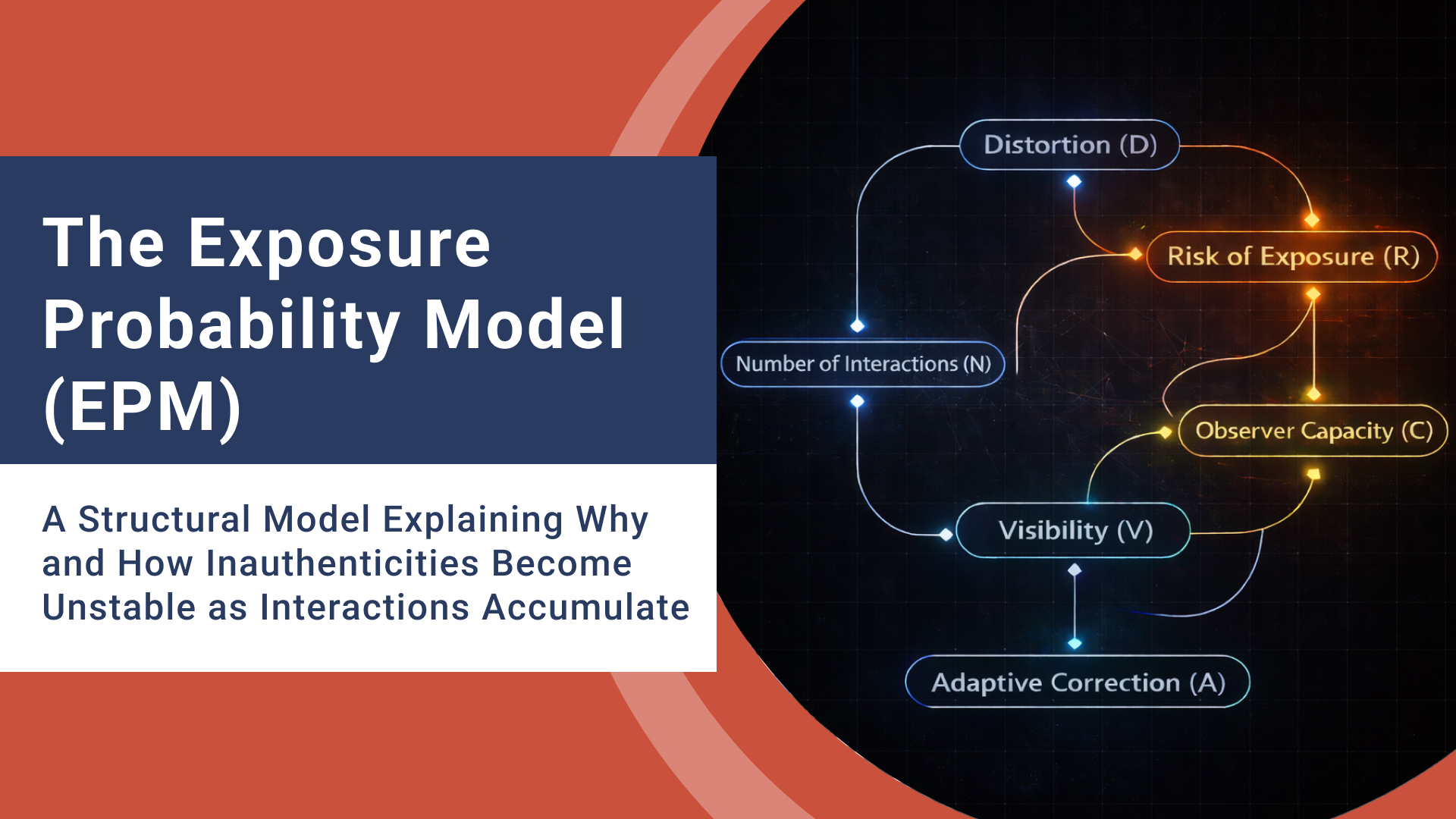
The model, therefore, examines four key variables that influence the likelihood of exposure. These variables do not operate independently. They interact continuously, shaping how quickly contradictions accumulate and how easily observers can detect them.
The first variable is distortion. Distortion represents the gap between projected identity, narretives or perception offered and observable reality. When distortion is small, the narrative requires relatively little effort to maintain coherence because events naturally support the identity being presented. When distortion grows large, however, the system must increasingly rely on explanation, reinterpretation, and narrative reinforcement to maintain consistency.
The second variable is interaction volume. Every conversation, decision, statement, policy, or outcome represents an interaction between the narrative or perception being offered and reality. Each interaction generates information that observers can evaluate. As the number of interactions increases, so does the informational field within which patterns can emerge.
The third variable is visibility. Visibility refers to how many observers (or those who are experiencing it) can examine the interactions produced by the system. A private individual operating within a small social environment may produce many interactions that remain largely unseen. In contrast, leaders, institutions, and nations operate within environments of high visibility where decisions and outcomes are widely observed and recorded.
The fourth variable is adaptive correction. Adaptive correction refers to the capacity of an individual or system to revise its behaviour when reality contradicts the narrative. When leaders acknowledge mistakes, adjust policies, or revise beliefs in response to evidence, distortion is reduced and contradictions are resolved before they accumulate. When adaptive correction is weak, distortions persist and the informational burden required to maintain the narrative grows.
These four variables together form the foundation of the Exposure Probability Model. By examining how distortion, interaction volume, visibility, and adaptive correction interact across time, the model provides a way of understanding why inauthenticities often appear stable initially yet gradually become structurally unstable as contradictions accumulate.
To clarify how these variables interact, the next section introduces a simple conceptual expression that captures the relationship between distortion, interactions, visibility and adaptive correction within the Exposure Probability Model.
A Conceptual Expression of the Exposure Probability Model
The interaction between distortion, interactions, visibility, and adaptive correction can be illustrated through a simple conceptual expression within the Exposure Probability Model. The purpose of this expression is not to calculate exact probabilities, but to clarify how the structural pressures within an identity system change as these variables evolve across time.
The relationship can be represented as:
R = (D × N × V) / A
Where:
R represents the risk of exposure, or the likelihood that contradictions between narrative and reality will become visible.
D represents distortion, the gap between projected identity and observable reality.
N represents the number of interactions through which the narrative encounters real-world outcomes.
V represents visibility, the number of observers capable of examining those interactions.
A represents adaptive correction, the system's capacity to revise behaviour, beliefs, or narratives when contradictions emerge.
The logic of the expression reflects the dynamics already described. When distortion increases, the narrative must accommodate a larger gap between what is claimed and what reality produces. When the number of interactions grows, the system generates more observable events that can either reinforce or contradict the narrative. When visibility expands, more observers become capable of comparing those events and identifying patterns across time.
Adaptive correction functions as the stabilising variable within the model. When individuals or institutions respond to evidence by adjusting their behaviour, acknowledging mistakes, or revising interpretations, distortions are reduced before contradictions accumulate. In such cases, the informational burden on the system remains manageable because the narrative evolves alongside reality.
When adaptive correction is weak or absent, distortions persist. The narrative must remain intact even as outcomes contradict it. Under these conditions, the informational burden increases with every interaction because explanations must continually reconcile new events with an identity that no longer reflects reality.
A simple analogy illustrates this dynamic. Imagine a leader who claims to possess exceptional strategic judgement. If the leader's decisions consistently produce successful outcomes, the narrative reinforces itself and distortion remains low. If several decisions fail but the leader acknowledges the mistakes and adjusts strategy, adaptive correction reduces distortion and prevents contradictions from accumulating. The narrative evolves alongside reality.
However, if the leader continues insisting on exceptional wisdom while outcomes repeatedly contradict that claim, the distortion grows. Each additional decision produces new evidence that must be explained. Observers begin comparing earlier statements with later outcomes. Over time, the informational field becomes dense enough that patterns emerge. At that point, the narrative can no longer rely solely on explanation or authority. The accumulated evidence begins to challenge the identity that was projected.
The same dynamic appears in institutions and nations. An organisation that claims moral authority but repeatedly violates its own standards gradually accumulates contradictions within its informational record. A nation that presents itself as uniquely strong or historically inevitable may initially reinforce that narrative through selective successes. Yet wars, economic outcomes, diplomatic responses, and internal developments continuously generate observable results. As these interactions accumulate, the narrative must remain consistent with an expanding field of evidence.
What the Exposure Probability Model reveals is that the collapse of distorted narratives rarely occurs suddenly. Instead, exposure becomes more likely as distortion remains high while interactions and visibility continue to increase without adaptive correction.
Understanding this relationship helps explain why inauthenticities can survive for extended periods yet eventually become unstable. The narrative does not fail simply because distortion exists. It fails because the informational environment eventually contains enough evidence for observers to recognise the contradictions.
The next section examines why these contradictions rarely accumulate in a simple linear fashion and why exposure often appears sudden, even though the underlying inconsistencies have existed for a long time.
Observer Capacity and the Limits of Exposure
The model presented so far describes the structural pressures acting on identity systems themselves. Yet exposure ultimately occurs within the interpretive field of observers. For this reason, the framework can be understood as an expanded form of the Exposure Probability Model that incorporates observer capacity.
The Exposure Probability Model explains why contradictions between narrative and reality become increasingly difficult to sustain as distortion, interaction volume, and visibility expand. Yet an additional factor must also be considered. Exposure does not depend solely on how much information exists. It also depends on the capacity of observers to interpret / understand that information.
In other words, the informational field may contain abundant evidence while many observers remain unable to recognise the pattern that evidence reveals.
This introduces an important asymmetry within the model. Interactions produce observable signals, but the interpretation of those signals depends on the sense-making and meaning-making capacity of those who encounter them. Some observers remain satisfied with immediate perception. Others move beyond initial impressions and develop deeper conceptions of what they are observing.
Within the Metacontent discourse, and more extensively developed in the book Metacontent, this difference is explained through the Nested Theory of Sense-Making. Human beings do not all engage reality with the same depth of interpretation. Some remain at the level of surface perception, accepting narratives largely as they are presented, while others move beyond perception toward interpretation and conception, gradually developing more congruent understanding of the fragment of reality they encounter.
The difference between these modes of engagement has profound consequences for exposure.
A low-capacity observer may encounter many interactions without recognising the contradictions embedded within them. Statements may be accepted at face value, explanations may be repeated without examination, and outcomes may be interpreted through the narrative that has already been presented. Under such conditions, even significant distortions may remain undetected for long periods because observers do not develop sufficiently integrated conceptions of what they are witnessing.
A high-capacity observer engages the informational field differently. Rather than stopping at immediate perception, such individuals are concerned with developing congruent and authentic conceptions of the fragment of reality they encounter. They examine patterns across time, compare narratives with outcomes, and remain willing to revise interpretations as new information emerges. In the Metacontent discourse this mode of engagement is referred to as Authentic Awareness.
Authentic Awareness does not imply perfect knowledge. Rather, it describes a progressively less distorted relationship with reality in which perception, interpretation, and conception move toward greater congruence with observable evidence.
Observers who possess higher capacity in sense-making and meaning-making therefore detect contradictions earlier and more accurately. They are less easily manipulated by narratives that rely on emotional appeal, authority, or repetition. Because they develop deeper conceptions of events rather than relying solely on immediate impressions, the informational signals produced by interactions become more meaningful and easier to interpret.
This dynamic suggests that the risk of exposure is shaped not only by the behaviour of those projecting the narrative but also by the cognitive and interpretive capacities of those observing it.
For this reason, the framework can be understood as an expanded form of the Exposure Probability Model that incorporates observer capacity for sense-making and meaning-making.
To reflect this additional dimension, the conceptual expression of the Exposure Probability Model can be extended:
R = (D × N × V × C) / A
Where:
C represents observer capacity for sense-making and meaning-making.
Higher levels of C increase the probability that contradictions between narrative and reality will be recognised. Lower levels of C delay exposure because observers may fail to integrate the information available to them.
This variable highlights an often overlooked dimension of systemic stability. Narratives may persist not only because distortion exists but because observers lack the conceptual tools required to examine the informational field critically.
The development of those tools is precisely the concern of the Metacontent discourse and the Nested Theory of Sense-Making. These works explore how individuals move beyond immediate perception toward deeper conceptual understanding of reality and how Authentic Awareness allows human beings to engage reality with progressively greater accuracy and coherence.
From the perspective of the Exposure Probability Model, this capacity becomes a critical variable. Distorted narratives encounter reality continuously through interactions. But whether those contradictions are recognised depends partly on the interpretive capacity of those who encounter them.
In environments where observer capacity remains low, distortion can persist for extended periods even when interactions and visibility are high. In environments where sense-making and meaning-making capacities are well developed, contradictions become visible far more quickly.
Exposure, therefore, emerges not only from the accumulation of evidence but also from the presence of observers capable of recognising what that evidence reveals.
In the Metacontent discourse this mode of engagement is referred to as Authentic Awareness, a progressively less distorted relationship with reality in which perception, interpretation, and conception move toward greater congruence with observable evidence.
Beyond Sense-Making: Capacity in Engaging With Reality
At this point, an important clarification becomes necessary. Capacity is not just about developing more expanded Metacontent in order to infer and develop conception of various fragments of reality, including but not limited to identity narratives, things, ideas, narratives and stories, domain recognition, paradigms, mental models, contextualised variable, and more.
That dimension remains essential. Without it, human beings remain trapped in immediate perception, shallow interpretation, and manipulable impressions. The Metacontent discourse and the Nested Theory of Sense-Making address precisely this problem by explaining how one moves beyond surface-level engagement toward deeper and more authentic conception. They help explain why some individuals can see through distortions, manipulations, and contradictions more quickly and more accurately than others.
Yet capacity must not be reduced to the intellectual or awareness layer alone.
The problem of our time is not merely that people fail to understand reality well enough. It is also that many human beings lack the actual capacity in their engagement with reality in times of coercion, manipulation, deception, and propaganda. A person may recognise distortion intellectually and still fail to stand well in relation to it. One may understand a narrative as misleading yet remain vulnerable to fear, pressure, seduction, conformity, dependency, or internal instability when confronted by it directly.
The world is not so much in shortage of ideas or “values,” but in shortage of methods and ways to bring them into reality and actualise them. This is where transformation at the level of capacity, rather than merely awareness, becomes essential.
This is where the discussion must go beyond Metacontent discourse alone.
To understand reality more accurately is one level of development. To become transformed in one’s capacity for engaging with reality, and in one’s interactions with others and the world one lives in, is another.
This second dimension is phenomenological. It concerns not only what we know or how well we interpret, but how we stand, respond, relate, decide, endure, act, and remain in contact with reality when reality becomes difficult, costly, pressuring, or confronting. It concerns the structure and quality of our Being as Human Beings.
A person may possess substantial conceptual sophistication and yet remain fragile in actual life. They may identify manipulation and still submit to it. They may perceive propaganda and still become captured by moods such as fear, anxiety, resentment, insecurity, or the desire for belonging. They may know better, yet lack the embodied capacity to remain in a healthy relationship with reality under pressure.
For this reason, capacity must be understood more comprehensively. It includes sense-making and meaning-making, but it also includes the transformation of our way of Being in the world.
This is where the Being discourse becomes indispensable.
Within the Being discourse and the Being Framework, the question is no longer only whether a person can develop a more congruent conception of reality, but whether they possess the qualities of Being required to engage reality well. Can they remain authentic under pressure? Can they act responsibly in ambiguity? Can they sustain courage when distortion is costly to challenge? Can they hold integrity when manipulation offers advantage? Can they remain grounded in awareness rather than collapsing into reactive moods or defensive postures?
These are not merely cognitive questions. They are phenomenological questions about Human Being.
They concern how we exist, how we relate, and how we participate in the world.
In this sense, the Being Framework extends the implications of the Metacontent discourse. The Metacontent discourse explains how human beings develop more expanded and more authentic sense-making and meaning-making. The Being discourse addresses whether the individual has undergone the deeper transformation required to live, act, choose, and engage reality coherently and responsibly.
This distinction matters greatly.
In a world saturated with manipulation, coercion, deception, and propaganda, survival does not depend only on recognising falsehood more quickly. It depends on becoming the kind of person who can stand in a healthier, more coherent, and more responsible relationship with reality itself.
That is why capacity must be understood not only as epistemic expansion but also as ontological and phenomenological transformation.
The former helps us see better.
The latter helps us stand better.
Together, they form a more complete account of what it means to become less manipulable, less coercible, less easily captured by distortion, and more capable of engaging reality with congruence, integrity, and depth.
This is where the Being discourse becomes indispensable. The question is no longer only whether a person can develop a more congruent conception of reality, but whether they possess the qualities of Being required to engage reality well. These themes are explored more fully in my work on Being and Human Being and within the Being Framework, which examines the qualities and conditions that shape human capacity to engage reality, self, others, and the world coherently and responsibly.
While observer capacity influences how quickly contradictions are recognised, the structural dynamics within identity systems continue operating regardless of whether observers immediately detect them.
Why Contradictions Grow Faster Than Expected
One of the most important dynamics within the Exposure Probability Model is that contradictions rarely accumulate in a simple linear manner. At first glance, it may appear that each new interaction merely adds one more data point to the informational field. In reality, the process is far more complex because each new event must remain consistent with the entire history of prior statements, decisions, and outcomes that the narrative has already produced.
This creates what can be described as an expanding web of informational relationships. Every new statement must align not only with reality but also with previous statements. Every decision must remain coherent with earlier explanations. Every observable outcome becomes part of a record that observers can compare across time. As this record grows, the number of possible comparisons between events increases rapidly.
A simple analogy illustrates the dynamic. Imagine a person who tells a single misleading story. Maintaining that story requires remembering only one version of events. If the person tells two or three misleading stories, each one must remain consistent with the others. Soon, the individual must remember not only the stories themselves but also how they relate to one another. With enough stories, maintaining coherence becomes increasingly difficult because each new statement must align with a growing network of prior claims.
Identity narratives operate in a similar way. When distortion exists, each new interaction introduces another element that must remain compatible with the entire narrative history. The system must continually reconcile new events with older claims, older explanations, and earlier outcomes. Over time, this task becomes progressively more complex.
Observers contribute to this dynamic because they do not examine events only in isolation. Human beings naturally search for patterns. When enough information accumulates, people begin comparing statements made months or years apart. Decisions that once appeared unrelated start forming recognisable sequences. Outcomes that were initially dismissed as anomalies begin to resemble recurring tendencies.
This is why exposure often appears sudden, even though the contradictions existed long before the moment of collapse. The informational field gradually becomes dense enough that the pattern becomes visible. Once observers recognise the pattern, the narrative can no longer rely on isolated explanations to preserve coherence.
The Exposure Probability Model, therefore, highlights an important structural reality. Distortion increases the informational burden on a system, and interactions continuously add new information to the system. As the informational field expands, contradictions do not merely add up. They interact with one another, producing a growing network of inconsistencies that becomes increasingly difficult to manage.
Understanding this nonlinear growth of contradictions helps explain why distorted narratives can remain stable for long periods and then unravel quickly once the accumulated evidence crosses a threshold of visibility.
The Visibility Paradox of Power
Power introduces a paradox within the dynamics described by the Exposure Probability Model. At first glance, power appears capable of protecting distorted narratives. Leaders with authority can shape messaging, control institutional communication, and influence how events are interpreted. Organisations may manage information flows, emphasise favourable outcomes, and minimise attention to contradictions. Nations with significant influence may reinforce their narratives through diplomacy, alliances, and media presence. In such conditions, power can delay the recognition of inconsistencies by shaping how observers interpret events.
Yet the same power that helps maintain a narrative also increases the number of interactions through which reality can test that narrative. Leaders make decisions continuously. Policies produce consequences that affect large populations. Institutions create records of actions that remain visible across time. Nations operate within complex international environments where their behaviour is observed by allies, rivals, analysts, and historians.
Power, therefore, expands the informational field in which identity is evaluated.
A private individual may generate relatively few interactions that attract widespread attention. In contrast, a leader or institution operating within a high-visibility environment produces an enormous number of observable signals. Every speech, policy decision, negotiation, and outcome becomes part of the informational record. Each of these signals provides another opportunity for observers to compare narrative with reality.
The result is a structural paradox. Power can delay exposure in the short term by influencing perception and shaping interpretation. However, power simultaneously increases both interaction volume and visibility. As these variables grow, the informational environment becomes more capable of revealing inconsistencies.
Consider a leader who consistently presents themselves as uniquely competent or historically exceptional. Early successes may reinforce this narrative and strengthen public belief in the identity being projected. Yet leadership also generates a continuous stream of decisions whose consequences cannot remain hidden indefinitely. Economic performance, organisational outcomes, international responses, and public reactions all create measurable results. Over time, these outcomes accumulate and provide observers with a broader basis for evaluating the narrative.
Institutions face similar dynamics. An organisation that claims principled conduct must continuously demonstrate behaviour consistent with that claim. Each new action either reinforces the narrative or introduces a contradiction that must be explained. As the organisation grows and becomes more visible, the number of observers capable of evaluating those actions increases as well.
Nations encounter the paradox on an even larger scale. Claims of strength, exceptionalism, or moral authority may serve important functions in shaping national identity and international perception. Yet the actions of nations are recorded through wars, treaties, economic outcomes, diplomatic relationships, and historical developments. Over time, these events create an extensive informational record against which national narratives can be evaluated.
The Exposure Probability Model reveals that power does not eliminate the risk created by distortion. Instead, power increases the scale of the informational environment in which identity is tested. The greater the authority of a system, the greater the number of interactions and observers through which the narrative must remain coherent.
In this sense, power amplifies both the ability to maintain narratives and the number of opportunities for those narratives to be challenged. The stability of identity, therefore, depends not on the strength of authority alone, but on the degree to which the narrative remains aligned with reality as interactions and visibility continue to expand.
Resetting the Interaction Field
When distortion grows and contradictions begin to accumulate, individuals and institutions often attempt to reduce exposure risk by altering the informational environment rather than correcting the underlying narrative. One of the most common strategies for doing this is what can be described as resetting the interaction field.
Within the Exposure Probability Model, the variable N represents the number of interactions through which narrative and reality encounter one another. Each interaction adds information to the system and increases the possibility that observers will compare past claims with present outcomes. When the number of interactions becomes large, the informational field becomes dense and patterns of inconsistency become easier to detect.
Resetting the interaction field reduces this density.
A person who repeatedly exaggerates their achievements may move between social circles where prior interactions are unknown. Within a new environment, the narrative encounters fewer observers who possess historical information about earlier contradictions. The interaction count effectively begins again from a smaller base. The same identity story can therefore be presented without the burden of accumulated evidence from previous environments.
Similar dynamics appear within organisations. Leadership changes, restructures, rebranding efforts, and narrative shifts can sometimes function as mechanisms that reduce the apparent continuity between past outcomes and present claims. When a new narrative is introduced, observers may temporarily suspend comparisons with earlier events because the informational field has been reframed.
Nations and institutions sometimes employ comparable strategies at a larger scale. Changes in leadership, strategic repositioning, or shifts in public narrative can create the impression of a new chapter that separates present identity from past contradictions. These shifts can temporarily reduce the perceived density of the informational record.
Such resets can delay exposure because they interrupt the continuity through which observers recognise patterns across time. However, they do not eliminate the underlying distortion if the narrative itself remains disconnected from reality. Once interactions begin accumulating again, the same structural dynamics reappear. Decisions produce outcomes, observers compare events across time, and the informational field gradually becomes dense enough for contradictions to re-emerge.
The Exposure Probability Model, therefore, suggests that resetting the interaction field can reduce exposure risk temporarily, but it cannot permanently stabilise an inauthentic narrative. Long-term stability requires something different from narrative repositioning. It requires reducing distortion itself.
This is where authenticity becomes structurally significant.
Authenticity as Structural Stability
The Exposure Probability Model ultimately returns to the question of authenticity. Within the Being Framework, authenticity is not merely a moral preference or a personal style of expression. It is a condition in which self-image, persona, beliefs, and opinions remain aligned with reality. When this alignment exists, identity systems remain capable of adapting as new information emerges.
Seen through the lens of the model, authenticity functions as a stabilising mechanism because it directly affects two of the model’s key variables. First, authenticity reduces distortion. When individuals or institutions are willing to examine reality honestly, exaggerated self-images and defensive narratives are less likely to develop. Claims remain closer to observable evidence, and the gap between narrative and reality remains small.
Second, authenticity strengthens adaptive correction. Authentic systems respond to contradictions by revising their behaviour rather than protecting their identity at all costs. Leaders who acknowledge mistakes adjust strategies before failures accumulate. Organisations that recognise inconsistencies in their conduct revise policies before contradictions become systemic. Individuals who reflect on outcomes revise beliefs when evidence challenges prior assumptions.
In such conditions, the informational burden on the identity system remains manageable. Interactions continue to occur, visibility may increase, and observers may compare outcomes across time. Yet because distortion remains low and adaptive correction remains active, contradictions are resolved before they accumulate into patterns that threaten credibility.
This dynamic can be observed in effective leadership. A leader who publicly recognises a flawed decision and adjusts course does not weaken their authority. On the contrary, such behaviour often strengthens trust because observers witness coherence between narrative and reality. The leader’s identity remains credible because the narrative evolves alongside observable events.
The same principle applies to institutions. Organisations that examine their own failures and correct them early maintain coherence between their stated values and their conduct. Although such corrections may involve short-term reputational costs, they prevent the accumulation of contradictions that would otherwise threaten long-term legitimacy.
In contrast, systems that resist authenticity gradually accumulate informational pressure. When identity must be preserved regardless of evidence, distortion increases while adaptive correction decreases. Each new interaction, therefore, adds further strain to the narrative. Over time, the system must devote increasing effort to explanation, reinterpretation, and defence simply to maintain coherence.
The Exposure Probability Model reveals that authenticity, therefore, has practical significance beyond ethical aspiration. It functions as a structural safeguard against the probabilistic pressures that arise when distortion, interaction volume, and visibility grow simultaneously. Systems grounded in authenticity continuously realign their narratives with reality and therefore remain stable even as interactions expand.
Inauthentic systems attempt the opposite. They attempt to preserve the narrative while reality continues to produce evidence. In doing so, they gradually increase the conditions under which exposure becomes likely.
Applying the Exposure Probability Model
The Exposure Probability Model is not intended only as a theoretical explanation of why narratives collapse. It can also be used as a practical lens for examining the stability of identity systems across different domains of life. Because the model focuses on distortion, interactions, visibility, and adaptive correction, it allows observers to ask concrete questions about the structural health of individuals, leaders, organisations, and nations.
At the individual level, the model encourages reflection on the relationship between self-image and reality. A person who consistently presents themselves as highly capable, virtuous, or knowledgeable must eventually encounter situations where outcomes either confirm or contradict those claims. When such contradictions appear, the stability of the identity narrative depends largely on adaptive correction. If the individual acknowledges mistakes, adjusts behaviour, and revises beliefs when evidence demands it, distortion remains limited and the identity system remains stable. If instead the narrative must be preserved at all costs, explanations multiply, contradictions accumulate, and the probability that observers will eventually recognise the pattern increases.
Leadership provides another clear illustration of the model’s dynamics. Leaders generate a large number of interactions through decisions, policies, and public statements. These interactions produce observable consequences that followers, critics, and external observers can evaluate across time. A leader who projects exceptional competence while refusing to acknowledge errors gradually increases distortion while reducing adaptive correction. In the short-term, such narratives may remain persuasive, particularly if supporters reinforce them. Over time, however, outcomes accumulate and observers begin comparing rhetoric with results. The informational field becomes dense enough for patterns to emerge.
Organisations face similar pressures. Institutions often construct narratives about their values, culture, and mission. When organisational behaviour consistently reflects those claims, the narrative becomes credible and reinforces trust among employees, stakeholders, and the public. When actions repeatedly contradict stated values, the gap between narrative and reality begins to widen. Internal observers compare decisions with declared principles, external observers evaluate outcomes against promises, and the informational record gradually reveals the inconsistencies.
At the scale of nations, the same structural dynamics become even more visible. Nations construct powerful narratives about identity, strength, morality, and historical destiny. These narratives shape collective self-understanding and influence international perception. Yet nations also generate vast numbers of interactions through diplomacy, economic activity, military actions, and internal developments. Each of these interactions produces observable outcomes that other nations, analysts, and citizens can examine. Over time, these outcomes accumulate into an informational record that either reinforces or challenges the national narrative.
The Exposure Probability Model, therefore, encourages a practical set of diagnostic questions. How large is the distortion between narrative and reality? How many interactions are occurring through which that narrative is tested? How visible are those interactions to observers? And to what extent does the system possess the capacity for adaptive correction when contradictions appear?
By examining these questions, individuals and institutions can recognise the structural pressures acting upon their identity narratives. The model does not guarantee that exposure will occur at a specific moment, but it reveals how the conditions that make exposure likely develop gradually through the interaction between distortion and accumulated evidence.
Conclusion - Why Reality Ultimately Prevails
The Exposure Probability Model reveals a structural dynamic that appears repeatedly across individuals, leaders, institutions, and nations. Identity narratives can persist for long periods even when they contain distortions. Supporters may reinforce them, authority may amplify them, and power may shape how observers interpret events. For a time, these forces can sustain the appearance of coherence between narrative and reality.
Yet none of these mechanisms remove the underlying interaction between identity and observable outcomes. Every decision generates consequences. Every action produces evidence. Every statement becomes part of a record that observers can later compare with events. As interactions accumulate across time, the informational field surrounding the identity system expands.
When distortion remains small and adaptive correction remains active, this expanding informational field reinforces credibility. Narrative and reality continue aligning because the system adjusts as new information emerges. Authenticity, therefore, stabilises the identity system by maintaining coherence between what is claimed and what actually occurs.
When inauthenticities persist, however, the situation evolves differently. Distortion grows while adaptive correction weakens. Each new interaction produces additional evidence that must be reconciled with the narrative. Observers begin connecting statements with outcomes, explanations with results, and promises with consequences. Gradually, the informational field becomes dense enough for patterns of inconsistency to appear.
What may appear to outsiders as a sudden collapse of credibility is rarely sudden at all. The contradictions were often present long before the moment of exposure. They accumulated quietly across decisions, interactions, and observable outcomes until the informational burden required to maintain the narrative became too great.
The Exposure Probability Model, therefore, reframes the problem of hubris and distorted identity. Exposure does not occur primarily because observers suddenly become morally outraged or because critics appear unexpectedly. Exposure occurs because the accumulation of interactions eventually produces enough evidence for contradictions to become visible.
In this sense, authenticity is not simply a moral ideal but a structural necessity for stability. Systems grounded in authenticity remain capable of adapting as reality unfolds. Systems grounded in distortion must continually defend narratives that reality increasingly challenges.
Over time, the difference between these two approaches becomes decisive.
Narratives can be repeated, reinforced, and amplified. Power can shape perception for a time. But every interaction with reality produces new information, and as that information accumulates, the probability that contradictions will reveal themselves continues to grow.
Reality does not defeat illusion through argument alone.
Reality defeats illusion through accumulation.