

Background and Introduction
In conversations around human development, leadership, coaching, and assessment, one question arises repeatedly: what exactly is the Being Profile assessing, and how is it different from more familiar tools such as psychometric tests? This is not a minor technical question. It is one of the most common questions asked by individuals, practitioners, and organisations who are considering the value and relevance of the Being Profile.
The question matters because many people understandably assume that all human assessment tools do roughly the same kind of work. If a tool produces scores, profiles, categories, or developmental insights, it is often assumed to belong to a single family of assessment. Yet this assumption is misleading. Not all assessments operate on the same premise, nor are they designed to answer the same kind of question. Some tools are built to compare individuals against a population. Others, where rigorously constructed, are built to orient individuals in relation to a deeper developmental structure. When these different purposes are not clearly distinguished, confusion follows. Comparative tools may be mistaken for developmental ones, descriptive tools may be expected to produce transformation, and deeper developmental tools may be judged by standards that do not belong to their actual purpose.
This article addresses that distinction directly. It clarifies the difference between psychometric and ontometric assessment, and explains why the Being Profile is better understood within the latter category. In doing so, it helps establish a clearer foundation for understanding the role of the Being Profile, the nature of its reference structure, and the type of developmental work it is intended to support.
This article is extracted from the Being Framework whitepaper and has been presented here in article form to make the distinction more accessible to a broader audience. While the whitepaper provides the wider theoretical and methodological context, this piece stands on its own as a response to a very common and important question: if the Being Profile is not a psychometric instrument in the conventional sense, then what kind of assessment is it, and what exactly is it assessing?
Framing the Role of Assessment
Assessment tools play a critical role in how individuals and systems understand capability, behaviour, and development. However, not all assessment tools operate on the same premise, nor are they designed to answer the same type of question. A lack of clarity at this level can lead to misapplication, where tools are used beyond their intended scope or interpreted in ways that distort their value. Within this context, it is important to distinguish between two fundamentally different approaches to assessment: psychometric and ontometric. This distinction is not cosmetic. It reflects two different relationships to the human being, two different reference points, and two different purposes.
At a high level, the distinction can be stated simply. Psychometric tools measure and locate. Ontometric tools, where rigorously developed, orient and develop. That contrast helps clarify why these approaches should not be treated as interchangeable, even if both are concerned with understanding human functioning. Each is asking a different kind of question, and each is designed to generate a different kind of insight.
Psychometric Assessment: Measurement and Comparison
Psychometric assessments are designed to measure and compare relatively stable patterns of cognition, personality, or behaviour against a statistical population distribution. Their methodology is grounded in norm-referenced calibration, meaning that an individual’s results are interpreted in relation to what is typical, average, above, or below within a defined population. Even when the characteristics being measured are not strictly fixed, they are generally treated as relatively stable, measurable, and comparable across individuals. This allows for standardisation, benchmarking, and consistency across contexts such as recruitment, education, research, and behavioural assessment.
Psychometric tools, therefore, provide descriptive and comparative insight. They answer questions such as where an individual sits relative to others, how their patterns compare to established norms, and what characteristics are consistently observable and measurable across populations. Their strength lies in their ability to map human variation and provide clarity within a distribution of observed traits and behaviours. In this sense, psychometric assessment is primarily concerned with positioning within a population. It helps identify where a person stands in relation to measurable traits that are already observable within humanity.
Ontometric Assessment: Orientation and Development
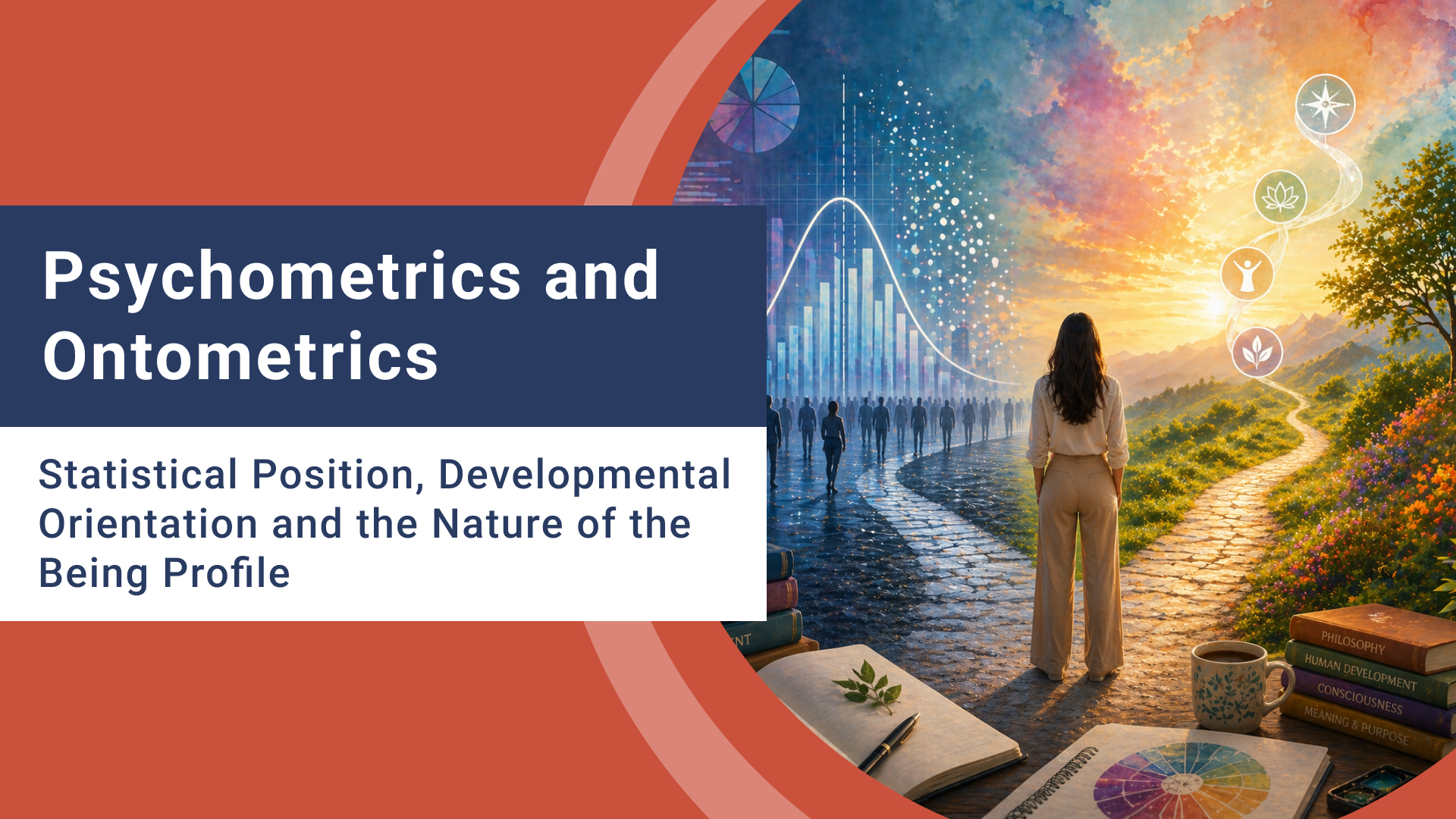
Ontometric assessment operates on a different premise. Rather than positioning an individual within a statistical distribution, ontometric tools assess the degree to which a person is aligned with a structured ontological and developmental orientation. The Being Profile is an example of such an assessment, with a specific focus on one’s state or way of being. In this context, the focus is not on comparison, but on alignment, coherence, and direction. The central question shifts from, “Where does this person stand among others?” to, “To what extent is this person aligned with what is developmentally possible within the structure of their human orientation?”
Ontometric assessment, therefore, evaluates the relationship between how a person is currently being and how they could progressively embody greater coherence, integrity, and effectiveness over time. It is concerned less with relative standing and more with developmental orientation. This shift in emphasis is significant because it changes the purpose of the tool itself. Rather than locating the person within an already mapped population, it seeks to orient the person in relation to a structured path of development.
Reference Points: Distribution Versus Orientation
The distinction between psychometric and ontometric approaches becomes clearer when we examine their reference points. Psychometric tools reference the population. Their outputs are meaningful in relation to averages, percentiles, and distributions. They locate individuals within an existing map of human variation. Their logic depends on comparability and on the ability to situate a person within a broader field of measurable characteristics.
ntometric tools, by contrast, reference a developmental orientation. Their outputs are meaningful in relation to the degree of alignment with a structured ontological orientation that supports development, coherence, and more sustainable functioning. Rather than primarily locating individuals within a distribution, they orient them in relation to a developmental direction. This shifts the nature of interpretation. Psychometric results indicate position, whereas ontometric results indicate direction. One tells us where a person stands relative to others. The other tells us how a person is oriented in relation to what is possible within their own development.
Beyond the Notion of an “Ideal”
It may be tempting to describe ontometric assessment as measuring against an ideal. However, that term is not precise enough. The word ideal often implies a fixed, static endpoint, a form of perfection, or an abstract moral standard that one is expected to reach. Those implications are not quite right for the kind of developmental work being described here, because they risk making the process sound rigid, moralistic, or unrealistically absolute.
Ontometric assessment, at least in the rigorous sense being discussed here, does not operate in this way. A more accurate concept is that of a developmental horizon. This refers to a structured potential of being that can be progressively realised, rather than definitively achieved. It is dynamic, unfolding, and responsive to context. It represents what is possible, not what must be perfectly completed. Human history provides examples of individuals and systems that embody aspects of this horizon to a high degree, yet no individual fully exhausts it. The horizon remains open, inviting continuous development rather than final arrival. This is why the language of developmental horizon is more accurate than the language of ideal.
Functional Differences in Practice
The distinction between these two approaches has practical implications. Psychometric assessment provides comparative positioning, supports benchmarking and selection, identifies patterns within populations, and informs decisions based on relative standing. Its function is primarily descriptive and comparative. It is especially useful where standardisation, population-level analysis, and measurable comparison are required.
Ontometric assessment provides developmental orientation, supports alignment and coherence, identifies areas of growth in how one is being, and informs decisions based on direction and integrity of action. Its function is primarily developmental and orientational. This does not mean one is superior to the other. It means they serve different purposes and operate at different layers of inquiry. Confusion only arises when one is expected to perform the role of the other.
Complementary, Not Competing
These approaches should not be understood as competing or mutually exclusive. Each serves a different function and each can be useful within its proper domain. Psychometric tools are well-suited for contexts where comparison, standardisation, and population-based insight are required. Ontometric tools are suited for contexts where development, alignment, and transformation are the focus. Their difference is not a sign of incompatibility, but of differing scope and intention.
When used appropriately, they can be complementary. Psychometrics can inform understanding of current patterns, while ontometrics can help orient the direction of development. One locates. The other orients. One compares. The other develops. When these functions are kept clear, each approach can contribute meaningfully without being confused with the other.
A Necessary Qualification: Not Every Tool Is Ontometric in a Rigorous Sense
An important qualification must be added here. Not every tool that moves beyond psychometric comparison should automatically be considered ontometric. Nor should ontometric become a loose label for any assessment that sounds more philosophical, developmental, or non-statistical. If that happens, the term quickly loses precision and becomes little more than branding language.
For a tool to be considered ontometric in a rigorous sense, it must meet several conditions. It must assess the person in relation to a structured ontological orientation, not merely describe preferences, attitudes, states, or behaviours. It must be developmental rather than primarily comparative. It must have a clear and defensible reference structure. And it must avoid collapsing into vague idealism, moral fantasy, or culturally loaded notions of what a “better human” looks like. This means the claims made in this section do not automatically apply to any tool that happens to call itself ontometric. They apply to ontometric tools that are genuinely constructed to assess alignment with a structured developmental orientation of being.
The Being Profile in This Context
In this sense, the Being Profile is not merely non-psychometric. It is ontometric because it assesses the degree of alignment between a person’s current state of being and a defined developmental architecture of coherence, integrity, and effectiveness. The strength of the distinction, therefore, depends on the rigour of the tool’s underlying ontological structure. Without such a structure, the term ontometric would be weak or misleading.
The Being Profile does not ask where a person ranks among others, nor does it attempt to position them within a statistical norm. Its primary concern is whether the qualities of being reflected in the assessment are aligned, underdeveloped, distorted, or unfolding in relation to a structured developmental horizon. This gives the Being Profile a different role from conventional psychometric tools. It is not primarily descriptive of population variation. It is developmental in orientation. It helps reveal how a person is standing in relation to what is possible in the maturation, coherence, and enactment of their state or way of being. That is why the Being Profile is better understood as an ontometric assessment tool. It assesses not simply what is already observable across a population, but the degree to which one’s current way of being is aligned with a structured potential that can be progressively realised.
Closing Distinction
The distinction can be summarised succinctly. Psychometric assessments measure and compare relatively stable human characteristics against what is already observable within the population. Ontometric assessments, where rigorously developed, evaluate the degree of alignment with a developmental horizon of being, which is a structured potential that can be progressively realised rather than a fixed ideal to be achieved. This summary matters because it protects against conflating two very different forms of assessment and expecting from one what only the other was designed to provide.
Put even more simply, psychometrics indicates where an individual stands among others. Ontometrics indicates how an individual is oriented in relation to what is possible. Understanding this distinction helps ensure that each approach is applied with clarity, precision, and integrity within its proper domain. It also protects against confusing location with direction, which is a serious mistake in any serious developmental work. One may know exactly where a person stands in relation to others, yet still have no meaningful account of how they are standing in relation to what they could become.