
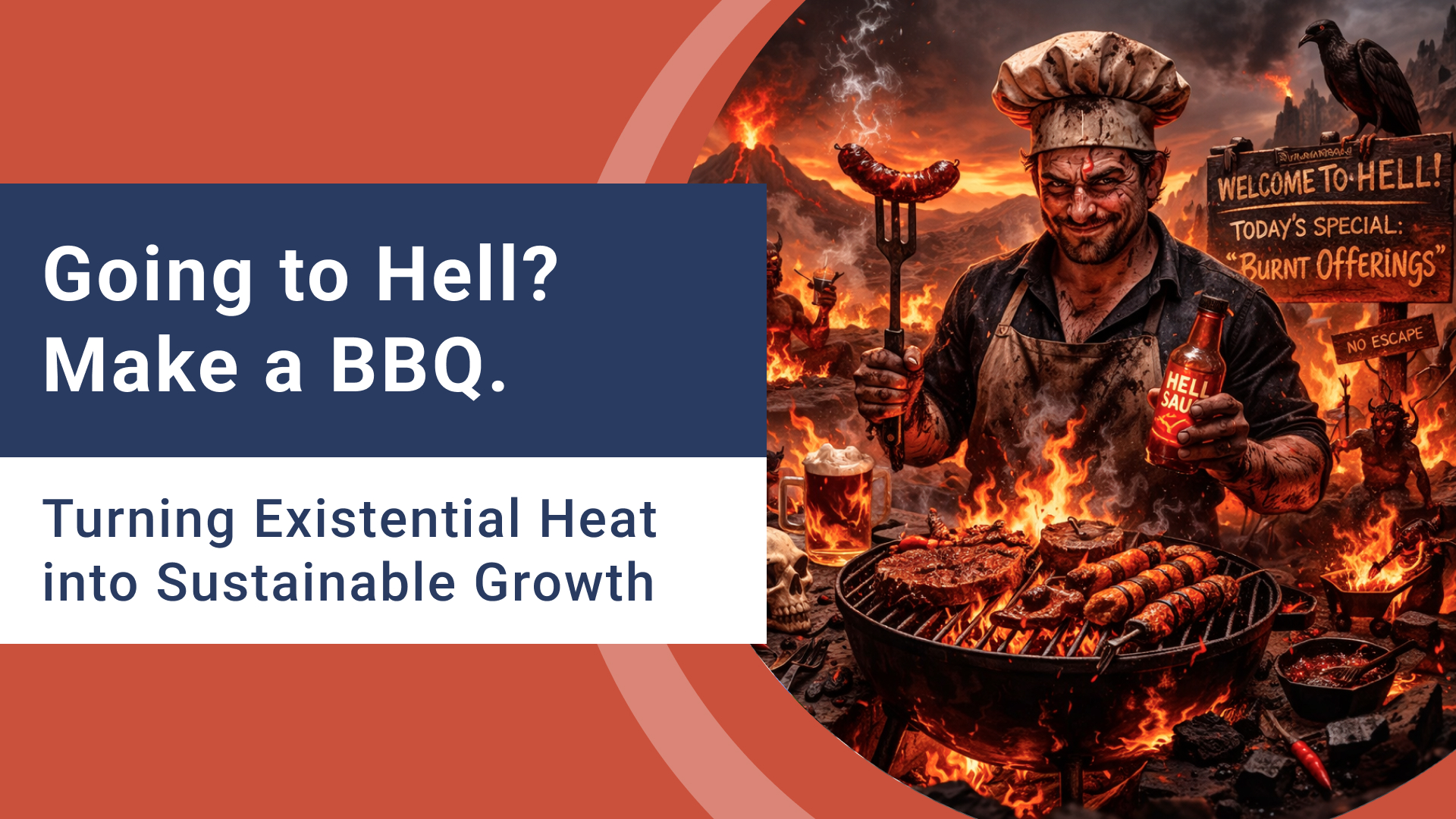

Background - The Cult of Comfort and the Fear of Heat
We live in a time where discomfort is treated like a design flaw. If a relationship becomes tense, something must be wrong. If work feels demanding, something must be toxic. If a conversation gets heated, someone must apologise immediately or leave. We have developed a cultural allergy to temperature.
Peace has been rebranded as the absence of friction. Maturity has been rebranded as the absence of conflict. Mental health has been reinterpreted as the elimination of stress. The unspoken expectation is simple. Life, if lived correctly, should feel like a curated wellness retreat with tasteful lighting and mild background music.
Unfortunately, reality has other architectural plans.
Arguments happen. Businesses fail. Partners disappoint each other. Children rebel. Bodies age. Markets crash. People misunderstand you. You misunderstand yourself. Sometimes you wake up and your internal climate feels like an overheated engine. None of this is exceptional. It is structural.
And yet many people are quietly convinced that if they were more evolved, more aligned, more spiritual, more self aware, the heat would reduce. They believe growth should be peaceful. They assume love should be effortless. They imagine leadership should be calm and inspiring without strain. They expect that once they have “worked on themselves,” life will stop raising its temperature.
This belief does not make them weak. It makes them unprepared.
The problem is not that fire exists. The problem is that we have not been taught what to do with it.
So we either try to extinguish it at the first sign of smoke, or we stand too close and get burnt. We avoid confrontation. We suppress resentment. We pretend everything is fine. Or we explode and then call it authenticity. In both cases, the fire controls us.
What we rarely consider is that heat is not the enemy. Heat is information. Heat is intensity. Heat is energy. It is what makes transformation possible. Without heat, nothing changes. Nothing softens. Nothing reshapes. Nothing becomes edible.
The question is not whether you will encounter hell. You will. The question is whether you know how to cook.
Introduction - This Is Not a Survival Guide. It Is a Cooking Guide.
At some point in life, you will visit hell. Not the mythological version with pitchforks and dramatic lighting. The ordinary one. The one called divorce, betrayal, business collapse, public embarrassment, family tension, health scares, identity crisis or simply the slow burn of prolonged uncertainty. The version where things do not go as planned and your internal temperature rises beyond comfortable levels.
You do not need to earn this visit. It is included in the package.
Some people spend enormous energy trying to avoid it. They avoid difficult conversations. They avoid confrontation. They avoid risk. They avoid intensity. They construct their lives around minimising heat. The strategy is understandable. If fire burns, then distance must be wisdom.
But here is the uncomfortable truth. Avoiding fire does not eliminate it. It only postpones it. And when postponed long enough, it does not arrive as manageable heat. It arrives as wildfire.
This article is not about surviving hell. Survival is basic. It is about learning how to use it. It is about becoming the kind of person who can stand near intensity without being consumed by it. It is about turning unavoidable friction into something workable, meaningful and even nourishing.
We are not trying to extinguish the fire. We are learning how to cook with it.
Because life does not offer a heat free option. What it offers is transition. States shift. Emotions rise and fall. Relationships move from closeness to tension to repair to growth. Mental health fluctuates. Businesses expand and contract. Identity refines itself through pressure. Nothing remains static. Everything is in motion.
The question is whether we engage with these transitions consciously or react to them blindly. When we bring awareness into the movement, when we participate rather than resist, something changes. The same fire that could have burnt us begins to serve us.
The goal is not to eliminate intensity. The goal is modulation.
And modulation is not a theory. It is how you handle the heat in real time.
The Fantasy of a Heat-Free Life
There is a quiet fantasy circulating in modern culture. It suggests that if you optimise correctly, regulate properly, communicate gently and select the right partner, career and morning routine, life will stabilise into something permanently manageable. No major friction. No serious arguments. No existential overheating. Just steady growth and curated fulfilment.
This fantasy is extremely popular.
It tells couples that healthy relationships rarely raise their voices. It tells leaders that effective leadership should feel inspiring rather than heavy. It tells entrepreneurs that aligned work should not feel stressful. It tells individuals that if they are truly self aware, they will no longer be triggered.
The underlying assumption is elegant. Mature life equals low temperature.
Unfortunately, this assumption collapses under basic observation.
Growth is disruptive. Intimacy exposes insecurity. Leadership attracts conflict. Creation invites resistance. Expansion generates strain. The more meaningful your life becomes, the more heat it generates. A life with no friction is not evolved. It is inactive.
Yet many people interpret the presence of heat as evidence of failure. If an argument occurs, something must be broken. If tension rises, someone must be toxic. If stress appears, something must be misaligned. The response is often immediate avoidance. Lower the temperature. Change the subject. Exit the situation. Protect your peace.
There is wisdom in not living in constant chaos. But there is danger in assuming peace means the absence of intensity.
Avoidance does not produce maturity. It produces fragility.
When we design our lives around minimising heat, we inadvertently minimise growth. We become skilled at surface stability but underdeveloped in depth. We prefer polite silence over necessary confrontation. We prefer emotional sedation over transformative friction. We mistake calmness for competence.
Life does not cooperate with this fantasy for long.
Eventually, the heat returns. Not as a small flame, but as accumulated pressure. What we avoided in small doses arrives in concentrated form. The argument that should have happened months ago erupts. The business tension ignored for years explodes. The resentment politely suppressed becomes bitterness.
Fire does not disappear when ignored. It relocates.
The problem is not that heat exists. The problem is that we have not learned to relate to it properly. We either flee it or fight it. Rarely do we understand it.
And without understanding, every flame feels like a threat.
Welcome to Hell. It Is Called Reality.
Let us remove the drama from the word hell. Hell is not mystical punishment. It is intensity beyond your preference. It is the moment when life refuses to cooperate with your expectations. It is the argument that will not resolve quickly. The business that does not stabilise. The child who does not obey. The partner who does not understand you. The body that does not perform as it once did. The version of yourself that no longer fits.
Hell is friction.
And friction is not optional.
You can design your calendar carefully. You can meditate daily. You can curate your social circle. You can optimise your nutrition. None of these eliminate the structural fact that life contains pressure. Pressure between who you are and who you are becoming. Pressure between what you want and what is possible. Pressure between your values and your impulses. Pressure between you and other human beings who are equally complex.
The idea that mature life should be free of these pressures is not spiritual. It is naive.
Fire is what makes transformation possible. Metal is refined in heat. Food is made edible through heat. Clay hardens through heat. Without temperature, nothing changes form. Without intensity, nothing evolves.
So when life turns up the temperature, the first question should not be why is this happening to me. The better question is what is this trying to refine.
This does not mean glorifying suffering. It means recognising function. Fire can destroy. Fire can also cook. The difference is not in the flame. It is in the relationship to it.
Most people encounter hell and immediately assume they are being punished. Something must be wrong. Someone must be blamed. They search for an escape route. They try to extinguish the fire as quickly as possible. Sometimes that is necessary. Often it is premature.
Not every flame is a disaster. Some are invitations.
The deeper truth is uncomfortable. If you are building anything meaningful, you will encounter heat regularly. If you are loving deeply, you will encounter tension. If you are leading, you will face resistance. If you are growing, you will feel instability. The absence of heat is not maturity. It is stagnation.
The goal is not to eliminate hell. It is to learn how to stand in it without turning into ash.
The Amateur Who Gets Burnt
When most people encounter heat, they respond in one of two predictable ways. They either stand too close or run too far.
Standing too close looks brave at first. They overcommit. They argue without restraint. They take on more than they can handle. They internalise every criticism. They try to prove themselves in the middle of pressure. They treat every fire as a personal test of worth. Eventually, exhaustion arrives. Then resentment. Then cynicism. Then the quiet sentence that follows many ambitious lives: I am burnt out.
Running too far looks mature at first. They disengage. They avoid confrontation. They reduce risk. They silence their opinions. They leave at the first sign of temperature. They call it protecting their energy. Over time, something else grows instead. Fragility. Insecurity. A life that feels stable but undercooked.
In both cases, the fire wins.
The amateur does not understand heat. They either fight it or fear it. They treat intensity as an enemy rather than information. They assume that the presence of discomfort means something is broken. They search for comfort before they search for understanding.
Burnout is rarely caused by fire alone. It is caused by unmanaged fire.
You can sit beside a well controlled flame for hours without damage. You can stand in direct, uncontrolled heat for minutes and suffer. The difference is not in the temperature. It is in regulation.
When there is no sense-making, heat feels chaotic. When there is no meaning-making, suffering feels pointless. When Being is reactive, every flame feels personal. The argument becomes an attack. The failure becomes identity. The pressure becomes proof of inadequacy.
Without conscious engagement, hell becomes trauma. With conscious engagement, hell becomes training.
The amateur thinks the goal is to extinguish the fire. The chef knows the goal is to understand it.
And understanding changes everything.
The Chef Who Modulates Fire
A chef does not panic when the grill gets hot. That would defeat the purpose. Nor does the chef shove their hand into the flame to prove resilience. They adjust.
They understand distance. They understand timing. They understand rotation. They know that not every piece of meat requires the same intensity. Some need slow heat. Some require a quick sear. Some must be turned frequently. Some must be left alone.
Fire is not the enemy. Mismanagement is.
Modulation is the difference between burning and cooking. It is not theoretical. It is not spiritual decoration. It is practical engagement with reality as it unfolds.
When an argument begins to rise in temperature, modulation means lowering your tone instead of raising it. It means pausing before escalating. It means asking what is actually happening rather than reacting to the surface words. It means recognising when the flame is productive and when it is becoming destructive.
When work pressure increases, modulation means adjusting pace. It means prioritising rather than panicking. It means recognising that intensity does not require chaos. It means regulating your internal state before attempting to control the external situation.
When criticism hits, modulation means examining it before defending. It means separating ego from information. It means deciding what to absorb and what to discard.
This is not suppression. It is not avoidance. It is conscious engagement.
The amateur is consumed by the flame because they do not regulate themselves. The chef regulates both the fire and their proximity to it. They step closer when needed. They step back when necessary. They add fuel intentionally. They remove fuel deliberately.
This is where Being becomes visible. Under heat, you are revealed. Are you reactive charcoal, easily ignited and quickly exhausted, or are you deliberate, aware and steady?
Modulation requires sense-making. What is this heat about. What is actually being challenged. It requires meaning-making. What can this refine. What is being cooked here. And it requires integrity. What must be preserved while this transformation takes place.
You do not control whether life turns up the temperature. You control how you relate to it.
That is the difference between burnout and nourishment.
Life Is Not Linear. It Is Transitional
One of the reasons people panic in heat is because they assume life should move in straight lines. Improvement should be steady. Relationships should gradually get better. Mental health should stabilise. Businesses should grow predictably. Once you fix something, it should remain fixed.
Life does not operate that way.
Everything moves in transitions. Closeness becomes tension. Tension becomes repair. Repair becomes deeper connection. Confidence becomes doubt. Doubt becomes reflection. Reflection becomes clarity. Stability becomes disruption. Disruption becomes reinvention. Nothing remains static. Systems shift constantly.
Your marriage is not stable. It is transitioning. Your mental health is not fixed. It is modulating. Your business is not secure. It is adapting. Your identity is not finished. It is refining.
The expectation of permanent stability is what makes heat feel catastrophic. When something shifts, we interpret it as regression. When tension appears, we assume failure. When intensity rises, we fear collapse.
But transition is not collapse. It is movement.
Imagine a loop rather than a straight line. You return to similar themes, similar arguments, similar doubts. But you do not return as the same person. Each cycle has the potential to refine you if you engage consciously. If you resist, the cycle becomes repetition. If you participate, it becomes development.
This is why fire keeps appearing. It is part of transition. Growth without intensity is fantasy. Refinement without pressure is decoration.
The mature person understands that states change. Calm is temporary. Heat is temporary. Confidence is temporary. Doubt is temporary. The system is always moving. The question is whether you are aware of the movement.
When you bring consciousness into transition, you stop treating every rise in temperature as disaster. You begin to see it as phase. Not permanent identity. Not irreversible damage. Phase.
And phases can be modulated.
Modulation as Conscious Engagement
Modulation begins the moment you notice the shift. Not after the explosion. Not after the burnout. Not after the resentment has hardened. In the moment.
You feel the temperature rising in a conversation. Your chest tightens. Your tone sharpens. Your thoughts accelerate. That is transition. Most people move unconsciously from irritation to accusation in seconds. Modulation interrupts that slide. It inserts awareness between stimulus and response.
Instead of escalating, you slow your speech. Instead of defending, you ask a clarifying question. Instead of interpreting the comment as an attack, you examine whether your ego is inflamed. This is not weakness. It is temperature control.
In work pressure, modulation might mean admitting capacity limits before collapse. It might mean redefining success for a season rather than pretending endurance is infinite. It might mean reallocating resources instead of glorifying overextension.
In failure, modulation means refusing the immediate story that you are inadequate. It means pausing long enough to extract information. What did this reveal. What assumption failed. What can be refined. Without this pause, heat becomes identity. With it, heat becomes instruction.
In intimacy, modulation means staying in the argument long enough to understand it, but not so long that it becomes destruction. It means knowing when to step back and cool down without abandoning the issue entirely. It means revisiting the flame when you are steady rather than when you are combustible.
This is not theoretical self-regulation. It is conscious engagement with reality. You do not suppress heat. You interact with it. You adjust proximity. You adjust interpretation. You adjust pace.
Sense-making asks what is happening. Meaning-making asks what this can serve. Being answers who you are becoming in the process.
Resentment grows when heat is endured without modulation. Burnout grows when intensity is sustained without adjustment. Fragility grows when fire is avoided entirely.
The chef does not resent the flame. The chef studies it.
And over time, modulation becomes instinct. You recognise patterns in yourself. You notice early signs of overload. You sense when conversation is tipping into destruction. You adjust before catastrophe.
You do not eliminate hell. You navigate it deliberately.
Transformation Is Not Surgical
There is another illusion that quietly undermines growth. The illusion that transformation should be clean. Precise. Efficient. Like a surgical procedure where the problem is removed and the system returns to normal.
Many people approach change this way. They want the insecurity removed. The bad habit extracted. The toxic pattern eliminated. The uncomfortable emotion excised. As if growth were a technical correction rather than a developmental process.
But transformation is rarely surgical.
It is developmental. And development requires tension.
When you stretch a muscle, there is tension. When you grow a business, there is tension. When a relationship deepens, there is tension. When identity evolves, there is tension. Tension is not a sign of malfunction. It is a sign of expansion.
Avoidance relieves tension temporarily but arrests development. Escape lowers temperature but freezes growth. Collapse releases pressure but weakens structure. None of these cultivate transformation. They merely interrupt it.
The capacity to leverage tension is what differentiates regression from growth.
When tension appears, you have options. You can treat it as evidence that something is wrong. Or you can treat it as potential energy. Not every tension is healthy. Not every flame should be intensified. But neither should every tension be neutralised immediately.
Transformation happens when tension is engaged consciously. When you stay long enough to understand it. When you allow it to refine your assumptions. When you permit discomfort to stretch your capacity without shattering your integrity.
This is not comfortable work. It is developmental work.
You do not remove insecurity like a tumour. You outgrow it. You do not extract impatience with a scalpel. You cultivate restraint through repetition. You do not eliminate relational tension entirely. You learn how to navigate it with increasing skill.
Transformation is not about cutting something out. It is about becoming someone new through sustained engagement with pressure.
And that requires tolerance for heat.
Sustainability Is Not Peace. It Is Workable Heat
Many people imagine sustainability as calm. A life without major disruptions. A relationship without recurring tension. A business without volatility. A nervous system that never spikes. That is not sustainability. That is sedation.
Sustainability is not the absence of fire. It is fire in its rightful place.
When heat is suppressed, systems stagnate. When heat is uncontrolled, systems collapse. Sustainability lives in the disciplined middle. Not extinguishing intensity. Not being consumed by it. Modulating it so that the system continues functioning and evolving.
Integrity plays a crucial role here. Integrity is not a trophy you win and display. It is not a linear achievement you check off. It is a horizontal value. Something you aim toward constantly. You never fully arrive. You adjust toward it. You realign toward it. You return to it when you drift.
Under heat, integrity is tested. Do you exaggerate to win the argument. Do you betray your own values to avoid discomfort. Do you abandon your standards when pressure increases. Or do you recalibrate.
Sustainable systems, whether personal or relational, are not stable because they avoid transition. They are stable because they adapt through transition. Your mental health modulates. Your marriage modulates. Your leadership modulates. Your identity modulates. The goal is not to freeze these systems at a perfect temperature. The goal is to remain conscious while they shift.
Workability becomes the measure. Is this system still functional? Can this relationship still repair? Can this business still adapt? Can this nervous system still recover? If the answer is yes, then the fire is being used rather than endured.
When sustainability is misunderstood as permanent calm, any rise in temperature feels like failure. When sustainability is understood as regulated intensity, heat becomes expected. It becomes part of the design.
You do not seek a life without hell. You build a life capable of navigating it repeatedly.
Because the loop continues. Calm to heat. Heat to refinement. Refinement to growth. Growth to new tension. This is not dysfunction. It is aliveness.
And aliveness requires flame.
Conclusion - You Cannot Avoid Hell. But You Can Choose the Menu.
At some point, life will turn up the heat. It will not ask whether you feel ready. It will not check your calendar. It will not consult your mood. It will arrive in the form of conflict, failure, disappointment, pressure or unexpected change.
You can try to avoid it. Many do. You can design a small life with minimal exposure. You can reduce risk. You can silence difficult conversations. You can step away from intensity. You can call it peace. For a while, it may even feel convincing.
But avoidance has a cost. What does not get cooked rots.
The alternative is not recklessness. It is not martyrdom. It is not romanticising suffering. It is something far less dramatic and far more demanding. It is learning to stand in the heat without turning into ash. It is learning to regulate instead of react. It is learning to interpret fire as information rather than punishment.
Hell is not a destination reserved for the unlucky. It is a recurring condition of growth. The question is not whether you will encounter it. The question is whether you will enter it as charcoal or as a chef.
Charcoal ignites quickly and collapses just as fast. The chef studies the flame. The chef adjusts distance. The chef chooses what to place on the grill and what to keep aside. The chef knows that not everything belongs on high heat.
Life is not designed to be permanently comfortable. It is designed to be transitional. Systems shift. Relationships evolve. Identity refines itself under pressure. Sustainability is not found in eliminating fire but in keeping it workable. Integrity is not achieved once and preserved forever. It is aimed at repeatedly, especially when the temperature rises.
You cannot avoid hell. But you can choose the menu.
You can decide what this intensity will refine. You can decide who you will become under pressure. You can decide whether the heat will burn you or feed you.
The goal of life is not to extinguish every flame. It is to become someone capable of cooking with it.
And that, strangely enough, is a far more joyful way to live.