
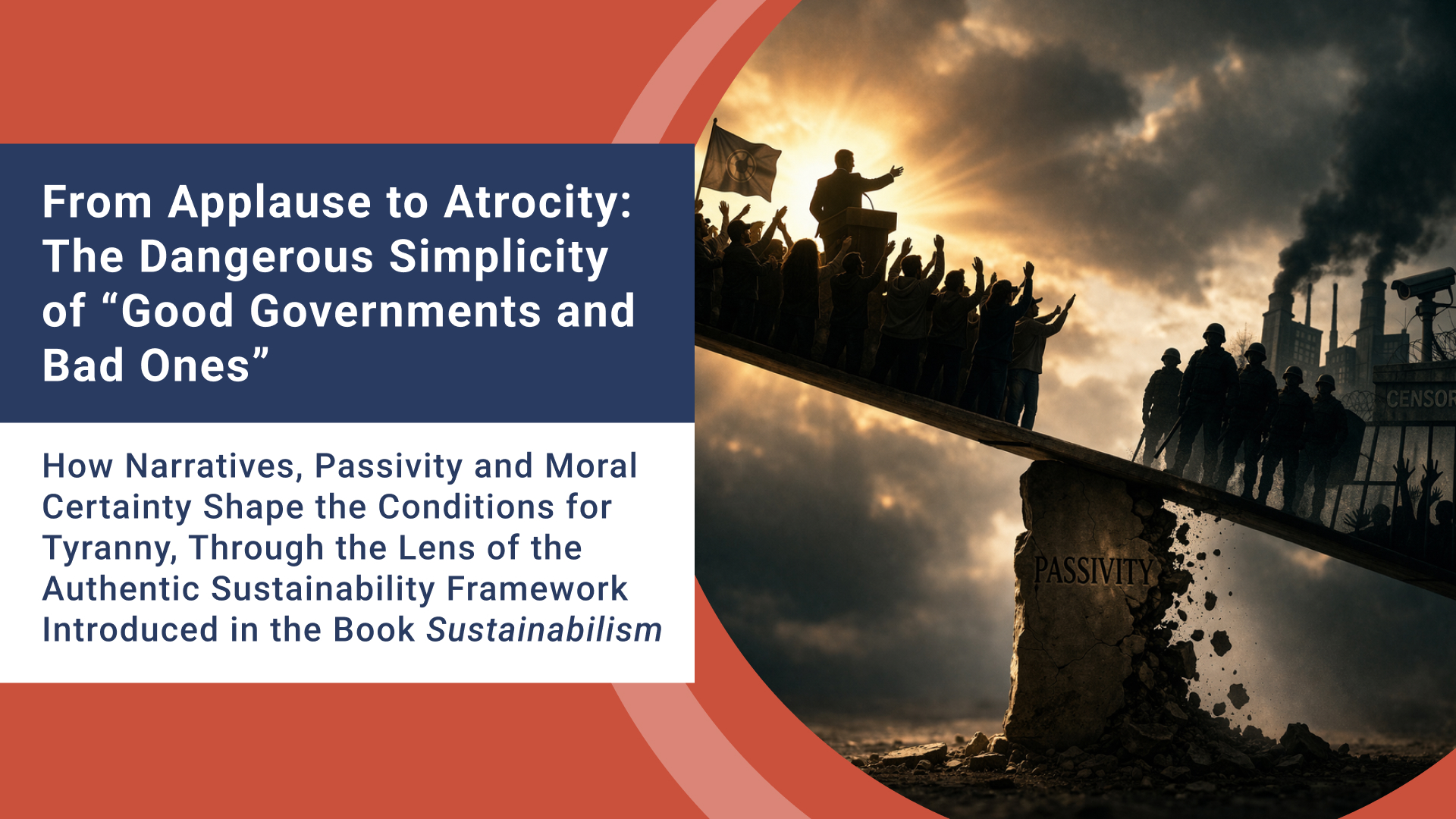

The greatest risk is not only oppression, but the loss of the capacity to respond to it.
The Seduction of Simplicity
We are living in a time where complex realities are increasingly reduced to simple moral frames. Entire conflicts, nations, and systems are collapsed into binaries that feel intuitively right but rarely withstand deeper examination. On one side, there are the “good” governments, the civilised actors, the ones assumed to be operating with legitimacy and restraint. On the other side, there are the “bad” regimes, often labelled as terrorist, rogue, or fundamentally illegitimate. The conclusion that quietly follows is rarely questioned. If the bad actors are removed, neutralised, or replaced, then stability, and perhaps even peace, will naturally emerge.
This way of seeing the world is not new, but it has become more pervasive and more emotionally charged. It is reinforced through media cycles, political rhetoric, and the speed at which information travels. Narratives are formed quickly, positions are taken almost instantly, and moral certainty becomes the default posture. In such an environment, hesitation is often mistaken for weakness, and inquiry is mistaken for complicity. Yet the very speed at which these conclusions are formed should invite caution rather than confidence.
What makes this framing particularly dangerous is not simply that it is incomplete, but that it creates the illusion of clarity where there is, in fact, deep complexity. It allows individuals and societies to feel aligned with what is “right” without fully engaging with the structures, histories, and dynamics that shape what is unfolding. It replaces the effort of understanding with the comfort of judgment. In doing so, it subtly conditions the mind to accept actions that would otherwise be questioned, simply because they are presented within a morally simplified narrative.
History has shown, repeatedly and without ambiguity, that the world does not organise itself neatly into good regimes and bad ones, nor do outcomes follow such clean lines. The belief that removing a perceived evil will automatically result in a better world has, more often than not, led to consequences far more complex, and at times far more devastating, than anticipated. Yet despite this, the allure of simplicity remains. It offers certainty in uncertain times, direction in moments of chaos, and a sense of moral positioning that feels both justified and necessary.
This is where the real risk begins, not in the existence of conflict or disagreement, but in the unquestioned acceptance of the frames through which we interpret them.
The Forgotten Pattern: Tyranny is Often Popular at First
There is a comforting belief that tyranny arrives as an imposition, that it is forced upon populations who resist it, suffer under it, and long for its removal. This belief allows distance. It creates the sense that what has happened in history belongs to a different kind of people, under different conditions, shaped by circumstances we would never replicate. It reassures us that we would have seen it, resisted it, and stood on the right side of it.
Yet the historical record does not support this comfort.
Many of the regimes that are now universally condemned did not begin as fringe impositions. They were not initially sustained by fear alone. They emerged through participation, through endorsement, and through the gradual alignment of the crowd with the narratives being presented to them. In many cases, they were not only tolerated but actively supported.
Nazi Germany did not rise in isolation from its people. It was carried by widespread approval, by a population that, for a period of time, saw restoration, pride, and direction in what was unfolding. Fascist Italy under Mussolini was not merely endured; it was embraced by many who believed in the promise of national revival. The Cultural Revolution in China mobilised masses, not as passive observers, but as active participants in the persecution of others. In Cambodia, the Khmer Rouge were able to enact one of the most devastating regimes of the twentieth century within a context where ideology had already taken hold. In Rwanda, the genocide was not carried out by a distant elite alone, but involved large segments of the civilian population, shaped by years of narrative conditioning.
Even beyond these examples, the pattern repeats. In the Congo Free State under King Leopold II, systemic brutality was normalised and economically rationalised, distant from those who benefited from it yet sustained by the structures that enabled it. In the Yugoslav wars, neighbours turned against neighbours as narratives of identity, fear, and grievance intensified and hardened.
What becomes evident across these contexts is not simply the presence of cruelty, but the process through which it becomes possible. Tyranny does not arrive fully formed. It is preceded by alignment, by gradual shifts in perception, and by a growing acceptance of narratives that simplify reality in ways that justify increasingly extreme actions.
This is difficult to confront because it challenges a deeply held assumption about human behaviour. It suggests that the line between those who commit atrocities and those who would never do so is not as fixed as we would like to believe. It is influenced, shaped, and at times blurred by context, by narrative, and by the collective movement of the crowd.
If this pattern is not recognised, it is not only misunderstood, it is repeated.
The Mechanism: How Dehumanisation is Engineered
At no point does a society wake up one day and decide to commit atrocity. There is no singular moment where a collective consciously agrees to cross a moral threshold. What exists instead is a sequence, a progression that unfolds gradually, often subtly, and almost always under the guise of necessity, security, or even righteousness.
It begins with narrative. A story is introduced, repeated, and refined. It offers an explanation of the world that feels coherent, even if incomplete. It identifies threats, assigns roles, and establishes a sense of direction. At this stage, the narrative does not need to be entirely false. It only needs to be selective. Certain facts are amplified, others are ignored, and complexity begins to narrow into something more digestible.
From there, simplification takes hold. The world, with all its nuance and contradiction, is reduced into clearer categories. Ambiguity becomes uncomfortable, and certainty becomes desirable. What was once a layered reality is now easier to grasp, easier to communicate, and easier to align with. This simplification is not experienced as distortion. It is experienced as clarity.
As the narrative stabilises, groups begin to be monolithised. Diverse individuals, with different beliefs, behaviours, and intentions, are collapsed into a single identity. A nation becomes one thing. People become one thing. An ideology becomes one thing. The internal differences that once existed are no longer relevant within the frame that has been constructed.
Once monolithisation (Read The Illusion of Monolith) takes hold, generalisation follows naturally. The actions of some are extended to define the whole. Exceptions become irrelevant, nuance becomes inconvenient, and the idea of individual variation begins to dissolve. It becomes easier to speak about entire populations as if they share the same motives, the same dangers, and the same moral standing.
With generalisation comes moral labelling. The group is no longer just different; it is assigned a value. It becomes dangerous, backward, aggressive, corrupt, or irredeemable. This is a critical shift because it moves the perception from description to judgment. It is no longer about what is happening, but about what something is.
From here, degradation begins. Language changes. The group is spoken about with less care, less precision, and less regard. The tone shifts from analysis to dismissal. Over time, this degradation becomes normalised. What would have once been seen as unacceptable language becomes part of everyday discourse.
The final step is dehumanisation. The group is no longer perceived as fully human in the same way. Their suffering becomes easier to justify, their loss becomes less significant, and actions taken against them begin to feel proportionate, even necessary. At this point, the moral barriers that would have once prevented violence have already been eroded.
Each step on its own can appear minor, even reasonable within its context. It is the accumulation that matters. It is the progression that creates the conditions in which actions that would have once been unthinkable become not only possible, but supported.
This is how societies move, not abruptly, but incrementally, from complexity into cruelty.
The Role of the Elite, the Leader, and the Crowd
To understand how these mechanisms take hold and sustain themselves, it is not enough to look at events or policies in isolation. What must be examined is the interplay between three forces that exist in every society, regardless of culture, geography, or political system. These forces can be understood as the Elite, the Leader, and the Crowd. (Read The Silent Weight of Leadership)
The Elite are those who hold disproportionate power. This power may come through political authority, economic control, institutional position, or influence over information and narrative. It is important to be precise here. Elites are not inherently corrupt, nor are they inherently virtuous. What matters is their relationship with power. When that relationship becomes distorted, when power is exercised without grounding in reality, without accountability, or without restraint, the potential for harm expands rapidly. The issue is not the existence of elites, but the condition of their Being and the structures that either constrain or enable them.
The Leader operates at the intersection between power and people. A leader is not simply a position, but an existential orientation that functions; it sits at the level of being, not just doing. It is the role through which narratives are translated into direction, and direction into action. A leader can stabilise a society by holding complexity, by resisting simplistic narratives, and by maintaining alignment with reality even under pressure. Equally, a leader can accelerate distortion by amplifying fear, by simplifying complexity into emotionally charged binaries, and by mobilising the population around narratives that demand allegiance rather than understanding.
Yet neither the Elite nor the Leader can operate in isolation. Their power, in practice, is mediated through the Crowd.
The Crowd is often misunderstood. It is not a collection of unintelligent individuals, nor is it inherently irrational. It is composed of ordinary people, each with their own lives, concerns, and intentions. However, when individuals become part of a collective, something shifts. Responsibility diffuses. Critical thinking can give way to alignment. The desire for belonging, for certainty, and for moral clarity begins to outweigh the effort required to hold complexity.
This is where passivity becomes decisive.
Passivity is not merely inaction. It is the gradual surrender of discernment. It is the willingness to accept narratives without fully examining them, to adopt positions without fully understanding them, and to align with movements without recognising their trajectory. It does not require malice. It requires only disengagement at the level of responsibility.
Tyranny, in this sense, is rarely sustained by force alone. It is sustained by a combination of active endorsement and passive compliance. The Elite may design and direct, the Leader may articulate and mobilise, but it is the Crowd that ultimately enables or constrains what becomes possible.
When the Crowd remains attentive, discerning, and engaged, the excesses of power are limited. When it becomes passive, when it defers its responsibility to question, to examine, and to hold complexity, the conditions for distortion expand. Over time, this expansion does not remain abstract. It manifests in policies, in actions, and eventually in consequences that affect real lives at scale.
This is not an accusation. It is a structural observation. Without the participation, whether active or passive, of the Crowd, the trajectory of power would look very different.
The Applause Problem: When We Cheer for Power
In moments of conflict, escalation, or crisis, something predictable begins to happen. Positions form quickly. Narratives solidify. Actions taken by those in power are interpreted through already established frames, and for many, the response becomes immediate and certain. Support is expressed, often strongly, sometimes passionately, and at times without hesitation.
Military actions are applauded. Strategic strikes are justified. Calls for regime change are endorsed. Entire populations or governments are reduced to singular labels, and once that label is accepted, the range of acceptable responses begins to expand. What might otherwise raise questions is instead seen as necessary. What might otherwise be examined is instead defended.
The question that rarely gets asked is a simple one. What exactly is being supported?
Is it a specific action, understood in its full context, including its consequences and limitations? Or is it a narrative, accepted because it aligns with an existing frame of who is right and who is wrong? In many cases, it is the latter. The reaction is not grounded in a deep engagement with the situation, but in an alignment with a simplified interpretation of it.
This is not a matter of intelligence or intention. It is a matter of how quickly certainty is adopted in environments where information is partial, evolving, and often mediated. The speed of modern communication amplifies this effect. Images, headlines, and fragments of information circulate rapidly, creating the impression of understanding without necessarily providing its substance. In such conditions, it becomes easier to feel informed than to actually be informed.
What follows is a form of moral outsourcing. The responsibility to evaluate, to question, and to hold complexity is transferred to those perceived to be in authority. If a government acts, it is assumed to be justified. If a narrative is dominant, it is assumed to be accurate. The individual, rather than remaining engaged, becomes aligned.
This alignment is reinforced socially. Agreement brings belonging. Dissent brings friction. Over time, the cost of questioning increases, and the reward for conformity becomes more immediate. The result is not always silence, but something more subtle. It is the absence of depth in how positions are formed and expressed.
This is where the earlier mechanisms begin to reappear. Simplification, generalisation, and moral labelling are no longer distant processes. They are active, present, and often unfolding in real time. The difference is that they are now experienced as justified, because they are aligned with a narrative that feels correct.
Applause, in this context, is not neutral. It is participation. Even when it is expressed from a distance, it contributes to the environment in which certain actions become easier to take, easier to justify, and harder to question.
This does not mean that all actions are equivalent or that all responses are unjustified. It means that the threshold for support should be far higher than it often is. It requires a level of awareness that goes beyond immediate reaction, and a willingness to remain with uncertainty rather than rushing toward conclusion.
Without that, the line between observation and participation becomes thinner than most realise.
Condemning the Oppressor is Easy
There are certain positions that require very little effort to hold. Condemning oppression is one of them. Across cultures, across belief systems, and across personal values, there is a broad and deeply embedded agreement that coercion, abuse, and domination are wrong. Whether it appears in the form of political tyranny, institutional corruption, or interpersonal violence, the instinct to reject it is immediate and widely shared.
In everyday life, this clarity is even more pronounced. When coercion appears in a relationship, it is recognised as abuse. When power is used to manipulate, control, or silence, it is named and condemned. In workplaces, in families, and in communities, the misuse of power is seen as a violation of something fundamental. It crosses a line that most people, regardless of background, can recognise without needing extensive explanation.
This clarity creates a sense of moral stability. It reassures individuals that there are boundaries that should not be crossed, and that certain behaviours are unacceptable regardless of context. It allows for a shared language through which harm can be identified and addressed. In many ways, this is necessary. Without such clarity, the ability to recognise injustice would be significantly weakened.
At the level of nations and global affairs, the same pattern applies, at least in principle. Authoritarianism, repression, and the abuse of power are criticised. The suffering of populations under such conditions is acknowledged. The idea that no group should be subjected to systematic harm is broadly accepted, even if the application of that principle is often inconsistent.
This is where most discussions begin, and often where they end. The oppressor is identified, condemned, and positioned as the source of the problem. The moral landscape appears clear. There is harm, and there is the one who causes it. The conclusion seems straightforward.
Yet it is precisely at this point, where clarity feels strongest, that the conversation tends to stop. Not because there is nothing more to examine, but because what comes next is more difficult to hold.
The Harder Question: What About the Oppressed?
At this point, the conversation becomes more difficult, not because it lacks clarity, but because it challenges a deeply conditioned way of thinking. The moment attention shifts from the oppressor to the oppressed, there is often an immediate resistance. It can be perceived as a redirection, or worse, as an attempt to dilute responsibility. In many contexts, even raising the question is enough to trigger the accusation of victim-blaming.
It is therefore necessary to be explicit. This is not about attributing fault to those who suffer. It is not about diminishing the reality of harm, nor is it about equating the actions of the oppressor with the experience of the oppressed. The existence of oppression remains unjustifiable. The misuse of power remains a violation. None of that is in question.
What is in question is something else entirely.
What happens when oppression is not only experienced, but gradually internalised. What happens when it begins to shape identity, perception, and the sense of what is possible. What happens when individuals or even entire populations, over time, start to relate to themselves primarily through the lens of what has been done to them?
This is not an abstract concern. History offers many examples where prolonged oppression has not only constrained external conditions but has also influenced how people see themselves, what they believe they can do, and what they consider acceptable. The longer such conditions persist, the more they can narrow the horizon of action, not only physically, but psychologically and existentially.
There is a difference between being subjected to oppression and becoming defined by it.
When that line begins to blur, something deeper is at stake. Human beings are not only reactive entities. There is, within the structure of human existence, an inherent orientation toward dignity, toward agency, and toward a form of sovereignty that does not disappear even under constraint. This does not mean that all situations allow for equal action, nor does it ignore the very real limitations imposed by power. It means that the relationship to those limitations is not fixed.
The risk emerges when the condition of being oppressed becomes the primary identity through which one relates to the world. In such cases, the possibility of movement, however constrained, begins to shrink further. Not only because of external forces, but because the internal reference point has shifted. The narrative is no longer only about what is being done, but about what one is.
To raise this is not to judge, but to recognise a dynamic that has profound implications. If the identity of victimhood becomes stable and unquestioned, then the very qualities that allow for resistance, adaptation, and transformation can begin to weaken. Not because they no longer exist, but because they are no longer accessed.
This is where the conversation must move beyond moral framing into existential consideration. Not to replace compassion with critique, but to ensure that compassion does not inadvertently reinforce a condition that limits the very people it seeks to support.
The question, then, is not whether oppression exists. It clearly does. The question is how individuals and collectives relate to it, and whether that relationship sustains only the experience of suffering, or also preserves the possibility of dignity and agency within it.
Responsibility Within Constraint
At this point, a deeper distinction becomes necessary, one that is often misunderstood and therefore avoided. The distinction is responsibility, not as blame, but as a way of being.
In everyday language, responsibility is frequently reduced to fault. It becomes a question of who caused what, who is to be blamed, and who should be held accountable. Within that framing, to speak of responsibility in the context of oppression can appear misplaced, even unjust. Yet this is precisely where the misunderstanding begins.
Responsibility, in its deeper sense, is not about assigning fault for what has happened. It is about how one relates to what is happening. It is about the capacity to respond, rather than to be fully defined by reaction.
Responsibility is being the primary cause of the matters in your life, regardless of their source. It is the extent to which you choose to respond rather than react to them. Responsibility is distinguished by how you honour the autonomy that you have as a human being and is considered the power to influence the affairs, outcomes and consequences you are faced with. Responsibility is not about blaming or determining whose fault it is. Instead, it is to intentionally choose, own, cause and bring about outcomes that matter, work and produce results while also being answerable for the impact and consequences.
A healthy relationship with responsibility indicates that you have the power to influence the circumstances you find yourself in and/or cause. Others may consider you capable of appropriately responding to matters, which is a prerequisite to producing and bringing to fruition effective results. You fully accept ownership of both outcomes and consequences and have the capacity to make informed, uncoerced decisions. You are unquestionably the active agent in your life.
An unhealthy relationship with responsibility indicates that you may often be stuck, experience a loss of power, and are a victim of circumstances. You frequently experience being disarmed, as though you have no choice in influencing outcomes and there is an inevitability about your future. You may be inclined to self sabotage and make repetitive complaints without seeking, putting forward and implementing solutions. You frequently make excuses for your lack of accomplishments while abdicating or avoiding consequences. You may be considered ineffective in consistently fulfilling the promises you make and producing intended results. You are a passive victim in your life. Alternatively, you may live life from the viewpoint of being the sole cause of matters and exert your will onto your surroundings and others or be over-responsible and attempt to control all matters all the time. You may also expect that matters should always go your way.
Reference: Tashvir, A. (2021). BEING (p. 277). Engenesis Publications.
This distinction is load-bearing because it reframes the entire conversation. It separates the external condition from the internal orientation. It allows for the recognition that while circumstances may not be chosen, the relationship to those circumstances is not entirely fixed.
A healthy relationship with responsibility does not deny limitation. It does not pretend that all conditions are equal or that all outcomes are equally accessible. What it does is preserve the individual or collective as an active agent within reality, even when that reality is constrained. It holds that there remains a capacity to influence, to respond, and to shape outcomes, however incrementally.
An unhealthy relationship with responsibility, on the other hand, collapses this capacity. It frames the individual or collective as primarily acted upon, rather than acting. Over time, this can lead to a sense of inevitability, where outcomes are no longer engaged with but expected. Not because they are necessarily fixed, but because the relationship to them has already been surrendered.
This is why the distinction matters here. To speak of responsibility within oppression is not to shift blame. It is to prevent the complete erosion of agency. It is to ensure that even within constraint, the human being is not reduced to a passive consequence of circumstance.
Without this distinction, the conversation remains incomplete. With it, a different possibility begins to emerge, not as idealism, but as orientation. (Tashvir, A. (2021). BEING. Engenesis Publications.)
The Loss of Sovereignty
Oppression is most visible when it is external. It appears in the form of force, restriction, surveillance, violence, and control. It can be seen, named, and, at least in principle, resisted. Because of this, much of the attention remains directed outward, toward the structures and actors that impose these conditions.
Yet there is another layer that is less visible and, in many ways, more consequential.
Oppression does not remain confined to external conditions. Over time, it has the capacity to move inward. It begins to shape how individuals perceive themselves, what they consider possible, and how they relate to their own agency. The longer it persists, the more it can alter not only circumstances, but orientation. What was once resisted may become normalised. What was once questioned may become accepted. What was once experienced as constraint may begin to define identity.
This is where sovereignty begins to erode.
Sovereignty, in this sense, is not merely political. It is not limited to borders, institutions, or formal structures of governance. It is existential. It is the capacity to recognise oneself as an agent, as a being capable of relating to reality with awareness, dignity, and intention, even when conditions are far from ideal. It does not deny limitation, but it refuses reduction.
When this form of sovereignty weakens, the consequences extend beyond the immediate context. Individuals begin to relate to themselves as fundamentally constrained, not only in action, but in possibility. The horizon narrows. The sense of what can be influenced, shaped, or changed diminishes. Over time, this can create a form of resignation that is not imposed directly, but emerges through repeated exposure to constraint.
At a collective level, this dynamic becomes even more significant. Entire populations can begin to organise themselves around a shared sense of limitation. Narratives of incapacity, inevitability, or permanent disadvantage can take hold. These narratives may be grounded in real conditions, but they do not remain neutral. They shape behaviour, decision-making, and the capacity to respond to changing circumstances.
This is not a denial of suffering. It is a recognition of an additional dimension within it.
To be human is not only to experience what happens, but to relate to it. There is, within that relationship, a space that cannot be entirely removed, even under severe constraint. It may be reduced, it may be pressured, it may be challenged in ways that are difficult to comprehend from the outside, but it is not entirely extinguished. It is within this space that dignity, however fragile, continues to exist.
The greatest danger is not only that power is exercised over individuals or populations, but that, over time, this power becomes the primary reference point through which they understand themselves. When that happens, the external condition has succeeded in extending itself inward. It no longer only restricts action. It begins to define being.
To speak of sovereignty at this level is not to ignore reality. It is to refuse to allow reality to collapse into a single dimension. It is to hold that even within constraint, there remains something that must not be surrendered, not because it guarantees immediate change, but because without it, the possibility of change diminishes further.
This is not an easy position to hold. It does not offer comfort. But it is load-bearing.
Sovereignty as Inner Authorship
If responsibility preserves the capacity to respond, sovereignty defines the quality of that response.
The erosion of sovereignty is not only the loss of external control. It is the loss of authorship. It is the gradual shift from acting with clarity to reacting under pressure, from responding with intention to moving under the weight of conditioning, fear, or imposed narratives.
To understand this more precisely, sovereignty must be distinguished beyond its political usage.
Sovereignty is the structural capacity for coherent authorship – in an individual, a collective or any manufactured system. It is neither defiance nor submission, but the integrity of acting from inner clarity rather than external compulsion, fear or inherited conditioning. Sovereignty integrates what is often described as freedom, liberty, autonomy or agency – but grounds them in coherence and authorship rather than indulgence or resistance. Where agency is the capacity to act and make choices, autonomy is the independence from external control, and authorship is the responsibility of shaping one’s own path. Sovereignty holds these together, expressing not just the ability to choose, but the capacity to do so with integrity, clarity and coherence. In people, sovereignty expresses itself as inner authorship: the ability to act and respond in alignment with one’s deeper truth. In organisations, institutions, cultures and societies, it is decision-making rooted in shared ethical principles and coherence rather than reaction, reputation or metrics of conformity. Sovereignty is what makes meaningful self-governance possible – where freedom is exercised with discernment and choice arises from clarity rather than impulse or rebellion.
A healthy relationship with sovereignty indicates that you move through life with grounded agency and authorship. You can distinguish between your truth and others’ projections – between what arises from authentic awareness and what is imposed by others’ fears, expectations or distortions – and between your values and external agendas. You neither collapse into conformity nor react compulsively against it. Instead, you remain responsive, principled and intact – able to engage with others while staying connected to yourself. You adjust course when clarity demands it, not when pressure coerces you. In manufactured systems, healthy sovereignty shows up in institutions and cultures that remain agile without abandoning their core values. They uphold ethical autonomy without isolating themselves, and sustain liberty, not as indulgence, but as a disciplined space where integrity guides action.
An unhealthy relationship with sovereignty indicates that you are either passively dependent or performatively rebellious. On one side, you may defer choices, echo others’ opinions or collapse into blame, giving away your authorship. On the other side, you may mistake rigidity or withdrawal for strength – resisting not from clarity, but from unprocessed wounds or reactive identity. This distortion can also lead to being excessively reactionary, mistaking rebellion for freedom. In larger systems, unhealthy sovereignty shows up as erratic policy, brittle governance or moral grandstanding. What is lost is not only power, but coherence. Without sovereignty, no system – human or institutional – can sustain itself. It eventually defaults to either excessive control or collapse.
This framing expands the earlier discussion. Sovereignty is not simply about resisting control, nor is it about asserting independence at all costs. It is about coherence. It is about acting from a place where one’s choices are not dictated by external pressure alone, nor by reactive opposition to it, but are grounded in clarity.
This is where the distortion becomes most visible.
When sovereignty is weakened, individuals and collectives tend to move in one of two directions. They either collapse into passivity, deferring authorship and adopting externally imposed narratives, or they become reactively oppositional, mistaking resistance for clarity. In both cases, the underlying issue is the same. Action is no longer grounded in coherence.
At a collective level, this has profound implications. Societies that lose sovereignty in this sense become highly susceptible to narrative capture. Decisions are made not from grounded understanding, but from pressure, perception, or conformity. Over time, this erodes not only stability but the capacity for meaningful self-governance.
To restore sovereignty, therefore, is not merely to reclaim control. It is to re-establish authorship. It is to act from a place where clarity, integrity, and discernment guide decision-making, even in the presence of constraint.
Without sovereignty, responsibility cannot be sustained. Without responsibility, sovereignty cannot be expressed. Together, they form the foundation upon which any meaningful response to reality becomes possible. (Tashvir, A. 2025 – Sustainabilism / Unified Ontology of Systemic Integrity)
Beyond Victim and Oppressor
At this point, the argument can easily be misunderstood. The moment the conversation moves beyond condemning the oppressor and begins to examine the condition of the oppressed, it risks being reduced to a familiar accusation. That by speaking about agency, dignity, or sovereignty within constraint, one is somehow diminishing suffering or assigning responsibility where it does not belong.
This is not what is being said.
There is a fundamental distinction between blame and responsibility. Blame is moral accusation directed at what has been done. Responsibility, in this context, is not about fault, but about capacity. It is about recognising that even within limitation, there remains a relationship to reality that is not entirely determined by external forces.
To collapse this distinction is to reduce the human being to a passive entity. It is to assume that once harm is present, agency is no longer relevant. While this may appear compassionate, it carries its own consequences. It frames individuals and populations in a way that, over time, can reinforce the very condition it seeks to address.
To acknowledge capacity within constraint is not to deny the severity of that constraint. It is to refuse to define a person or a people solely by it.
This matters because identity is not neutral. The way individuals and collectives come to understand themselves shapes how they act, what they consider possible, and how they respond to changing conditions. If the identity of victimhood becomes central and fixed, it can begin to limit not only external possibilities, but internal orientation. The narrative shifts from what is being experienced to what one is.
This is where the conversation must be held with care. Not to remove compassion, but to deepen it. Not to replace understanding with judgement, but to ensure that understanding does not become reduction.
To move beyond the binary of victim and oppressor is not to erase the distinction between them. It is to recognise that human beings cannot be fully understood within that frame alone. There are dimensions of Being that persist regardless of circumstance, and it is within those dimensions that the possibility of response, adaptation, and transformation continues to exist.
To engage with this is not comfortable. It asks for a level of nuance that resists quick conclusions. It requires holding two realities at once. That harm can be real, severe, and unjust, and that, within that harm, the human being is not entirely defined by it.
Without this, the conversation remains incomplete.
The Civilisational Consequence
When these dynamics are viewed in isolation, they can appear as separate issues. Narratives shaping perception, crowds aligning with simplified frames, leaders amplifying certain directions, and individuals struggling within conditions of constraint. Yet at scale, these are not separate at all. They form a pattern, and that pattern has civilisational consequences.
A society does not drift into dysfunction only because of its leaders, nor only because of its structures. It drifts when the relationship between the Elite, the Leader, and the Crowd loses its balance. When power is no longer held with responsibility, when leadership becomes an instrument of narrative rather than a steward of reality, and when the crowd gradually disengages from its role in holding both to account, the system begins to move.
This movement is rarely sudden. It is gradual, often imperceptible at first. Each step can be justified within its own context. Each shift can be explained as necessary, proportional, or temporary. Yet over time, the accumulation of these shifts creates a trajectory that becomes increasingly difficult to reverse.
At the same time, when individuals and collectives begin to internalise limitation, when sovereignty is no longer actively related to, and when identity becomes anchored in either superiority or victimhood, the capacity of a society to respond to its own conditions weakens further. The system is no longer only influenced by external forces or internal decisions. It is shaped by the orientation of those within it.
This is where the earlier mechanisms return, not as abstract ideas, but as lived realities. Simplification replaces understanding. Generalisation replaces discernment. Moral certainty replaces inquiry. Participation, whether active or passive, reinforces the direction of movement.
The result is not only conflict or instability. It is something more fundamental. It is the erosion of a society’s ability to relate to reality with clarity, to hold complexity without collapsing into extremes, and to act without being driven by distorted narratives.
At this level, the question is no longer about specific events or specific actors. It is about the condition of the system itself, and the role each part plays in sustaining or altering that condition.
What we are witnessing is not only a political or moral phenomenon. It is systemic. And to understand it properly, we need a way to see how systems hold together and how they begin to break. For that, we need a structure that allows us to see beyond events and into the architecture of systems themselves.
Authentic Sustainability Framework (ASF)
Authentic Sustainability: From Idea to Architecture
Sustainability is often spoken about as if it were a set of actions, policies, or commitments. Organisations publish reports, governments set targets, and individuals adopt practices, all under the banner of sustainability. Yet despite this proliferation of effort, the underlying conditions we claim to address continue to deteriorate. Environmental systems degrade, institutional trust erodes, and social fragmentation intensifies. The question is no longer whether we are doing enough, but whether we are even approaching sustainability in a way that is structurally coherent.
The issue is not a lack of activity. It is a lack of architecture.
Most approaches to sustainability operate at the level of content. They focus on what is being done: initiatives, metrics, compliance frameworks, and visible outputs. What they fail to address is the deeper question of how systems hold together over time, how coherence is maintained under pressure, and how integrity is either sustained or eroded through everyday decisions. Without this deeper layer, sustainability becomes performative. It appears active, yet remains structurally fragile.

The Authentic Sustainability Framework (ASF) emerges as a response to this gap. It does not begin with actions or policies, but with the underlying conditions that determine whether any system can remain coherent, adaptive, and viable over time. Rather than asking what sustainability looks like, the ASF asks what makes sustainability possible in the first place.
At its core, the ASF is an ontological architecture. It describes the fundamental dimensions through which systems either sustain integrity or drift into disintegration. These dimensions are not abstract ideals. They are observable in how individuals, organisations, institutions, and societies function in reality.
The framework is structured across four interrelated spheres.
The Integrity Sphere concerns the conditions that allow a system to hold together. It includes intention, trust, sovereignty, and Being. When these are aligned, a system has a centre of gravity. Decisions are not random, relationships are not purely transactional, and actions are anchored in something coherent. When these are weak or distorted, the system becomes unstable regardless of how well it performs on the surface.

The Disintegration Sphere reveals what happens when that coherence begins to erode. It surfaces as distortion, fragmentation, misalignment, and eventually entrenched dysfunction. This is not merely failure in a technical sense, but a deeper loss of orientation, where systems continue to operate yet drift further away from their own integrity.
The Modulation Sphere represents the capacity of a system to navigate transition. No system remains static, and sustainability does not mean preserving a fixed state. It requires the ability to adjust, respond, and recalibrate without collapsing into chaos or rigid control. Patience, tolerance, adaptability, and surrender are not passive qualities here. They are the mechanisms through which systems regulate movement and maintain coherence under changing conditions.
The Architectonic Sphere holds the meta-structure that shapes how the system sees, interprets, and organises itself. It includes meta-awareness, systemic integrity, sustained effectiveness, and normativity. This sphere determines whether a system can recognise its own distortions, align its actions over time, and maintain a coherent standard for what ought to be.
These four spheres are not independent. They operate as a dynamic whole. Integrity without modulation becomes rigidity. Modulation without integrity becomes drift. Architectonic capacity without grounding leads to abstraction, while ignoring disintegration leaves systems blind to their own collapse.
The ASF, therefore, does not present sustainability as a goal to be achieved, but as a condition to be maintained. It shifts the focus from outcomes to coherence, from activity to alignment, and from isolated interventions to systemic understanding.
Within this architecture, different tools and models play specific roles. Some help us see where systems are breaking down. Others guide how systems can be reconstructed. Without the architecture, these tools remain disconnected. With it, they become part of a coherent approach to understanding and engaging sustainability.
What follows builds on this foundation. First, we examine how systems lose their coherence through the Systemic Subversion Cycle. Only then can we meaningfully explore how they can be reconstructed through a Reconstructive Ontology of Sustainability.
The Systemic Subversion Cycle (SSC): How Systems Quietly Turn Against Themselves And Are Influenced by Multiple Forces
One of the most persistent misconceptions in how we understand systems is the belief that breakdown is sudden, accidental, or primarily caused by external shocks. We speak as if systems fail because something unexpected happens, as if disruption is the problem. Yet, when observed more carefully, a different pattern emerges. Systems rarely collapse because of a single event. They collapse because, over time, they begin to lose alignment with their own integrity, and in doing so, they gradually turn against themselves.
The Systemic Subversion Cycle (SSC) provides a way of seeing this process. It is not a predictive model designed to forecast crises, nor is it a technical framework dependent on data modelling. It is a diagnostic lens, one that reveals how dysfunction unfolds, how it stabilises, and how it becomes embedded within the very structures that once sustained coherence. What it shows, often uncomfortably, is that crisis is rarely the beginning of failure. It is the moment failure becomes visible.

What becomes visible through the SSC is not a vague deterioration, but a patterned movement. This movement can be understood through a sequence of phases through which systems progressively turn against their own coherence:
Crisis Trigger
A visible event brings attention to the system. This may be a conflict, an attack, a political rupture, or a social disturbance. It appears as the beginning, yet in reality it is an exposure point. The underlying fragility was already present.Structural Breakdown
The system begins to lose clarity and alignment. Communication fragments, trust weakens, roles and expectations drift, and coherence starts to thin. What is often dismissed as temporary disruption marks the early erosion of integrity.Displacement and Resource Strain
Pressure increases and attention shifts from coherence to survival. Individuals, groups, and institutions begin competing for resources, whether material, relational, or symbolic. Scarcity reshapes behaviour and narrows perception.Escalation and Fractures
Tension turns into division. Shared sense-making collapses into competing narratives. Polarisation intensifies, and the system no longer agrees on what is happening, let alone what should be done.Exploitation and Entrenchment
Instability creates opportunity. Power begins to consolidate, narratives are shaped to justify actions, and short-term advantage overrides long-term integrity. What would once be resisted becomes normalised.Institutional Inertia and Inaction
Activity increases, but meaningful change does not occur. Responses become performative. What is required is often visible, yet not enacted. Avoidance stabilises dysfunction.Self-perpetuation and Recurrence
The pattern embeds itself. Dysfunction becomes part of the system’s identity. When the next crisis emerges, the system does not respond anew; it repeats the same cycle.
At the heart of the SSC is a simple but profound shift in perspective. Instead of asking what went wrong at the moment of disruption, it invites us to examine what had already been weakening beneath the surface. A triggering event, whether a financial shock, a leadership change, a betrayal, or a broader societal disturbance, does not create fragility. It exposes it. When a system is coherent, it absorbs shock and reorganises. When it is not, the same shock begins a cascade.
This cascade does not unfold randomly. It follows a recognisable pattern. Structures begin to loosen, not always dramatically, but subtly at first. Communication loses clarity, roles become ambiguous, expectations drift, and trust begins to thin. These are often dismissed as temporary disturbances, yet they mark the early stages of structural breakdown. As pressure increases, the system starts reallocating its energy not towards coherence, but towards survival. Individuals and groups begin to compete for resources, whether those resources are material, relational, psychological, or symbolic. Scarcity, whether real or perceived, reshapes behaviour.
From here, tension escalates into fragmentation. Alignment gives way to division. What was once a shared orientation becomes competing narratives. Polarisation emerges, not necessarily as ideological extremity, but as a breakdown in shared sense-making. The system no longer agrees on what is happening, let alone what should be done. It is at this point that the cycle takes a more insidious turn. Instability creates opportunity, and within that opportunity, subversion begins to take hold.
Subversion, in this context, is not limited to deliberate malice. It includes any movement through which the system begins to undermine its own coherence. This can manifest as individuals consolidating power under the guise of stability, as decisions driven by short-term advantage at the expense of long-term integrity, or as narratives that distort reality to maintain control or avoid accountability. Whether intentional or unconscious, these actions deepen the misalignment. The system is no longer merely struggling; it is now reinforcing the very conditions that are causing its breakdown.
As this pattern stabilises, inertia sets in. Activity does not cease; in fact, it often increases. Meetings multiply, statements are issued, strategies are drafted, yet very little changes at a structural level. The appearance of movement replaces actual intervention. What looks like response becomes performance, and what appears as correction leaves the underlying conditions untouched. What is required is often clear, but it is not enacted. Avoidance, fear, misaligned incentives, or a lack of capacity prevent meaningful correction. Over time, the dysfunction ceases to feel like an exception. It becomes familiar. Then it becomes normal.
This is the point at which the cycle completes itself. The unresolved breakdown embeds into the culture of the system. It becomes “the way things are.” When the next disruption occurs, and it inevitably will, the system does not respond anew. It reactivates the same pattern. What appears to be a new crisis is, in fact, a continuation of the previous one. The system is no longer simply experiencing instability; it is organised around it.
Understanding this changes how we interpret what we see. What looks like chaos is often patterned. What feels like randomness is often cyclical. What appears to be driven by external pressure is frequently the exposure of internal misalignment. This applies across all scales. In nations, it shows up as recurring political or economic crises that never fully resolve. In organisations, it appears as cultural dysfunction that persists despite repeated restructuring. In relationships, it manifests as the same conflicts resurfacing in different forms, despite attempts to move past them.
Without a lens such as the SSC, the default response is reaction. We look for someone to blame, we simplify causes, and we attempt interventions that address symptoms rather than structure. In doing so, we unintentionally reinforce the cycle. The SSC redirects attention. It moves us from blame to diagnosis, from isolated events to patterned dynamics, from surface-level interpretation to structural awareness. It does not remove responsibility; it deepens it. Because once the pattern becomes visible, failing to respond to it is no longer ignorance. It becomes participation.
Within the Authentic Sustainability Framework, the SSC operates within the Disintegration Sphere. Its role is not to construct or prescribe sustainability, but to reveal how sustainability is lost. It surfaces the points at which integrity thins, where distortion takes hold, and where systems begin to drift away from coherence. In doing so, it provides a necessary counterbalance to any constructive framework. Without understanding disintegration, sustainability risks becoming an abstract ideal rather than a grounded practice.
The practical relevance of the SSC lies in its ability to make these dynamics tangible. It is not confined to global crises or large-scale systems. It is present in everyday life. A leadership change in an organisation creates uncertainty. Communication weakens, informal power structures emerge, and over time, culture deteriorates. A breach of trust in a relationship goes unaddressed. Resentment accumulates, conversations become guarded, and the same conflict repeats in cycles. In both cases, the initial disruption is not the core issue. The issue is the failure to recognise and interrupt the cycle before it becomes embedded.
What the SSC ultimately offers is orientation. It shifts the fundamental question from “What is happening?” to “Where are we in the cycle?” This seemingly simple shift changes the nature of intervention. Instead of reacting to symptoms, we begin to identify phases. Instead of applying generic solutions, we start to locate leverage points. Instead of waiting for resolution, we recognise the early signals of entrenchment.
This is where the SSC becomes not just a conceptual tool, but a practical one. It allows leaders, practitioners, and individuals to engage systems with greater precision. It invites questions that are structurally relevant rather than emotionally reactive: Where is integrity breaking down? What is being avoided? Where is opportunism or distortion entering the system? What patterns are already becoming normalised? These questions do not guarantee immediate solutions, but they restore clarity, and clarity is the precondition for any meaningful intervention.
In this sense, the SSC does not offer comfort. It offers visibility. It reveals that many of the crises we face are not isolated disruptions, but the continuation of unresolved patterns. Yet within that realisation lies its value. Because if the cycle can be seen, it can be interrupted. And if it can be interrupted, the possibility of restoring coherence and moving towards authentic sustainability becomes real rather than rhetorical.
Reconstructive Ontology of Sustainability (ROS): Rebuilding Coherence from the Inside Out
If the Systemic Subversion Cycle reveals how systems drift into dysfunction, then a more difficult and often neglected question emerges. Once distortion has taken hold, once patterns of breakdown have stabilised, and once dysfunction has become embedded, how do we intervene in a way that does not simply repeat the cycle in a different form?
Most attempts at repair fail precisely because they operate at the same level at which the breakdown became visible. They respond to symptoms rather than structure. They introduce new policies, new initiatives, or new leadership, yet leave untouched the deeper conditions through which meaning is formed, decisions are made, and behaviour is sustained. As a result, the appearance of change is achieved, but the underlying patterns remain intact. The system reorganises, but it does not transform.

The Reconstructive Ontology of Sustainability (ROS) emerges from the recognition that sustainability cannot be restored through surface-level correction. It must be rebuilt from within the architecture of the system itself. Reconstruction, in this sense, does not mean starting again. It means reconfiguring the very foundations through which the system perceives, interprets, and acts.
At its core, ROS is not a framework of actions. It is a framework of alignment. It addresses the ontological ground from which actions emerge, the epistemological processes through which reality is understood, and the practical pathways through which that understanding becomes embodied in conduct. It draws on deeper layers of sense-making, meaning, and human conduct to address not just what systems do, but how they come to act the way they do, including the Being Framework, Metacontent, the Nested Theory of Sense-making, the Unified Ontology of Systemic Integrity, and the Transformation Methodology of the Being Framework (to fundumentally change at a capacity level and not only awareness), not as separate models, but as interdependent dimensions of a single reconstructive movement.
What distinguishes ROS from conventional approaches is that it does not treat sustainability as something to be implemented. It treats it as something that must be generated through coherence. This requires a shift from focusing on what is being done to examining how reality is being made sense of, what meaning is being attributed, and how that meaning is shaping behaviour over time.
This is where the movement from content to clarity to conduct becomes central. Every system is immersed in content. Data, events, narratives, and experiences are constantly present. Yet content alone does not produce change. Without clarity, content overwhelms. It fragments attention, fuels misinterpretation, and reinforces existing biases. Clarity emerges only when sense-making becomes disciplined, when the lenses through which reality is interpreted are examined, refined, and aligned.
But clarity, on its own, is still insufficient. Systems often understand what is happening and still fail to act coherently. This is where meaning becomes decisive. Without a deeper sense of significance, clarity remains inert. It informs, but it does not mobilise. Only when meaning is established does clarity begin to translate into conduct.
Conduct, in this context, is not behaviour in isolation. It is the embodied expression of coherence. It is where Being, sense-making, and meaning converge into action. When conduct is aligned, sustainability is no longer an objective. It becomes a lived reality within the system.
ROS operates across these layers simultaneously. It does not move linearly from analysis to solution. It reconstructs the system by realigning its internal processes. It surfaces distorted metacontent, clarifies fractured sense-making, restores meaningful orientation, and supports the embodiment of that alignment through practice. In doing so, it addresses the very mechanisms through which the Systemic Subversion Cycle takes hold.
Importantly, ROS does not replace the SSC. It works alongside it. The SSC reveals where and how the system is breaking down. ROS provides the pathway through which that breakdown can be addressed without reinforcing the same patterns. One diagnoses disintegration. The other enables reconstruction.
This relationship is critical. Without diagnosis, reconstruction is blind. It risks addressing the wrong layer, or applying solutions that appear effective but deepen the problem. Without reconstruction, diagnosis becomes static. It increases awareness, but leaves the system unchanged. Together, they form a complete movement: from seeing clearly to rebuilding coherently.
In practical terms, this means that intervention is no longer defined by scale or intensity, but by precision. Large-scale reforms that ignore underlying distortions often fail, while small, well-aligned shifts can begin to restore coherence. A conversation that surfaces hidden assumptions can alter decision-making more effectively than a comprehensive strategy built on unexamined premises. A recalibration of intention can shift the trajectory of an organisation more than a restructuring of its departments.
This is because systems do not change through force alone. They change through the alignment of perception, meaning, and action. ROS provides a way of engaging that alignment deliberately.
It also reframes the role of leadership and participation. Leadership, in this context, is not merely about directing action. It is about holding and restoring coherence. It involves the capacity to see beyond immediate symptoms, to recognise patterns of disintegration, and to guide reconstruction at the level where those patterns originate. Participation, similarly, is no longer passive. Every individual contributes to the metacontent, meaning, and conduct of the systems they are part of. Whether consciously or not, each action either reinforces distortion or supports coherence.
What emerges from this is a different understanding of sustainability. It is no longer defined by compliance, performance metrics, or external validation. It is defined by the system’s ability to remain coherent over time, to adapt without fragmenting, and to act in ways that are aligned with its underlying integrity.
This does not eliminate complexity, nor does it remove uncertainty. Systems will continue to face disruption, pressure, and competing demands. What ROS offers is not control, but orientation. It provides a way of engaging complexity without collapsing into reactivity, and a way of navigating uncertainty without abandoning coherence.
In this sense, reconstruction is not a one-time effort. It is an ongoing process. Systems must continuously move between seeing, understanding, and acting. They must remain attentive to the conditions that sustain integrity, and responsive to the signals that indicate drift. The work of sustainability, therefore, is not in maintaining a fixed state, but in sustaining the capacity for coherence.
When this capacity is present, systems do not simply survive disruption. They reorganise, learn, and evolve. When it is absent, even the most well-designed interventions eventually degrade.
The Reconstructive Ontology of Sustainability places this capacity at the centre. It shifts sustainability from something we attempt to achieve to something we continuously generate through how we see, how we make meaning, and how we act.
A Final Consideration
Before taking a position, before expressing support, before aligning with a narrative that feels clear and compelling, there is a pause that is rarely taken. It is the pause in which a more difficult set of questions begins to surface. What exactly am I seeing, and what remains outside my view? Through what frame is this being presented to me, and how much of that frame have I examined rather than inherited? More importantly, what am I already part of, not in intention, but in effect?
These questions do not offer comfort. They interrupt certainty and slow the impulse to react. They return responsibility to where it belongs, not with leaders, institutions, or dominant narratives, but with the individual. To remain with these questions requires a willingness to stay in contact with complexity rather than collapsing it into immediate judgment. It requires resisting the pull toward premature clarity in environments where information is partial, mediated, and often shaped by forces that are not immediately visible.
This is where the real tension sits. It is easier to adopt a position than to examine it, easier to align with a narrative than to interrogate its construction, and easier to condemn what is visible than to recognise what is quietly forming beneath it. Yet this ease carries consequences. Over time, the habit of unexamined alignment does not remain neutral. It contributes to the conditions in which certain actions become acceptable, certain perspectives become dominant, and certain questions cease to be asked.
History does not move on intention alone. It reflects participation, not only through the actions that are taken, but through what is accepted without scrutiny. It reflects not only the decisions made by those in power, but the environment that allowed those decisions to unfold, and the gradual shifts in perception that made them possible. The distance between witnessing a trajectory and becoming part of it is not measured in time, but in awareness, in the extent to which one remains present to what is unfolding rather than absorbed into it.
At that point, the question is no longer about them. It is about us. The system is us. (Read The System is Us)