
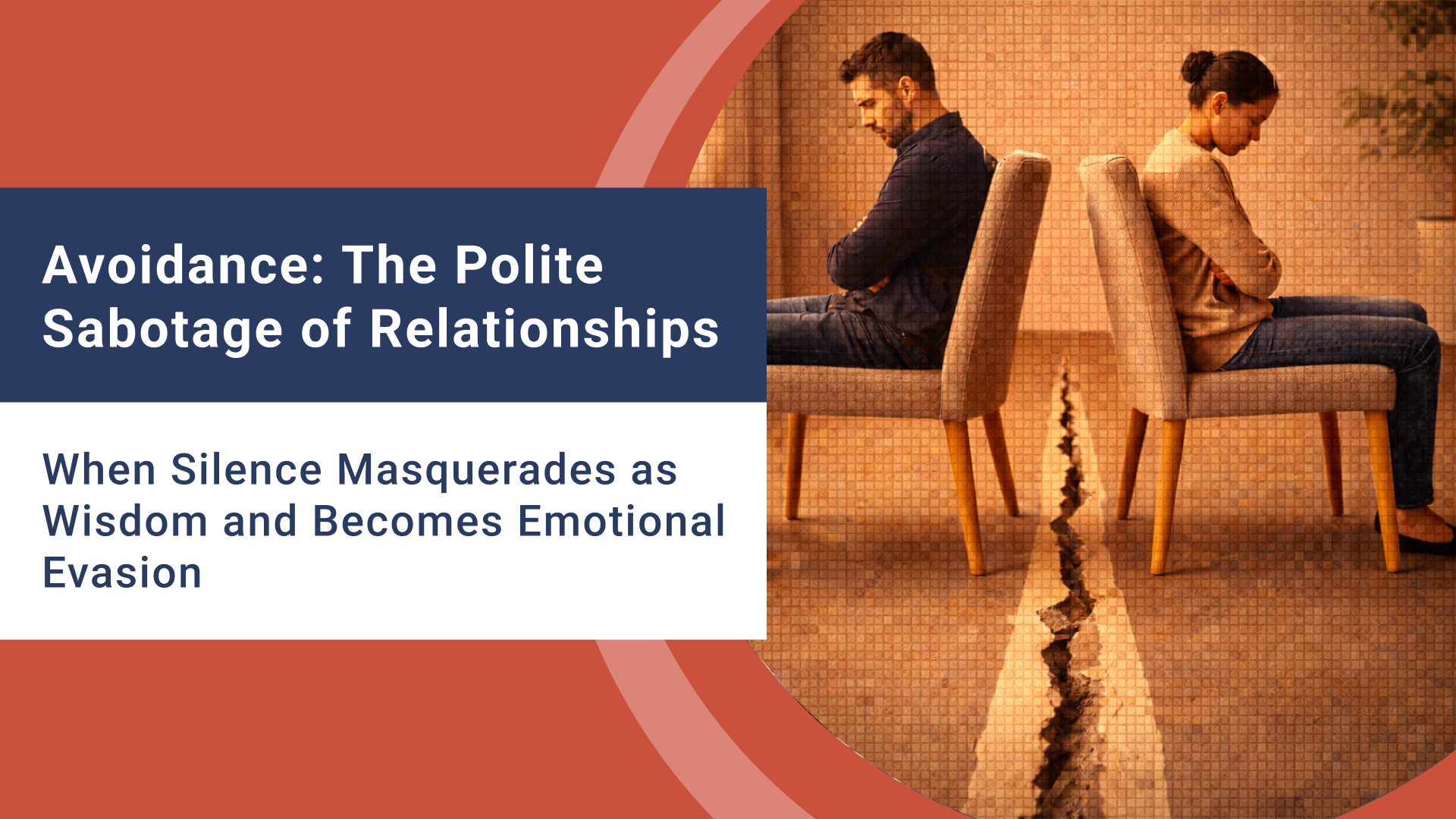

Background: The Comfort of Delay
In most relationships, whether intimate, professional or strategic, avoidance does not present itself as avoidance. It rarely feels irresponsible in the moment. It rarely feels weak. In fact, it often feels thoughtful. It feels calm. It feels like restraint. We tell ourselves we are being measured and considerate. We say the emotions are high and now is not the right time. We say the issue is small and not worth disturbing the overall harmony. We convince ourselves that maturity means not reacting.
In teams and organisations, this posture is frequently rewarded. The person who does not challenge openly is seen as easy to work with. The leader who does not confront tension immediately is seen as composed. In partnerships, especially long-term ones, silence can be interpreted as patience. Over time, this creates a subtle cultural norm. It becomes normal to smooth things over. It becomes normal to postpone. It becomes normal to carry small irritations quietly rather than surface them directly.
Psychologically, this makes sense. Avoidance reduces immediate discomfort. It regulates the nervous system. It lowers the intensity of the moment. When something feels threatening, whether that threat is rejection, escalation or disconnection, stepping back feels protective. The body calms. The interaction moves on. The surface returns to stability.
But the absence of visible conflict does not mean the absence of tension. When an issue is not addressed, it does not evaporate. It shifts location. Instead of existing in a shared conversation, it begins to exist privately. It lives in interpretation. It lives in internal dialogue. It lives in the stories we tell ourselves about what the other person meant or failed to do.
Over time, these private narratives shape posture. We become slightly more guarded. Slightly more distant. Slightly less open. Nothing dramatic happens, yet something important changes. What looked like peace may have been postponement. What looked like maturity may have been fear. Avoidance is subtle, and that subtlety is precisely what allows it to slowly weaken relationships while maintaining the illusion that everything is fine.
Introduction: When Space Becomes Escape
There is a subtle but decisive difference between giving something space and avoiding it. On the surface they can look identical. Both involve silence. Both involve delay. Both involve stepping back rather than stepping in. Yet psychologically and relationally they operate from very different places. Space has intention behind it. It is chosen. It is conscious. It serves clarity. Avoidance, by contrast, is rarely deliberate in that way. It is usually driven by discomfort. It is a reflex to reduce emotional tension. It creates distance not to gain insight, but to escape friction.
In many relationships, especially those that value harmony, avoidance is mislabelled as maturity. People pride themselves on not being reactive. They tell themselves they are not dramatic. They see confrontation as unnecessary intensity. In professional settings it becomes even more sophisticated. Leaders say they are waiting for the right timing. Colleagues say they do not want to escalate matters. Partners say they do not want to hurt feelings. The language is careful. The posture appears composed. Yet beneath that composure there is often an unspoken reluctance to step into discomfort.
The reality is that most relationships do not deteriorate because people lack intelligence or good intentions. They deteriorate because difficult conversations are postponed repeatedly. Each postponement seems small. Each delay feels harmless. But over time those small silences accumulate. What is left unaddressed begins to form interpretations. Interpretations become assumptions. Assumptions harden into stories. And those stories quietly shape how we show up with one another.
This article is not an argument for aggression or relentless confrontation. It is not a call to dramatise every tension. It is an invitation to examine something more fundamental. When we say let us give it time, are we creating space for responsibility, or are we stepping away from it. When we choose silence, are we strengthening the foundation of the relationship, or are we protecting ourselves from discomfort at its expense.
The distinction matters because avoidance does not simply delay resolution. It shapes how we are being with each other. And how we are being, over time, determines the quality, resilience and depth of every partnership we build.
Why We Avoid
Before judging avoidance, it is important to understand it. Most people do not avoid because they are careless or malicious. They avoid because something inside them is trying to stay safe. Conflict activates uncertainty. Uncertainty activates fear. Fear activates protection. In that chain of reactions, avoidance becomes a strategy for self-preservation.
At the emotional level, avoidance is often driven by the fear of losing connection. We fear that raising an issue will create distance. We fear being misunderstood. We fear being seen as difficult, overly sensitive or confrontational. In professional settings, the fear may be reputational. In intimate relationships, the fear may be abandonment. In partnerships, it may be the loss of stability. So instead of risking rupture, we choose silence.
There is also a deeper layer. Confrontation requires exposure. To speak honestly about what bothered us, what hurt us or what felt misaligned means we must reveal our internal world. That vulnerability can feel more threatening than the original issue itself. It is easier to manage irritation privately than to reveal that we felt dismissed, unvalued or unheard. Avoidance shields us from that exposure.
On a behavioural level, avoidance can masquerade as patience. We tell ourselves we are waiting for the right time. We say we need more information. We rationalise that the issue may resolve itself. Sometimes that is true. Often it is not. What is really happening is that we are postponing the discomfort of stepping into clarity.
In this sense, avoidance is not simply a communication choice. It reflects a posture. It reflects how we relate to discomfort, responsibility and courage. It reveals whether we prioritise short-term emotional safety or long-term relational strength. The intention may be harmony. The outcome, however, is often something else.
What Avoidance Actually Does
Avoidance does not remove tension. It relocates it. When a concern is not brought into conversation, it does not dissolve into nothing. It moves from the shared space between two people into the private space of one mind. What could have been clarified through dialogue becomes filtered through interpretation.
In that private space, stories begin to form. We replay the moment. We assign meaning to tone. We interpret intention. We fill in gaps with assumption. Without the corrective of open conversation, those assumptions gain strength. Over time they harden into belief. What began as a small misunderstanding can quietly transform into a settled narrative about who the other person is.
In teams, this shift is particularly damaging. Silence creates misalignment. Misalignment reduces trust. Trust erosion reduces collaboration. On the surface the team may appear functional, even cordial. Meetings continue. Tasks are completed. Yet beneath the activity there is hesitation. People speak less freely. Feedback becomes diluted. Innovation slows because psychological safety is compromised by unspoken tension.
In intimate relationships, avoidance often leads to emotional distance. When disappointment is not voiced, it turns inward. When frustration is not clarified, it becomes stored. The body may relax in the moment, but the bond absorbs the cost. Over time the connection feels thinner. Not because of dramatic conflict, but because of repeated silence.
Avoidance creates a false sense of stability. There is no visible disruption, so it appears that nothing serious has happened. But stability built on suppression is fragile. What is repeatedly compressed eventually seeks release. When it does, the reaction often feels disproportionate to the original issue. In reality, it is the accumulated weight of many unaddressed moments finally surfacing.
The Myth of “Let’s Give It Time”
Few phrases sound as reasonable as let us give it time. It signals calm. It signals restraint. It suggests that wisdom lies in patience. And sometimes it does. Emotions can be high. Perspective can be limited in the heat of the moment. A pause can prevent escalation and allow reflection.
But time by itself does not resolve what is never addressed. Time amplifies what is reinforced. If distance grows while silence remains, then time is not healing. It is deepening separation. If assumptions are forming while dialogue is absent, then time is not clarifying. It is solidifying interpretation.
There is an important distinction here. A pause is intentional. It has a clear boundary. It is used to prepare for a more grounded conversation. Avoidance, however, has no such boundary. It drifts. There is no set moment to return. No clear ownership of the issue. No commitment to resolution. What was meant to be temporary becomes indefinite.
When people say let us give it time, the real question is this. What is happening during that time. Is reflection occurring. Is responsibility forming. Is emotional regulation taking place. Or is the discomfort simply being buried beneath daily routine.
Time can assist responsibility. It cannot replace it. Without ownership, time becomes a hiding place. With ownership, time becomes preparation. The difference is not in the clock. It is in the posture of the people involved.
Healthy Confrontation Is Not Aggression
One of the reasons avoidance persists is because confrontation is often confused with aggression. Many people equate raising an issue with attacking, blaming or escalating. They imagine confrontation as emotional intensity, raised voices or personal criticism. If that is the only model available, then silence can feel like the more civilised choice.
But healthy confrontation is not an act of domination. It is an act of responsibility. It does not aim to win. It aims to clarify. It does not seek to overpower. It seeks to align. At its core, it is an invitation into truth without humiliation.
Healthy confrontation begins with ownership. Instead of accusing, it names experience. Instead of declaring what the other person did wrong, it articulates what was felt, perceived or needed. This shifts the posture from attack to accountability. It signals that the goal is understanding rather than victory.
There is also a clean-up process involved. Few conflicts are entirely one-sided. Even when we feel wronged, our silence, assumptions or delayed reactions often contribute to the misalignment. Cleaning up our part does not minimise the issue. It strengthens credibility. It demonstrates maturity. It reduces defensiveness.
When ownership and clean up are present, movement becomes possible. The conversation is no longer about who is at fault. It becomes about what is required going forward. That is the point of healthy confrontation. Not to relive the past endlessly, but to prevent its repetition.
Avoidance protects comfort in the moment. Healthy confrontation protects the integrity of the relationship over time. One preserves surface calm. The other builds depth and resilience.
When Is Avoidance Actually Wise
It would be simplistic to argue that all avoidance is wrong. Not every tension requires immediate confrontation. Not every irritation deserves elevation into a serious discussion. Maturity includes discernment. The question is not whether we ever step back. The question is why we are stepping back.
There are moments when pause is genuinely wise. When emotions are flooded and clarity is low, speaking too quickly can cause unnecessary damage. When a person is exhausted, overwhelmed or reactive, temporary distance can create the stability required for a constructive conversation. In such cases, stepping back is not avoidance. It is preparation.
There are also situations where safety must be considered. If the other party is volatile, abusive or incapable of dialogue, confronting them may escalate harm rather than resolve tension. In those contexts, strategic disengagement may be necessary. Protection is not avoidance. It is prudence.
The problem arises when what begins as a pause becomes indefinite postponement. When there is no intention to return to the issue. When silence becomes the default pattern. When discomfort is consistently deferred rather than integrated.
A pause has a direction. It leads back to engagement. Avoidance has no direction. It leads to drift. Discernment lies in examining the internal posture. Am I stepping back to return with clarity, or am I stepping back to escape discomfort. The behaviour may look the same. The motive makes all the difference.
Responsibility: The Antidote to Avoidance
At the heart of avoidance lies a deeper issue than communication. It is not simply about whether we speak up. It is about how we relate to responsibility. Many conflicts remain unresolved not because people lack intelligence or care, but because they have an unhealthy relationship with responsibility itself.
Let's look into the Being Framework ontological distinction of responsibility:
Responsibility is being the primary cause of the matters in your life, regardless of their source. It is the extent to which you choose to respond rather than react to them. Responsibility is distinguished by how you honour the autonomy that you have as a human being and is considered the power to influence the affairs, outcomes and consequences you are faced with. Responsibility is not about blaming or determining whose fault it is. Instead, it is to intentionally choose, own, cause and bring about outcomes that matter, work and produce results while also being answerable for the impact and consequences.
A healthy relationship with responsibility indicates that you have the power to influence the circumstances you find yourself in and/or cause. Others may consider you capable of appropriately responding to matters, which is a prerequisite to producing and bringing to fruition effective results. You fully accept ownership of both outcomes and consequences and have the capacity to make informed, uncoerced decisions. You are unquestionably the active agent in your life.
An unhealthy relationship with responsibility indicates that you may often be stuck, experience a loss of power, and are a victim of circumstances. You frequently experience being disarmed, as though you have no choice in influencing outcomes and there is an inevitability about your future. You may be inclined to self sabotage and make repetitive complaints without seeking, putting forward and implementing solutions. You frequently make excuses for your lack of accomplishments while abdicating or avoiding consequences. You may be considered ineffective in consistently fulfilling the promises you make and producing intended results. You are a passive victim in your life. Alternatively, you may live life from the viewpoint of being the sole cause of matters and exert your will onto your surroundings and others or be over-responsible and attempt to control all matters all the time. You may also expect that matters should always go your way.
Reference: Tashvir, A. (2021). BEING (p. 277). Engenesis Publications.
There is another distortion as well. Some individuals live as though they are the sole cause of all matters. They become over-responsible. They attempt to control every outcome and every person. In relationships this can manifest as dominance rather than dialogue. Instead of avoiding conflict, they force it. Instead of ownership, they impose will. Both extremes share the same root. A distorted relationship with responsibility.
In the context of avoidance, responsibility invites a different posture. It asks a simple question. Given that this tension exists, how will I respond. Not who caused it. Not who is at fault. Not whether it is fair. But what is my chosen response. When responsibility is understood in this way, silence is no longer neutral. It becomes a choice with consequences. Engagement becomes an act of agency rather than aggression.
Avoidance thrives where responsibility is misunderstood. Where responsibility is clear, confrontation becomes less about conflict and more about authorship. You are not entering the conversation to win. You are entering it to influence, align and produce outcomes that matter. That is the power of a healthy relationship with responsibility.
Own It. Clean It Up. Move On.
Avoidance often hides inside partial action. People say they want to move forward, but they skip the stages that make movement real. In healthy conflict resolution there is a practical sequence that prevents matters from remaining incomplete. Own it. Clean it up. Move on. Each stage serves a distinct function. When one is skipped, tension lingers.
Own it does not mean accept blame. It does not mean declare yourself at fault. It means identify where you have influence. It means recognising that regardless of who initiated the issue, you are responsible for your response. For example, in a team meeting you felt dismissed when your idea was interrupted. Owning it would sound like this. I felt overlooked in that moment and I did not clarify my point. That is ownership. It identifies your experience and your contribution without collapsing into self-blame. It shifts you from victim to agent.
Clean it up means address what was left misaligned. It requires conversation. It requires clarification. It may require apology. It may require renegotiation of expectations. In the same example, cleaning it up would involve speaking with the colleague and saying I want to revisit what happened in the meeting. I realised I withdrew rather than clarifying my idea. I would like us to ensure we both have space to finish our points. Clean up restores alignment. It repairs the rupture rather than pretending it never occurred.
Move on means release the matter once it has been addressed. It means not weaponising the past. It means not carrying resolved issues into future interactions. After ownership and clean up, forgiveness becomes possible. Movement becomes natural. Without this final stage, people remain stuck in replay. They keep referencing what happened. They project old tension onto new situations. The issue may have been discussed, but it was never truly closed.
Many relational problems arise because this sequence is disrupted. Some want to move on immediately. They say let us forget it and continue. But without ownership and clean up, moving on is denial. The issue remains active beneath the surface. Others may own their part but resist clean up. They acknowledge what happened internally, yet avoid the necessary conversation. Insight without action does not resolve misalignment.
There are also those who attempt to fix matters instantly without ownership. They jump into solutions. They change processes. They make promises. But if their own posture is not examined, the same pattern reappears in a different form. Finally, some people own it and clean it up yet refuse to move on. They keep revisiting the past. They bring it into new discussions. They project old narratives onto present behaviour. Completion requires release.
When all three stages are honoured, relationships strengthen. Ownership restores agency. Clean up restores alignment. Moving on restores freedom. Avoidance disrupts this sequence by skipping the first step. Over control distorts it by refusing the last. Integrity requires all three.
Inject this section immediately after the Responsibility section and before the Conclusion. The Responsibility section establishes the posture. This practical sequence translates that posture into action. The Conclusion can then land with strength and coherence.
Forgiveness: Completion Without Carrying
If ownership restores agency and clean up restores alignment, forgiveness restores freedom. Without forgiveness, even resolved matters can linger emotionally. The conversation may have occurred. The apology may have been offered. The behaviour may have changed. Yet internally, something is still being carried.
Let's look into the Being Framework ontological distinction of forgiveness:
Forgiveness is the quality of being able to let go and move on. It provides access to restoring integrity to how it used to be before the act or event you are forgiving. When you forgive, you completely discard any resentment, anger or hurt towards a person (including yourself) in relation to the act in question. Forgiveness is not about condoning another’s behaviour or actions; it is freeing and releasing oneself from the past while embracing the lesson learned. Forgiveness brings about ease and flow.
A healthy relationship with forgiveness indicates that you mostly experience freedom from resentment and choose to discard resentment, anger or hurt towards yourself and others quickly and completely. Others may experience you as someone who can move on from negative experiences or issues with ease. You look to actively resolve issues and restore relationships.
An unhealthy relationship with forgiveness indicates that you often dwell on and repeatedly bring up past events and have difficulty letting go of blame or shame. Others may consider you vengeful, bitter, or someone who can maintain a grudge for a long time. You may have a tendency to blame circumstances, past events or others for the outcomes you experience in life. You may also consider yourself forgiving of others but hesitate or decline to forgive yourself. Alternatively, you may frequently try to move on too quickly without learning the lessons, resolving any issues and bringing about closure. You may be considered naive and unable to discern the motives of others and often accept excuses to preserve the peace. You may let others take your forgiveness for granted and are susceptible to being taken advantage of.
Reference: Tashvir, A. (2021). BEING (p. 439). Engenesis Publications.
There is another distortion that often hides behind politeness. Moving on too quickly without learning the lesson, resolving the issue or establishing new boundaries is not forgiveness. It is naivety. It invites repetition. It may appear peaceful, yet it leaves you vulnerable to being taken for granted or taken advantage of.
True forgiveness requires completion. Ownership clarifies your part. Clean up addresses the rupture. Forgiveness releases the residue. Without forgiveness, the past continues to shape the present. With it, relationships regain ease and flow. Forgiveness is not weakness. It is the strength to close what has been resolved and walk forward unburdened.
Conclusion: The Cost of Polite Silence
Avoidance feels calm. It feels mature. It feels like we are choosing stability over drama. In the short-term, it often works. The immediate tension subsides. The interaction continues. Nothing visibly breaks. But relationships are not strengthened by the absence of visible conflict. They are strengthened by the presence of clarity, ownership and courage.
When difficult conversations are repeatedly postponed, something subtle shifts. Trust becomes thinner. Transparency becomes selective. Authenticity becomes filtered. Over time, people stop bringing their full experience into the relationship. They manage it privately instead. What remains may look functional, even peaceful, but it lacks depth.
Healthy relationships are not those without tension. They are those where tension can be addressed without humiliation or fear. That requires a certain way of being. It requires the willingness to own experience, to clean up contribution and to move forward without clinging to resentment. It requires courage to value truth over temporary comfort.
Before choosing silence, it is worth asking a simple question. Am I protecting the relationship, or am I protecting myself from discomfort. The answer may not always be easy, but it is revealing. Peace that depends on suppression is fragile. Alignment that is built through honest engagement is resilient.
Avoidance can preserve surface harmony. Responsibility builds strength. Over time, only one of them sustains connection.