

About this Series
This article is part of a six-part series exploring why many inclusion, leadership, and transformation efforts stall despite good intent and significant investment. Working beneath behaviour and policy, the series examines how identity-level pressure quietly shapes who feels able to belong, lead, and contribute without adaptation. Across gender, age, culture, and place, it traces how legitimacy becomes conditional, how identity load accumulates, and why organisations often misread these signals as performance, engagement, or capability problems rather than systemic strain.
The Authority That Shifts as We Age
In modern organisations, people speak about generations more than ever, yet rarely name the tension it creates. We talk about Boomers, Gen X, Millennials, and Gen Z as if naming the cohorts explains the problem. We invest in reverse mentoring, future skills, and knowledge transfer. We ask leaders to stay relevant and younger employees to be patient. And yet something fundamental remains unresolved.
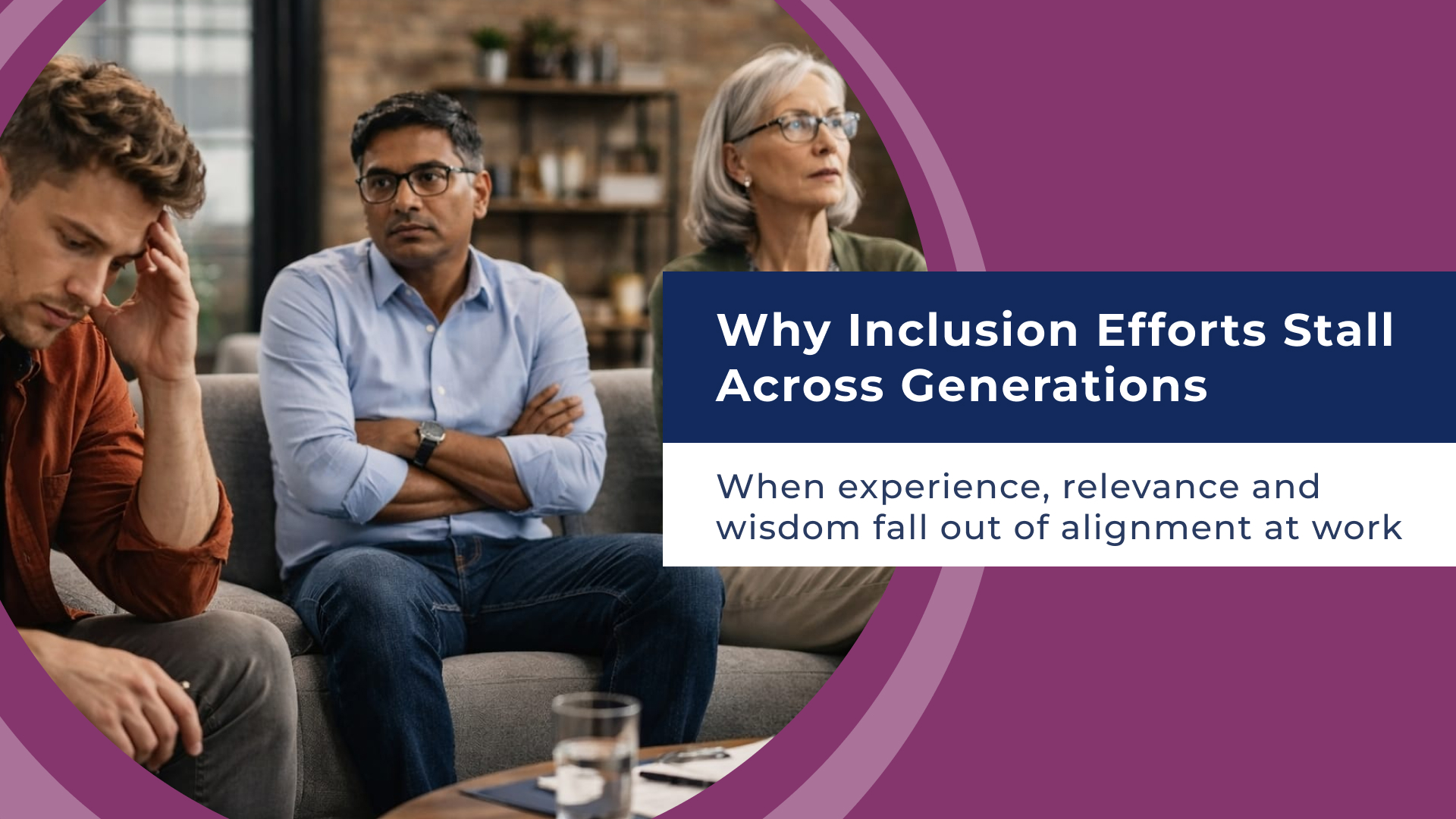
Across age groups, people are quietly managing how legitimate they feel. Not whether they are capable. Not whether they are committed. But whether their voice still counts, or has started to count less. This is not experienced as overt discrimination. It shows up as uncertainty. As self-monitoring. As adaptation. As the sense that authority has conditions attached to it that shift over time, often without being spoken. We are older as a workforce. But whether we are wiser in how we relate to age is far less certain.
The Age You’re Allowed to Lead At
Age, in organisational life, is rarely discussed as exclusion. It is experienced as uncertainty. Uncertainty about when authority applies. About when voice carries weight. About when experience counts, and when it quietly becomes a liability.
Age operates less like a demographic fact and more like a social contract. It carries expectations about pace, confidence, adaptability, energy, authority, and relevance. These expectations are rarely written down. They are absorbed through observation and reinforced through subtle signals about who is trusted, who is consulted, and whose ideas land without qualification.
At different stages of life, people learn different rules about how much certainty they can express, how much influence they can claim, and how visible their ambition should be. When those rules are unclear or shifting, legitimacy becomes something to manage rather than inhabit. This is where identity-level strain begins.
Too Early: The Cost of Being Young
For younger leaders and professionals, legitimacy is often provisional. Capability may be present. Insight may be strong. But credibility must be earned repeatedly and performed carefully. Uncertainty is hidden. Preparation is excessive. Authority is softened to avoid being seen as arrogant or naive.
The adaptation here is subtle. Younger employees learn to speak later in meetings. To hedge statements. To demonstrate diligence before judgment. To work harder to be taken seriously. From the outside, this looks like ambition and commitment. From the inside, it can feel like constant proof.
When legitimacy feels conditional, energy shifts away from contribution toward impression management. Innovation narrows not because ideas are lacking, but because risk feels costly when authority has not yet settled.
Too Late: The Cost of Being Experienced
Later in the career arc, legitimacy shifts again. Experience, once an asset, can become something to downplay. Expertise is offered cautiously. New ideas are framed as support rather than direction. Curiosity is emphasised to avoid being seen as rigid. Confidence is tempered so it does not read as resistance.
Older leaders often guard against appearing outdated, inflexible, or out of step with change. They adapt by staying agreeable, by stepping back before being asked, or by positioning themselves as mentors rather than decision-makers.
Again, this rarely looks like disengagement. It looks like maturity. But it carries a cost. Systems lose access to judgment forged over time. Patterns that could be recognised early are noticed late. Wisdom becomes optional rather than integral.
The Middle: Carrying the System Quietly
Between these poles sit those in mid-career, often carrying the most invisible load. They translate between generations. Hold institutional memory. Stabilise teams during change. Absorb pressure from above and below. They are relied upon but rarely named as critical.
Authority here is often implied rather than granted. Responsibility expands faster than permission. Exhaustion accumulates quietly. This group is frequently praised for resilience while being stretched thin by unacknowledged expectations.
When Wisdom Is Mistaken for Weight
There is an old Zen story about two monks walking together on a long journey.
They come to a river where a young woman is standing, unsure how to cross. She is bound by the customs of the time and cannot touch the monks. One monk lifts her onto his back, carries her across the river, and sets her down on the other side. The monks continue walking in silence. Hours later, the second monk finally speaks.
“How could you do that?” he asks. “You know we are not permitted to touch a woman.”
The first monk replies, “I put her down at the river. Why are you still carrying her?”
This story is often told as a lesson about attachment. It is also a lesson about age and wisdom. The younger monk follows the rule correctly but carries the weight long after the moment has passed. The older monk understands something quieter. Wisdom is not rigid adherence. It is discernment. Knowing what must be held, and what can be released.
In many organisations, age has become confused with weight. Experience is treated as something heavy. Something to manage. Something that slows the system down. Older leaders are encouraged to make space or stay relevant, as though wisdom itself were a liability.
What is missed is that wisdom is not accumulation. It is selection. It is the ability to recognise what matters now because you have seen what does not last. To distinguish signal from noise. To set down what no longer serves and act cleanly in the present. When systems mistake wisdom for weight, they ask people to carry what no longer matters while discarding what could guide them.
Cultural Views of Age and the Loss of Perspective
This misstep is not universal. Many Indigenous cultures hold age as a marker of responsibility rather than decline. Elders are valued not for speed, but for memory, judgment, and perspective across time. Authority grows through lived understanding rather than constant performance.
In contrast, modern Western organisational culture is shaped by acceleration. Youth becomes shorthand for innovation. Age becomes something to manage rather than integrate. This bias is rarely hostile. It is structural. As a result, organisations grow older demographically while becoming younger in how they value perspective. People live longer, work longer, and span more life stages within a single career than ever before. Yet the systems they work within have not adapted to hold legitimacy across time.
We are older. The question is whether our systems are wise enough to recognise what that makes possible.
The Organisational Cost of Conditional Legitimacy
When legitimacy shifts silently with age, organisations pay for it in ways that are difficult to trace. Innovation slows because people hedge. Learning contracts because admitting uncertainty carries risk. Decisions take longer because authority is diffused or withheld. Succession planning becomes technical rather than relational.
Leadership pipelines thin not because talent is lacking, but because identity safety erodes across time. This is not a generational conflict. It is a legitimacy problem that moves as people age. Until this is recognised, organisations will continue to invest in capability while quietly losing coherence.
Why This Matters Now
As work becomes more complex, more global, and more psychologically demanding, identity-level strain is no longer marginal.
Trust, decision quality, and adaptive capacity depend on people feeling able to speak with authority appropriate to their experience. When leaders are managing how they appear rather than engaging fully, systems stabilise at the cost of vitality.
Strategy may be sound. Structure may be robust. But the human system is constrained by unspoken identity risk. Organisations cannot train their way out of this. They cannot optimise fast enough to offset systems that quietly require people to manage who they are to belong. This is not a problem of age. It is a problem of how age is interpreted.
What Comes Next
This article is not an argument for privileging one generation over another. It is an invitation to notice how legitimacy is negotiated across time, often without awareness.
In the next pieces, the focus will move to culture and place, exploring how adaptation, belonging, and identity safety are shaped not only by age but by the meaning systems and landscapes in which people are formed. Leadership fatigue, burnout, and organisational drag do not arise from a single source. They emerge when identity must be managed rather than inhabited. And that begins with how we see.