
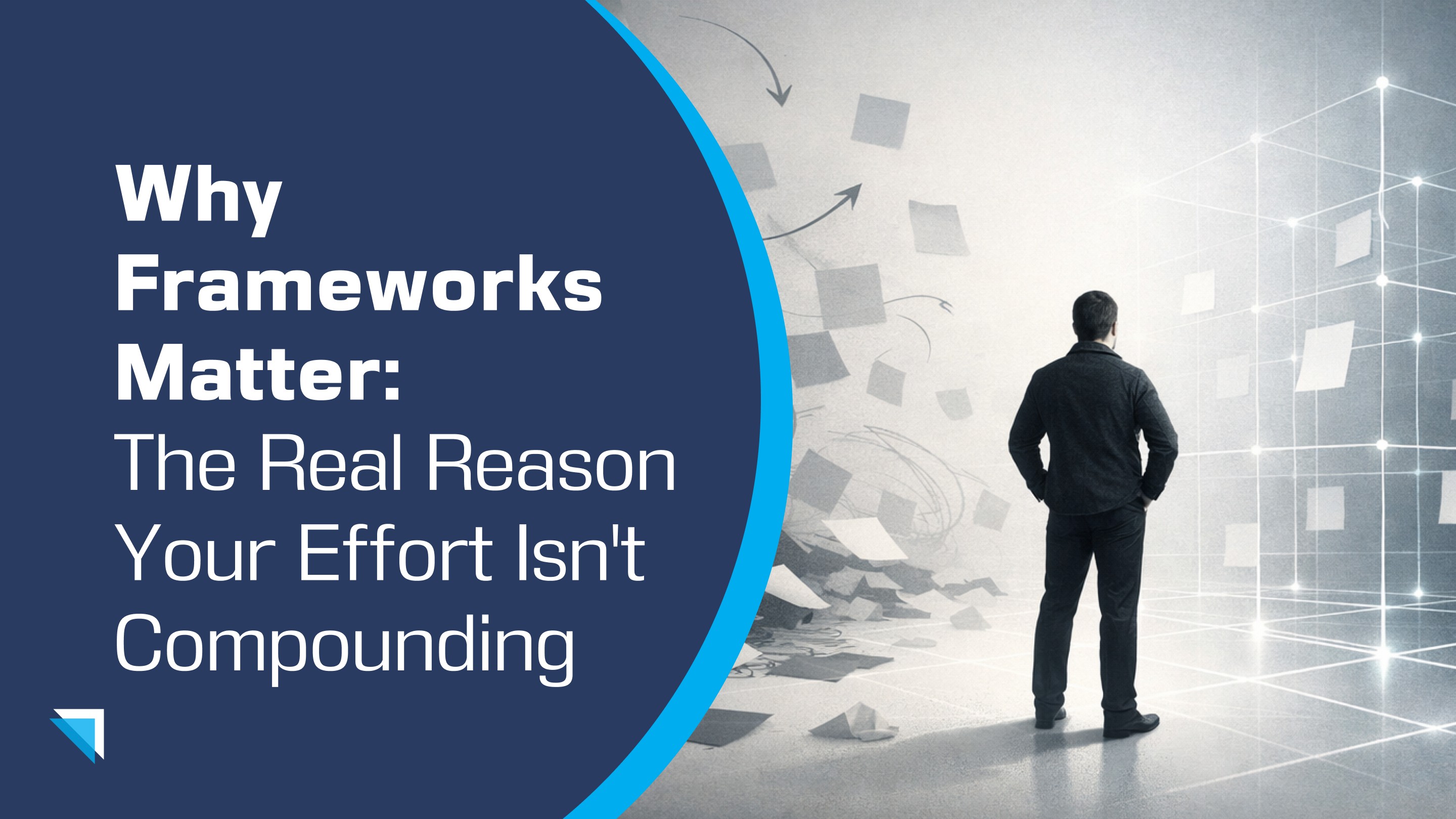

There is a problem that many capable people quietly live with. They work hard, they care deeply, they keep learning, and yet their effort does not truly compound.
In working with hundreds and hundreds of entrepreneurs, business owners, and leaders, I have found that there is a reason this happens. There is something underneath it. In this article, we will explore why frameworks matter far more than most people initially realise.
We are surrounded by a culture that keeps telling us the answer is more effort. It is in our social media feeds. It is in the advice people repeat. Work harder. Stay disciplined. Keep pushing. Be more consistent. Of course effort matters. But this explanation is too shallow. It does not explain why sincere, intelligent, hardworking people can still remain stuck in cycles of instability, unsustainability, friction, and repeated reinvention. Many people know the feeling. They are moving, but not developing anything stable. They are learning, but still struggling to gain clarity they can rely on. They are working, but not seeing the kind of momentum that should come from that work. This article looks more closely at why that happens.
When effort is real but progress still feels fragile
One of the most frustrating experiences in serious work is to know that the effort is real and still feel that the results are not stabilising.
From the outside, things may still look promising. There may be movement, activity, output, even moments of traction. But from the inside, something often feels heavier than it should. Decisions take more energy. Execution becomes inconsistent. Progress depends on bursts of momentum rather than something sturdy underneath it.
People describe this in different ways. They say they are overwhelmed. They say their team is not aligned. They say they keep second-guessing themselves. They say they are learning, but not arriving at the level of clarity, coherence, or traction they expected. These symptoms often look separate. Very often, they come from the same deeper issue.
Why the usual answers often fail
When people experience this kind of friction, the usual response is to reach for more effort, more tactics, more urgency, or more optimisation.
Sometimes that helps for a while. It can create a temporary lift. It often does not solve the deeper issue. It treats the visible struggle while leaving untouched the thing that keeps producing it. This is why many people find themselves revisiting a version of the same problem again and again. The context, the language, and the surface challenge may all change, but the underlying strain remains strangely familiar.
That is usually a sign that the real issue sits deeper than execution alone.
Why we misunderstand wisdom
We all recognise the archetype of the aged mentor. The person with battle scars. The person who has seen enough, lived enough, and endured enough to carry a kind of calm, grounded understanding. We respect that image because it points to something real. There is wisdom there. There is depth. There is usually a stronger ability to see patterns, avoid naive mistakes, and grasp what matters beneath the surface.
But we often misunderstand where that wisdom comes from.
It is easy to assume that wisdom comes from experience itself. That age produces depth. That years automatically mean clarity. Yet experience alone does not create understanding. What creates understanding is what someone extracts from experience. The patterns they notice. The relationships they understand. The distinctions they learn to make. The way they organise what they have lived through into something coherent.
Two people can go through similar years, similar setbacks, even similar victories, and arrive in very different places. One becomes clearer, steadier, and wiser. The other becomes repetitive, reactive, or merely more confident in a narrow slice of understanding. The difference is not simply the number of years. It is what they extracted from those years, and whether they turned those lessons into a coherent way of seeing.
Wisdom is less about accumulation and more about organisation.
The invisible layer underneath effort
Beneath every decision, every action, and every interpretation of a problem, there is a structure. There is a way of seeing, organising, prioritising, and connecting what is happening. We call this a person’s metacontent.
This is one reason wisdom is often misunderstood. People think depth comes from time alone, when very often it comes from the structure a person has built from what they have lived through. Whether someone realises it or not, they are already operating from a framework. This matters because people often imagine frameworks as an optional extra, something abstract that sits above real life. But in reality, everyone already has one. The real issue is not the absence of structure. It is the presence of a structure that is invisible, fragmented, incomplete, or inconsistent.
Most people are not operating without a framework. They are operating from one that has gaps, one that is fragmented, one that is only partially formed by what they have lived through so far. And very often, that is exactly what turns into the frustration they feel without fully understanding why. The instability, the repeated friction, the heaviness in decision making, and the sense that effort is not quite translating all often trace back to this deeper structural problem.
Why no one naturally wants to learn a framework
Almost no one wakes up wanting to learn a framework. They want relief. They want stronger decisions, clearer direction, fewer repeated mistakes, better results, more stable teams, and less friction in situations that keep draining them.
That matters because it changes how frameworks should be introduced. A framework is rarely the thing people think they want. It is the thing that explains why they are still getting the symptoms they do not want. It makes visible what is otherwise vague, exhausting, and repeatedly costly.
The bridge is this: people usually do not want a framework for its own sake. They want to stop paying the price of operating without one.
The hidden cost of building understanding slowly
Most people are, in effect, trying to build their own frameworks manually. They are constructing mental models one lesson at a time, one costly experience at a time, one mistake at a time. A setback becomes a warning. A win becomes a principle. A painful conversation becomes a lesson about people. A failed hire becomes a lesson about leadership. A missed opportunity becomes a lesson about timing. Over the years, these lessons accumulate.
There is something admirable about this. There is courage in living, trying, failing, learning, and getting back up. But there is also a cost that is too rarely named.
Learning this way is slow. It is expensive. It can take years to discover what could have been understood far earlier if there were a clear structure for making sense of things. It also leaves people vulnerable to gaps, contradictions, blind spots, and unnecessary repetition. We tend to romanticise the struggle, as though hard-earned lessons are automatically more noble simply because they were costly. But much of that cost is not essential. Much of it is the price of trying to build understanding without enough structure.
There is another layer here as well. Sometimes people feel that they need to earn the lesson for themselves. They feel that their self-validation depends on learning it directly, through their own mistakes, their own setbacks, and their own lived trial and error. We saw this at times with entrepreneurs we supported. We would draw on a wide body of experiences across wins, losses, setbacks, accelerations, and different industries, and occasionally the response would be, "Yes, but I want to learn it for myself."
There is something understandable in that. It matters that a person develops real conviction and real self-validation. But when that need becomes tightly coupled with building a business, leading a team, or advancing a mission, the price can become far too high. The organisation should not have to absorb the cost of every lesson being earned personally from scratch. That does not make the desire wrong. It simply means it should not be fused so tightly with the practical work of building something that matters.
This is why frameworks matter. They are not a rejection of experience. They are a way of preventing experience from remaining scattered.
When experience turns into fragmented confidence
There is another subtle risk here. Many people feel that because they have spent years in a domain, they must understand it deeply. They have seen patterns. They have learned hard lessons. They can speak with confidence. They can point to real-world experience. From the outside, this can look like maturity and competence.
Sometimes it is. But it is worth asking a more precise question. Is that understanding truly coherent, or is it made up of fragments?
It is entirely possible to collect many accurate pieces without having a complete or sufficiently integrated structure. A person may have real insights and still not have a coherent way of organising them. They may know certain truths, but not know how those truths relate to one another. They may have strong instincts in familiar situations, but weak judgement when the context changes. They may sound certain because they have seen enough to become confident, while still lacking the deeper coherence needed for consistently sound decisions.
This is where a dangerous gap can appear between confidence and competence.
A fragmented structure can create the illusion of mastery. It can make someone feel more certain than they should. Even accurate pieces of knowledge can become liabilities when they are overgeneralised, misapplied, or disconnected from a broader whole. A person can end up acting decisively from an incomplete map.
The aim is not perfection, and it is not having all the answers. The aim is greater coherence, greater congruence, and greater completion of structure. The more the pieces fit together, the more reliable the understanding becomes. The more they remain fragmented, the more risk there is that learning will mislead rather than guide.
Why other serious fields do not rely on raw trial and error
This becomes obvious in fields where the cost of error is high. Take medicine. We do not train surgeons by telling them to simply start operating and slowly piece together their own understanding of the human body. We do not ask them to rely only on personal experience, instincts, and lessons gathered one patient at a time. That would be reckless, not because experience does not matter, but because the cost of learning in that way would be far too high.
Instead, humanity has spent generations mapping the body, identifying patterns, naming systems, clarifying relationships, and developing structured knowledge. We have tried to understand reality well enough that the next person does not need to start from scratch. When a surgeon begins training, they inherit a body of organised understanding. They are not merely collecting random lessons. They are stepping into a structure.
That structure does not eliminate the need for effort. It does not remove practice. It does not guarantee that mistakes will never be made. But it changes the nature of those mistakes. They are no longer blind guesses made from an unstructured relationship with reality. They happen within a clearer map.
Frameworks do not eliminate mistakes. But when a mistake happens within a coherent structure, it is easier to identify, correct, and learn from, rather than repeating the same error without ever understanding why.
The same principle applies far beyond medicine. Whenever the stakes matter, humanity progresses by building structured ways to understand what is happening, not by forcing every individual to rediscover everything through raw trial and error.
The absurd thing we normalise in business and life
And yet in business, leadership, self-development, and decision making, people often accept a standard that would seem absurd elsewhere. They assume it is normal to piece everything together through scattered experience. They assume it is normal to operate with partial maps. They assume it is normal to be highly active while still lacking a coherent structure for seeing what is really going on.
Because the consequences are usually slower and less visible than a surgical error, the danger is easier to ignore. But it is still there. It appears in years of wasted energy. In repeated relational dynamics. In team confusion. In overconfidence. In business growth that looks promising for a time but does not hold. In decisions that seem right in the moment and prove costly later. In endlessly trying to fix symptoms without understanding the deeper structure producing them.
What makes this difficult is that the person may still be learning. They may still be sincere. They may still be smart. But sincerity and intelligence do not automatically create coherence.
Without a stronger framework, people can spend years mistaking activity for progress and fragments for understanding.
What it looks like when the framework is weak, broken, or incoherent
When someone is operating from an unhealthy, incomplete, or incoherent framework, the symptoms are often familiar.
Decisions feel inconsistent. What seemed obvious yesterday becomes doubtful today. Different advice pulls in different directions because there is no stable structure for evaluating it. Strategies are changed too often, not necessarily because reality has changed, but because the person does not yet have a coherent way of interpreting reality.
Execution becomes inconsistent. There are spikes of effort and periods of hesitation. Energy goes into reacting, recalibrating, and mentally reassembling the situation each time something shifts. The result is that execution becomes reactive. Progress depends on emotional surges or external pressure rather than a reliable internal structure that holds regardless of how the moment feels. The same problems tend to resurface over time. A hiring issue, a leadership breakdown, a communication failure, these can look unrelated on the surface, but often trace back to the same structural gap. In each case, the real issue is not the surface problem. The gap is in how the person is making decisions, interpreting situations, or organising their understanding, not in the specific domain where the problem appeared. Without a clear enough structure for seeing what is actually happening and why, the same friction keeps returning in different forms.
Mental load also increases. Everything has to be figured out in real time. There is no dependable structure carrying some of the interpretive load. This creates fatigue, indecision, and instability. It can also create a strange combination of busyness and fragility, where much is happening but little is truly compounding. Good individual pieces do not add up to reliable outcomes when there is no coherent structure connecting them.
What it feels like when the framework is sturdy and coherent
By contrast, when there is a robust framework behind what someone is doing, the experience changes in important ways.
Decisions become clearer. The person has a consistent way of evaluating what is in front of them. They can look at a situation and quickly identify what type of problem it is, what matters most, and what the right next step is likely to be.
Execution becomes steadier. Actions are linked by an underlying logic rather than driven only by urgency or emotional triggers. There is more continuity, more internal consistency, and more ability to follow through without having to re-negotiate the fundamentals each time. Patterns become easier to see. Challenges are not merely encountered one by one. They are recognised as expressions of deeper structures. This allows the person to address root causes rather than remaining trapped at the level of symptoms.
In practical terms, the person makes faster decisions with less second-guessing, recognises familiar patterns sooner, and spends less energy reinterpreting situations they have already encountered in some form. The work still requires effort, but that effort is directed rather than scattered.
Outcomes begin to change as well. Progress becomes more reliable. Team alignment becomes easier because people are not merely sharing tasks, they are sharing the same internal frameworks. Communication improves because language maps to something deeper than personal opinion. Decisions travel faster because not every decision has to be built from scratch. Learning compounds because new experiences can be integrated into an existing structure rather than floating as isolated fragments. In other words, sturdy frameworks do not merely change what you think. They change the symptoms you experience, the quality of your decisions, the consistency of your execution, and the nature of the results you produce.
The real contrast
One path feels reactive, fragmented, mentally heavy, and inconsistent. The other feels structured, grounded, and increasingly stable. One path accumulates activity. The other builds momentum. One path relies on scattered interpretation and repeated reinvention. The other relies on a coherent structure that can hold learning, guide judgement, and support action. One path makes it more likely that confidence outpaces competence. The other creates the conditions for competence to become deeper, clearer, and more transferable.
This is why frameworks matter so much. They determine the difference between random effort and organised progress.
The two ways to build understanding
At a practical level, there are two broad ways to develop understanding.
The first is to build it almost entirely through personal trial and error. This is the path of slow accumulation. It can eventually produce wisdom, but it often does so at great cost. It is vulnerable to blind spots, repetition, overconfidence, contradiction, and wasted years.
The second is to leverage existing structure. To make use of a framework that has already been shaped, tested, refined, and articulated. To work with organised understanding rather than trying to generate every important distinction from scratch.
This does not mean bypassing real life. It does not mean becoming detached from practice. It does not mean treating a framework like a shortcut to success or a substitute for thinking. And it certainly does not mean adopting someone else's framework blindly. People can leverage what has already been mapped out, test it against reality, examine where it holds, adapt parts of it, add to it, and strengthen it over time. It means beginning from a stronger starting point rather than beginning from zero.
You cannot shortcut the application. But you can shortcut the confusion.
That matters. Because the point of a framework is not to save you from effort. The point is to save you from avoidable chaos, fragmented thinking, and years of rebuilding internal frameworks one piece at a time.
What a framework actually is
A framework is not just a model, a diagram, or a set of ideas. At its best, it is a structured way of relating to reality. It helps deconstruct complexity, clarify relationships, and organise understanding into something that can actually guide decisions and action.
You could say that a framework is a form of compressed experience. It takes patterns extracted from many lives, many mistakes, many iterations, many observations, and many notes shared across people and teams, and turns them into something transferable. It allows understanding to move from one mind to another, from one team to another, from one generation to another, without requiring everyone to pay the full original price of discovery.
This is one of the reasons frameworks matter so much in teams. Without a shared structure, people may each have their own fragments, their own instincts, their own interpretations, their own terminology. They may all be intelligent and sincere, yet still operate with misalignment because they are not sharing the same underlying mental map. A robust framework makes deeper coordination possible because it gives people shared reference points, shared distinctions, and a shared language for what they are seeing.
In that sense, a framework is not merely information. It is shared metacontent. It is a deeper structure that makes communication, thinking, and action more coherent.
It does not replace thinking. It organises it.
Implicit frameworks and explicit frameworks
Not all frameworks are named.
Many are implicit, developed gradually through experience. A gardener, for example, may spend decades learning how to grow a thriving garden. They develop a deep understanding of soil, timing, and the relationships between different elements. They may never formally name that understanding, but they are clearly operating from it.
There is value to this.
However, implicit frameworks are difficult to transfer, refine, or scale. They tend to remain tied to the individual who developed them, or are transferred to another in a fragmented and unstructured way. This limits the ability for others to adopt it.
Explicit frameworks are different. They are structured, named, and shared. They can be tested, improved, and applied across people and contexts.
Creating them requires discipline. But once created, they become assets that can spread and endure.
Implicit insight begins the process. Explicit frameworks allow it to scale.
Why frameworks can feel difficult at first
Even with all of this, it is still understandable that some people may have the tendency to initially resist adopting a framework.
A good framework can feel like a mental stretch. It can feel abstract before it becomes practical. It can feel slower than immediate action. For someone used to moving quickly, solving things on instinct, or improvising under pressure, it may even seem unnecessary at first.
But that initial resistance is not necessarily a sign that the framework is disconnected from reality. Often, the person is so focused on the immediate problem in front of them that stepping back to learn a framework feels like a detour. It does not feel like a detour once the framework starts working.
There is a short period where things may feel more conceptual, more demanding, and less instantly gratifying than simply doing whatever seems obvious in the moment. Yet if the framework is sound, that early stretch becomes one of the most efficient and effective ways to improve decision making, reduce gaps in execution, and build a stronger relationship to reality.
The question, then, is not whether structured learning feels effortless at the beginning.
The question is whether someone is willing to go through that initial stretch in exchange for greater clarity, stronger judgement, and a more coherent path forward.
Structured effort is different from scattered effort. It provides more intentional, consciously directed results.
A gentle challenge
This is the challenge.
Are you willing to go through a relatively short period learning, even if it initially feels theoretical, in order to avoid years of fragmented decisions, repeated mistakes, and preventable confusion? Are you willing to let your current understanding be examined, not in order to diminish what you have learned, but in order to see whether the pieces truly fit together? Are you willing to consider that some of the friction you have accepted as normal may not be the price of ambition, but the consequence of operating from an incomplete structure?
Adopting a framework requires a willingness to move beyond instinct, beyond fragments, beyond the comforting familiarity of one’s current map, and into a more disciplined relationship with reality.
And while it does not guarantee immediate success, it can significantly change the quality of the path. It can fast-track the development of clearer judgement. It can reduce the cost of avoidable errors. It can strengthen teams by giving them shared structure rather than isolated cleverness. It can help turn scattered insights into a coherent operating system.
It does not replace the work. But it changes the nature of the work.
Where this leads
As a venture builder, we have spent years building businesses, working with partners, collaborating with founding teams, supporting business owners, and learning alongside operators across different stages and conditions. We have supported people to sell businesses for millions of dollars, scale customers and revenue by significant multiples, expand into international markets, and raise funding from investors. In that process, we repeatedly encountered the same deeper patterns. Capable people making costly decisions from incomplete structures. Teams working hard but not sharing the same mental maps. Businesses growing without enough systemic integrity to hold that growth. Individuals with real strengths whose way of operating was still shaped by invisible internal patterns they had not yet brought fully into view.
So we did what serious work demands. We invested the time, the energy, the years, and the cost. We studied our own experiences. We studied the experiences of others. We shared notes across teams. We looked for recurring patterns beneath surface-level problems. We tried to organise what was real, not merely what sounded impressive.
Out of that process, two particular frameworks emerged as especially important.
One addresses the way a person operates, the deeper drivers beneath perception, decision making, behaviour, and day-to-day functioning. The other addresses the integrity of the systems they are building, whether those systems can hold together, regenerate, and support healthy growth over time.
These became what we now refer to as the Being Framework and the Authentic Sustainability Framework.
They are not offered as slogans, and not as simplistic answers. They are the result of sustained effort to organise what repeatedly makes the difference, both within the operator and within the system.
This is where the conversation begins to move beyond the general importance of frameworks and towards two specific structures that, in our experience, materially change what becomes possible.
The Being Framework
The first relates to the operator.
Every person is constantly making decisions, taking actions, responding to challenges, and navigating uncertainty. They are dealing with fears, hesitation, doubt, and internal patterns that shape how they behave. Yet most of this happens without a clear structure for understanding it.
People often try to improve through effort alone or through fragmented insights. But without a coherent way to understand how they are operating, progress remains inconsistent.
The Being Framework provides a structured way to see and work with this layer. It helps individuals understand how they make decisions, how they relate to situations, read the drivers of others, and what is driving their behaviour beneath the surface. Instead of relying on trial and error alone, it offers a shared map for engaging with the realities every human being faces.
The Authentic Sustainability Framework
The second relates to the system.
For anyone building a business, leading a team, or shaping an organisation, there is always a system being formed. Structures emerge, relationships habitualise, and patterns take hold, whether consciously designed or not.
Many people experience building something that grows, but does not hold. It becomes fragile or disintegrated over time. This is often because the underlying systems were never fully identified or intentionally shaped.
The Authentic Sustainability Framework is a way of understanding and working with these systems. It supports building structures that are coherent, integrated, and capable of sustaining themselves. Rather than leaving systems to chance, it provides a way to consciously design them so they can stand, evolve, and continue over time.
These two frameworks address the two layers that consistently determine outcomes.
The operator.
And the system.
These are also the two frameworks we support and train leaders, business owners, and entrepreneurs in through one of our signature programs, the Engenesis Influence Leadership Program.
Understanding these layers is where the conversation moves from insight into application.
Where progress starts to change
In the end, this is what the article has been pointing to from the beginning. The issue is often not effort alone. It is the structure underneath effort, the way understanding is organised, and the way both the eoperator and the system are shaped over time. That is why effort can feel real and still fail to compound. That is why frameworks matter.
The promise here was to look more closely at why capable people can work hard and still not see progress stabilise. We have traced that back to a deeper problem. When the underlying structure is fragmented, invisible, or weak, effort becomes heavier, decisions become less reliable, and progress struggles to hold. When structure becomes clearer, more coherent, and more deliberate, effort has a far better chance of translating into momentum that can actually endure.
I have seen too many people who are sincere, committed, and genuinely willing to contribute. People who want to solve real problems. People who want to serve, build, lead, and create something of value. And yet if their effort is continually stalled, if their intentions are repeatedly thwarted, if they keep pouring energy into work that never quite gains traction, then the loss is not only personal.
It becomes a loss at a much larger scale. It affects the kinds of solutions humanity receives. It affects the strength of the organisations being built. It affects the wellbeing of the people and communities those organisations are meant to serve. When capable people remain trapped in fragmentation, the cost is carried far beyond the individual.
So my hope is not simply that this article gives you an insight. My hope is that it helps you take your own structure more seriously. That it helps you see that stronger frameworks are not cold abstractions, but part of what allows good people to become more effective in what they are here to do. And if that shift is taken seriously, then the future is no longer just more effort. It becomes clearer judgement, steadier execution, stronger systems, and progress that is far more able to hold. From there, the question is no longer whether effort matters. It is whether the structure beneath that effort is strong enough to carry what you are trying to build, and strong enough to support the contribution you are here to make.
The recommended place to learn more
Being Framework: Human Being by Ashkan Tashvir
Authentic Sustainability Framework: Sustainabilism by Ashkan Tashvir