

Conversations and consequence
A few nights ago, I found myself scrolling through Netflix trying to decide what to watch. You probably know the ritual. Someone asks what everyone feels like watching. Nobody knows. Suggestions are made and rejected. Someone says they are happy with anything, which is almost never entirely true. Eventually, one person takes responsibility, presses play and everyone settles in. Forty minutes later, someone reaches for their phone. “I didn’t really want to watch this anyway.”
Why didn’t you say something? It is such an ordinary human exchange that we barely notice what sits underneath it. We accommodate. We read the room. We don’t want to be difficult. We defer to someone who seems to care more than we do. We decide it isn’t worth arguing about. Sometimes we simply don’t know what we want until someone else chooses it for us. The stakes are hardly catastrophic. At worst, we lose an evening to a mediocre crime drama. The same thing happens when someone finally tells you that you have parsley in your teeth. “How long has that been there?” Nobody quite knows where to look. “Since lunch?” Again, the obvious question: why didn’t anybody tell me?
There are perfectly understandable reasons. Perhaps nobody noticed. Perhaps they noticed but didn’t want to embarrass you. Maybe they assumed someone else would say something. Maybe they thought you already knew. Human beings are constantly making tiny calculations about what to say, what not to say, when to speak and what the consequences of speaking might be. Most of the time, those calculations barely matter. But what happens when the stakes become higher?
What happens when the question isn’t what to watch tonight, but whether to close a division, remove a senior executive, proceed with a merger, recommend a controversial policy, challenge a board, leave a career or make a decision that will materially affect hundreds, perhaps thousands, of people? Human dynamics don’t disappear simply because the decision has become more important. If anything, they become more pronounced. The more consequential the role, the more consequential the conversation. As the consequences of our decisions grow, the number of people who can be genuinely independent of them often shrinks.
For some people, decisions of this magnitude are rare. For others, they are simply Tuesday. The difficulty lies not only in the weight of any single decision, but in the cumulative demand of repeatedly making choices under uncertainty; knowing that other people’s livelihoods, safety, confidence or futures may be affected by what you decide. In those environments, access to candid conversation is not a leadership luxury. It is part of the infrastructure of sound judgement.
Phone a friend
Most of us have people we turn to. You always talk to your husband. Except this particular decision will change his life too. You ring your mother. Except she has wanted you to move home for the past ten years. Your sister will tell you the truth. She always does. Unfortunately, she formed a very definite opinion about the person you are asking about sometime around 2011 and has shown little inclination to revisit it. Your closest friend knows you better than almost anyone. She is also fiercely loyal and quite possibly incapable of believing that you might be the problem. None of these people is untrustworthy. Quite the opposite. Their lack of independence may arise precisely because they love us.
We encounter the same phenomenon in professional life. A trusted colleague may understand the situation intimately, but they are part of it. Your executive team knows the organisation better than almost anyone, but they will live with the consequences of your decision. Your Chair may be wise, experienced and deeply trusted, but the Chair also carries governance responsibilities. Your lawyer considers legal exposure. Your finance team considers financial consequences. Your communications adviser considers reputation. The consultant advising on the programme may have a stake in its continuation.
Each sees something important. None sees from nowhere. This does not make their advice less valuable. Good decisions often depend upon precisely this diversity of perspectives. But it does mean that every conversation takes place within a context of relationships, responsibilities, interests, histories and consequences. Independence, then, cannot mean perfect objectivity. Human beings do not possess it. We all bring assumptions, experiences, preferences and biases to the table. Perhaps independence is better understood as having enough distance from the consequences of a decision to examine it without requiring a particular outcome. And as the stakes rise, that distance can become surprisingly difficult to find.
Who Wants to Be a Millionaire? understood something about human beings making decisions under pressure. When you don’t know the answer, you get lifelines: Phone a Friend, Ask the Audience, 50:50. Leadership has its own lifelines too. We phone a friend, ask the room, seek expert advice, commission more analysis or find someone who has encountered something similar before. All are sensible. But consequential leadership introduces a complication the game show doesn’t. What if your friend is affected by the answer? What if the audience works for you? What if the person helping narrow the choices already knows which answer you prefer? There is another complication too. Sometimes the problem isn’t whether we have people willing to give us advice. It is whether they are able to tell us what they really think.
Tell me what you really think
Most leaders I have known genuinely want honest advice. I have heard versions of the same invitation countless times: “I want people to challenge me.” “Don’t tell me what you think I want to hear.” “If you disagree, say so.” “Tell me what you really think.” Usually, they mean it. But the person sitting opposite them hears more than the words.
They know who is asking. They know what the leader has previously supported. They know which initiatives carry her name. They know who else is sitting around the table. They know whether disagreement is normally met with curiosity or irritation. They know what happened to the last person who challenged the proposal. They know which subjects make the boss impatient and which ideas seem to light him up. They know what gets rewarded in this organisation and what does not.
Power is present in the conversation whether anyone mentions it or not. This does not require a domineering leader or a frightened workforce. Human beings are extraordinarily attentive to belonging, hierarchy, approval and risk. We read rooms. We anticipate reactions. We adjust language. We decide whether something is worth saying now, later, privately or perhaps not at all.
No one needs to consciously lie. A sentence is softened. An inconvenient paragraph disappears from the briefing. A recommendation is reframed. Someone decides the leader already knows. Someone else concludes that now isn’t the right time. A concern becomes an observation, the observation becomes a footnote and eventually the footnote disappears. By the time reality reaches the top of an organisation, it may be considerably more comfortable than when it began. Then something goes wrong. “Why didn’t anybody tell me?” And somewhere else in the organisation people are thinking, with equal sincerity: “We did.”
The emperor’s problem
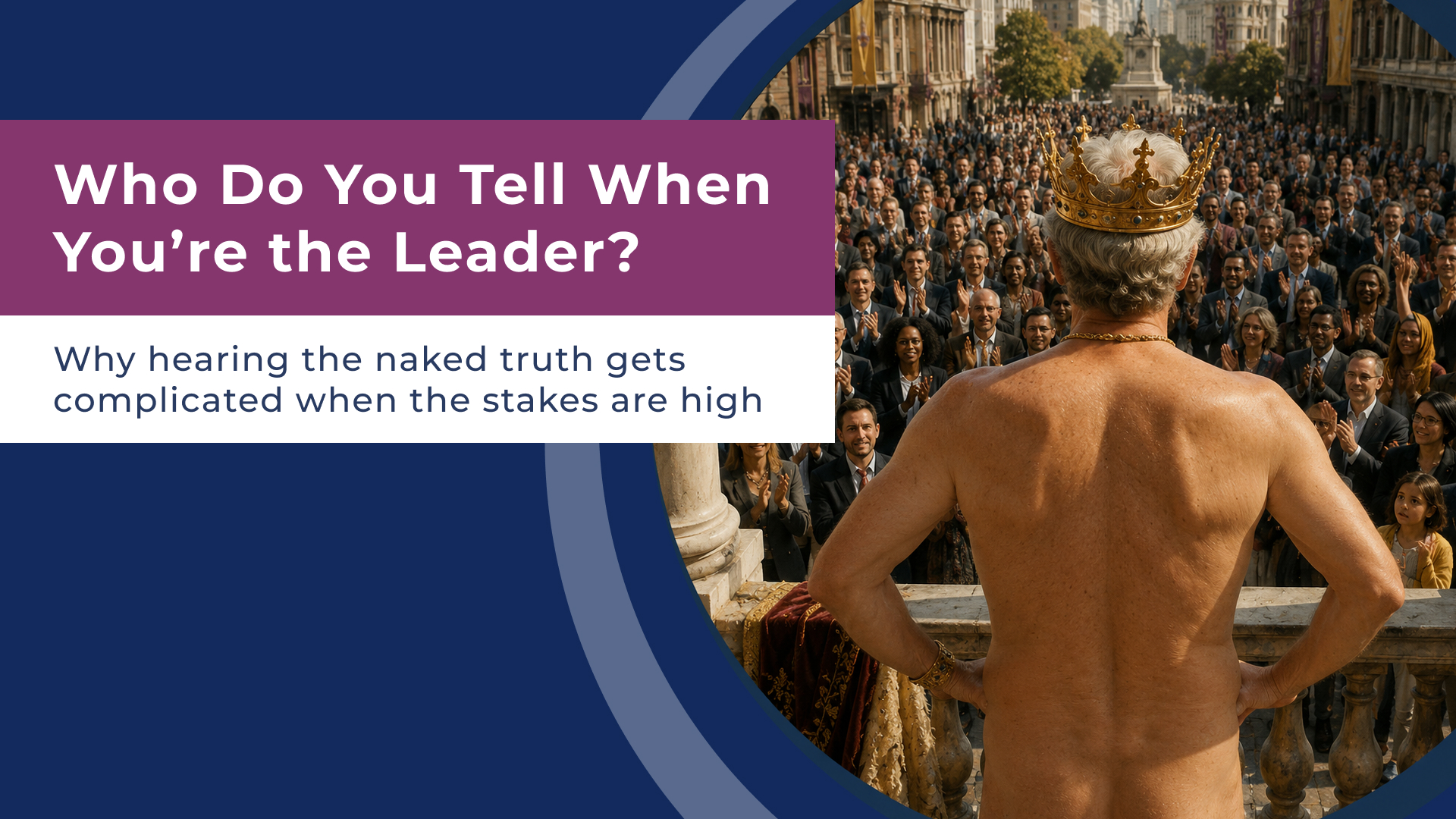
Hans Christian Andersen’s The Emperor’s New Clothes tells of an Emperor persuaded that he has been given magnificent clothes that are invisible only to those who are foolish or unfit for their positions. In reality, there are no clothes at all. Yet as the naked Emperor parades before his subjects, officials and townspeople alike praise what they supposedly see. It takes a child, with considerably less status to protect, to say what is obvious: the Emperor is wearing nothing. The story is usually remembered as a tale about vanity and foolishness. Yet it is also a remarkable story about information and power.
The Emperor is not alone. He is surrounded by people. Officials, advisers, subjects and an entire crowd are present. They can see what is happening. The information exists. The problem is that it cannot travel. Everyone has a reason to participate in the fiction. Reputation, status, fear of appearing foolish, deference to authority, the behaviour of everyone else. Eventually an entire social system becomes capable of sustaining something almost everyone within it can see is untrue.
The interesting leadership question may therefore be less Why couldn’t the Emperor see that he was naked? and more Why had everyone around him become unable to tell him? This is what makes the child so interesting. Not because children possess some magical access to truth, but because the child is not managing the same web of status, reputation and consequence as everyone else in the crowd. The child can say what everyone can see because, in that moment at least, there is less to lose by saying it aloud. Every organisation develops its own version of this problem. Not usually involving naked executives, thankfully. But it does raise a useful question: who gets to be the child in your organisation? Who can say what everybody else can see without first calculating what saying it might cost them?
Over time, organisations learn their leaders. People discover which truths travel easily and which require protective packaging. They learn which questions open conversations and which close them. They learn when “challenge me” genuinely means challenge me and when it means challenge me within these fairly narrow parameters. Leaders are therefore not merely receiving information about their organisations. They are receiving information that has travelled through a system shaped partly by their own presence within it. That makes one question particularly worth asking: How far can an uncomfortable truth travel through your organisation before somebody makes it more comfortable?
From the fitting room to the boardroom
I learned a much smaller version of this lesson long before I found myself working with leaders and organisations. While studying at university, I worked in a clothing store. Like most retail jobs, part of my role was to help customers find clothes they wanted to buy. A woman would emerge from the fitting room, turn towards the mirror and ask the question salespeople everywhere recognise. “What do you think?” There is an obvious commercial answer. You look fabulous. Except sometimes she didn’t.
I realised fairly quickly that selling someone something that clearly didn’t suit her might produce a successful transaction, but it could also destroy something much more valuable. She would eventually encounter another mirror. Or a husband, daughter, sister or friend who had no sales target to meet. If they looked at the outfit and said, “Why on earth did she tell you that looked good?”, I had taught the customer something about me. I wanted the sale more than I wanted to tell her the truth.
The test of good advice isn’t whether we like it when we hear it. It is whether we still trust its source when reality arrives. The fitting room and the boardroom are obviously different places, but perhaps not as different as we imagine. In both, the person asking the question is relying on the other person to resist the temptation to provide the most pleasing answer. And in both, trust is built partly through our willingness to say, kindly and constructively, “I don’t think that works.”
Free and frank: an impossible position?
Early in my career, working in and around government, I encountered the public service tradition of providing “free and frank” advice. The phrase describes something I have always valued: the responsibility of professional advisers to provide decision-makers with their best advice, including when that advice is inconvenient, unwelcome or inconsistent with the direction the decision-maker may prefer to take. Of course, no advice is entirely free of perspective. Advisers are human too. Institutions have cultures. Political environments matter. Evidence can be interpreted differently and every generation worries, with some justification, about whether those charged with advising power remain sufficiently able to speak truthfully to it. But the principle matters.
People carrying consequential responsibility need access not only to information, but to information that has not been excessively shaped by anticipation of what they want it to say. Businesses need it as much as governments; as do boards, families and leaders. We might call it candour, constructive challenge, professional integrity or simply straight talk. Whatever language we use, the underlying requirement is similar: reality needs some way of reaching the people responsible for making decisions about it. Yet asking others to be candid is only half of the equation. We also need to pay attention to the position in which we place them when we ask.
“Tell me what you really think” sounds like a generous invitation. Sometimes it is. Sometimes it is also an impossible request. If I ask my husband for impartial advice about a decision that will uproot his life, he cannot magically become independent simply because I need him to be. If a chief executive asks a junior employee to give an unfiltered opinion in front of six senior executives, the invitation does not erase hierarchy. If I ask my sister for an objective assessment of someone who hurt me years ago, history has already entered the room. If a board asks an executive to speak freely about a decision that could determine whether that executive still has a role, the consequences are part of the conversation before anybody speaks.
Good judgement therefore involves more than choosing the right people to ask. It also involves recognising what we are asking those people to carry. There is a difference, too, between someone being willing to listen and being in a position to hear us clearly. A person can love us, want the best for us and genuinely intend to give good counsel while still being too entangled in the consequences to hold the question neutrally. Sometimes what we are asking them to hear threatens something they value, fear losing or already believe to be true. That does not make them incapable of insight. It simply means we should be thoughtful about what kind of counsel we are asking them to provide.
Sometimes the people closest to a situation are exactly the people whose views we need. Those affected by our decisions deserve a voice. Expertise matters. Organisational knowledge matters. Relationships matter. But we should not mistake proximity for independence. Nor should we blame people for failing to provide a kind of neutrality their position makes almost impossible.
The conversation before the conversation
There is another kind of conversation that becomes increasingly difficult as responsibility grows. It is the conversation that does not yet have a conclusion. Before the difficult conversation with the board, there may be a half-formed doubt. Before challenging a colleague, there may be an uncomfortable pattern we are not yet sure we have interpreted correctly. Before changing strategy, there may be a period in which a leader privately questions assumptions they have publicly defended. Before deciding to leave, there may simply be a feeling that something has changed. Sometimes the thought is barely a thought. Something about this doesn’t feel right. I know everyone supports this, but I’m no longer sure I do. What if the problem isn’t what we think it is? I might be completely wrong about this, but.... I don’t know what I think yet. These are not necessarily requests for advice. They are the beginnings of sense-making.
Conversation is not simply how we communicate thoughts we have already completed. It is one of the ways we discover what we think. We say something and hear that it isn’t quite true. Someone asks a question we had not considered. We tell the story again and notice that we emphasise something different. An assumption becomes visible. A certainty softens. A problem we thought we understood reveals another problem nested within it. There is often a conversation before the conversation.
For leaders, finding somewhere to have it can become increasingly difficult because their words carry weight. A chief executive wondering aloud whether a strategy is working may simply be thinking. The executive listening may reasonably hear an instruction. An innocent question can become a project by lunchtime. A passing concern can travel through an organisation with considerably more certainty than it possessed when it left the leader’s mouth.
Experienced leaders learn to be careful. That care is part of responsible leadership. But it can also mean that, at precisely the point when decisions become more consequential, leaders lose access to one of the most ordinary human ways of making sense of complexity: thinking aloud with another person. Sometimes you do not need someone to tell. You need someone with whom you can discover what there is to tell.
Somewhere independent enough
I have become increasingly interested in independence as a quality of consequential conversation. Confidentiality matters enormously. Leaders need to know that sensitive information will remain where it belongs. But confidentiality and independence are not the same thing. Confidentiality determines where the conversation goes next. Independence shapes what can happen inside it.
A useful leadership ecology contains many kinds of counsel. People who know us deeply. People who understand the organisation. People affected by the decision. Technical specialists. Trusted colleagues. Boards that challenge. Friends who know our history. Family who care about what happens to us. We need those perspectives precisely because they are not detached.
The point is not to find one perfectly objective person and replace all the others, but to recognise what each kind of counsel can, and cannot, provide. Different relationships allow us to see different parts of the situation. The person who knows us intimately may see something the technical expert cannot. The colleague inside the organisation understands context an outsider will miss. The board sees responsibility differently from the executive team. Independence is not a substitute for these perspectives; it is another perspective among them. And sometimes we need something else.
Someone sufficiently outside the hierarchy, politics and immediate consequences of the decision that the conversation can remain unfinished for a while. Someone who does not need us to choose a particular answer. Someone willing to challenge the premise of the question rather than simply help answer it. Someone who can notice what we may be protecting, avoiding or assuming. Someone who can say the equivalent of, “Actually, I don’t think that dress works,” without either of us needing the dress to sell. The purpose is not to outsource judgement. Quite the opposite. A genuinely independent adviser is not there to make the decision for you. Their independence helps return the decision to you.
Who can tell you?
Perhaps the more responsibility we carry, the more deliberately we need to cultivate the conditions in which reality can reach us. We need people who will tell us when there is parsley in our teeth. People who will admit they never wanted to watch the movie. People who will tell us the gravy is oversalted, the proposal has holes in it, the room does not agree, the strategy is no longer working, or the problem we are trying so hard to solve may not be the problem at all.
The stakes change. The human problem does not. The more consequential the role, the more consequential the conversation. Leadership therefore asks something more demanding than surrounding ourselves with intelligent people. It asks us to notice the relationships, loyalties, interests, histories and power shaping what can be said, what can be heard and what gets quietly edited somewhere between reality and us.
There will always be conversations that belong with our partners, our friends, our colleagues, our boards and our professional advisers. There will also be moments when the people we trust most cannot be independent precisely because they are standing beside us inside the consequences. Perhaps Who do you tell when you’re the leader? is therefore only half the question. The other half may be more important. Who can tell you?
Dr Jordan Marijana Alexander is a writer, executive advisor and human systems strategist exploring how identity, place, culture and living systems shape participation in the modern world. She works alongside leaders, boards and organisations navigating complex questions of leadership, change and participation, and is the co-founder of RelateAble.Global. If this article has raised questions, sparked reflection or highlighted a decision you’re carrying, you’re invited to book a confidential conversation. You can follow DrJMA on LinkedIn and Engenesis for ongoing essays, reflections and research exploring leadership, identity, belonging and participation.