

Somewhere before the decision
What was the last decision you made? Not the life-changing one. The ordinary one. Perhaps it was whether to order the flat white or the long black at your favourite café. Maybe you stood in front of the menu for a moment longer than usual, tempted to try something different before instinctively ordering what you always do. Perhaps you chose the motorway over the scenic route home, decided against another episode before bed, or found yourself reaching for the same packet of salted kettle chips you’ve bought for years without giving it much thought.
Most decisions pass almost unnoticed. They slip into the fabric of everyday life, leaving little trace that they ever happened. Others redraw the landscape of our lives. Accepting a job. Starting a business. Choosing a partner. Having children. Moving countries. Leaving a profession. Retiring. Research has long suggested that few decisions shape our lives more profoundly than choosing the person with whom we will share them. Yet even that decision is rarely made in a single moment. Long before someone asks, “Will you marry me?”, countless smaller moments have already shaped the answer. Conversations. Shared experiences. Quiet disappointments. Unexpected joys. Tiny observations that seemed insignificant at the time but slowly accumulated into something larger.
Looking back, we remember these moments as decisions. I’m no longer convinced they are. The decision is simply the visible moment. What fascinates me is everything that happened before it. Somewhere before the decision. We tend to imagine that decisions begin when options appear. A list of pros and cons. A cost-benefit analysis. Advice from trusted colleagues. A recommendation from the executive team. A board paper. A vote around the table. These are valuable disciplines. They help us compare alternatives, test assumptions, assess risk and weigh consequences. They bring rigour to our thinking and discipline to our judgement. Yet they all assume the same thing. That we already understand the problem.
We give decisions too much credit. By the time we consciously begin weighing alternatives, much of the work has already taken place. We have been noticing patterns, interpreting events and orienting ourselves to reality for months, years or even decades. We remember the decision because it is visible, while forgetting the sense-making that preceded it. Reality is rarely hiding from us. More often, we simply haven’t yet learned how to see it.
The problem before the problem
Over the past three decades I have found myself sitting beside chief executives, ministers, governors, judges, founders and executive teams as they wrestled with decisions whose consequences extended far beyond themselves. Looking back, what strikes me is not how often people made poor decisions. In truth, most of the leaders I have worked with were thoughtful, intelligent and deeply committed to doing the right thing.
What surprises me is how many of the most expensive decisions I have witnessed were logical responses to problems that had never been properly defined. When we hear the word expensive, our minds usually turn to money: failed acquisitions, costly restructures, budget overruns or investments that never delivered the promised return. Yet some of the most expensive decisions leave no obvious line in a financial report.
The cost may be a decade spent solving yesterday’s problem. A merger that never truly becomes one organisation because nobody realised people were using the same language to describe entirely different realities. A talented executive who quietly resigns because everyone assumed the issue was remuneration when what had actually been lost was purpose. A profession that slowly forgets what it exists to steward. A chief executive who retires believing they have failed when the real question was never whether to leave, but how to leave well.
Each of those responses may have made perfect sense at the time. That, perhaps, is the point. Every solution is perfectly designed for the problem we believe we have, which is precisely why understanding the problem matters so much. Perhaps the greatest cost is not making the wrong decision, but becoming brilliantly effective at solving the wrong problem. Over time, my interest shifted to what happens before either the problem or the decision becomes visible: the decision before the decision, the problem before the problem, and the quiet process through which people gradually come to believe: this is the reality we are facing.
Seeing before solving
One conversation comes to mind. A chief executive had recently taken responsibility for a newly formed public organisation created by bringing together four large government entities. Like many leaders inheriting a significant transformation, he was looking beyond the mechanics of the merger towards the organisation he hoped would eventually emerge. His ambition was simple. He wanted people to become more innovative, more agile and, in his words, “more willing to take risks.” On the surface, the challenge seemed straightforward. Almost everyone around the table agreed that becoming more innovative was both desirable and necessary. Yet the longer we spoke, the less certain I became that everyone was talking about the same thing. As we explored the issue further, another layer revealed itself.
One part of the organisation carried national responsibility for health and safety. For these teams, reducing risk wasn’t evidence of bureaucracy or resistance to change. It was the very reason they existed. Their professional judgement, their experience and, in many respects, their identity had been shaped around protecting people from harm. Elsewhere in the organisation, risk meant something entirely different. It represented experimentation, innovation and the willingness to try new approaches in the face of uncertainty. From that perspective, excessive caution felt like the greatest threat of all. The conversation wasn’t really about risk. It was about meaning. People were trying to honour different responsibilities while using the same word to describe them. That distinction changed everything.
The work was no longer about convincing one group to think more like the other. Instead, it became developing a shared understanding of what different kinds of risk meant in different parts of the organisation and when each was not only appropriate but necessary. Once people could see the different realities that sat behind the same language, the conversation became noticeably less adversarial. Innovation and protection were no longer competing agendas. They became complementary responsibilities within the same organisation.
I’ve returned to that conversation many times over the years because it taught me something I have continued to encounter in organisations, communities and, if I’m honest, in my own life. People rarely argue only about the issue sitting on the table. More often, they are responding to different understandings of the reality that surrounds it. The first problem is rarely the wrong problem. It’s simply the outermost one. That insight gradually changed the way I approached every conversation that followed. For years I assumed my value lay in helping leaders make better decisions through better information, better analysis, better options and, hopefully, better advice. Increasingly, however, I wanted to understand how people had come to see it as the problem in the first place.
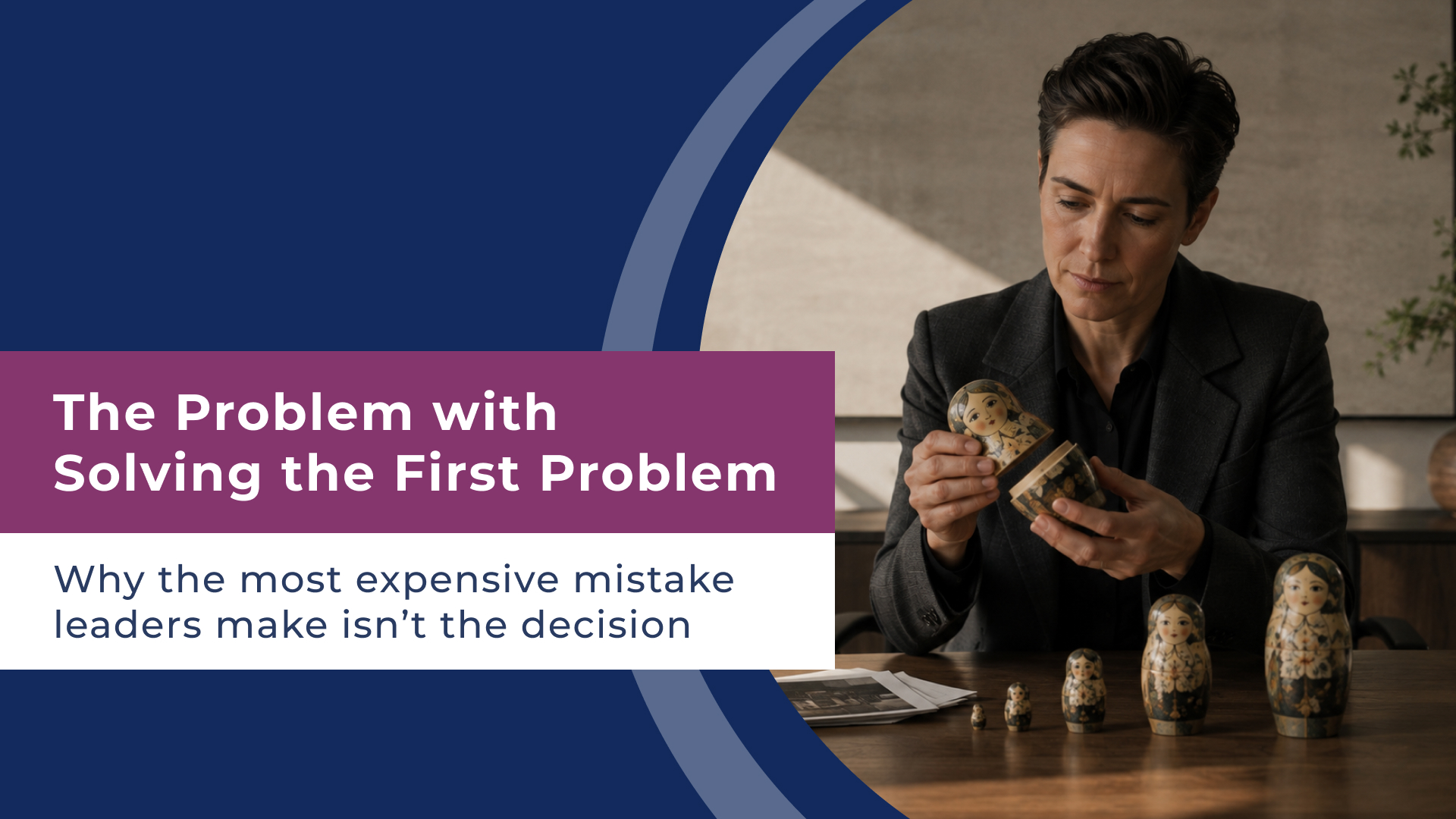
Over time, this became a simple discipline in my work: seeing before solving. Before trying to improve a situation, redesign a system or resolve a conflict, I wanted to better understand the reality people were already living. Not only the visible facts, but also the assumptions, relationships, histories, identities and places that gave those facts their meaning. Perhaps this is why I return, again and again, to the matryoshka doll.
Growing up with my Ukrainian heritage, the dolls were more than decorative objects sitting on a shelf. I loved the simple ritual of opening one to discover another waiting patiently inside. Each seemed complete until it revealed a larger context for itself. Nothing was discarded. Nothing was exposed as false. Every doll remained part of the story, yet each only made complete sense in relation to the others. Years later, while researching identity, culture and place, I realised I had been carrying that image with me all along. We inherit histories we did not choose. We occupy places that shape what we notice. We participate in relationships that influence what feels possible. We tell ourselves stories about who we are and what kind of future we are trying to create. Every one of these becomes another doll. The more I worked with people, organisations and communities, the more they resembled those dolls. Every time we become curious enough to open another doll, we don’t discover the answer. We discover another reality.
A disagreement about governance becomes a conversation about competing visions of the future, with neither side quite recognising that they are trying to protect a different version of what the organisation might become. A performance issue uncovers years of avoided conversations everyone knew needed to happen but nobody quite managed to have. A debate about innovation reveals different professional identities trying to honour different responsibilities. A conversation about succession becomes less about whether someone should leave and more about what they still hope to leave behind.
The outer doll was never wrong. It was simply waiting to be understood within something larger. This, I think, is where many leadership conversations quietly change. Not because new information suddenly appears, nor because someone arrives with a more sophisticated framework, but because people begin seeing the reality they are already living from a different orientation.
Real before right
Like many people whose work revolves around thinking, advising and solving problems, I took pride in being well prepared, thoughtful and able to bring clarity to complexity. Expertise matters. Experience matters. Good judgement matters. Yet I began to notice that the conversations which stayed with me long after they had ended were rarely those in which I had offered the most insightful answer. They were the conversations in which something became visible that none of us had seen when we first walked into the room. It slowly dawned on me that I had been measuring my contribution in the wrong place. The most useful thing I could bring to a conversation wasn’t always an answer. Sometimes it was the willingness to remain curious for a little longer, to resist reaching too quickly for an explanation and to allow reality the time and space to reveal something we had not yet noticed.
Around that time, I wrote three words in the margin of my notebook: Real before right. They weren’t intended as a leadership principle or a piece of advice for clients. They were a quiet reminder to myself of how easily I could become attached to appearing competent, insightful or helpful, particularly in rooms where people expected certainty. Reality, however, has an inconvenient habit of refusing to conform to our expectations. Being real before right doesn’t mean abandoning expertise. It doesn’t ask us to ignore evidence, suspend judgement or pretend every perspective is equally valid. It means allowing reality to interrupt expertise. It means holding our knowledge with enough humility that we remain open to discovering that we may not yet be asking the most useful question.
I’ve come to believe this is one of the quiet disciplines of leadership. Before we can be right about the solution, we first need to become real about the situation. Real about what we know and what we don’t. Real about the assumptions we have inherited, the conversations we have avoided, the histories that continue to shape the present and the futures we are trying to protect. Perhaps this is why I no longer think leadership begins with strategy, vision, culture or execution. It begins with orientation—with becoming more deeply acquainted with the reality we are already participating in before we rush to improve it.
None of us enters a conversation empty-handed. We arrive carrying professional training, personal experience, organisational culture, inherited assumptions and the places that have shaped how we see the world. We don’t simply inherit problems. We inherit ways of seeing them. That, I suspect, is why the work of leadership has become less interesting to me as the work of solving and far more interesting as the work of seeing. Every organisation has facts, data and strategies. What often changes everything is not another report or another framework, but a subtle shift in orientation that allows people to see the same reality differently. Possibilities that were previously obscured can begin to come into view.
One last look
There will always be moments when leadership demands decisiveness. Boards need recommendations. Organisations need direction. Teams deserve clarity. There is a time to act, and there is a responsibility to do so. Yet I have come to wonder whether some of the most important work in leadership happens long before the decision is ever made. It happens in the discipline of noticing, remaining curious a little longer than certainty would prefer, resisting the temptation to conclude too soon and paying closer attention to the reality we are already participating in.
Every decision is made within a story about reality, and every story is nested within other stories: histories, relationships, places, identities and aspirations. None exists in isolation. Every one shapes the others, often in ways we barely notice until we become curious enough to look again.
When we become willing to open one more doll, something remarkable often happens. The options haven’t changed. The facts haven’t changed. Yet decisions that once felt overwhelmingly complex sometimes become surprisingly clear because our understanding of the problem has changed. Perhaps that is the quiet work of leadership: not becoming more certain, but seeing reality more clearly; not solving the first problem, but remaining curious long enough to discover what it is nested within.
When you next find yourself facing a decision, before asking, What should we do?, perhaps there is another question worth living with: What is this nested within? Because the first problem is rarely the whole problem. It’s simply the first one we have recognised.
Dr Jordan Marijana Alexander is a writer, executive advisor and human systems strategist exploring how identity, place, culture and living systems shape participation in the modern world. She works alongside leaders, boards and organisations navigating complex questions of leadership, change and participation, and is the co-founder of RelateAble.Global. If this article has raised questions, sparked reflection or highlighted a decision you’re carrying, you’re invited to book a confidential conversation. You can follow DrJMA on LinkedIn and Engenesis for ongoing essays, reflections and research exploring leadership, identity, belonging and participation.