

Background
We live in an age defined by speed, scale, and constant stimulation. Information travels instantly, opinions form rapidly, and responses are often expected before understanding has had time to develop. While this environment has brought undeniable advances, it has also created a quiet erosion of depth in how individuals and societies relate to complexity.
Across public life, difficult questions are increasingly compressed into simple narratives. Nuance is treated as hesitation. Reflection is mistaken for weakness. In moments of uncertainty or crisis, the pressure to act quickly often overrides the responsibility to act wisely.
This pattern has consequences.
When sense-making becomes shallow, decision-making becomes brittle. Actions may appear decisive, yet they fail to address underlying conditions. Social trust weakens, dialogue narrows, and communities become more reactive and polarised. Over time, this creates a climate where fear substitutes for understanding and moral certainty replaces ethical responsibility.
At the same time, many institutions have drifted away from their original purpose. Systems designed to serve human well-being have become preoccupied with control, efficiency, or public performance. In doing so, they often overlook the human dimension that sustains legitimacy and cohesion.
These developments are not nessesarily the result of individual failure or bad intent. They are structural and cultural patterns that have accumulated over time. They reflect how modern societies have learned to prioritise output over orientation, reaction over reflection, and visibility over integrity.
Yet beneath this fragmentation, there is a growing recognition that something essential is missing.
Many people sense that progress cannot be sustained without ethical grounding. That technological capability without discernment creates new risks. That social harmony cannot be legislated or enforced, but must be cultivated through shared responsibility and mutual recognition.
There is also an increasing awareness that lasting solutions do not emerge from single domains. Science without ethics is incomplete. Policy without human insight is fragile. Technology without philosophical orientation amplifies existing distortions rather than correcting them.
The background from which GHEST emerges is therefore not one of despair, but of reckoning.
A recognition that humanity has reached a point where further advancement requires a deeper integration of understanding, responsibility, and care. That navigating uncertainty demands not only better tools, but better ways of being. And that the health of societies depends as much on how people make sense of the world as on the systems they build within it.
GHEST is grounded in this recognition. It begins from the understanding that sustainable transformation must address the human foundations of action, decision-making, and cooperation, before it can meaningfully reshape institutions or outcomes.
Introduction
GHEST exists to offer a different starting point for how people come together around questions of humanity, society, and the future.
Rather than beginning with solutions, positions, or demands, GHEST begins with orientation. With how individuals relate to reality, to uncertainty, and to one another before they act. This shift may appear subtle, yet it is foundational. Many of the failures we witness in public life do not stem from lack of intelligence or effort, but from misalignment between intention, understanding, and action.
GHEST is not designed to compete with existing institutions, movements, or disciplines. It exists alongside them as a connective space. A place where philosophy, science, technology, culture, and lived experience can inform one another without being reduced to slogans or instrumentalised for influence.
At its core, GHEST is concerned with coherence.
Coherence between what we claim to value and how we behave.
Coherence between individual responsibility and collective outcomes.
Coherence between progress and care.
This coherence cannot be imposed. It must be cultivated.
GHEST therefore functions as a convening ground rather than a directive authority. It does not instruct people what to think or which positions to adopt. Instead, it invites engagement with frameworks and conversations that strengthen discernment, ethical awareness, and shared responsibility.
Importantly, GHEST is not limited to moments of crisis. While periods of disruption often expose underlying weaknesses, the work of sense-making and integration is ongoing. It applies to everyday decisions, long-term planning, leadership, community life, and the quiet choices that shape culture over time.
The intention of GHEST is to create a stable reference point in an increasingly volatile environment. A place where depth is not treated as elitism, and restraint is not mistaken for indifference. Where people are encouraged to think carefully, speak responsibly, and act with integrity even when external pressures reward the opposite.
GHEST recognises that disagreement is inevitable and often valuable. What matters is not the absence of difference, but the quality of engagement across it. The capacity to remain human in disagreement is one of the defining markers of a mature society.
This is the orientation GHEST offers. Not certainty, but clarity. Not conformity, but coherence. Not control, but shared responsibility.
Foundational Statement
GHEST is grounded in the belief that humanity’s deepest challenges are not resolved solely through systems, technologies, or policies, but through the integrity of individuals and the coherence of our collective Being. Social cohesion, democracy, sustainability, and meaningful transformation do not emerge from arrogance, domination, or haste. They arise when human beings act with responsibility, discernment, and care, while recognising both their limits and their capacity for authentic contribution.
Each human being is finite, vulnerable, and situated within forces beyond their control. At the same time, each is capable of insight, ethical awareness, and intentional action. GHEST holds this tension as central to the human condition. It is not a weakness to be eliminated, but the ground from which maturity, responsibility, and sustainable action become possible.
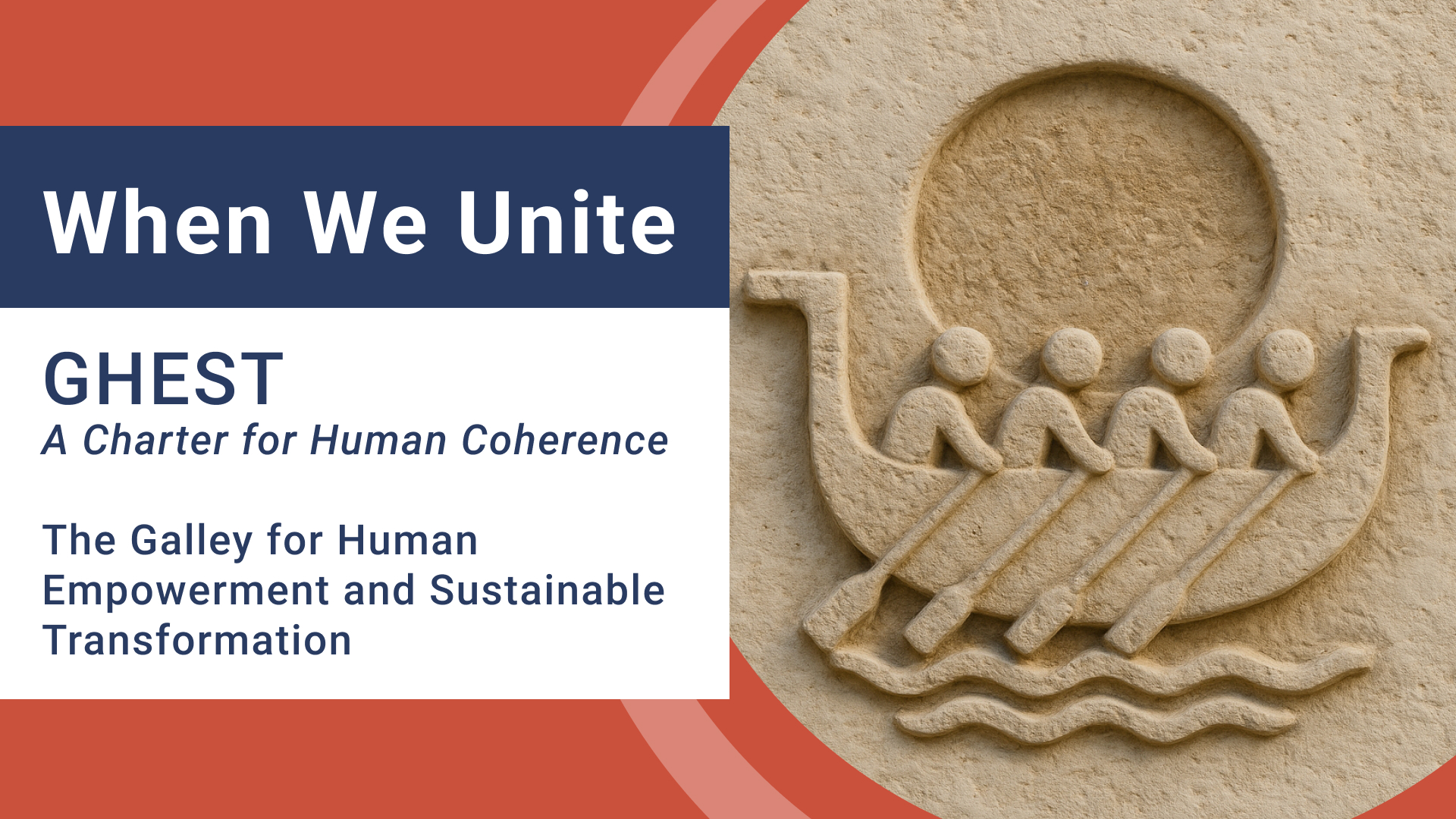
The galley symbolises this condition. We are not the generators of the wind, nor the masters of the ocean, yet we are not powerless or adrift. We move through uncertainty by rowing together, guided by shared rhythm rather than force. Progress is not achieved through uniformity, but through coordination, attentiveness, and mutual responsibility.
GHEST exists as a global foundation to convene, to support sense-making, and to enable action grounded in integrity. Its purpose is to articulate and advance frameworks that help individuals and societies move from fragmentation toward authentic sustainability. This work is inherently integrative. It draws from philosophy, science, technology, culture, and governance, recognising that no single domain can grasp reality in isolation. Only through inquiry, dialogue, and collaboration can deeper coherence and human well-being be sustained.
What Has Led to GHEST
GHEST has not emerged from a single insight or moment. It has grown through sustained inquiry into how human beings make sense of the world and how that sense-making shapes action, institutions, and collective outcomes.
Across years of philosophical work, leadership practice, and engagement with diverse communities, a consistent pattern has become visible. When people lack the ability to make sense of complexity, they become vulnerable to simplification. When meaning is thin, identity becomes rigid. When responsibility is unclear, blame fills the gap.
These dynamics are not abstract. They play out in organisations, communities, public discourse, and everyday life. Well-intentioned individuals contribute to harmful outcomes not because they lack care, but because they lack frameworks that help them navigate uncertainty with discernment and restraint.
Much of the existing public conversation focuses on what should be done. Far less attention is given to how decisions are formed, how values are interpreted, and how internal orientations shape external behaviour. Yet again and again, it becomes clear that without addressing these deeper layers, surface interventions fail to endure.
Over time, the work underpinning GHEST has articulated a simple but demanding insight. Sustainable change requires alignment between being, sense-making, and action. When these are fragmented, even sophisticated systems drift toward dysfunction. When they are coherent, transformation becomes possible without coercion.
Recent developments in the world have brought this insight into sharper focus. Moments of disruption tend to accelerate existing patterns. They reveal how quickly fear overrides understanding, how easily urgency displaces wisdom, and how fragile social cohesion becomes when people are pushed into binary positions.
These moments have also revealed something else. A growing number of people are quietly seeking an alternative. Not another ideology. Not another movement demanding allegiance. But a place where depth, ethical reflection, and integrative thinking are taken seriously without being weaponised or commodified.
GHEST arises from this need.
It is shaped by the recognition that many people wish to engage with meaningful ideas and contribute to social coherence without enrolling in formal programs, affiliating with institutions, or entering commercial relationships. They want access to frameworks and conversations that help them live, lead, and participate more responsibly, while remaining free to chart their own path.
GHEST provides that space.
It allows the body of work that informs it to serve a broader public purpose. Not as doctrine, but as orientation. Not as instruction, but as invitation. It creates a shared ground where individuals can benefit from structured thinking while retaining autonomy and diversity of expression.
In this sense, GHEST represents both a continuation and an opening. A continuation of long-standing inquiry into human integrity and systemic coherence. And an opening toward a wider community that values responsibility over reaction, depth over immediacy, and care over control.
The Seduction of Strong Leadership
Across much of the developed world, a familiar rhetoric has returned with force. In times of uncertainty, social strain, and institutional fatigue, there is a growing call for what is often described as “strong leadership”. Leadership that is decisive, immediate, and uncompromising. Leadership that promises to fix complex problems quickly through sweeping actions. Close the borders. Ban this. Remove that. Restore order.
The appeal is understandable. When people feel overwhelmed, clarity feels like safety. When systems appear slow or ineffective, force can look like competence. And when complexity becomes exhausting, simple answers offer relief.
But history is unambiguous on this point.
What begins as decisiveness often hardens into coercion. What is framed as strength frequently erodes accountability. And what promises order in moments of fear has repeatedly led societies into deeper division, repression, and long-term harm.
This pattern is not new. It is one of the oldest traps in human governance.
Strong leadership, when defined by speed, dominance, and unilateral control, does not resolve complexity. It suppresses it. It postpones reckoning rather than addressing root causes. And over time, it replaces responsibility with obedience and discernment with compliance.
The result is rarely stability. More often, it is fragility disguised as order.
When Urgency Replaces Understanding
The demand for immediate action often arises when sense-making has broken down. When people no longer trust institutions, when public dialogue collapses into slogans, and when fear outpaces understanding, urgency becomes intoxicating. Decisions are expected before questions are fully articulated. Measures are applauded for their visibility rather than their wisdom.
In such conditions, policies are mistaken for solutions, and enforcement is confused with leadership. Complex human realities, such as migration, cultural integration, social cohesion, or economic displacement, are reduced to technical levers to be pulled rather than conditions to be understood.
This is not leadership. It is reaction elevated to authority.
History shows us that societies rarely suffer because they thought too carefully. They suffer because they acted too quickly on incomplete understanding, driven by fear, resentment, or the illusion of control.
GHEST’s Commitment
GHEST exists in conscious resistance to this cycle.
It does not oppose leadership, decisiveness, or responsibility. On the contrary, it affirms them. But it rejects the idea that strength is measured by haste, domination, or the silencing of complexity.
GHEST is committed to cultivating communication, dialogue, and shared inquiry that restore sense-making and awareness before action hardens into irreversible consequence. It seeks to create spaces where difficult questions can be explored without collapsing into polarity, and where responsibility is grounded in understanding rather than impulse.
This commitment is not passive. It is preventative.
By strengthening the capacity for discernment, ethical reflection, and integrative thinking, GHEST aims to reduce the likelihood that societies swing from fragmentation into authoritarian simplicity, mistaking control for coherence.
The work of GHEST is to help ensure that in responding to real challenges, humanity does not escape one pitfall only to fall into another.
Choosing Maturity Over Impulse
The future will not be shaped by those who promise certainty in an uncertain world. It will be shaped by those who can hold uncertainty without surrendering to fear, and who can act decisively without abandoning wisdom.
GHEST stands for this maturity.
It is a commitment to slow down when speed becomes dangerous, to deepen understanding when simplification is rewarded, and to communicate in ways that expand awareness rather than constrict it.
This is how societies remain free without becoming fragile.
This is how leadership remains strong without becoming destructive.
And this is how we avoid repeating patterns that history has already judged.
Who GHEST Is For and How People Engage
GHEST is for people who sense that the quality of our shared life depends not only on what we build, but on how we think, relate, and act together.
It is for those who feel uneasy with the prevailing tone of public discourse, where complexity is often dismissed and disagreement quickly becomes hostility. It is for individuals who value depth, integrity, and responsibility, yet do not wish to be absorbed into ideological camps or institutional agendas.
GHEST is intentionally open to a wide range of participants.
Some will engage quietly by reading, reflecting, and integrating ideas into their own lives and work. Others may participate in dialogue, contribute perspectives, or collaborate on initiatives aligned with the values of coherence and care. Some may later choose to engage more formally through education, research, or professional pathways. Many will not.
All forms of engagement are valid.
Participation in GHEST does not require commercial engagement or program enrolment. Membership exists to support connection and continuity, not to impose obligation, ideology, or transactional expectation. GHEST serves the public good by making sense-making frameworks, ethical reflection, and integrative thinking accessible beyond formal or commercial pathways.
What unites participants is not agreement, but orientation.
A shared willingness to approach complexity with humility.
A commitment to engage without dehumanising others.
A recognition that responsibility begins with how one is being, not merely what one is demanding.
GHEST respects individual autonomy. Participants are encouraged to draw what is useful, question what is unclear, and adapt insights within their own cultural, professional, and personal contexts. There is no prescribed path and no expectation of conformity.
This openness is deliberate.
Social coherence cannot be imposed. It emerges when people are trusted to engage thoughtfully and responsibly. GHEST therefore prioritises quality of engagement over scale, depth over visibility, and integrity over expansion.
In this way, GHEST functions as a shared galley. Some row at the front, some in the middle, some observe and learn the rhythm before joining in. No single role defines belonging. What matters is the shared direction and the care taken not to disrupt the collective movement.
This is a space for those who wish to contribute to a healthier social fabric without abandoning nuance, restraint, or humanity.
Orientation Forward
GHEST does not claim to hold the answers to humanity’s challenges. It offers something more enduring. A way of standing in relation to them.
The work ahead is not quick, and it is not simple. It requires patience where speed is rewarded, discernment where certainty is demanded, and care where division is easier. It asks individuals to remain present to complexity rather than retreat into reaction or avoidance.
This orientation applies everywhere. In leadership and governance. In technology and science. In culture and education. In families, workplaces, and local communities. Wherever human beings interact, the quality of sense-making and responsibility shapes the outcomes that follow.
GHEST exists to support this work over time.
It will evolve through dialogue, inquiry, and collaboration. It will remain open to learning, correction, and refinement. It will resist the pressure to become performative, ideological, or prescriptive, even when those paths appear easier or more visible.
What anchors GHEST is a simple commitment. To act with integrity. To engage without dehumanising. To contribute to social coherence rather than fragmentation.
This is not a space for outrage or haste. It is a space for those willing to think carefully, speak responsibly, and act in ways that reduce harm and build trust.
The galley moves forward only when people row together with awareness of one another and of the waters they are navigating. No single rower controls the journey. No one is exempt from responsibility for the rhythm.
GHEST is an open invitation to take part in this shared effort.
You may engage briefly or over time. You may participate quietly or actively. You may never engage beyond reflection. All of this is valid.
What matters is the choice to remain human in how you relate to others and to the world you are helping shape.
This is the work GHEST exists to hold.
The invitation stands.
Joining the GHEST Community

GHEST is a community grounded in integrity, responsibility, and thoughtful engagement. Those who wish to participate are invited to join the GHEST community through the Engenesis platform.
To join, individuals create an account on the Engenesis platform and submit a request to become part of the GHEST community. Requests are reviewed to ensure alignment with the principles and orientation outlined in this charter. Once approved by an administrator, members gain access to the community space and ongoing dialogue.
This process is not designed to exclude, but to protect the quality of engagement and the integrity of the shared space. GHEST values sincerity, discernment, and care over scale or speed.
https://engenesis.com/communities/ghest