
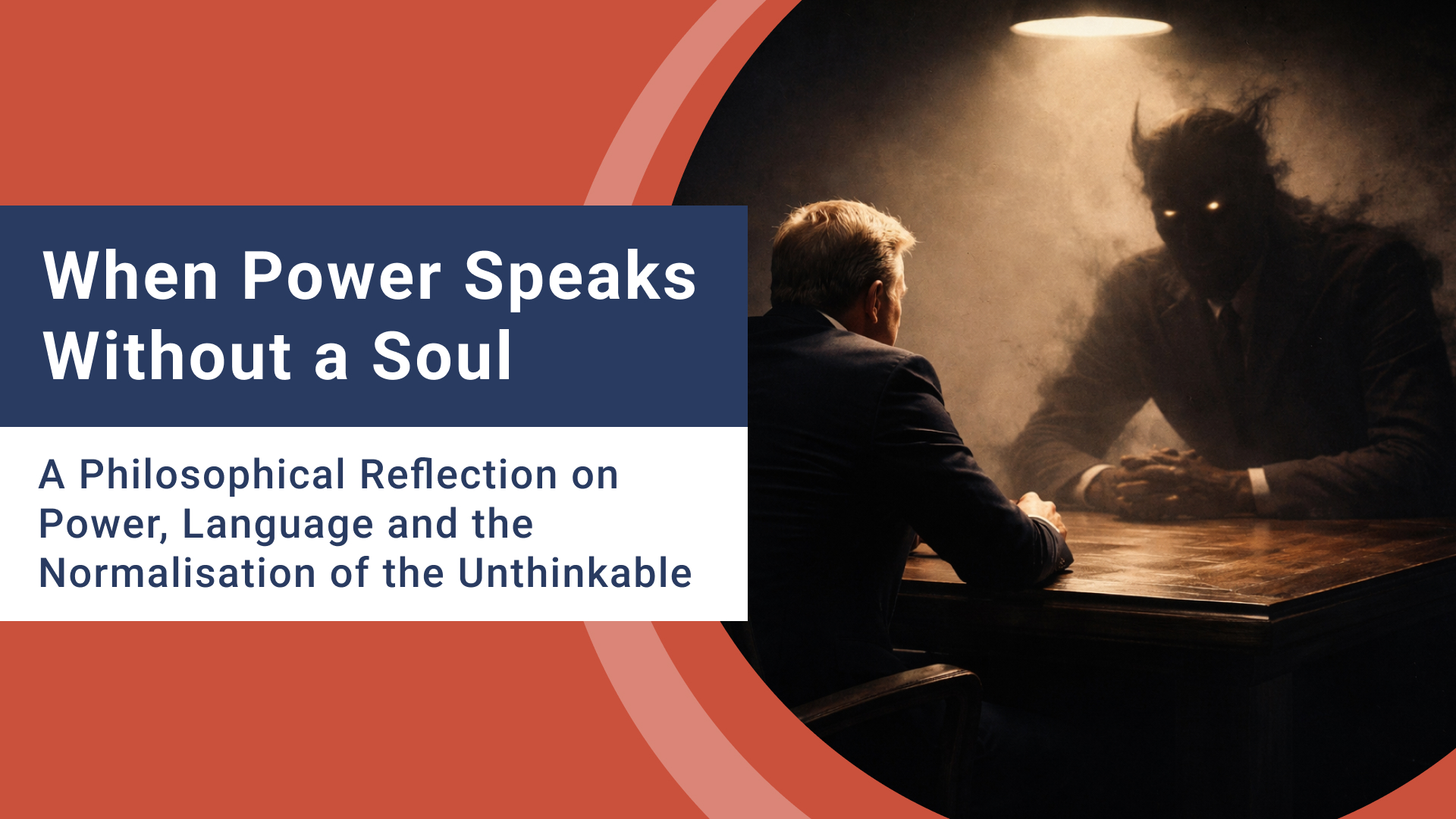

The real crisis is not what power is doing, but what humanity has become in order to make it possible.
Before the Irreversible
There are moments in history when one does not write to comment, but to bear witness before something irreversible unfolds. This is one of those moments. The atmosphere is not one of ordinary political tension. It is charged with the possibility of decisions that cannot be undone, words that cannot be recalled, and actions whose consequences will not be contained within borders, ideologies, or regimes. Something deeper is at stake, and it is already moving.
We are witnessing a sequence of statements, threats, and actions that signal not only escalation, but a shift in what is considered sayable, thinkable, and ultimately doable. The destruction of infrastructure, the targeting of systems that sustain life, the open articulation of civilisational threats, and the casual proximity to catastrophic outcomes all point to a threshold being approached. Whether that threshold is crossed or not is not the only concern. The fact that it is being approached with such language and posture is itself the event.
This is not written after the fact, when history has already selected its narrative and distributed its justifications. It is written before the outcome has hardened, while ambiguity still exists, while responsibility is still alive, and while the human capacity to perceive clearly has not yet been fully numbed by what may follow. There is still a narrow space in which one can look at what is unfolding without distortion, without allegiance, and without the comfort of retrospective explanations.
What is being expressed in this moment is not merely political intent. It is a revelation of something beneath politics, beneath diplomacy, and beneath the curated language of leadership. It is the exposure of a way of being that has long existed but has rarely spoken so openly. The concern is not only what may happen next. The concern is what has already become permissible to say and to do, and what that reveals about the condition of the world that is listening.
Not a Man, A Phenomenon
It is tempting, and perhaps comforting, to reduce what is being witnessed to the behaviour of a single individual. To isolate a figure, to attach the weight of concern to a personality, and to conclude that the problem begins and ends there. This move is understandable, but it is also deeply insufficient. It allows the structure to remain invisible while the surface absorbs the scrutiny.
What is being expressed is not the anomaly of a man. It is the articulation of a phenomenon that has found a voice. The language, the posture, the casual relationship to destruction, and the oscillation between aggression and performance are not emerging from nowhere. They are made possible by a deeper configuration of thought, power, and permissibility that precedes any one leader and will outlast him.
When such a figure rises and speaks in this manner, the correct question is not simply who he is, but what has allowed him to be. What kind of cultural, political, and psychological environment produces a leader who can speak of devastation without restraint, who can trivialise loss, who can weaponise language so openly, and still remain within the bounds of what is tolerated as leadership? The presence of such a figure is not the root issue. It is a signal.
This is why focusing on personality becomes a form of distraction. It personalises what is structural. It invites reaction instead of understanding. It narrows the field of inquiry to character, temperament, and intention, while leaving untouched the deeper layers of metacontent that shape what is considered acceptable, effective, or even admirable in positions of power.
The figure at the centre of this moment is therefore not the subject of this inquiry. He is the expression through which something more fundamental is being revealed. To engage only with him is to remain at the surface. To look through him is to begin to see the phenomenon itself.
The Language of Degradation
What has been most revealing in this moment is not only the content of what has been said, but the quality of the language through which it has been expressed. Language is not neutral. It carries weight, structure, and orientation. It reflects the relationship between thought, reality, and responsibility. When language degrades, it is not merely a stylistic issue. It is a sign that something deeper has shifted in how reality is being held.
We are now hearing expressions in which the death of children can be acknowledged with a tone of acceptance rather than rupture. We hear profanity woven into geopolitical threats, not as a momentary lapse, but as a mode of articulation. We hear entire peoples referred to in dehumanising terms, as if complexity can be flattened into insult. We witness the sacred invoked not with reverence, but as performance, as if words that once carried transcendence can now be used as rhetorical accessories. Alongside this, we hear claims of destroying entire civilisations overnight, statements so inflated that they reveal not only aggression, but a disconnection from the nature of what is being spoken about.
This is not simply offensive language. It is language that has lost its ontological grounding. Words that once mediated between human experience and moral responsibility are now functioning as extensions of impulse. They no longer hold the weight of consequence. They no longer slow the speaker down. They no longer require alignment between what is said and what is real. Instead, they accelerate expression, amplify reaction, and bypass reflection.
When language loses its depth, it also loses its capacity to carry truth. The distinction between the tragic and the acceptable collapses. The sacred and the profane are no longer held in tension, but are mixed without awareness. Hyperbole replaces proportion. Assertion replaces articulation. In such a condition, language does not illuminate reality. It distorts it, simplifies it, and ultimately makes it easier to act without fully encountering the human and existential weight of those actions.
This degradation of language is not a side effect. It is part of the phenomenon itself. It signals that the structures which once mediated power through meaning, restraint, and responsibility are weakening. What remains is expression without depth, communication without grounding, and speech that no longer protects us from the consequences of what we are willing to say.
Psychological Structure of Power in Decay
Beneath the language sits a recognisable pattern of being. It is not necessary to diagnose an individual in order to see it. The pattern is visible in the way suffering is registered, in the way force is asserted, and in the way meaning is handled. What appears as bluntness is often the dulling of sensitivity. What appears as strength is often the inability to hold complexity without collapsing into domination.
There is a noticeable flattening of response to human loss. The acknowledgement of death does not arrive with gravity, but with a tone that suggests accommodation. This is not composure. It is desensitisation. When exposure to power and conflict is not accompanied by depth of reflection, the psyche adapts by reducing the felt weight of consequence. Decisions become easier not because they are clearer, but because they are less fully experienced.
At the same time, aggression begins to substitute for articulation. Profanity and threat are used not as precise tools, but as primary modes of expression. This indicates not an excess of clarity, but a shortage of internal language. When one cannot hold nuance, one increases intensity. Volume replaces depth. Force replaces understanding. The result is communication that pushes outward without first being formed inward.
There is also a fragmentation at the level of symbol and meaning. The sacred appears alongside the profane without tension or awareness. Invocations of the divine sit next to expressions of contempt and coercion. This is not synthesis. It is disintegration. It reflects a loss of orientation toward what is higher, and a conversion of all language into instruments of immediate effect.
Exaggeration completes the pattern. Claims of total destruction, of immediate annihilation, of absolute control over outcomes reveal a disconnection from limits. When power is overestimated, it tends to speak in absolutes. These absolutes compensate for an underlying insecurity about what can actually be achieved. The larger the claim, the less it is anchored in reality.
Taken together, these elements point to a mode of power that is no longer mediated by depth, reflection, or coherence. It moves quickly, speaks loudly, and acts with reduced sensitivity to consequence. It is not the presence of power that is most concerning. It is the absence of the internal structures that once shaped how power was understood, expressed, and restrained.
What Has Always Been There
What is being witnessed in this moment can be mistaken for a rupture, as if something new has suddenly entered the world. It is more accurate to see it as an exposure. The underlying orientation has not emerged overnight. It has been present, operating through institutions, strategies, and policies, often mediated by language that rendered it acceptable, or at least less visible. What has shifted is not the core, but the degree to which it is concealed.
At the level of metacontent, the patterns are familiar. The preservation of dominance, the use of coercion as a means of securing compliance, and the instrumental treatment of human life in the pursuit of strategic objectives are not inventions of the present moment. They have been part of the architecture of power for centuries. What has allowed them to function without constant rupture is the presence of a narrative layer that translated these orientations into the language of order, security, and necessity.
That narrative layer has served as a form of insulation. It has provided justification, softened perception, and maintained a degree of coherence between what is done and how it is understood. It has enabled populations to participate in, or at least tolerate, actions that might otherwise have produced deeper resistance. In this sense, language has not only described reality. It has shaped the conditions under which reality could be accepted.
What is now occurring is a thinning of that insulation. The translation is weakening. The distance between what is done and how it is spoken is narrowing. As a result, the underlying metacontent, the depth of a meaning (Mina), is becoming more directly perceptible. Coercion appears less disguised. Dominance speaks with less mediation. The instrumentalisation of life is less carefully framed.
This is why the present moment feels different, even if the structural elements are not new. It is not that power has suddenly become more aggressive. It is that it is being expressed with fewer layers of interpretation. The phenomenon is not an escalation of essence, but a reduction of disguise. And when disguise diminishes, what has long been present begins to appear with a clarity that is difficult to ignore.
The Arrogant Order of Domination
What is unfolding cannot be contained within the actions or language of a single administration. It belongs to a broader configuration, an order that has come to see itself not only as powerful, but as entitled to define the terms of reality for others. This is an order marked by a form of arrogance that is not merely emotional, but structural. It is embedded in how decisions are made, how language is used, and how consequences are distributed.
This can be described as an arrogant order of domination, a hegemonic system that operates with an implicit assumption of exemption. It acts as if it stands above the constraints it invokes for others. It appeals to law when it is useful, and bypasses it when it is inconvenient. It speaks of order while generating instability. It claims moral authority while applying that authority selectively.
Arrogance in this sense is not loud or theatrical. It is often quiet, procedural, and normalised. It appears in the expectation that threats will be taken seriously when issued, but questioned when received. It appears in the confidence that actions will be interpreted within a favourable narrative, regardless of their human cost. It appears in the belief that one’s own perspective defines legitimacy, while others must continually justify their existence.
Such an order does not require every participant to be consciously arrogant. It sustains itself through systems, alliances, and shared assumptions that reinforce its position. Over time, these assumptions harden into a worldview in which asymmetry is no longer perceived as a problem, but as a natural condition. The imbalance becomes invisible to those within it, and oppressive to those outside it.
The danger of such an order is not only in what it does, but in what it makes possible. When power is combined with a sense of exemption, the threshold for action shifts. What would once have required careful justification can now be asserted more directly. What would once have provoked widespread condemnation can now be met with hesitation or silence. In this way, arrogance becomes not only a feature of behaviour, but a condition that shapes the entire field in which behaviour unfolds.
The Double Standard: The Silence That Condemns
There is a way to see the structure clearly, and it does not require complex theory. It requires a simple inversion.
Imagine that the direction of action were reversed. Imagine that a state widely positioned as adversarial had carried out acts of this magnitude against a Western nation. Imagine that civilian infrastructure had been deliberately targeted, that schools had been struck, that language of annihilation had been publicly articulated. Imagine that such actions were accompanied by casual acceptance, by profanity, by statements that reduced human loss to something one could live with.
The response would not be ambiguous. It would be immediate and coordinated. Political leaders would be asked, without pause, to condemn. Media cycles would align around a unified narrative of outrage. Terms such as terrorism, barbarity, and violation of international norms would be used without hesitation. There would be declarations of unconditional support, affirmations of the right to defend, and calls for accountability that would echo across institutions.
Now remove the imagination and return to the present. When the direction of power shifts, the clarity dissolves. Condemnation becomes measured language. Outrage becomes analysis. Silence becomes diplomacy. The same structural patterns that would trigger immediate moral response in one context are met with hesitation in another. The language softens, the questions change, and the urgency dissipates.
This is not neutrality. It is asymmetry.
The double standard is not only in policy. It is in perception. It is in what is allowed to be seen clearly and what is obscured by layers of justification. It is in which lives trigger a global response and which are absorbed into the background of geopolitical complexity. It is in which actions are named directly and which are reframed until their meaning is diluted.
The most revealing aspect of this moment is not only what is being done, but how it is being received. The absence of consistent condemnation is itself a form of expression. It signals that the application of moral language is contingent, that the thresholds for outrage are uneven, and that the global field is structured in a way that distributes attention and accountability according to power.
In this sense, silence is not empty. It speaks. And what it says is as consequential as the actions it surrounds.
This is not a difference in events. It is a difference in whose actions are allowed to remain visible as they are.
The Budget as a Mirror of Being
If one seeks a less rhetorical and more structural way of understanding a civilisation, one does not begin with its speeches. One begins with its allocations. Budgets do not speak in metaphors. They reveal priorities without the need for interpretation. They show, with clarity, what a system is organised to sustain and what it is prepared to sacrifice.
There was a time in human history when the concentration of resources into warfare was neither hidden nor contested. In empires such as Rome, a significant proportion of economic output was directed toward military expansion, defence, and territorial control. Power was understood in explicit terms. It was exercised through force, and its maintenance required continuous investment in that force.
The modern period introduced a different articulation. Particularly following the devastation of the two World Wars, a global shift began to take shape. The mid-twentieth century saw the establishment of institutions such as the United Nations and the emergence of frameworks that would later be formalised as international law. The intention was not the elimination of power, but its containment. Sovereignty was to be recognised. Aggression, at least in principle, was to be constrained. The overt domination of one nation by another was no longer to be celebrated. It became something that required justification, concealment, or reframing.
For a period, this produced a form of restraint. Major powers continued to act in their interests, often through indirect means, but there remained a boundary that could not be crossed without consequence to legitimacy. The language of international norms carried weight. Even when violated, those violations had to be denied, obscured, or justified within an existing moral framework.
What is now being witnessed is a shift away from that condition. The taboo that once surrounded overt threat and destruction of sovereign entities has weakened. This is not a sudden rupture but a gradual erosion that has accelerated in recent decades. The early twenty-first century, particularly following the events of 2001 and the subsequent reconfiguration of global security narratives, marked a turning point. Interventions became more openly justified. Pre-emptive action entered the language of legitimacy. The boundaries that had been constructed after the Second World War began to blur.
This shift is not only visible in language. It is reflected in allocation. Military expenditure among major powers has not diminished in proportion to their economic capacity. In many cases, it has expanded, both in absolute terms and as a strategic priority. The development of advanced weaponry, including nuclear arsenals, has continued alongside the institutional frameworks that claim to regulate them.
The Nuclear Non-Proliferation Treaty represents one of the central attempts to manage this tension. It establishes a distinction between states that possess nuclear weapons and those that do not, while committing to the long-term goal of disarmament. Yet this structure contains an inherent asymmetry. A small number of states retain the capacity to inflict destruction on a scale that exceeds any previous historical possibility. Their position is further reinforced by mechanisms such as veto power within international institutions, which allows them to shape or block collective responses.
The result is a condition in which the formal architecture of restraint coexists with the practical concentration of overwhelming force. The system does not eliminate domination. It redistributes and stabilises it among a limited set of actors.
To examine budgets within this context is to encounter a revealing question. What does a civilisation invest in when it is not required to do so? When survival is not immediately at stake, where does it direct its surplus capacity? The answer to this question exposes not only strategic considerations but underlying orientation.
When significant resources continue to be allocated toward the capacity for destruction, even within a framework that claims to limit it, one must consider what is being preserved beneath the surface. The presence of institutions does not in itself guarantee transformation. It may indicate modulation rather than change.
The danger in the current moment lies not only in the existence of such capacities, but in the shifting willingness to invoke them, threaten their use, or normalise their presence within public discourse. When the structural capacity for large-scale destruction is combined with a diminishing restraint in language and perception, the distance between possibility and action narrows.
This is not an abstract concern. It is a convergence. A convergence between what is materially possible, what is institutionally permitted, and what is psychologically acceptable. When these three align, the threshold for catastrophic action is no longer theoretical. It becomes contingent on decision rather than limitation.
What This Says About Us
It is easy to hold attention on what is being said and done at the level of power. It is more difficult to turn that attention toward ourselves and ask what our responses reveal. The presence of such language and such actions is not only a statement about leadership. It is also a mirror held up to the collective that hears it.
How does a figure emerge who can speak in this way and remain within the bounds of what is considered leadership? What does it say about a society that can produce, elevate, and sustain such a presence? These questions are not asked to assign blame, but to understand the conditions that make this moment possible.
There is a gradual process through which sensitivity diminishes. Exposure to repeated conflict, repeated justification, and repeated reframing of human loss leads to a form of normalisation. What once would have provoked immediate moral clarity begins to feel familiar. The threshold shifts quietly. Language that would have been rejected becomes tolerable. Actions that would have been unthinkable become part of the background.
This process does not occur only within one nation. It extends across the global field. Audiences everywhere participate, often unconsciously, in the filtering and interpretation of events. Some align with narratives that protect their sense of order. Others withdraw into fatigue, feeling that nothing can be changed. In both cases, a distance forms between perception and response.
The question is not whether one agrees with one side or another. The question is whether one still feels the weight of what is occurring with enough clarity to respond inwardly, even if outward action is limited. When that inner response weakens, something essential is lost. The capacity to distinguish, to feel proportion, to recognise the human reality beneath abstraction begins to erode.
This is why the phenomenon cannot be located only in institutions or leaders. It is distributed. It lives in the way narratives are accepted, in the way attention is directed, and in the way silence is maintained. To see this is not to collapse into guilt. It is to recognise that the field in which these events unfold includes all who are witnessing them.
The Illusion of Absolute Power
Among the many statements that have surfaced in this moment, perhaps none reveals more than the claim that an entire civilisation can be destroyed overnight. It is a statement that carries force, but not truth. It reflects an imagination of power that confuses capacity with totality, and reach with essence.
Civilisations are not reducible to regimes, infrastructures, or political systems. They are not contained within borders or sustained only by institutions. A civilisation lives through continuity. It exists in language, memory, culture, relationships, and the accumulated depth of human experience across generations. It is carried by people, not merely governed by structures. It persists through disruption, adapts through adversity, and outlives those who seek to dominate it.
History offers no example of a civilisation of depth and scale being erased in an instant. Empires have fallen. Cities have been destroyed. Populations have suffered immense loss. Yet the civilisational fabric, when it is deeply rooted, does not vanish at the command of force. It reconfigures, it migrates, it transforms, but it endures.
The claim of total and immediate destruction, therefore, reveals less about the target and more about the speaker. It indicates a misunderstanding of what power can actually reach. Power can damage, disrupt, and even devastate. It can dismantle systems and inflict profound suffering. But it does not possess the capacity to extinguish the continuity of a people and their civilisational depth in a single moment.
This is not a statement of reassurance. It does not deny the severity of what can be done. The destruction of infrastructure, the targeting of knowledge institutions, and the loss of human life are all real and consequential. They shape futures, alter trajectories, and leave scars that persist across generations. But they do not equate to the annihilation of civilisation itself.
To understand this distinction is to resist the inflation of power into myth. When power is believed to be absolute, it is both overestimated and misunderstood. Recognising its limits does not diminish its danger. It restores proportion, and with it, a clearer sense of reality.
The Collapse of the Sacred
There was a time when the invocation of the sacred introduced a pause into speech. It required a certain alignment, a recognition that one was entering a domain not to be used lightly. The sacred functioned as a boundary. It oriented language toward something higher than impulse, something that demanded sincerity, restraint, and coherence.
What is now being witnessed is a reversal of that function. The sacred appears alongside profanity, threat, and coercion without tension. Words that once pointed toward transcendence are inserted into statements that carry no reverence, no humility, and no awareness of their weight. They are used as accents, as instruments of effect, as rhetorical gestures that serve the moment rather than honouring what they refer to.
This is not a matter of religious correctness. It is a sign of dislocation. When the sacred can be invoked in the same breath as contempt, it indicates that the symbolic order has fragmented. There is no longer a clear distinction between what elevates and what degrades. All language is flattened into utility. Words become interchangeable, stripped of their depth, and repurposed according to immediate need.
The consequence of this collapse is not limited to speech. It reflects a broader loss of orientation. When the sacred no longer holds a distinct place, there is no higher reference point against which action is measured. Power is no longer checked by something beyond itself. It becomes self-referential, justified by its own capacity rather than guided by a sense of what ought to be.
In such a condition, the invocation of the sacred does not restore meaning. It exposes its absence. It reveals that what once grounded human expression has been hollowed out, leaving behind forms that can be used without being inhabited. The result is not merely inconsistency. It is a deeper erosion of the structures that once connected language, meaning, and responsibility.
The Moment of Seeing
There comes a point where analysis must give way to seeing. Not seeing in the sense of gathering more information, but seeing in the sense of perceiving what is already present without the filters that make it easier to accept. This is what transception, as it is coined here, points to. It is not accumulation of knowledge. It is a deepened capacity to discern, to recognise, and to allow reality to register without distortion. It moves beyond perception, which registers what appears, and beyond conception, which organises and interprets it. Transception is the restoration of a direct encounter with what is, prior to its normalisation or rationalisation.
The question at this stage is no longer what was said or who said it. The question is what has happened within us that we can hear such words and remain largely undisturbed. There was a time when certain expressions would have produced an immediate rupture in perception. They would have been felt as intolerable, not because of opinion, but because of a direct encounter with their meaning. That rupture has softened.
This softening is not neutral. It is the result of repeated exposure, repeated justification, and repeated adaptation. The mind learns to process what would once have overwhelmed it. The language becomes familiar. The framing becomes expected. Gradually, what is extraordinary is absorbed into the ordinary. This is how perception is reshaped, not through a single event, but through accumulation. Without transception, one continues to perceive and to think, yet remains unable to recognise the depth of what is unfolding.
To engage in transception is to interrupt that process. It is to return to the immediacy of what is being expressed and to allow it to be seen as it is. It requires a willingness to feel the weight of words, to recognise the implications of actions, and to resist the impulse to normalise what should not be normalised. It is not a call to reaction. It is a call to clarity.
This clarity is not directed outward first. It is directed inward. It asks whether one is still able to distinguish between what aligns with human depth and what diminishes it. It asks whether one can perceive proportion, whether one can sense when something has crossed a boundary that ought to matter. Without this inner capacity, external analysis becomes detached, and language loses its connection to reality.
In this sense, transception is not an intellectual exercise. It is not merely a refinement of perception nor an extension of conception. It is a restoration of contact. It reopens the space in which one can encounter what is unfolding without immediately translating it into familiar categories. It allows the event to speak before it is explained. And in doing so, it returns a measure of responsibility to the one who is witnessing.
The Real Catastrophe
The greatest danger in this moment is not only what may happen next. It is what has already become acceptable. It is the quiet shift in what can be said, what can be done, and what can be heard without rupture. Catastrophe does not begin at the point of impact. It begins at the point where the conditions that make impact possible are normalised.
A threat of destruction can be issued. Lives can be lost. Systems that sustain human existence can be dismantled. These are visible, measurable, and devastating. Yet beneath them lies a more subtle transformation. A world in which such possibilities can be articulated casually, processed analytically, and absorbed collectively without a corresponding depth of response is a world that has already crossed a threshold.
The erosion does not announce itself loudly. It appears as adjustment, as pragmatism, as the language of complexity. It presents itself as the necessity to understand all sides, to remain balanced, to avoid premature judgment. These movements have their place, but they can also function as coverings. They can create distance between the reality of what is occurring and the clarity with which it is perceived.
What is at risk is not only stability, but coherence. When language no longer carries weight, when the sacred no longer anchors meaning, when power no longer recognises limits, and when those who witness no longer feel the need to pause, something essential begins to unravel. It is not confined to one nation or one conflict. It extends across the fabric of human relation.
The question that remains is not directed at leaders alone. It is directed at the condition of the world that receives them. What kind of order has been formed in which such expressions can arise, circulate, and settle without a fundamental disturbance in the human spirit? To ask this question is not to arrive at a simple answer. It is to refuse to look away.
If there is any responsibility in this moment, it lies in the refusal to participate in the quiet acceptance of what should still be felt as unacceptable. Not through reaction, not through alignment with opposing camps, but through the restoration of a way of seeing that does not allow language, power, and reality to separate completely.
The catastrophe, if it comes, will be visible. The deeper one is already underway.