
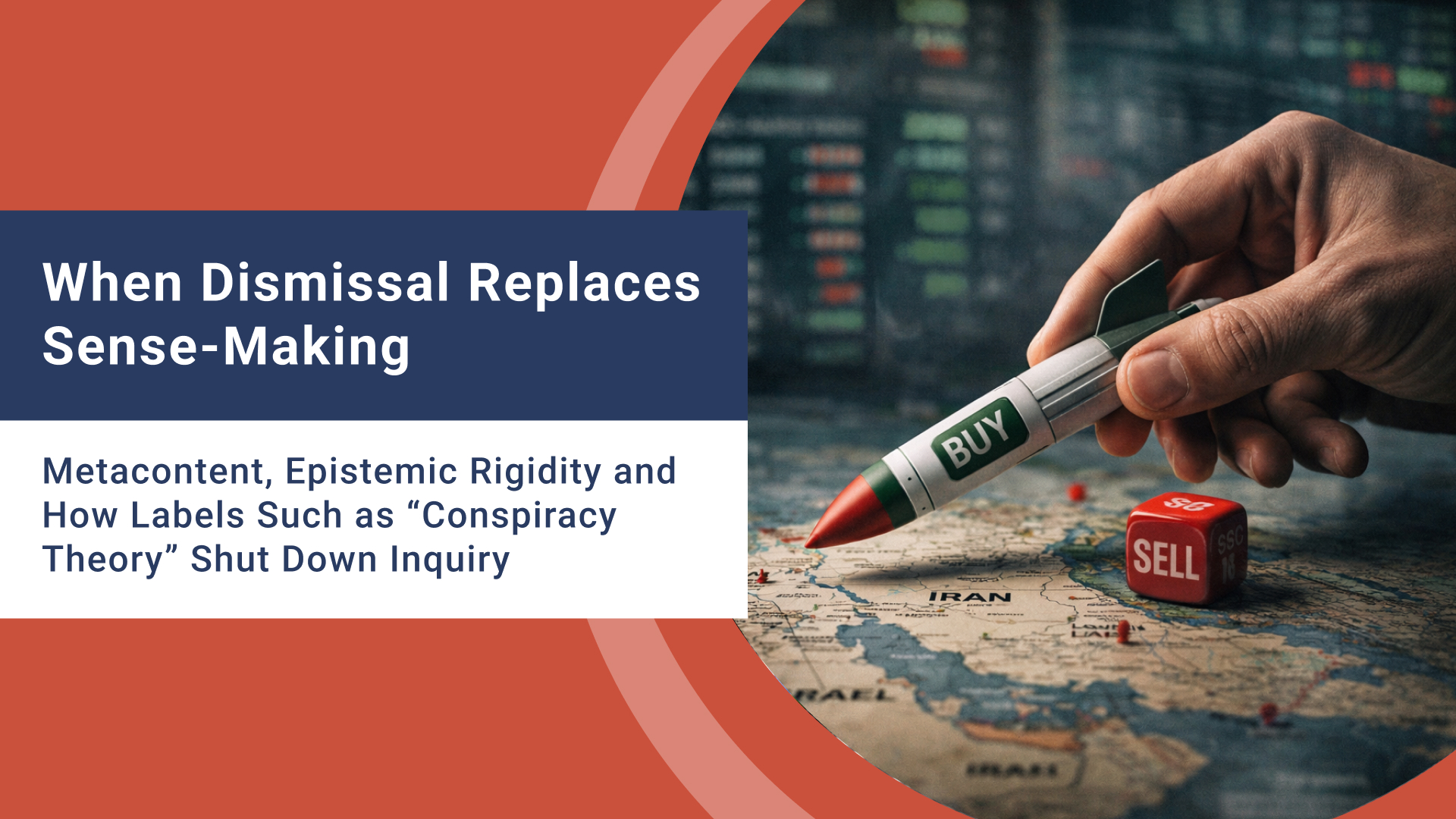

When Dismissal Replaces Engagement
There is a pattern that has become increasingly common in how people engage with ideas that sit outside conventional narratives. The moment a topic moves even slightly beyond what is familiar, widely accepted, or institutionally validated, it is often dismissed with a single label: “conspiracy theory.” This response tends to occur quickly and almost reflexively. It rarely emerges from careful examination, structured analysis, or a genuine attempt to understand what is being presented. Instead, it functions as a boundary marker, a quiet signal that what lies beyond it does not need to be engaged with.
At first glance, this may appear to be a reasonable defence mechanism. There is no shortage of claims that are poorly constructed, emotionally driven, or based on weak reasoning. Many individuals adopt perceptions without scrutiny, arrive at conclusions prematurely, or fail to apply even basic standards of logic and coherence. This reality must be acknowledged clearly and without hesitation, because ignoring it would weaken the integrity of the discussion from the outset.
However, stopping at this point creates a serious blind spot. Alongside these cases, there are also situations where substantial amounts of information, documentation, and evidence exist, yet are not meaningfully engaged with. In such instances, the label of “conspiracy theory” is no longer being used to identify weak reasoning. It is being used to avoid engagement altogether. The issue, therefore, is not simply the existence of poor claims, but the growing tendency to dismiss entire areas of inquiry without examination.
This avoidance is rarely neutral. In many cases, ideas are not dismissed because they are weak, but because they are perceived to be dangerous, destabilising, or simply too costly to engage with. Some lines of inquiry threaten existing belief systems, challenge institutional trust, or introduce levels of complexity that are cognitively overwhelming. Others collide directly with personal interests, identities, or social positioning, making genuine engagement inconvenient at best and existentially uncomfortable at worst. There are also instances where engaging seriously would require a re-evaluation of prior commitments, decisions, or allegiances, something many are neither prepared nor willing to confront.
In this sense, dismissal becomes a protective mechanism. Labelling something, for example, as a “conspiracy theory” functions as a way to contain cognitive dissonance, to avoid the burden of deeper analysis, and to preserve coherence within one’s existing conceptual world. What appears as scepticism on the surface may, in fact, be a refusal to engage with material that is too contradictory, too complex, or too disruptive to the current frame of understanding.
To understand this properly, we need to move beyond the surface level of content and examine the structures through which content is encountered. In the Metacontent discourse, everything we engage with can be understood as content. Events, data, reports, documents, narratives, analyses, and even our own thoughts and reactions all fall within this domain. More fundamentally, all there is, all that exists, can be understood as content: the dog, the cat, the plant, substances, as well as abstract ideas and constructs. Content is what appears. It is what is presented, observed, and discussed in everyday conversation and formal analysis alike.
Yet content is never encountered directly or in isolation. It is always engaged through metacontent. Metacontent refers to the underlying structures that shape how we make sense of what we encounter. It includes our cognitive maps, mental models, assumptions, stories, categories, and perspectives. It determines what we notice, what we ignore, what we accept, and what we reject.
In this sense, content does not speak for itself. It is always filtered, interpreted, and positioned through these deeper structures.
This is why two individuals can encounter the same body of information and arrive at entirely different conclusions. The difference does not necessarily lie in the content itself, but in the metacontent through which that content is processed. What appears obvious to one may appear irrelevant or even absurd to another, not because one is intelligent and the other is not, but because their structures of sense-making are operating at different levels or in different configurations.
This distinction becomes particularly important when we examine the reflexive use of labels such as “conspiracy theory.” In many cases, this label is applied not after a careful evaluation of the content, but at the very moment the content exceeds the boundaries of what the existing metacontent can comfortably process. What is being rejected, therefore, is not necessarily falsehood. It is unfamiliarity, complexity, or discomfort that cannot be easily integrated.
Each person carries their own metacontent, but this metacontent is not formed in isolation. It is shaped through exposure, education, culture, media, institutional narratives, and social reinforcement. Over time, certain frameworks become dominant. These dominating metacontent structures define what is considered reasonable, credible, or acceptable within a given environment. They influence not only what people believe, but also what they are willing to engage with in the first place.
This is where a critical shift occurs. When dominating metacontent becomes too rigid or too narrow, it begins to limit the range of content that can be meaningfully processed. Anything that falls outside its boundaries is not examined on its own terms. It is filtered out, dismissed, or labelled in ways that remove the need for engagement. In this context, the label “conspiracy theory”, for example, becomes less of an analytical category and more of a protective mechanism.
The consequence of this is not simply misunderstanding. It is the creation of a metacontent gap. This gap is the distance between what is being presented and the capacity of an individual’s existing metacontent to engage with it. When this gap is small, content can be examined, questioned, and integrated. When it is large, content is more likely to be rejected, distorted, or avoided altogether.
This article is concerned with that gap. Not as an abstract concept, but as a practical and increasingly visible limitation in how people make sense of complex realities. Because when engagement is replaced by dismissal, the question is no longer whether something is true or false. The question becomes whether it is allowed to be seen at all.
The Misplaced Confidence of Immediate Dismissal
Having established the distinction between content and metacontent, we can now return to the reflex that this article seeks to examine more closely. The immediate labelling of something as a “conspiracy theory” often carries with it a subtle but powerful implication. It signals that the matter has already been understood sufficiently to be dismissed. It suggests that no further examination is required. In many cases, this confidence is not earned through careful analysis but assumed through alignment with what is already familiar.
This is where the problem deepens. Because what appears as confidence is often not the result of rigorous thinking, but the absence of engagement. The individual is not necessarily rejecting the content after examining it. They are rejecting it because it does not fit within the boundaries of their existing metacontent. The label becomes a shortcut, a way of closing the conversation before it has meaningfully begun.
It is important to be precise here. This is not a matter of intelligence. Many highly intelligent individuals fall into the same pattern. Intelligence, in itself, does not guarantee the ability to engage with unfamiliar or complex material. Without an adequate metacontent structure, even high levels of intelligence can be applied within a narrow range. In such cases, intelligence may even reinforce the dismissal by constructing more sophisticated justifications for avoiding engagement.
This often presents itself through seemingly rational judgements: “it is not scientific,” “it is pseudoscience,” “it is not credible,” or “it does not meet the ‘standard’.” While such distinctions can, at times, be valid, they are not always the result of careful evaluation. In many instances, they reflect a rigid attachment to a preferred epistemic domain, where only certain forms of knowledge are recognised as legitimate. Anything that falls outside this domain is not explored, but pre-emptively dismissed.
What becomes visible here is not a lack of intelligence, but a limitation in capacity. The individual has not developed the ability to remain with material that appears contradictory to their existing mental models, metacontent structures, or value frameworks. Their current frame becomes the implicit benchmark of what is “right,” and whatever aligns with it is accepted, while whatever does not is excluded before meaningful engagement can even begin. In such a state, the development of conception through processes such as comparison, analysis, dialogue, constructive debate, consultation, and reflection is curtailed at the outset.
By contrast, a high-capacity individual is able to move fluidly across domains and contexts without collapsing into rigid judgement. They are not bound to a single epistemic frame, nor do they impose one mode of evaluation onto all forms of content. Instead, they are able to dynamically shift how they engage depending on the domain, the nature of the material, and the context in which it appears.
They can engage with a scientific paper and apply analytical rigour, and they can do the same with a religious text, a philosophical argument, a fantasy or fiction novel, or even a Disney movie, each time relating to the material in a way that is appropriate to its nature. Meaning is not confined to a single epistemic standard, nor is it restricted to what is considered intellectually or culturally “serious.”
It can emerge from the simplest and most mundane moments of life: from watching a ladybug in the garden, from the smell of grass on a rainy day, from dogs playing, from a simple breakfast with a friend, or from the subtle smile of a stranger in the middle of an ordinary morning. These are not trivial experiences. They are part of the field of meaning that becomes available when metacontent expands.
In this sense, expanded metacontent and capacity are not merely intellectual advantages. They fundamentally alter one’s relationship with reality. The individual is no longer confined to a narrow band of acceptable inputs, nor are they positioned on a hierarchy of “worthy” and “unworthy” sources of meaning. They are able to engage more fully with the richness and depth of existence itself.
What is at play is better understood as a metacontent gap. When content exceeds the capacity of the existing metacontent to process it, a form of friction emerges. This friction is often experienced as discomfort, confusion, or even irritation. Rather than remaining with that friction and working through it, the mind seeks resolution. One of the fastest ways to achieve this is through categorisation. By placing the content into a familiar category such as “conspiracy theory,” the need for further processing is removed.
This process happens quickly and often unconsciously. The individual may not be aware that they are avoiding engagement. From their perspective, the matter has already been resolved. The label provides a sense of closure. Yet what has actually occurred is not resolution, but withdrawal.
At the same time, this pattern is reinforced socially. In many environments, dismissing something as a “conspiracy theory” signals alignment with what is considered reasonable or informed. It becomes a marker of belonging within a particular intellectual or cultural group. Engaging with the same content, even critically, may carry a perceived risk of being associated with what is viewed as irrational or fringe. As a result, the cost of engagement increases, while the reward for dismissal remains high.
Over time, this dynamic shapes how entire groups relate to information. Certain areas of inquiry become implicitly off-limits, not because they have been thoroughly examined and found to be lacking, but because they fall outside the accepted boundaries of dominating metacontent. This creates an environment in which avoidance is normalised and even rewarded.
The consequence is a narrowing of what can be meaningfully discussed. Not through explicit restriction, but through the internalisation of limits. Individuals begin to self-regulate their engagement, often without realising it. They learn, consciously or unconsciously, where the boundaries lie, and adjust their attention accordingly.
This is where the earlier distinction becomes critical again. When content is dismissed at the level of metacontent limitation, the issue is not simply that something may be misunderstood. It is that it may never be understood at all. The opportunity for examination is removed before it has a chance to occur.
In this sense, the label “conspiracy theory” often functions less as a conclusion and more as a boundary. It marks the edge of what one’s current metacontent is able or willing to engage with. And once that boundary is drawn, what lies beyond it remains unseen, not because it lacks substance, but because it has not been allowed into the field of sense-making in the first place.
When Evidence Exists but Engagement Does Not
Up to this point, the focus has been on the mechanism of dismissal and the role of metacontent in shaping what can or cannot be engaged with. At this stage, it becomes necessary to address a crucial dimension that is often overlooked in these discussions. The assumption that what is being dismissed lacks substance or evidence.
There are indeed many cases where claims are weak, distorted, or constructed on fragile foundations. However, there are also situations where substantial amounts of documentation, data, and correspondence exist in the public domain. In these instances, the issue is not the absence of evidence. It is the absence of engagement with that evidence.
Over the past decades, large bodies of information have been released and made accessible. Documents, communications, reports, and records have surfaced through various channels. Some of these have been verified, cross-referenced, and examined by multiple independent sources. While interpretation of such material can vary, the existence of the material itself is not in question.
Yet, despite this, a common pattern persists. Rather than examining the content, assessing its validity, or even questioning its implications, the entire body of information is often grouped under a single dismissive category. The label replaces the process. Engagement is bypassed before it begins.
This raises an important question. How much information is required before engagement becomes necessary? At what point does the accumulation of documentation move from being ignored to being examined? And more importantly, what prevents that shift from occurring?
In many cases, the answer does not lie in the quantity or quality of the available material. It lies in the capacity of the observer to process it. When the volume of information becomes too large, too complex, or too misaligned with existing assumptions, it creates a form of cognitive overload. Without the necessary metacontent to structure and interpret that information, the individual is left without a clear pathway for sense-making.
In such situations, dismissal becomes a form of simplification. It reduces complexity to a manageable label. It allows the individual to move on without needing to reorganise their existing understanding. What appears as a judgment about the content is often a response to the difficulty of processing it.
This is where the concept of delayed sense-making becomes relevant. Rather than engaging with the material as it emerges, individuals may postpone or avoid engagement altogether. They may acknowledge that something exists, but choose not to examine it in depth. Over time, this delay can become indefinite. The content remains present, but outside the field of active consideration.
Delayed sense-making is not always conscious. It can take the form of subtle avoidance. Attention shifts elsewhere. Other priorities take precedence. The material is neither accepted nor rejected through analysis. It is simply not engaged with. In this way, large bodies of potentially significant information can remain effectively invisible, despite being publicly available.
The consequence of this pattern is not merely a lack of awareness. It is a distortion in how reality is constructed at a collective level. When certain forms of content are consistently excluded from meaningful examination, the overall picture that individuals and groups operate within becomes incomplete. Decisions, judgments, and positions are then formed based on partial visibility rather than a more comprehensive understanding.
This does not imply that all available information is accurate or should be accepted without question. On the contrary, it reinforces the need for careful examination, critical thinking, and structured analysis. The issue is not about believing everything. It is about being willing to engage with what exists, rather than dismissing it prematurely.
At this point, the discussion moves beyond whether specific claims are true or false. It shifts toward a more fundamental question. What are the conditions under which engagement with complex and potentially confronting material becomes possible? And what happens when those conditions are not present?
It is within this space that the role of models such as the Exposure Probability Model becomes significant, not as a theoretical abstraction, but as a way of understanding how exposure, capacity, and interpretation interact to shape what is ultimately seen, understood, or ignored.
Scepticism and Cynicism: A Subtle but Critical Distinction
At this point, it is necessary to draw a distinction that is often blurred, and at times deliberately so. The distinction between scepticism and cynicism.
Scepticism, in its proper form, is not opposition. It is discipline. It is the willingness to pause, to question, to examine, and to resist premature closure. It does not rush toward belief, but neither does it rush toward dismissal. It creates the conditions for deeper sense-making by holding space for ambiguity while actively engaging with available information. Within the Metacontent Discourse and the Nested Theory of Sense-Making, Scepticism is not merely encouraged. It is structurally required. Without it, perception collapses into assumption, and participation becomes reactive rather than considered.
Cynicism, however, operates very differently.
Cynicism presents itself as sophistication. It often appears as sharpness, as if it has already seen through everything. But in practice, it is a form of disengagement. Where Scepticism asks, cynicism concludes. Where Scepticism examines, cynicism dismisses. It replaces inquiry with a kind of pre-emptive negation, a stance that assumes distortion, manipulation, or futility before any meaningful engagement has taken place.
In the context of this discussion, cynicism becomes one of the most effective mechanisms for shutting down sense-making. When something exceeds the limits of one’s existing metacontent, cynicism provides an immediate exit. It allows the individual to reject without examining, to label without understanding, and to maintain a sense of intellectual superiority without doing the work required for deeper comprehension.
This is where the confusion becomes consequential.
A sceptical mind will encounter a complex or confronting claim and ask, what is this, how do I examine it, what evidence exists, what can be inferred, what remains uncertain. A cynical mind will encounter the same claim and respond, this is nonsense, this is manipulation, this is not worth my attention. Both may appear critical on the surface. But only one is engaged in sense-making. The distinction matters because cynicism often disguises itself as critical thinking, while in reality, it short-circuits it.
Within the framework of this article, the immediate labelling of something as “conspiracy” can emerge from either place. From Scepticism, it may arise after careful examination and reasoned conclusion. From cynicism, it arises almost instantly, as a reflex. The former contributes to clarity. The latter contributes to delayed sense-making.
To engage responsibly with reality, particularly in complex and high-stakes domains, requires more than intelligence. It requires the capacity to remain sceptical without collapsing into cynicism. It requires the willingness to stay with discomfort long enough to develop conception, rather than escaping it through dismissal.
When What Is Easily Dismissed Requires Deeper Engagement
There are moments in any inquiry where what is being described can be quickly labelled and set aside. In the context of this article, what follows could easily be dismissed as “conspiracy.” Yet the claim that something is a conspiracy is not, in itself, a refutation. In some cases, it becomes a mechanism of avoidance, a way of closing engagement at the very point where deeper sense-making is required.
This does not mean that what is presented is necessarily true, nor does it imply intent, coordination, or misconduct. The purpose here is not to assert conclusions, but to examine patterns that are visible when one moves beyond immediate perception and into structured conception. If such patterns are dismissed without examination, then the earlier argument of this article stands reinforced. The limitation is not in the content alone, but in the metacontent through which it is being engaged.
What follows, therefore, is not an assertion. It is an invitation to examine.
The Speculative War Loop
What follows can be read as an illustration of the pattern discussed above. It is not presented as a definitive claim, nor as an exhaustive account, but as a way of making visible how certain dynamics begin to take shape when examined beyond immediate perception. Whether one agrees with the interpretation is secondary. The point is to engage with the structure of what is unfolding, rather than dismiss it prematurely.
In earlier eras, however imperfectly, there remained at least a conceptual separation between the domains of war, governance, and markets. Decisions of war belonged to the realm of statecraft, shaped by strategy, ideology, and consequence. Markets, in contrast, responded to these decisions from a distance, absorbing shocks, pricing risk, and reallocating capital. Governance, ideally, stood as the mediating force between the two, bearing responsibility for decisions whose consequences extended far beyond financial gain.
What we are increasingly witnessing is not merely the erosion of these boundaries, but their convergence into a single, self-reinforcing loop.
The rise of prediction markets introduces a new layer to this convergence. Platforms now allow participants to place substantial financial positions on the probability, timing, and nature of geopolitical events, including military actions. War, in this configuration, is no longer only a matter of strategy or survival. It becomes a probabilistic event, continuously priced, traded, and speculated upon in real time.
At the same time, the proximity between political power and financial infrastructure has become increasingly intimate. Investment vehicles, venture capital structures, and technological platforms intersect with individuals and networks that are not merely observers of geopolitical events but, in some cases, are situated close to the very centres of decision-making. When those adjacent to executive authority are structurally connected, directly or indirectly, to platforms that monetise the outcomes of that authority, a tension begins to form. It is not loud and not always visible, but it is persistent.
This dynamic is not abstract. It has begun to take recognisable shape.
Consider the emerging configuration around platforms such as Polymarket, founded by Shayne Coplan, where participants can place substantial positions on geopolitical scenarios, including whether military escalation might occur, when such an event might take place, and how it might unfold. These are not symbolic wagers. They involve real capital positioned in anticipation of real-world consequences.
Now, place alongside this the investment ecosystem surrounding such platforms. Venture capital networks associated with figures such as Peter Thiel and funds such as 1789 Capital have been reported as participants in adjacent technological and financial infrastructures. Within overlapping networks, individuals connected to political power, including Donald Trump Jr., have held roles in governance or advisory capacities within investment structures.
Nothing here, in isolation, proves misconduct. There is no need to force that claim. The discomfort arises elsewhere.
It arises in the proximity.
A sitting president holds the authority to influence, directly or indirectly, decisions of war. His inner circle, his advisors, and in some cases his family, occupy positions within networks that intersect with financial platforms where the outcomes of those decisions are actively traded. Meanwhile, participants across the world take positions, long or short, on whether escalation will occur, whether conflict will intensify, and how events may unfold.
The same potential event exists simultaneously across multiple layers of reality. For some, it is strategy. For others, it is survival. For others still, it is a position on a screen, fluctuating in value as probabilities shift.
This is where the distinction between content and metacontent becomes critical. At the level of content, one might see separate elements. A geopolitical tension, a technology platform, an investment network, a political family. But at the level of metacontent, a pattern emerges. The domains of war, finance, and governance are no longer distinct fields interacting across boundaries. They are folding into one another.
When domains collapse without integrity, meaning itself begins to distort. War is no longer solely conflict. It becomes liquidity. Governance is no longer stewardship. It becomes positioning. Markets are no longer mechanisms of allocation. They become arenas where consequence is continuously translated into opportunity.
There is something quietly unsettling about a world in which the anticipation of a military escalation can accumulate millions of dollars in positions before a single decision is formally announced. Not because such anticipation is new, but because it is now structured, scaled, and normalised. The abstraction of conflict into probabilities creates a distance from consequence, allowing participation without presence and exposure without accountability.
This phenomenon does not emerge in isolation. It is a natural extension of an over-financialised system, which this broader body of work describes as a hollow economy. In such a system, value is increasingly derived not from creation, but from the extraction of volatility itself. Uncertainty becomes an asset class. Instability becomes a source of yield. Conflict, in its most extreme form, becomes a driver of liquidity.
Within this configuration, the question is no longer simply whether decisions are right or wrong, or whether individuals have acted appropriately. The deeper question is whether the system retains any meaningful capacity to separate consequence from gain. When influence, information, and financial positioning begin to occupy the same space, even indirectly, the architecture itself begins to blur the line between participation and advantage.
And in that blur, something subtle shifts.
War does not need to be desired.
It only needs to be priced.
The Normalisation of Betting on War
What may initially appear as an abstract concern begins to take a far more concrete and unsettling form when we examine how these dynamics are already unfolding in practice.
Across platforms such as Polymarket, substantial volumes of capital have been placed on the probability, timing, and nature of real-world military events. In the early phases of the recent West Asia (aka Middle East) escalation, hundreds of participants positioned funds on whether the United States or Israel would strike Iran, when such actions might occur, and how they might unfold. These were not marginal activities. They attracted significant engagement, with some markets drawing millions of dollars in trading volume and, in aggregate, reaching hundreds of millions across related contracts.
The scale of participation was equally notable. Reports indicate that more than 150 accounts placed substantial wagers in advance of confirmed military actions, with some individuals generating hundreds of thousands of dollars in profit from correctly anticipating strikes. What raises concern is not merely the profitability, but the proximity between prediction and occurrence, which has led to growing scrutiny around the possibility of information asymmetries or privileged access.
Beyond broad escalation, markets extended into more granular and immediate questions. Contracts were created around whether missile strikes would occur on specific dates, with individual markets attracting between $14 million and $23 million in volume tied to a single day’s outcome. In this configuration, the occurrence of a missile landing, regardless of its scale or consequence, became a financially determinative event. At this point, something more subtle begins to shift. The integrity of information itself becomes entangled with financial outcomes.
A particularly revealing incident illustrates this dynamic. An Israeli military correspondent reported that a missile had landed in an open area, causing no casualties. The report was factual, verified, and relatively minor in military significance. Yet because this single data point determined the resolution of a high-value betting contract, it triggered an intense response from participants who stood to lose money.
The journalist received a barrage of messages urging him to alter his reporting. Some offered incentives. Others escalated into direct threats, including threats against his life and family, with individuals claiming knowledge of his location and issuing ultimatums to change the narrative. In total, dozens of messages were sent within a short period, all centred on a single objective: to reshape the record of reality in order to influence a financial outcome.
This moment is deeply revealing. It is no longer simply that people are betting on events. It is that participants begin attempting to influence the informational substrate upon which those events are recognised and validated. At this stage, the boundary between observation and participation collapses. What was once a report becomes a variable. What was once a fact becomes a contested input. What was once an event becomes a financial trigger.
The system does not require explicit bets on specific tragedies. It operates at a level of abstraction where positioning occurs on the conditions that make such events possible. War, escalation, and instability are translated into probabilities. Those probabilities are translated into prices. And those prices invite participation.
This is why the concern cannot be reduced to any single market, platform, or participant. The issue is structural. When large-scale capital, real-time information, and geopolitical consequence begin to converge within the same loop, the system creates incentives that extend beyond passive observation.
In such an environment, the question is no longer whether individuals desire conflict.
It is whether the system increasingly rewards proximity to it.
The Exposure Probability Model: Why Seeing Is Not Simply a Matter of Availability
At this point, the question is no longer whether information exists, but why contradictions, patterns, or tensions within reality do or do not become meaningfully visible. The assumption that once enough information is present it will naturally be seen, understood, and evaluated does not hold in practice. This is where the Exposure Probability Model (EPM) becomes important.
In its conceptual form, the model is not designed to calculate exact probabilities, but to clarify the structural pressures that shape whether contradictions between narrative and reality become visible over time. Its basic expression can be represented as R = (D × N × V) / A, where R represents the risk of exposure, or the likelihood that contradictions between narrative and reality will become visible; D represents distortion, the gap between what is projected or claimed and what observable reality actually shows; N represents the number of interactions through which that narrative encounters real-world outcomes; V represents visibility, the number of observers capable of examining those interactions; and A represents adaptive correction, the capacity of the system, individual, or group to revise behaviour, beliefs, or narratives when contradictions emerge.
The logic is straightforward. As distortion increases, the gap between what is claimed and what reality produces becomes harder to sustain. As interactions increase, more events accumulate through which that gap can become observable. As visibility expands, more observers become capable of comparing statements, actions, and outcomes across time. Adaptive correction functions as the stabilising variable within the model. When individuals or systems revise themselves in response to contradiction, distortion is reduced before it accumulates. When adaptive correction is weak or absent, the burden grows. The narrative must remain intact even as reality repeatedly challenges it.
This becomes especially relevant in relation to public discourse, institutional narratives, and the dismissal of difficult material. Large bodies of evidence may already exist, contradictions may already be accumulating, and interactions may be generating observable signals, yet exposure in any meaningful sense may still be delayed. This is because visibility alone is not enough. It is not only a matter of whether there are observers, but whether those observers have the capacity to recognise what the informational field is revealing.
For this reason, the model can be understood in an expanded form by incorporating Observer Capacity (C). In this formulation, exposure is shaped not only by distortion, interaction volume, visibility, and adaptive correction, but also by the capacity of observers to interpret what they encounter. In other words, the informational environment may contain abundant evidence while many remain unable to recognise the pattern that evidence reveals. Observer capacity refers to the sense-making and meaning-making ability of those engaging the material. It includes the capacity to move beyond immediate perception, to compare narrative with outcome, to tolerate ambiguity, to remain present with contradiction, and to develop more congruent conception rather than merely reacting to surface impressions.
This is where the Metacontent discourse and the Nested Theory of Sense-Making become directly relevant. Human beings do not all engage reality with the same depth of interpretation. Some remain at the level of surface perception, accepting explanations largely as they are presented. Others move toward interpretation and conception, gradually developing more authentic and coherent understanding of the fragment of reality they encounter. In that sense, exposure is not purely external. It is mediated by the developmental quality of the observer.
A low-capacity observer may encounter many interactions without recognising the contradictions embedded within them. Statements may be accepted at face value, explanations repeated without examination, and outcomes filtered through pre-existing narratives. Under such conditions, even significant distortions may remain undetected for long periods. A high-capacity observer, by contrast, engages the informational field differently. Such an observer is more likely to recognise patterns across time, compare claims with consequences, revise interpretations as new material emerges, and detect contradiction earlier and with greater coherence.
The Exposure Probability Model therefore does not simply explain why evidence exists. It helps explain why exposure may still be delayed even when the informational field is dense. Contradictions do not become visible merely because they are present. They become visible when distortion, interaction, and visibility reach a point at which they can no longer be easily absorbed, and when observers possess sufficient capacity to recognise what those interactions reveal. In this way, what is often presented as a simple question of truth or falsehood is also a question of distortion, visibility, adaptive correction, and observer capacity.
Within this article, that insight matters because it clarifies why dismissal can persist even in the presence of substantial information. The issue is not always that evidence is absent. It is often that the conditions for meaningful exposure and interpretation have not yet matured. For a fuller articulation of the model, including its conceptual expression and expanded formulation, see Tashvir, A. (2026) The Exposure Probability Model (EPM), Engenesis, from the unpublished book Capacity.
Beyond Empiricism: The Role of Inference in Human Sense-Making
At this stage, another assumption needs to be examined more carefully. The belief that only what is empirically verified, directly observable, and conclusively proven should be engaged with or considered valid. This position is often presented as rational, scientific, and disciplined. Yet when taken as an absolute (or the only valid way of knowing), it becomes limiting in ways that are rarely acknowledged.
Human beings do not operate solely on empirically verified information. In practice, much of what we navigate in life involves incomplete data, partial visibility, and evolving conditions. If engagement were restricted only to what is fully verified at all times, the range of what could be understood or acted upon would become extremely narrow. In this sense, an exclusive reliance on empirical verification is not necessarily a mark of scientific rigour. It can also reflect a self-imposed limitation on the scope of sense-making.
To understand this more concretely, it is useful to look at developmental psychology. A newborn infant does not yet possess what is known as object permanence. When the mother is not within the infant’s immediate sensory field, there is no basis for inferring her continued existence. In that moment, from the infant’s perspective, the mother effectively ceases to exist. There is no observable evidence to the contrary.
As the child develops, this changes. The infant gradually acquires the ability to infer that the mother continues to exist even when she is not visible. This shift marks a significant cognitive development. The child is no longer limited to what is immediately observable. It can hold a representation of reality that extends beyond direct sensory input.
This capacity to infer is not a departure from rationality. It is an advancement of it. It allows the individual to operate within a more expansive understanding of reality, one that is not confined to what can be directly seen, heard, or measured in the moment.
The same principle applies at more complex levels of human reasoning. In many real-world situations, decisions are not made based solely on fully verified data. They are made through a combination of what can be verified and what can be reasonably inferred. Patterns are recognised. Signals are interpreted. Probabilities are assessed. Hypotheses are formed and adjusted over time.
In this context, it becomes useful to distinguish between two components that contribute to what we commonly refer to as intelligence. The first is verified information, data that has been substantiated through observation, measurement, or reliable reporting. The second is high-quality inference, or what could be described as well-grounded guesses. These are not arbitrary assumptions. They are constructed through comparison, reflection, analysis, dialogue, and the integration of multiple sources of information.
Intelligence, in practice, emerges from the aggregation of these two components. It is not simply the accumulation of verified facts, nor is it the free generation of unchecked assumptions. It is the capacity to bring both together in a coherent and adaptive way.
This has direct implications for decision-making. Decisions are rarely made on the basis of complete certainty. They are made within conditions of partial knowledge. The quality of those decisions depends not only on the accuracy of the available data, but also on the quality of the inferences that are drawn from it. Even highly intelligent individuals can make poor decisions if their inferences are weak, biased, or misaligned with the broader context.
When inference is undervalued or excluded, the scope of understanding becomes restricted. When it is overused without discipline, it leads to distortion and error. The challenge, therefore, is not to choose between empirical data and inference, but to develop the capacity to integrate them effectively.
Returning to the earlier discussion, this is where the limitation becomes more visible. When individuals rely exclusively on what is immediately verifiable, they may dismiss patterns, signals, or emerging realities that do not yet meet their threshold for evidence. At the same time, without a structured approach to inference, they may also reject the possibility of engaging with complexity that requires interpretation beyond surface-level observation.
In such cases, the dismissal of certain content is not necessarily a reflection of its validity. It is a reflection of the constraints placed on the process of sense-making itself. The boundary of what is considered acceptable becomes aligned with what can be easily verified, rather than with what can be meaningfully explored and understood.
This brings the discussion back to the central theme of the article. The issue is not simply whether something is true or false. It is how individuals and groups engage with the process of knowing in the first place. And within that process, the role of inference is not optional. It is fundamental.
From Perception to Conception: Why Slowing Down Matters
Up to this point, we have examined how dismissal can occur, how evidence can exist without engagement, how exposure and capacity shape what is seen, and how inference plays a fundamental role in human sense-making. At this stage, it becomes necessary to look more closely at how individuals move from encountering something to acting upon it. Because one of the most consequential breakdowns does not occur at the level of access to information, but at the level of how quickly and uncritically perception turns into participation.
Perception, in its most immediate form, is tied to what we encounter through our senses or through readily available interpretations. It includes what we see, hear, read, and are told. It also includes perceptions that are not directly derived from our own experience, but adopted from others. These may come from media narratives, political messaging, ideological positions, religious authorities, or even simplified versions of scientific claims. In many cases, these perceptions are pre-packaged. They are presented in ways that require minimal effort to adopt and minimal scrutiny to maintain.
When individuals move directly from perception to participation, they begin acting on these inputs without sufficient development of understanding. This participation may take many forms. It can be expressed through opinions, decisions, affiliations, or actions. The key point is that the underlying structure through which the situation is understood has not been adequately developed. The individual is operating on immediate or inherited perception rather than on a more refined conception.
Conception is fundamentally different. It does not arise instantly. It is developed. It requires engagement with complexity and the willingness to remain with uncertainty. It involves comparison, reflection, contemplation, analysis, dialogue, and sometimes disagreement. It requires examining different perspectives, challenging assumptions, and working through tensions rather than avoiding them. It also involves engaging with questions of normativity, ethics, and coherence, not as abstract ideas, but as integral parts of understanding what is being encountered.
Developing conception is a slower process. It demands patience and discipline. It requires individuals to pause rather than react, to examine rather than assume, and to construct rather than simply adopt. In a context where information is abundant and speed is often rewarded, this slowing down can feel counterintuitive. Yet without it, the quality of participation is compromised.
This distinction is directly connected to the Metacontent discourse. Perception operates at the level of immediate content and inherited interpretations. Conception operates at the level of metacontent development. It involves refining the very structures through which content is made sense of. As these structures develop, the individual’s capacity to engage with complexity increases. What was previously dismissed or misunderstood can now be examined with greater clarity and depth.
This also connects to the Being discourse. The capacity to pause, to remain present with complexity, and to engage without immediate reaction is not only a cognitive function. It is also a way of being. It reflects the individual’s relationship with uncertainty, discomfort, and the unknown. Without this capacity, even well-developed conceptual tools may not be applied effectively.
The movement, therefore, is not linear in a simple sense. It is not merely from perception to conception and then to participation. It is a continuous cycle. Perception informs initial awareness. Conception refines understanding. Participation expresses that understanding in action. Through participation, new experiences are generated, which in turn feed back into perception and further development of conception.
When this cycle is interrupted, particularly when perception moves directly into participation without the development of conception, the quality of engagement deteriorates. Decisions become reactive. Positions become rigid. Complexity is reduced to simplified narratives. In such conditions, individuals are more likely to adopt, defend, or reject ideas based on incomplete or unexamined understanding.
This brings us back to the earlier discussion. The reflexive labelling of something as a “conspiracy theory” can be understood as a form of perception-driven participation. It is a reaction that occurs without the intermediary development of conception. The label is applied, the position is taken, and the opportunity for deeper engagement is closed.
Developing conception does not guarantee that all content will be accepted or validated. It does, however, create the conditions under which content can be meaningfully examined. It allows for discernment rather than reaction. It enables individuals to differentiate between weak and strong claims, between noise and signal, without collapsing into immediate dismissal or uncritical acceptance.
In this sense, slowing down is not a loss of efficiency. It is an investment in the quality of sense-making. It is the difference between reacting to what appears and understanding what is unfolding.
Not Becoming Part of the Pattern
At this stage, a natural question begins to emerge. If this is the pattern, then what is to be done? How does one respond to a condition where dismissal replaces engagement, where perception turns into participation without the development of conception, and where sense-making itself becomes constrained?
The answer is both simple and demanding. Not to become part of the pattern.
This “pattern” does not belong to a particular group, ideology, or belief system. It is not confined to one side of a political divide, nor to a specific religious or cultural framework. It is present wherever individuals move from perception to participation without sufficient depth of understanding. It appears in the loud voices and in the silent crowd. It exists in decision-makers, in institutions, in commentators, and in everyday interactions. The system is not something external. The system is us.
It is easy to point outward. To identify a group, a structure, or a set of actors and place the responsibility there. It is far more difficult to recognise how the same dynamics operate within one’s own engagement with the world. When perception is adopted without scrutiny, when conclusions are reached without sufficient development of conception, when dismissal replaces examination, the pattern is being reinforced. Not abstractly, but in real time.
The challenge, therefore, is not to correct others first. It is to withdraw one’s own participation from the cycle of shallow engagement. This requires a deliberate shift. It requires the willingness to pause, to examine, and to take responsibility for how one makes sense of what is encountered. It requires stepping out of the impulse to react and into the discipline of understanding.
This is not a passive stance. It is an active commitment. It involves refusing to contribute, either explicitly or implicitly, to the spread of unexamined perceptions. It involves resisting the pull toward quick categorisation and easy dismissal. It involves remaining present with complexity, even when that complexity is uncomfortable or does not immediately resolve into clear conclusions.
At a deeper level, this is a matter of ownership. Ownership of how one engages with reality, how one interprets information, and how one participates in shaping the collective environment. It requires moving away from projection, from attributing the problem solely to external forces, and toward recognising one’s own role within the broader system.
This is where the broader body of work becomes relevant. The Metacontent discourse, the Being discourse, and the Authentic Sustainability discourse are not abstract frameworks detached from lived experience. They are intended to support this very shift. They provide structures through which individuals can refine their sense-making, develop their capacity, and engage with reality in a more coherent and responsible manner.
The aim is not to arrive at perfect certainty or to eliminate disagreement. It is to increase the capacity to engage with complexity without collapsing into reaction or avoidance. It is to be able to remain with contradictions, to host tensions, and to engage with those who hold different positions without reducing them to simplified categories.
In this sense, making peace is not about agreement. It is about expanding the capacity to engage with what is perceived as opposition without losing coherence. It is about recognising that understanding does not require alignment, but it does require the willingness to remain in the space where understanding can develop.
When this shift occurs, even at an individual level, it begins to alter the dynamics of participation. Engagement becomes more deliberate. Judgments become more grounded. Decisions become more coherent. And the cycle of shallow reaction begins, slowly, to weaken.
This is not a quick solution. It is a continuous practice. But it is also the point at which meaningful change becomes possible.
Capacity, Discernment and the Responsibility of Sense-Making
Bringing these threads together, the issue at hand is not reducible to the existence of conspiracy theories, nor to the credibility of any single claim. It sits at a deeper level. It concerns the quality of sense-making through which individuals and societies engage with reality. When that capacity is limited, fragmented, or left undeveloped, the consequences extend far beyond misunderstanding. They begin to shape how decisions are made, how relationships are formed, and how collective directions are set.
The reflexive dismissal of unfamiliar or confronting material is one expression of this limitation. The uncritical adoption of weak or distorted claims is another. Both arise from the same underlying condition. A gap in metacontent, a lack of structured sense-making, and an underdeveloped capacity to move from perception to conception before participation. These are not marginal issues. They are central to how reality is constructed and acted upon.
Within this context, the distinction between verified information and high-quality inference becomes operational. Intelligence is not defined by the volume of data one holds, nor by the speed at which one reacts. It is shaped by the coherence with which verified information and well-grounded inference are brought together. When this coherence is absent, decisions are made on unstable foundations. When it is present, even in conditions of uncertainty, engagement becomes more deliberate and more effective.
This is where the broader frameworks discussed throughout this article converge. The Metacontent discourse highlights the structures through which content is made sense of. The Exposure Probability Model clarifies the conditions under which content becomes visible and understandable. The distinction between perception and conception emphasises the importance of developing those structures rather than bypassing them. The Being discourse points to the necessity of cultivating the capacity to remain present, to tolerate complexity, and to engage without immediate reaction. Together, these do not form a rigid system, but a set of orientations that support more coherent engagement with reality.
The challenge, therefore, is not to arrive at a final position on every issue, nor to eliminate uncertainty or disagreement. It is to increase the capacity to engage with what is encountered without collapsing into premature dismissal or unexamined acceptance. It is to refine the ability to discern, to differentiate between what is weak and what is worth examining, and to remain open to the possibility that understanding may require time, effort, and the reorganisation of existing assumptions.
In a world where information is abundant and attention is fragmented, this becomes increasingly difficult. Yet it is precisely under these conditions that the responsibility of sense-making becomes more significant. Not as an abstract ideal, but as a practical necessity that shapes outcomes at every level, from individual decisions to collective trajectories.
Ultimately, the question is not whether one encounters complexity. It is how one responds to it. Whether one retreats into familiar categories or develops the capacity to engage beyond them. Whether one contributes to the cycle of shallow reaction or steps into a more deliberate and responsible form of participation.
The difference between these paths is not determined by intelligence alone. It is determined by the development of metacontent, the cultivation of capacity, and the willingness to engage with reality as it unfolds, rather than as it is most comfortable to perceive.
What To Do: Developing the Conditions for Coherent Engagement
At this point, the discussion naturally turns toward action. If the limitation is not simply in the content we encounter, but in the structures through which we engage with it, then the response cannot be limited to seeking better information alone. It must involve developing the conditions that make meaningful engagement possible.
The first of these conditions is the deliberate cultivation of awareness at the level of metacontent. This begins with recognising that how we make sense of things is not neutral. It is shaped, structured, and often constrained. Becoming aware of one’s own assumptions, categories, and interpretive habits creates the possibility of working with them rather than being unconsciously governed by them. This is not a one-time insight, but an ongoing practice of reflection and refinement.
The second condition is the expansion of processing capacity. Engaging with complex or unfamiliar material requires the ability to remain present with uncertainty and ambiguity. It requires tolerance for not having immediate answers and the discipline to stay with a question long enough for deeper understanding to emerge. Without this capacity, even the most relevant information can be experienced as overwhelming or dismissed prematurely.
The third condition is the development of conception through structured engagement. This involves moving beyond immediate perception and engaging in processes such as comparison, analysis, dialogue, and critical examination. It requires exposure to multiple perspectives and the willingness to test one’s own understanding against them. In doing so, the individual begins to construct a more robust and flexible metacontent, one that can accommodate complexity without collapsing into simplification.
The fourth condition is the responsible use of inference. Rather than rejecting inference in favour of only what can be verified, or relying on it without discipline, the aim is to refine it. High-quality inference emerges from well-structured thinking, careful observation, and the integration of diverse sources of information. It allows individuals to navigate situations where complete verification is not immediately available, without drifting into speculation or distortion.
The fifth condition is intentional participation. Once conception has been developed, participation becomes more deliberate. It is no longer driven solely by immediate reactions or inherited perceptions. It is informed by a more coherent understanding of the situation. This does not eliminate disagreement or uncertainty, but it changes the quality of engagement. Actions, decisions, and positions become more grounded and less reactive.
Underlying all of these conditions is a shift in orientation. A movement away from seeking quick resolution and toward engaging with the process of sense-making itself. This shift requires both humility and responsibility. Humility to recognise the limits of one’s current understanding, and responsibility to actively develop the capacity to expand it.
This is not a prescription for certainty. It is an orientation toward coherence. It does not guarantee that all conclusions will be correct, but it increases the likelihood that they are reached through a process that is thoughtful, structured, and open to revision.
In this sense, what is being proposed is not a method for determining what to believe, but a way of engaging with the process of knowing. One that recognises the interplay between content and metacontent, between exposure and capacity, between perception and conception. And one that places the responsibility for that engagement, ultimately, with the individual.
Domains, Discernment, and the Collapse of Boundaries
There is another layer to this discussion that often sits beneath the surface but carries significant consequences when left unexamined. It concerns the distinction between domains and the loss of discernment when those domains collapse into one another. Within the Nested Theory of Sense-Making, domains represent different modes through which reality is engaged. These may include theology, history, personal experience, ethics, law, economics, and empirical inquiry. Each of these domains has its own structure, its own methods of validation, and its own limitations.
The difficulty arises when the boundaries between these domains are blurred or ignored. When a source that belongs to one domain is treated as if it operates fully within another, confusion begins to take shape. A text that functions as theological guidance may be read as historical record in a literal sense. A personal experience may be elevated to a universal truth. A moral framework may be imposed as a legal or economic system without consideration of context. In each case, the issue is not the value of the domain itself, but the lack of clarity about how it is being engaged.
This collapse of domains becomes particularly consequential when theology, history, anecdotal accounts, and claims of ultimate authority are brought together without differentiation. Questions that require careful examination begin to lose their structure. Is a given source being treated as a spiritual guide, a historical account, a normative framework, or an absolute description of reality? Without clarity, these distinctions merge, and the resulting interpretations can carry a level of certainty that is not supported by the nature of the source itself.
For the sake of argument, even if one were to assume that a particular scripture is the literal word of the divine, another layer of complexity remains. The question shifts from the nature of the source to the nature of the interpreter. What grants an individual the certainty that their understanding of that source is complete, accurate, and unmediated? What allows a human being, with limited access to context, language, and totality, to assume full authority over its meaning?
This is not a challenge to belief. It is a challenge to certainty.
The issue is not whether a text holds value or truth within its domain. The issue is how that text is being interpreted, positioned, and applied across domains without sufficient discernment. When this occurs, interpretation can become indistinguishable from projection. What is presented as truth may, in part, reflect the limitations of the interpreter’s metacontent rather than the depth of the source itself.
This brings the discussion back to sense-making and meaning-making. Sense-making concerns how we interpret and understand what is presented. Meaning-making concerns the value, significance, and direction we derive from that understanding. When domains collapse, both processes become compromised. Sense-making loses its structure, and meaning-making may become rigid, absolute, or misaligned with context.
Within the Metacontent discourse, this is not a marginal issue. It sits at the core of how individuals and groups navigate reality. Without discernment of domains, the structures through which content is interpreted become unstable. And when those structures are unstable, the capacity to engage with complex or sensitive matters diminishes.
This is also where the earlier discussion on political and ideological influence becomes relevant. When theology is drawn into ideological frameworks without clear differentiation, it can be used to justify positions that extend beyond its original domain. Similarly, when ideological narratives adopt theological elements, they may acquire a sense of absolute authority that discourages examination. In both cases, the lack of domain clarity allows different forms of content to be merged in ways that amplify certainty while reducing discernment.
The consequence is not only confusion, but the strengthening of positions that are resistant to examination. When sense-making is compromised at this level, engagement becomes more difficult. Dialogue becomes more polarised. And the possibility of navigating complexity with nuance begins to narrow.
Restoring discernment does not require rejecting any domain. It requires recognising the nature of each, understanding its scope, and engaging with it accordingly. It requires the ability to hold multiple domains in view without collapsing them into one another. And it requires the humility to recognise that interpretation is always situated within the limits of one’s current metacontent.
In this sense, the development of discernment is not an abstract intellectual exercise. It is a practical necessity for maintaining coherence in how we engage with reality.
The Quiet Threshold
There is a quiet threshold that sits in every moment of engagement. It is rarely noticed, yet it is crossed constantly. It is the point at which one either leans into understanding or retreats into familiarity. The point at which one either expands their capacity or protects the limits of what they already know.
Most of the time, this threshold is crossed unconsciously. A label is applied. A conclusion is assumed. A position is taken. The movement is quick, efficient, and often socially reinforced. Yet beneath that efficiency, something else is taking place. The opportunity to see more is being set aside.
What makes this threshold significant is not the scale of the decision, but its repetition. It is crossed in small moments, in conversations, in what we choose to read, what we ignore, what we question, and what we accept without examination. Over time, these small crossings accumulate. They shape the boundaries of our world, not through what exists, but through what we allow ourselves to engage with.
To remain on this threshold, even briefly, requires something different. It requires the willingness not to immediately resolve what is encountered. To stay with the discomfort of not knowing. To resist the pull toward quick categorisation. To allow understanding to develop rather than forcing it into pre-existing structures.
This is not a comfortable position. It does not offer immediate clarity or certainty. But it is where expansion becomes possible. It is where perception begins to give way to conception. It is where sense-making deepens rather than contracts.
In a time where speed is rewarded and simplicity is preferred, this way of engaging may appear inefficient. Yet it is precisely this slowing down that restores depth. It is what allows individuals to move beyond reaction and into responsibility. Not as a declaration, but as a way of being.
The threshold remains, whether it is noticed or not. The question is not whether it exists. The question is how often one is willing to remain there long enough for something more to emerge.
References
ABC News Australia (2026) Iran war: Polymarket gamblers made millions betting on strikes. Available at: https://www.abc.net.au/news/2026-03-11/iran-polymarket-anonymous-gamblers-made-millions-betting
Berg, J., Nelson, F. and Rietz, T. (2008) ‘Prediction markets’, Journal of Economic Perspectives, 22(2), pp. 107–126.
Business Insider (2026) Polymarket users threatened journalist to change missile strike report. Available at: https://www.businessinsider.com
Crunchbase (2024) 1789 Capital – investment and board structures. Available at: https://www.crunchbase.com
CT Insider (2026) Lawmakers raise concerns over insider trading linked to Iran strike betting. Available at: https://www.ctinsider.com
Financial Times (2024) Prediction markets and geopolitical risk pricing. Available at: https://www.ft.com
Polymarket (2024) Market data and platform overview. Available at: https://polymarket.com
Reuters (2023–2024) Coverage on venture capital, political networks, and emerging financial platforms. Available at: https://www.reuters.com
SEC (2023) Regulatory discussions on event-based contracts and prediction markets. Available at: https://www.sec.gov
The Atlantic (2026) Insider trading is going to get people killed. Available at: https://www.theatlantic.com
The Guardian (2026) Polymarket gamblers threaten Israeli journalist over missile strike wager. Available at: https://www.theguardian.com
The New York Times (2024) The rise of political betting markets and their implications. Available at: https://www.nytimes.com
The Washington Post (2026) A journalist reported a missile strike. Then came the death threats. Available at: https://www.washingtonpost.com
Wikipedia (2026) Polymarket. Available at: https://en.wikipedia.org/wiki/Polymarket
Wolfers, J. and Zitzewitz, E. (2004) ‘Prediction markets’, Journal of Economic Perspectives, 18(2), pp. 107–126.