
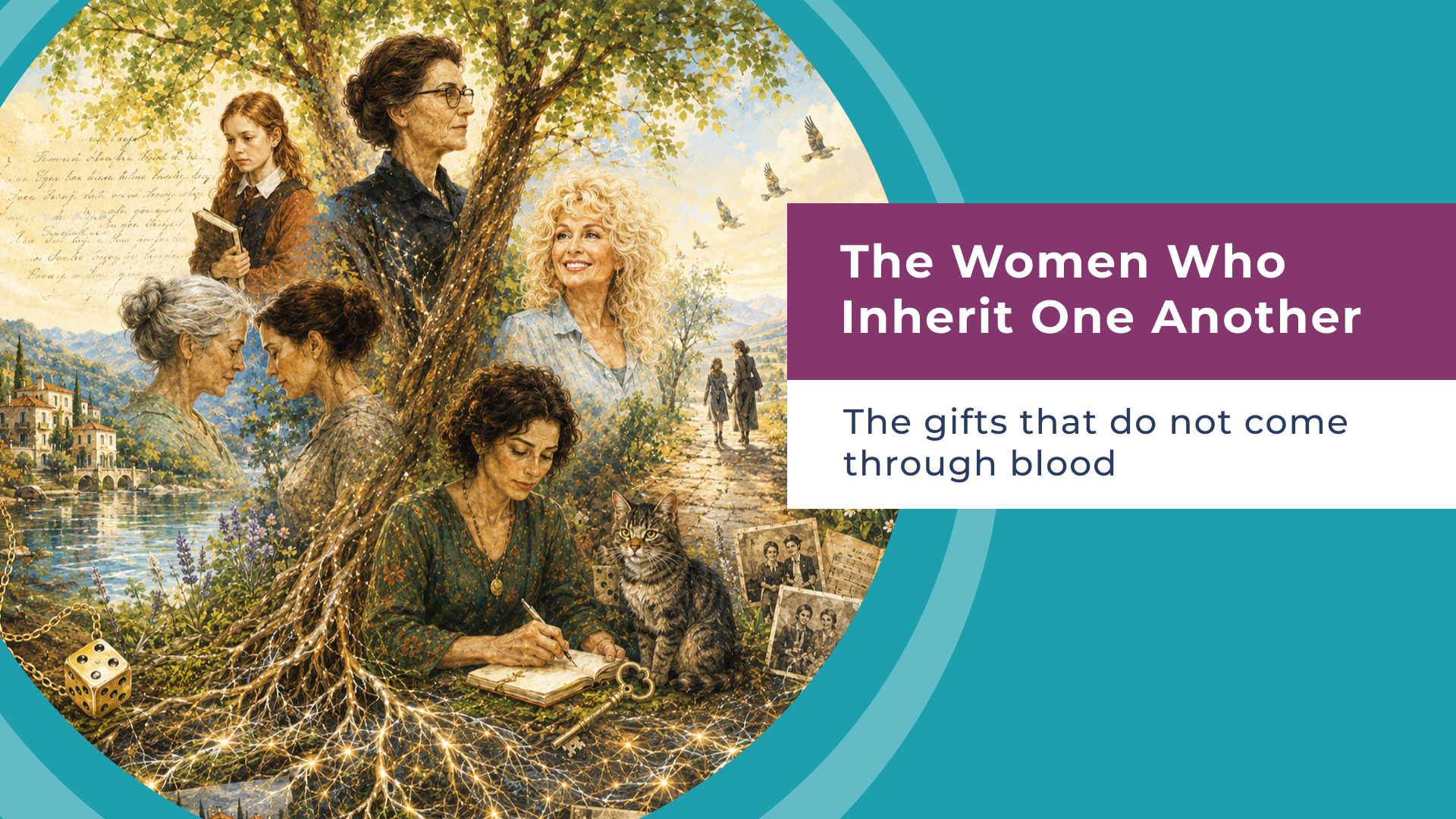

The family tree isn’t big enough
Near my desk sits a rusty old key. It once opened the door to the family villa in Croatia where my father was born. I brought it home after visiting there on my thirtieth birthday. It no longer opens anything. It is old and ordinary and, to anyone else, probably worth almost nothing. But that is hardly the point. It connects me to a place, a family and a history that existed before I did.
Around my neck I often wear something quite different: a small gold die given to me when I was a girl by my godmother. I think it was intended for my charm bracelet, although it never made it there. For years it lived among the accumulated objects of childhood until, about a decade ago, I began wearing it as a necklace. Somewhere along the way it became a kind of talisman from my growing-up years, connected not to ancestry but to a woman who helped make the world feel safer.
One came to me through blood; the other through relationship. I think I inherited them both. You may have objects like these too, things whose monetary value bears almost no relationship to what they carry. A grandmother’s recipe in handwriting you would recognise anywhere. A ring from a friend. A book inscribed by a teacher. A photograph, a scarf, a ridiculous ornament nobody else understands. Something that connects you to where you came from, or to someone who helped you leave it.
We usually imagine inheritance travelling through families, often arriving formally after someone dies. We draw family trees and follow the lines upwards and downwards: grandparents, parents, children, grandchildren. But the older I become, the less convinced I am that a family tree can account for all the people from whom we inherit ourselves. Some of the most consequential things we receive come from people with whom we share no DNA at all. And sometimes, wonderfully, they arrive almost by chance. How fitting that the object around my neck is a die.
I have been thinking about my middle-school English teacher, Ms Cullis. She was not the warm, effusive teacher of inspirational movies. She was strict, with cat-eye glasses, thick beige stockings and those wonderfully plain low-heeled shoes that seemed to belong to another decade. She rarely smiled, but when she did there was a warmth to it that made its rarity matter. Every now and then, she let me take the attendance register to the office. That was it. No grand speech about my gift for language or prediction that I would one day become a writer. Just a girl, a register and a walk down the school corridor.
I have no idea what Ms Cullis thought she was doing. Perhaps I was reliable. Perhaps it was my turn. Perhaps she needed the bloody register taken to the office and I happened to be standing closest to the door. Memory is an unreliable biographer, particularly when it tries to reconstruct the intentions of adults from the vantage point of childhood.
I remember what I thought it meant. She saw me. She trusted me. Something about words was awakening in me around that time too. I loved them. I became curious about what they could do, and somewhere in the peculiar archaeology of a life, Ms Cullis remains connected to that awakening. She had no children. Yet here I am, decades later, writing. Perhaps inheritance can be as quiet as that. Something passes between two people and takes root, while the person who gave it may never know what she gave.
A world of gifts
Years ago, in my doctoral research, I encountered the work of Jacques Godbout and Alain Caillé on what they called The World of the Gift. Building on Marcel Mauss’s earlier work on gift exchange, they challenged the idea that a gift can be understood simply as an object transferred from one person to another. Gifts exist within relationships and social worlds. Their meaning exceeds their monetary value, and the obligations, connections and reciprocity surrounding them are considerably more complex than a tidy exchange of equivalent things.
It makes intuitive sense when I think about my gold die. The object matters, but the gold is not really the gift. The relationship is in there somewhere. So is memory. So is safety. So is the girl I was when I received it and the woman I became before deciding, decades later, to put it around my neck. Gifts become even more interesting when we stop imagining reciprocity as a closed transaction between two people. Some gifts cannot be returned to their original giver. The grandmother is gone. The teacher disappears from our life. The author whose sentence changed something in us died before we were born. Sometimes the gift simply keeps travelling.
We do not necessarily give back. Sometimes we give onward. The encouragement someone gave us becomes the encouragement we offer another person. The door someone opened becomes one we hold open. The woman who once made us feel less alone becomes part of the reason we notice someone else standing at the edge of the room. Some inheritances diminish when divided. Others multiply when passed on. Inheritance begins to look less like property and more like transmission. Transmission requires a different picture of inheritance altogether.
There is something wonderfully orderly about the family tree. One person branches into another, generations arranged in comprehensible lines. It answers an important human question: Where did I come from? But it shows us only what can be seen above ground. Underneath a forest is another architecture altogether.
Roots cross and occupy shared soil. Mycorrhizal fungi form associations with plant roots, creating underground networks through which resources and chemical signals can move. The popular image of the “wood wide web”, in which benevolent trees deliberately send food and warnings to one another, goes considerably further than science allows us confidently to claim. I rather like that uncertainty. We do not need the forest to behave like a group of kindly women organising a casserole roster. It is extraordinary enough that what appears above ground to be a collection of separate individuals participates in relationships beneath the surface that are much harder to see. I think human inheritance has an architecture like that too.
Years ago, when we were flatmates, my friend Debbie gave me a MILK card that I somehow kept. Debbie later became Auntie Deb to my daughters. The card said, Friends are the family you choose. It sounded lovely to me when I was younger. I understand it differently now. We choose some of our inheritance too. Not all of it, of course. We do not choose our ancestors, our earliest histories or the circumstances into which we arrive. Nor do we completely choose the people who affect us. A classroom allocation, a job, a neighbour or a chance meeting can put someone in our path who becomes part of us for the rest of our lives. But as we grow older, our lives acquire roots that could never appear on a genealogical chart.
Sometimes we need a woman who loves us without having authored us. This is part of the particular gift that aunties, biological or otherwise, can offer. They can stand close enough to belong and far enough away to see something different. The family tree tells us something about where we came from. The forest contains everyone else who helped us become.
And then there are connections so fleeting they barely qualify as relationships at all. I have become increasingly fond of these as I grow older. They happen with women I do not know. You pass one another on a footpath, in an airport, at the supermarket or waiting for coffee. Your eyes meet. One of you notices something amusing happening nearby. Perhaps nothing has happened at all. And she smiles. Not necessarily the polite smile of social obligation. Something smaller. Knowing.
I have no idea what she knows. I do not know whether she has children or never wanted them, whether she has been happily married for forty years, left three husbands or loved women all her life. I do not know whether she has buried someone, built a company, cared for ageing parents, travelled the world, survived something terrible or lived a life of almost enviable steadiness. It would be absurd to manufacture sameness where none may exist. Still, sometimes there is that flicker. She’s been around long enough too.
I wonder if this is part of the peculiar mojo of midlife. Not that we have all lived the same life, but that we have lived long enough to know there are lives behind the faces we pass. I am not sure I want to explain it much further than that. We are rather fond of explaining human connection now: biology, hormones, socialisation, shared experience, empathy, evolution, culture, attachment. There may be truth in many of those accounts, but explanation can occasionally flatten the very thing it hopes to illuminate. Some forms of recognition are gifts we can simply receive. A smile, a moment, and then we both carry on.
Daughters are not required
Motherhood has, understandably, dominated the way we imagine female inheritance. A woman bears a daughter who may one day bear another daughter. Bodies literally produce the next generation. It is profound. It is also incomplete. Ms Cullis had no children. Neither did Dolly Parton. It is difficult to imagine two women more gloriously mismatched in an essay: my strict middle-school English teacher in cat-eye glasses and sensible shoes beside a rhinestoned country-music superstar. Yet together they make a point I think matters. A woman does not need daughters to become part of women’s inheritance.
Parton and her husband Carl Dean had once imagined they might have children. Later in life she came to understand their absence differently, wondering whether she had not been meant to have children so that, as she memorably put it, “everybody’s kids could be mine.” There is something especially poignant in those words now. Dolly Parton died on 25 August, and the world has spent the days since doing what we often do after a consequential life ends: taking stock of what remains.
In Parton’s case, what remains is considerably more than music. There is humour, business, philanthropy and the cultural permission that came from watching a woman be so unmistakably herself. Then there is the Imagination Library. Parton created it in 1995 in honour of her father, a man she described as extraordinarily intelligent but whose inability to read and write, she believed, limited the dreams available to him. What began in her home county in Tennessee now sends free books to more than three million children across five countries, and by the end of 2025 had gifted more than 304 million books.
Think about the inheritance moving through that story. A daughter witnesses something her father was denied. She turns that experience into a gift. The gift becomes books. The books travel into homes she will never enter and into the hands of children she will never meet. Somewhere among them will be girls who discover words. One may become a writer, another a teacher. Neither may ever know very much about the woman whose decision helped put one of those first books in her hands. Dolly herself wrote about dreams as seeds found in books, capable of growing far beyond the community in which they were first planted. It is difficult to imagine a better description of inheritance beyond blood.
Biological reproduction is one way life continues. Human beings have invented others. We teach, write, make art, build institutions, mentor, employ, encourage, challenge, care, introduce, fund and imagine. We make ways of living imaginable to people we may never know. Motherhood is an extraordinary way of creating what continues after us. It is not the only one. Women without children have always helped raise worlds.
What women weave
It is interesting how insistently images of thread and weaving recur in stories about women. In Greek mythology, the Moirai spin, measure and cut the thread of human life. Penelope weaves and unweaves. Ariadne provides the thread by which Theseus can find his way out of the labyrinth. They are different myths doing different work, but the recurrence of thread, continuity, creation and finding a way through remains evocative. Inheritance is not simply something we receive. We have to decide what to do with it.
Some threads we keep. Others we leave behind. Some we unravel, refuse or repair. Some we discover only after years of insisting they were never there. We combine what came through blood with what came through relationship, accident and choice. Then we make something with it. We inherit the thread. We decide what to weave. The result belongs neither entirely to the women who came before us nor entirely to us. It becomes something else: inheritance rewritten.
Perhaps by midlife we become more capable of seeing how much of this has been happening all along. The supposedly self-made self turns out to be rather crowded. There are women everywhere in there. Eventually, though, the direction of the question changes. For much of life, we can look backwards and ask: Who shaped me? Who believed in me? Who challenged me? Who made something possible? Who showed me another way to live? But inheritance does not stop with receiving. At some point we become part of the transmission too. We may know some of what we pass on. Much of it we probably won’t. A sentence said without much thought may stay with someone for decades. The way we behave when another person is frightened may become part of what she later offers someone else. Something we write may be read long after we have forgotten writing it.
The gift moves beyond the giver’s control. It is one of the most humbling things about inheritance. We do not get to decide which parts of us travel. Dolly Parton’s death makes that unusually visible. An estate can be counted: possessions, rights, money, property. But inheritance in the sense I am interested in here is much harder to inventory. It lives in what continues through other people. A song somebody sings. A book arriving through a letterbox. A little girl discovering that words might belong to her. The scale, ultimately, is not the point. Ms Cullis taught in a classroom. Dolly Parton filled stadiums. One handed a girl an attendance register. The other put hundreds of millions of books into children’s hands. Neither woman could possibly know the full extent of what travelled from her into other lives.
The family tree was never wrong. It was simply incomplete. There are women whose blood runs through us and women whose words do. Women whose courage, humour, standards, tenderness, defiance, curiosity or trust became part of how we learned to live. Some were given to us. Some we encountered. Some we chose. Some barely knew us at all.
Above ground, our lives may appear remarkably separate. Beneath the surface is another architecture: old roots and new ones, connections made through blood, chance and choice, gifts travelling farther than their givers could have imagined. Somewhere among them are threads we received from other hands and have woven into lives that are unmistakably our own.
Women have been doing this for one another all along. Not merely passing inheritance down through blood, but passing it between us. Look again at your own life.
Which women live in you?
What did they give you to weave into your own life?
And who may already be carrying a thread from you?
Dr Jordan Marijana Alexander is a writer, executive advisor and human systems strategist exploring how identity, place, culture and living systems shape participation in the modern world. She works alongside leaders, boards and organisations navigating complex questions of leadership, change and participation, and is the co-founder of RelateAble.Global. If this article has raised questions, sparked reflection or highlighted a decision you’re carrying, you’re invited to book a confidential conversation. You can follow DrJMA on LinkedIn and Engenesis for ongoing essays, reflections and research exploring leadership, identity, belonging and participation.