
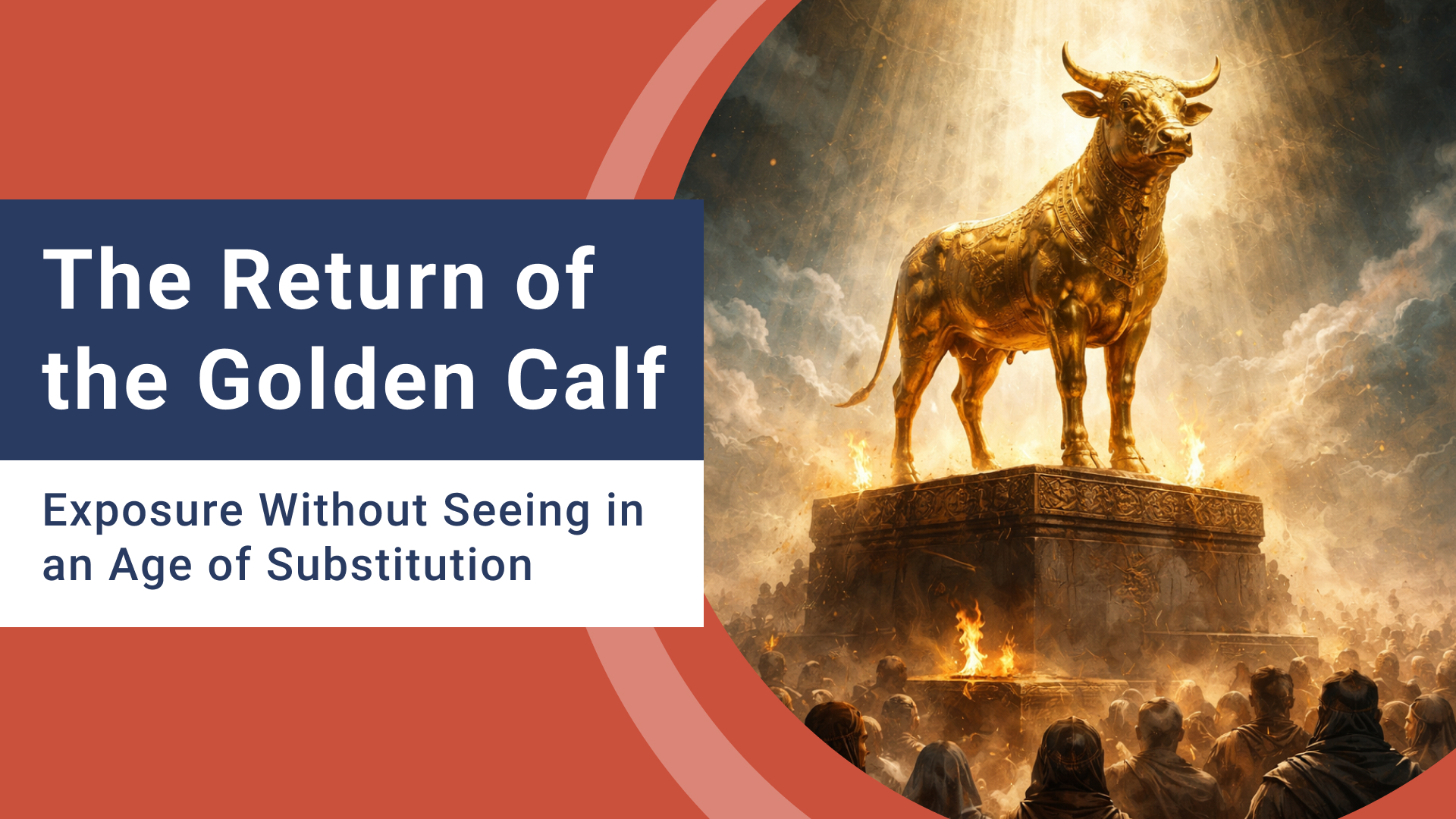

There are accounts that belong to theology, and there are patterns that belong to humanity. What matters is not whether one accepts a theological account as truth, but whether one can recognise the structure it reveals.
This is not an argument about belief or doctrine. It is an inquiry into a recurring pattern in human behaviour, one that has been preserved across traditions often seen as separate, yet aligned in what they observe. One such pattern appears early in both the Bible, specifically in the Book of Exodus within the Old Testament or Torah, and in the Quran, in what is commonly referred to as the account of the golden calf.
Even for those who do not engage with theological material, this remains accessible. These accounts can be read as early attempts to articulate something fundamental about how people respond to uncertainty, authority, and meaning. They offer a language for a pattern that did not remain confined to the past and does not belong to any one tradition.
In both accounts, the context is clear. People who had lived under prolonged domination, under a system often understood as the archetype of tyranny, are released from that condition. They are led out of it and moved toward a state that holds the possibility of autonomy. For those living within such conditions today, or even for those who desire such a transition, this moment carries a particular weight. The removal of constraint is often imagined as the arrival of clarity. In practice, it is the beginning of exposure.
Release does not instantly generate the capacity required to sustain autonomy. The external structure may be gone, or may be in the process of being challenged, but the internal capacity to orient without it has not yet stabilised. This creates a condition that is neither controlled nor fully coherent, a space where uncertainty is not only present but intensified.
Shortly after, the point of orientation becomes temporarily absent or less accessible. What had guided people, whether through authority, opposition, or resistance, no longer provides immediate direction. What lies ahead is not yet understood. In that space, pressure builds.
It is within this moment that something decisive occurs. A visible construct is formed by human hands. It becomes a point of reference, something people can see, gather around, and organise themselves in relation to. What begins as a response to uncertainty is quickly elevated into a central reference. Within a short span, a people who had just been released from one form of domination, or who are in the process of seeking release from it, can find themselves oriented around something they have constructed themselves.
This is where the pattern begins. Not as theology, but as a structure of substitution that continues to repeat across time, across societies, and across very different historical experiences.
The Pattern
Across both accounts, the sequence is consistent regardless of theological framing. People emerge from prolonged subjugation under a system that shaped not only their conditions but also their expectations of order, control, and direction. That system is removed, or begins to be challenged, and with it a familiar structure disappears. What replaces it is not immediate clarity, but exposure to uncertainty, responsibility, and the need to orient without a fully formed internal reference.
This transition is often underestimated. The movement away from constraint, whether realised or desired, does not automatically produce the capacity required to sustain autonomy. It opens a space that is inherently unstable. In that space, the absence of a clear and trusted point of orientation begins to generate pressure, both individually and collectively.
In response to that pressure, a substitute emerges. It is not random. It is something that can be seen, something that offers immediacy, and something that appears to restore coherence. It does not need to carry the depth of what it replaces. It only needs to provide enough clarity to reduce uncertainty and enough familiarity to be accepted.
Once introduced, it is rarely held as provisional. It is elevated quickly. It becomes the new reference point through which people interpret events, assign meaning, and align themselves. What supports it is reinforced. What contradicts it becomes difficult to process, not necessarily because it is absent, but because it no longer fits within the emerging frame.
This is the pattern. It is not confined to a particular people, nor to a single historical moment. It can be observed wherever societies move through uncertainty without sufficient development of the capacity required to hold complexity. It is present wherever something constructed begins to replace something that required deeper recognition, and where that substitution becomes convincing enough to be experienced as reality itself.
What the Calf Represents
What is constructed in that moment is not merely an object or an idea. It is a resolution to uncertainty. It provides orientation without requiring the capacity that genuine orientation demands.
The calf represents what is elevated when deeper awareness is not yet sufficiently stabilised. It becomes the point around which perception organises itself. Not because it fully reflects reality, but because it is accessible, visible, and collectively reinforced.
It carries specific characteristics that make it effective in this role. It offers clarity without depth and certainty without structural understanding. It simplifies what is complex into something that can be quickly grasped and widely shared. It creates the sense that something has been understood, even when the underlying structure remains unexamined. This is why it is convincing. It does not present itself as a substitute. It presents itself as an answer.
The issue is not that what replaces reality is entirely false. In many cases, it contains elements that are recognisable and partially valid. The problem is that it is incomplete. It removes relationships, context, and conditions that are necessary for coherence. What remains is easier to hold, but no longer accurate enough to guide effectively.
Once elevated, it begins to shape perception. It determines what is seen, what is ignored, and what is interpreted in ways that preserve it. Over time, the distinction between the constructed representation and the underlying reality fades. At that point, the substitution is no longer experienced as a substitution. It becomes the assumed structure itself.
Modern Forms
This pattern does not remain confined to early accounts. It reappears wherever complexity is reduced into something easier to adopt, especially in moments where people are either moving away from constraint or aspiring toward a different condition.
In modern contexts, the calf rarely appears as an object. It appears as interpretation. It shows up when complex systems are understood through fragments rather than through their full structure, when ideas developed within specific historical and institutional conditions are adopted elsewhere without those conditions, and when visible expressions are mistaken for the underlying mechanisms that sustain them.
One recurring form can be observed in how concepts such as freedom or democracy are received. Rather than being engaged as layered systems involving economic independence, institutional integrity, and long-term capacity, they are often reduced to their most visible expressions. These may include lifestyle choices, symbolic permissions, or forms of personal expression that are immediately understandable and emotionally compelling.
What is adopted in these cases is not the system itself, but a translated and simplified version of it. It carries the language and the imagery, but not the structure that makes it functional. This is not limited to one society or one group. It can be observed in different contexts, including among those who seek change and among those who believe they have already achieved it.
Historical experience reinforces this point. Moments of liberation or the establishment of new orders do not automatically resolve the underlying pattern. Whether in ancient transitions, later periods of political restoration, or modern state formations, the same structural challenge can reappear. The form changes, the language changes, but the tendency to substitute what is easier to grasp for what is more difficult to sustain remains present.
In each case, what is elevated is not necessarily false, but it is partial. It becomes a reference point that feels coherent enough to organise around, while leaving out the deeper conditions required to make it stable. Once this occurs, it begins to shape perception in ways that make the difference between representation and structure increasingly difficult to detect.
When Exposure Is High but Seeing Is Low
What makes this pattern more striking in the present is that it does not occur in conditions of limited access. In many cases, the opposite is true. Information is widely available, events are visible in near real time, and outcomes repeat across contexts in ways that should, in principle, allow for recognition and adjustment. Yet recognition does not reliably follow.
Contradictions can be observed without being integrated into understanding. Outcomes can repeat without altering interpretation. Signals accumulate, but they do not necessarily reorganise perception. What should lead to questioning often leads instead to reinforcement of what has already been assumed. This is not a failure of exposure. It is a limitation in how exposure is processed.
When visibility increases without a corresponding development in the capacity to interpret what is visible, the result is not clarity but saturation. Information becomes continuous, but its meaning remains fragmented. What is seen is filtered through existing frames, and anything that does not fit is either dismissed or reinterpreted in a way that preserves those frames.
In such conditions, repetition does not correct misunderstanding. It normalises it. What is encountered repeatedly begins to feel consistent, even when it contradicts underlying reality. Over time, the gap between what is presented and what is occurring becomes harder to detect, not because it is hidden, but because it is no longer being examined at the level required for it to become visible.
EPM and the Missing Variable
Up to this point, a tension has been building. The pattern shows itself repeatedly, exposure is high, outcomes are visible, and contradictions are not hidden. Yet recognition does not reliably follow. What should disrupt understanding often leaves it unchanged.
This raises a more precise question. If people are seeing more than ever before, why does seeing not translate into clarity?
This is where the Exposure Probability Model becomes necessary, not as an abstract construct, but as a way of explaining why visibility does not reliably lead to recognition.
R = (D × N × V) / A, expanded with Observer Capacity (C)
Where:
R represents the risk of exposure, or the likelihood that contradictions between narrative and reality become visible
D represents distortion, the gap between what is projected and what is actually occurring
N represents the number of interactions through which reality is encountered
V represents visibility, the extent to which those interactions can be observed
A represents adaptive correction, the ability of a system or individual to adjust when contradictions appear
C represents observer capacity, the ability to recognise and interpret what is visible
To make this more concrete, the relationship between exposure and observer capacity is not linear. High exposure does not guarantee recognition, just as low exposure does not prevent it.
When N and V are high, meaning events are frequent and widely visible, one would expect contradictions to become obvious. Yet if C remains low, there is still a high probability that what is clearly exposed is not recognised. It is seen, but not processed in a way that alters understanding. The signal is present, but the capacity to interpret it is insufficient.
Conversely, when exposure is limited, when N and V are lower, a sufficiently developed C can still allow for recognition. Higher observer capacity increases sensitivity to pattern, inconsistency, and underlying structure. In such cases, fewer signals are required for insight to emerge.
At higher levels of observer capacity, individuals do not depend solely on visibility. They develop a sensitivity that allows them to detect structure even when signals are weak, incomplete, or partially obscured. In this sense, capacity compensates for lack of exposure, while lack of capacity cannot be compensated for by exposure alone.
This is why increased visibility does not resolve the problem. Without the development of observer capacity, even what is obvious can remain unseen. With sufficient capacity, even what is not immediately visible can be recognised.
In many contemporary conditions, the variables that drive exposure are elevated. N is high, meaning events are repeated rather than isolated. V is high, meaning those events are widely accessible. D is also present, as narratives and framing shape how events are perceived. Under such conditions, one would expect that inconsistencies between what is claimed and what is occurring would become increasingly difficult to ignore.
Yet this expectation is not consistently met.
The reason lies in C. Observer capacity determines whether what is exposed is actually recognised for what it is. Without sufficient C, exposure does not translate into insight. It remains as information that is either absorbed into existing assumptions or dismissed without altering them. The system of interpretation remains intact even as contradictory signals accumulate.
This explains how a situation can reach a point where evidence is both abundant and ineffective. It is present in quantity, but limited in its ability to produce change in perception. The issue is not that reality is hidden, but that the capacity required to engage with it meaningfully has not been sufficiently developed. In that condition, what should disrupt understanding instead becomes part of what sustains it.
Observer Capacity
If observer capacity is the determining variable in whether exposure leads to recognition, then it becomes necessary to understand what it actually consists of. Observer capacity is not a function of intelligence, nor is it resolved through access to information or formal education. It is the ability to see structure rather than surface, to distinguish between what appears and what operates beneath it, and to remain with complexity long enough for it to organise into something coherent rather than collapsing it into something convenient.
It includes the capacity to hold contradiction without immediately resolving it, to recognise when a narrative and an outcome do not align, and to resist the pull toward conclusions that feel satisfying but are not structurally grounded. It also requires the ability to separate symbol from system, to see when what is being presented is a representation rather than the thing itself.
Without sufficient observer capacity, exposure does not deepen understanding. It fragments it. Information accumulates, but it does not integrate. Signals are received, but they are filtered through what has already been accepted. What does not fit is either dismissed or reshaped to maintain internal consistency.
In that condition, repetition becomes normalisation. What is encountered repeatedly begins to feel natural, even when it contradicts what is being claimed. Over time, the gap between narrative and reality widens, but it is no longer experienced as a gap. It becomes structurally invisible. This is the point at which substitution stabilises. Not because it is accurate, but because the capacity required to question it has not been sufficiently developed.
The Illusion of Freedom
One of the most persistent modern substitutions appears in the form of freedom, not as a fully developed condition, but as a simplified and visible interpretation of it. In many contexts, freedom is reduced to what can be immediately experienced and easily communicated, such as lifestyle choices, forms of personal expression, or permissions that operate at the surface of daily life. These visible elements are then taken as sufficient evidence that a deeper condition has been achieved.
What remains less examined are the structural dimensions that make freedom sustainable. These include economic independence, the ability to generate and retain value, institutional resilience, and the capacity to make decisions without external dependence. Without these underlying conditions, what appears as freedom can remain conditional, shaped by forces that are not immediately visible but continue to determine outcomes.
This creates a situation in which individuals or groups may experience a sense of autonomy while remaining structurally constrained. The visible layer provides enough clarity to feel convincing and enough alignment to be reinforced collectively. Because it is accessible and immediate, it becomes the reference point through which freedom is understood, even when it does not reflect the deeper structure required to sustain it.
In this sense, the idea of freedom itself can become a substitution when it is detached from the conditions that give it substance. It shifts from being a state that must be developed and maintained to an image that can be adopted. Once this image is accepted, it shapes perception in ways that make it increasingly difficult to distinguish between what is experienced at the surface and what is operating at the level of the system.
The External Saviour Projection
A related manifestation of the same pattern appears in the way solutions are projected outward. When internal clarity is not sufficiently developed, agency is often relocated to external actors who are imagined to resolve what has not yet been understood from within. This is not usually experienced as dependency. It is framed as alignment, support, or necessary intervention.
In such conditions, external power is interpreted through an image rather than through its structure, incentives, or historical behaviour. Selective signals are amplified because they align with what is already hoped for, while contradictory outcomes are minimised, reframed, or delayed in their recognition. Actions that produce visible harm can be interpreted as temporary steps toward a perceived long-term benefit, and inconsistencies are absorbed into the narrative rather than allowed to challenge it.
Even when exposure is high and outcomes are repeatedly visible, the underlying assumption can remain intact. This is not because evidence is absent, but because it is being processed within an established frame that is not easily revised. What does not fit is adjusted to preserve that frame, rather than prompting a reassessment of it. Over time, the distinction between expectation and outcome becomes increasingly difficult to hold in a coherent way.
This is where the substitution deepens. The external actor is no longer engaged as a complex system with its own interests and constraints. It is engaged as a representation that has already been accepted. In that condition, even clear contradictions do not necessarily lead to correction. They are integrated in ways that allow the original assumption to persist, often at a cost that is only recognised once it has already unfolded.
The Messiah Complex and the Abdication of Responsibility
A deeper layer of the same pattern appears in what can be described as the messiah complex, not in a theological sense, but as a structural tendency in human behaviour. Across traditions, there exists, in different forms, the idea that resolution will arrive through an external figure, a decisive intervention, or a force that will restore order and remove disorder. When translated into modern contexts, this tendency becomes a way of relating to reality itself. Instead of engaging with complexity directly, responsibility is projected outward, and the resolution of conflict, the correction of systems, and the reconciliation of contradictions are placed in the hands of something or someone else.
This is rarely explicit. It appears more as expectation than belief, a quiet assumption that change will be delivered, that alignment will be imposed, or that dysfunction will be resolved without requiring full participation from those within the system. At its core, this reflects a relationship with responsibility. Within the Being Framework, responsibility is not defined by fault or blame, but by authorship.
The Being Framework Ontological Distinction of Responsibility
Responsibility is being the primary cause of the matters in your life, regardless of their source. It is the extent to which you choose to respond rather than react to them. Responsibility is distinguished by how you honour the autonomy that you have as a human being and is considered the power to influence the affairs, outcomes and consequences you are faced with. Responsibility is not about blaming or determining whose fault it is. Instead, it is to intentionally choose, own, cause and bring about outcomes that matter, work and produce results while also being answerable for the impact and consequences.
A healthy relationship with responsibility indicates that you have the power to influence the circumstances you find yourself in and/or cause. Others may consider you capable of appropriately responding to matters, which is a prerequisite to producing and bringing to fruition effective results. You fully accept ownership of both outcomes and consequences and have the capacity to make informed, uncoerced decisions. You are unquestionably the active agent in your life.
An unhealthy relationship with responsibility indicates that you may often be stuck, experience a loss of power, and are a victim of circumstances. You frequently experience being disarmed, as though you have no choice in influencing outcomes and there is an inevitability about your future. You may be inclined to self-sabotage and make repetitive complaints without seeking, putting forward and implementing solutions. You frequently make excuses for your lack of accomplishments while abdicating or avoiding consequences. You may be considered ineffective in consistently fulfilling the promises you make and producing intended results. You are a passive victim in your life. Alternatively, you may live life from the viewpoint of being the sole cause of matters and exert your will onto your surroundings and others or be over-responsible and attempt to control all matters all the time. You may also expect that matters should always go your way.
Reference: Tashvir, A. (2021). BEING (p. 277). Engenesis Publications.
When responsibility is not fully owned, projection becomes the default and agency is relocated. What could be influenced is instead experienced as something that must be received, and even when exposure is high and contradictions are visible, the orientation remains passive. This is where the pattern intensifies. The expectation of a rescuer, whether in the form of a political force, an external power, the return of a prince from exile, a ‘divine’ representative, or a symbolic figure, becomes another form of substitution. It offers resolution without requiring participation and promises change without demanding the capacity to enact it.
Yet the very conditions that people seek to change cannot be transformed from a position of abdication. What is required is not rescue, but instatement. Integrity, not as a concept but in its most expansive sense, must be instated, not by a single figure and not through external imposition, but through collective authorship. Through individuals and groups choosing to relate to life, to society, and to each other as something worth engaging with, building, and sustaining. This requires a shift from waiting to participating, from projecting to owning, and from expecting resolution to instating it.
It requires the willingness to put one’s hand in the hand of others, not in agreement on all things, but in commitment to engage with what is, to work through contradictions, and to bring about outcomes that are not outsourced to forces beyond reach. Without this shift, the pattern repeats, not because people lack desire for change, but because the relationship to responsibility does not yet support it.
Why the Pattern Persists
This pattern persists not because people are incapable, but because it serves an immediate function. It reduces uncertainty without requiring the development of the capacity needed to engage with complexity. It provides orientation at a time when orientation feels necessary, even if that orientation is only partial.
What replaces a deeper structure is often easier to adopt, easier to communicate, and easier to align with collectively. It offers clarity without the effort of integration, and direction without the burden of sustained inquiry. In environments where pressure is high and the demand for immediate interpretation is constant, this becomes particularly attractive.
There is also a reinforcing dynamic at the collective level. Once a substitution is shared, it gains stability through repetition and social alignment. It becomes embedded in language, in conversation, and in how events are interpreted. Challenging it then requires not only individual capacity, but also the willingness to step outside what has become normalised within the group.
Over time, what began as a response to uncertainty becomes a stable frame of reference. It no longer feels like a substitution. It feels like the structure itself. At that point, it is not maintained through force, but through familiarity. It persists because it works well enough to avoid immediate disruption, even if it gradually distances perception from the underlying conditions that would otherwise be recognised.
What the Calf Looks Like Today
The calf no longer appears as an object. It appears as what is elevated without sufficient understanding.
It can take the form of a simplified idea of freedom that prioritises visible expression while overlooking structural dependence. It can appear as an imported model of governance adopted through fragments rather than through the conditions that make it functional. It can take shape as the belief that external actors will resolve internal complexity, even when their actions repeatedly contradict that expectation.
In each case, what is being elevated is not entirely false. It contains elements that are recognisable and, in isolation, meaningful. What makes it a substitution is not its falsity, but its incompleteness. It presents a partial structure as if it were sufficient.
This is what makes it convincing. It aligns with desire, it simplifies complexity, and it offers orientation without requiring the development of the capacity needed to sustain it.
Once accepted, it begins to organise perception. What supports it becomes visible. What challenges make it difficult to integrate? Over time, the distinction between representation and structure fades, and what was constructed is no longer experienced as such.
Closing Axiom
What this reveals is not a failure of access, but a limitation in how access is used. Information can be abundant while understanding remains shallow. Visibility can increase while clarity does not follow. Exposure can accumulate without producing correction.
The assumption that more information will resolve confusion rests on the idea that seeing naturally follows from visibility. In practice, this is not the case. Seeing is not passive. It is an active capacity that depends on the ability to interpret, to integrate, and to question what has already been accepted.
When that capacity is not sufficiently developed, what is available does not translate into what is recognised. Signals remain present, but their meaning does not reorganise perception. What is repeated becomes familiar, and what is familiar begins to feel true, regardless of its alignment with underlying reality.
This is why substitution is not an exception. It is a recurring outcome. Not because reality is hidden, but because it is not being engaged at the level required for it to become clear.
Final Reflection
The significance of the golden calf is not in the object that was formed, but in the pattern it reveals. People can move away from domination, or aspire to move beyond it, and still recreate a new point of orientation that carries the same limitations in a different form. This does not happen because they seek constraint, but because the capacity required to sustain what is less visible has not yet stabilised.
This is not confined to any one society, nor to any one historical moment. It can be observed wherever meaning is reduced, wherever complexity is set aside in favour of immediacy, and wherever something more accessible is allowed to take the place of what requires deeper engagement. The forms change, the language changes, and the context shifts, but the underlying structure remains recognisable.
What follows from this is not a prescription, but a question. Not what is being seen, but how it is being seen. Not what is available, but what is being recognised within it. Because the difference between substitution and understanding does not lie in the world alone. It lies in the capacity brought to it.
The golden calf does not need to remain in history to matter. It only needs the conditions under which it can reappear.