
Leadership is often mistaken as a position or title, but at its essence, it is a way of Being, a deep ontological commitment to who we are in each moment. Self-leadership means taking full ownership of one’s internal state, choices and actions, acknowledging the profound interconnectedness between individual presence and collective reality. The credit belongs to the man who is actually in the arena, whose face is marred by dust and sweat and blood... who strives valiantly... who knows great enthusiasms, the great devotions... who spends himself in a worthy cause.”1 In today’s complex and fragile world, the courage to show up as the person we truly are, vulnerable, responsible, and authentic, is the foundation of planetary leadership. This article explores the ontological roots of self-leadership, its ripple effects, and why cultivating this courage is essential to addressing the planetary crises we face. Ontology, the philosophical study of Being, asks the fundamental question: Who am I? and How do I show up in the world? Personal ontology brings this inquiry into the realm of daily living and leadership. It shifts focus from what we do to how we are Being as we do it. Personal ontology refers to the underlying dispositions, qualities and ways of Being that shape how a person perceives, chooses and acts. The Courage and the Being Framework teach that leadership arises not from external status but from an integrated state of presence, authenticity, and alignment with deeply held values and purpose2,3. This means becoming aware of one’s internal landscape, thoughts, emotions, fears and choosing to respond rather than react. As the philosopher Martin Heidegger noted, “We do not speak because we have a meaning to express, but because we are in a state of Being that demands expression.”4 Leadership is an expression of this Being, and self-leadership is the conscious stewardship of it. Each individual’s state of Being acts like a stone cast into a pond, creating ripples that influence the social and organisational waters around them. Research in organisational psychology confirms that leaders’ moods, authenticity, and behaviours significantly influence team trust, engagement, and performance 5. This principle extends beyond formal leadership roles to everyday interactions and societal influence. For example, a leader grounded in self-awareness and kindness creates a culture of psychological safety, fostering innovation and collaboration 6. Conversely, a leader driven by fear or ego often breeds mistrust and disengagement, fracturing communities. This dynamic underscores that personal transformation is not isolated but integral to collective healing and resilience. The ontological states we embody collectively determine the social realities we create. The health of our planet and societies depends fundamentally on individuals willing to engage in courageous self-leadership. The courage to be authentic and accountable translates into ethical choices that influence business, politics, and community. As vulnerability scholar Brené Brown puts it, “Authenticity is a collection of choices that we have to make every day. It’s about the choice to show up and be real. The choice to be honest. The choice to let our true selves be seen.”7 This authenticity anchors ethical leadership that transcends performative gestures. When leaders act from integrity and align their behaviours with values such as justice, sustainability, and compassion, they catalyse systemic change. The planet’s complex challenges, climate change, inequality, and conflict cannot be addressed by policies alone but require a shift in the collective consciousness anchored in authentic self-leadership. Courageous self-leadership requires the embrace of vulnerability as a strength, not a weakness. Cultural myths around invulnerability, especially for men, have long stigmatised openness as a sign of frailty, fostering disconnection and burnout 8. Yet vulnerability is essential to genuine connection, learning, and growth. To quote Theodore Roosevelt again, it is those “in the arena” who dare to be vulnerable, to risk failure and criticism, who ultimately lead change 1. Vulnerability enables leaders to face fear and uncertainty, fostering psychological safety where innovation thrives 9. Rejecting vulnerability denies our humanity and undermines leadership. Instead, embracing it invites authenticity and trustworthiness—the bedrock of effective self-leadership. Self-leadership flourishes through cultivating specific Ways of Being that nurture self-trust and ethical action: Awareness: Cultivating mindful presence and recognising internal and external influences 3. Authenticity: Aligning actions with true values despite external pressures 7. Vulnerability: Embracing uncertainty and emotional openness as leadership strengths 8. Responsibility: Accepting ownership of choices and their ripple effects 2. These Ways of Being foster trust in oneself, which is foundational for conscious decision-making and ethical leadership10. Without self-trust, individuals are prone to reactionary or fear-driven behaviours that undermine influence and well-being. This is not a “one and done” exercise; developing these Ways of Being is a continual practice involving reflection, feedback, and courage. Whatever level of self-assertiveness one achieves, magically the world rises to challenge you again and again and again. Self-leadership’s ultimate significance lies in its collective amplification. As more individuals embody authentic, responsible Being, their ripple effects transform cultures and systems. Leadership scholars highlight “distributed leadership” models that move beyond hierarchical paradigms toward networks of empowered individuals12. This democratisation of leadership reflects ontological maturity: recognising interdependence and co-creating futures. Examples from social movements, regenerative business models, and community healing illustrate how personal transformation fuels systemic change13. The stakes of our time demand a radical reimagining of leadership as ontological practice. The courage to be, to show up vulnerably, authentically, and responsibly, is not optional but essential. This courage resonates with Roosevelt’s vision of the “man in the arena,” the individual willing to risk failure for worthy causes 1. The arena today is complex and uncertain, but it is ours to step into with courage and presence. Mastering these Ways of Being equips us to be the leaders our world desperately needs. Our collective survival and flourishing rest on this ontological foundation. It is time to answer the call and embody the courageous Being that planetary leadership demands. Roosevelt, T. (1910). Citizenship in a Republic (“The Man in the Arena” speech). Paris, France. Williams, J. A. (2024). The Andreia Method: Courage and Character for Conscious Action. Andreia Publishing. Tashvir, A. (2023). The Being Framework. Engenesis Platform. Heidegger, M. (1927). Being and Time. Niemeyer Verlag. (English trans. Harper & Row, 1962). Goleman, D., Boyatzis, R., & McKee, A. (2002). Primal Leadership: Realizing the Power of Emotional Intelligence. Harvard Business Review Press. Edmondson, A. C. (1999). Psychological safety and learning behaviour in work teams. Administrative Science Quarterly, 44(2), 350–383. Brown, B. (2010). The Gifts of Imperfection. Hazelden Publishing. Williams, J. A. (2023). The Delusion of Invulnerability: The High Stakes Costs of Denying Vulnerability. Engenesis. Brown, B. (2012). Daring Greatly: How the Courage to Be Vulnerable Transforms the Way We Live, Love, Parent, and Lead. Gotham Books. Deming, W. E. (1986). Out of the Crisis. MIT Press. Kegan, R. (1982). The Evolving Self: Problem and Process in Human Development. Harvard University Press. Siegel, D. J. (2010). The Mindful Therapist: A Clinician’s Guide to Mindsight and Neural Integration. W. W. Norton & Company. Spillane, J. P. (2006). Distributed Leadership. Jossey-Bass. Chouinard, Y. (2016). Let My People Go Surfing: The Education of a Reluctant Businessman. Penguin Random House.Introduction
What Is Personal Ontology?
The Ripple Effect of Being
Self-Leadership as the Foundation for Planetary Leadership
Overcoming Barriers: The Courage to Be with Vulnerability, to Face Fear and Uncertainty
Practical Steps Toward Embodying Self-Leadership: Ways of Being for Trust and Responsibility
From Individual Being to Collective Impact
Conclusion: The Imperative of Courageous Being
References
Rosset, P. M., & Altieri, M. A. (2017). Regenerative agriculture: The future of food and farming? Agroecology and Sustainable Food Systems, 41(7), 823–829.
https://www.theodorerooseveltcenter.org/Learn-About-TR/TR-Encyclopedia/Culture-and-Society/Man-in-the-Arena
https://www.theandreiamethod.com
https://engenesis.com
https://journals.sagepub.com/doi/10.2307/2666999
https://engenesis.com/a/the-delusion-of-invulnerability-the-high-stakes-costs-of-denying-vulnerability
https://doi.org/10.1080/21683565.2017.1335153
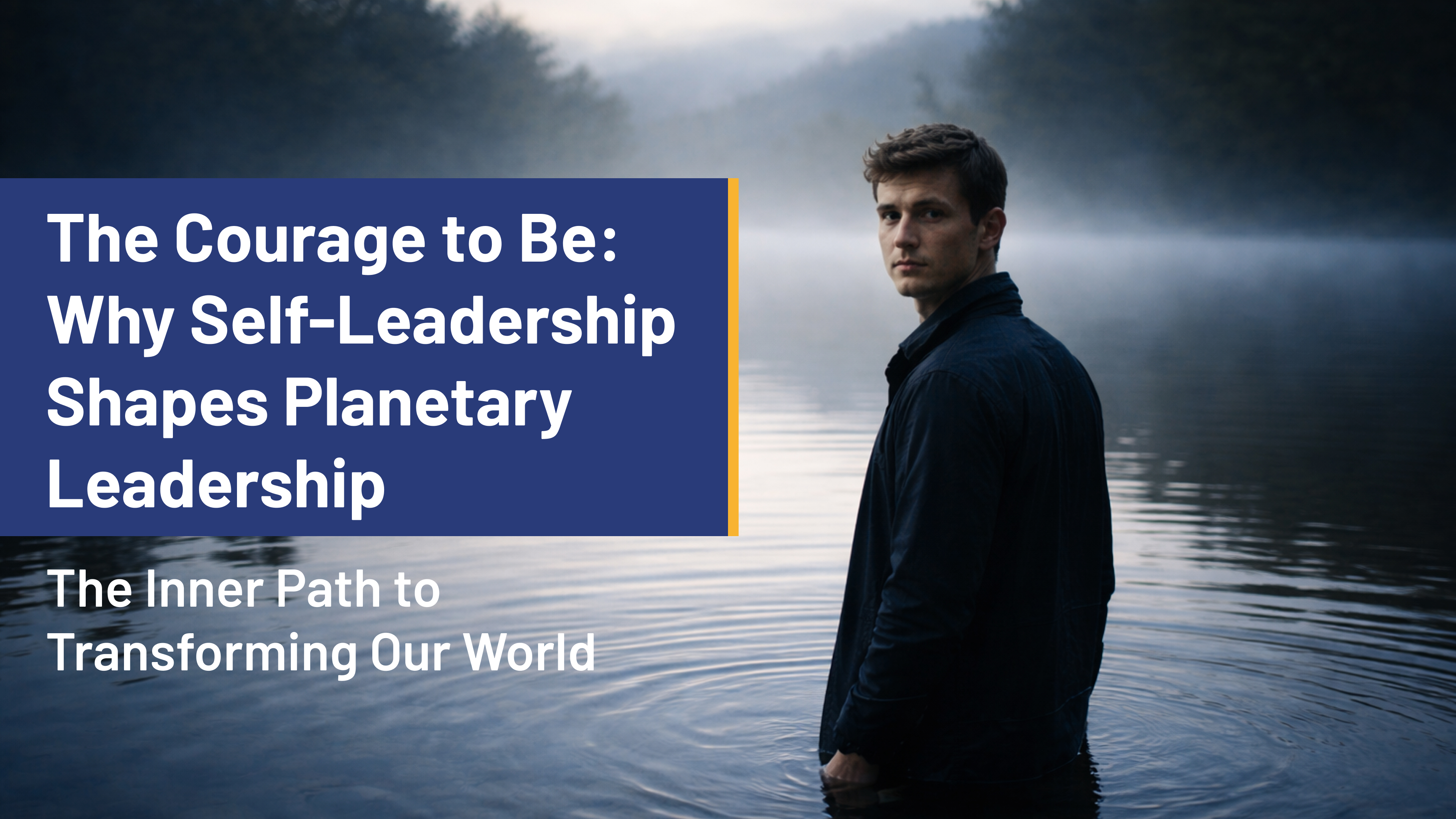
The Courage to Be: Why Self-Leadership Shapes Planetary Leadership
The Inner Path to Transforming Our World
This article argues that true leadership is not a title or role but an ontological practice grounded in self-leadership. It explores how personal ontology, the underlying dispositions and Ways of Being that shape how individuals perceive, choose and act, forms the foundation for authentic and courageous leadership in a rapidly destabilising world. Drawing on the Being Framework, the article shows how self-awareness, vulnerability, responsibility and authenticity influence not only personal behaviour but the cultural and systemic environments we co-create.
Using metaphors such as Roosevelt’s “man in the arena”, the article highlights how leaders’ internal states ripple outward into teams, organisations and societies. It outlines the practical Ways of Being that cultivate self-trust and ethical action, emphasising that courageous self-leadership is essential for addressing planetary crises such as climate change, inequality and social fragmentation. The article concludes that the future requires leaders who embody ontological maturity, recognising interdependence and showing up with presence, integrity and courage. Only through this shift in Being can genuine collective transformation occur.
1,213Jan 15, 2026210 mins1,294 words