

About this Series
This article is part of a six-part series exploring why many inclusion, leadership, and transformation efforts stall despite good intent and significant investment. Working beneath behaviour and policy, the series examines how identity-level pressure quietly shapes who feels able to belong, lead, and contribute without adaptation. Across gender, age, culture, and place, it traces how legitimacy becomes conditional, how identity load accumulates, and why organisations often misread these signals as performance, engagement, or capability problems rather than systemic strain.
From “Good Girl” to “Good” at Work
Many women learn early that being a “good girl” is a relational achievement.
It means being perceptive. Helpful. Attuned. Emotionally aware. It means reading the room, anticipating needs, smoothing tension, and maintaining connection. These behaviours are rarely named as labour. They are framed as character. As niceness. As maturity.
These are not weaknesses. They are sophisticated relational skills.
Modern organisations now reward these same qualities as leadership readiness. Emotional intelligence. Stakeholder management. Presence under pressure. Collaboration. Reliability.
The translation from “good girl” to “good” at work happens so seamlessly that it is rarely noticed. What began as early social conditioning becomes professional legitimacy. What once helped a girl stay safe becomes what helps a woman succeed.
The problem is not that women bring these capacities to work. It is that organisations have come to rely on them without naming what they are or accounting for what they cost. What is experienced internally as ongoing self-regulation is read externally as strength. What is sustained through adaptation is treated as an inherent capability. Over time, this misreading matters as it may shape who is seen as reliable or how leadership capacity is assessed. These kinds of effort remain invisible because the system has learned to depend on them quietly. This article examines how reliability comes to function as an identity-level leadership adaptation, which may be mistaken for strength. We will analyse how that notion carries consequences for both women and the systems that depend on them.
Why This Is Not About Confidence
When women struggle or burn out in senior roles, the default explanation often centres on confidence: Speak up more. Be bolder. Take up the space. This framing is seductive because it individualises the problem. It suggests that if women simply adjusted their mindset, the system would work. But confidence is rarely the issue.
What women are managing is not self-belief. It is a risk. Risk of being seen as too much. Too emotional. Too direct. Too demanding. Too soft. Too hard. Too visible. Too quiet.
Decades of research on gender and leadership show that women operate within a narrower margin for error. Studies consistently demonstrate that behaviour read as decisive in men is more likely to be interpreted as abrasive or unlikable in women. Warmth and competence remain in tension in ways men are rarely required to navigate simultaneously. Under these conditions, adaptation is not a weakness. It is logical.
The Hidden Burnout Beneath Performance
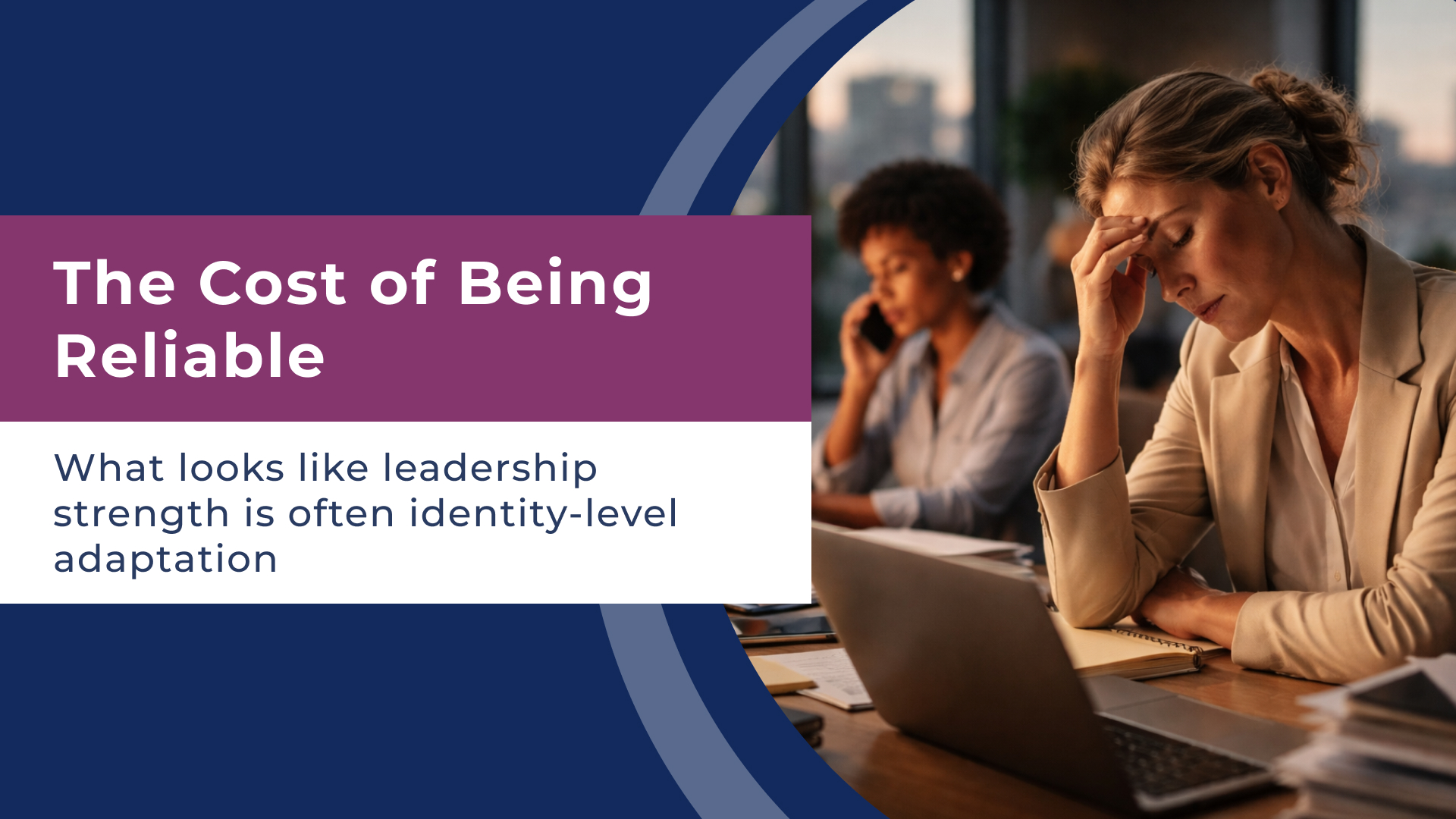
Large-scale workforce studies consistently show that women report higher levels of chronic exhaustion and burnout than men, even when working similar hours and holding comparable seniority. This pattern persists in organisations that are publicly committed to inclusion, wellbeing, and psychological safety. Burnout, in these cases, is often misdiagnosed. It is treated as a resilience issue. A workload issue. A personal sustainability issue. What is less often named is the identity load beneath it.
When people must continuously monitor how they are perceived in order to remain credible, effort shifts from contribution to regulation. The work still gets done. Performance often remains high. But the human system is operating with far less margin than it appears. Research on emotional labour has long shown that managing feelings, both one’s own and those of others, carries a cognitive and physiological cost. When this labour is invisible or expected, it compounds quietly. What looks like leadership stamina from the outside can feel like constant vigilance from the inside.
Reliability as a Gendered Leadership Tax
Reliability is one of the most prized traits in modern organisations. The reliable leader delivers. She follows through. She absorbs complexity. She does not escalate unnecessarily. She keeps things moving. She is trusted. But reliability becomes a tax when it is unevenly distributed.
Women leaders are disproportionately expected to carry the invisible work that keeps organisations functional. This often includes holding emotional residue after conflict so teams can move on, mentoring without mandate or recognition, translating between personalities, functions, and power levels, noticing early signs of disengagement before they appear in data, and stabilising teams during uncertainty without being named as doing so.
This labour is rarely captured in role descriptions, performance frameworks, or succession plans. It is treated as personality rather than contribution. As a disposition rather than work. Yet organisations quietly depend on it. When reliability becomes gendered, leadership capacity is subsidised by unrecognised effort. The system appears efficient, but only because someone is absorbing what it cannot yet hold.
The Organisational Cost of Not Seeing This
From an organisational perspective, this pattern is easy to miss. The woman who is coping does not look like a risk. She looks like a solution.
Performance metrics remain strong. Engagement surveys rarely surface the issue. Attrition, when it comes, often arrives late and with little warning. What leaks first is not output. It is future capacity.
When leadership strength is sustained through identity-level adaptation, organisations quietly narrow their options. Innovation slows because disagreement is softened rather than surfaced. Decision-making becomes cautious because relational risk is being managed downstream. Succession pipelines thin as high-capability women step back, step sideways, or step out.
The organisation feels stable. Underneath, it is becoming brittle.
Why Women’s Networks Help and Why They Are Not Enough
Women’s networks and professional circles exist for good reason. They provide language, validation, and solidarity in systems that often fail to offer those things. They help women survive environments that quietly demand adaptation. What they rarely do is change the conditions that make survival necessary.
When support sits primarily outside the system, organisations can mistake resilience for resolution. Women are buffered, coached, and encouraged, while the structures that rely on their invisible labour remain intact.
Networks should be bridges, not lifeboats. Until organisations take responsibility for the costs they quietly externalise, women will continue to adapt, connect, and compensate around systems that remain fundamentally unchanged.
Why This Reframe Is No Longer Optional
This is not a gentle adjustment. It is a structural reckoning. History shows that systems rarely fail because of what they confront openly. They fail because of what they quietly offload onto those most capable of carrying it. Reliability can look like strength right up until it masks fragility.
The question is not whether organisations can continue to rely on this invisible labour. It is how long they can afford to do so without mistaking endurance for sustainability. Seeing this clearly is not alarmist. It is responsible.
And responsibility, in leadership, is often the difference between continuity and collapse.