
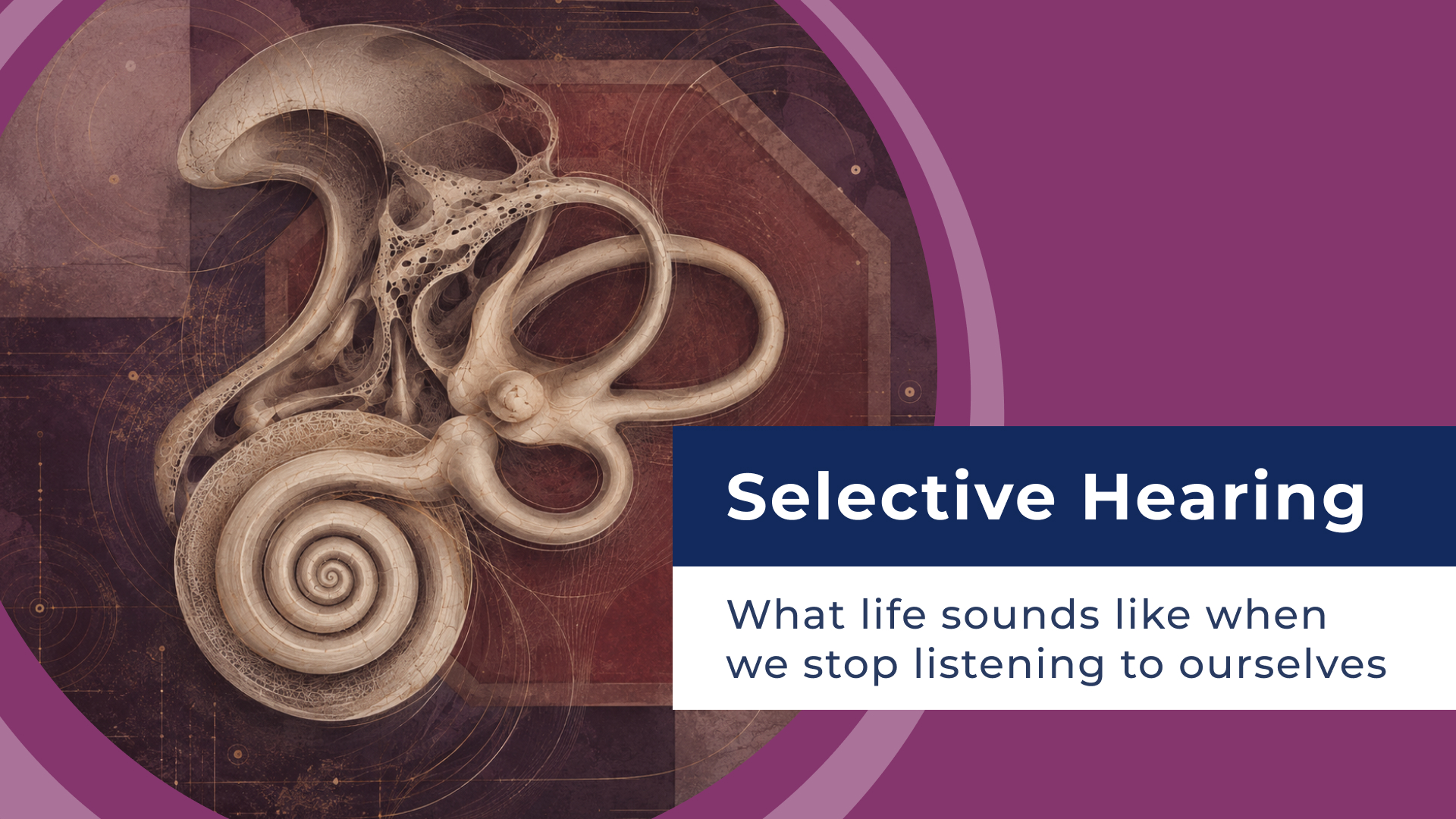

Most of us are remarkably good at selective hearing.
Before you read any further, listen. What are five things you can hear right now? Maybe there is traffic outside, the hum of an appliance, a dog barking somewhere down the road, music in another room, your own breathing. Maybe you can hear rain, birds, voices, a clock or the almost imperceptible electronic hum of whatever device you are reading this on. Don’t go looking for anything profound. Just notice what is already there.
Now listen again. What did you hear the second time that you missed the first? Nothing new necessarily happened. The refrigerator did not suddenly begin humming because you paid attention to it. The bird did not arrive for the exercise. The sounds were already there. What changed was your attention. I have started wondering how much of our lives work like that. What if the thing you most need to hear has already been said? Not by your partner, your boss, your therapist or the latest podcast in your queue. By you. Perhaps it was the hesitation before you said yes. The sudden envy of somebody living a life you have never admitted you wanted. The tiredness that sleep doesn’t seem to fix. The idea you keep returning to. Or the barely perceptible change in your own voice when you say, I’m fine.
There are moments in life when something suddenly becomes clear. A relationship ends and, somewhere beneath the shock, you think: I knew. You finally resign from the job you have been talking yourself into enjoying for the past three years and feel an almost indecent sense of relief. A friend asks one perfectly ordinary question over coffee and, inexplicably, you burst into tears. We tend to remember these as moments of revelation. The penny dropped. The fog lifted. We finally saw what had been staring us in the face. But perhaps revelation is not always the arrival of new information. Sometimes it is simply the moment something that was there all along finally receives our attention.
So here is the question I want to explore: What else might you already be hearing?
I have been watching Girlfriends’ Guide to Divorce, a sort of Sex and the City meets Desperate Housewives mash-up populated by beautiful women with complicated careers, complicated children, complicated ex-husbands, complicated sex lives and apparently limitless access to very good shoes. At various points, one of them inevitably loses it. It is easy to see why. She has taken on too much. She is juggling work, children, friendships, relationships, expectations, commitments and everybody else’s feelings until something finally gives.
We know the diagnosis. She needs boundaries. She needs to delegate. She needs some time for herself. Perhaps magnesium. But watching one of these women unravel recently, another possibility occurred to me. What if she had been losing something long before she lost it? What if she had gradually lost the ability to hear herself?
Many of us become remarkably good at reading other people. We can walk into a meeting and sense tension before anyone speaks. We know when our child is not quite themselves. We notice the expression that crosses our partner’s face. We adjust the presentation when the room isn’t with us, soften the email, remember the birthday and anticipate the objection. We call much of this emotional intelligence, and often it is. But what do you call it if you’re able to read everyone in the room except yourself?
We don’t stop hearing ourselves accidentally. We learn what not to hear. I learned not to hear certain things because hearing them complicated my life. Hearing myself might have required disappointing you. It might have threatened my marriage, made me a difficult daughter, meant declining the opportunity everyone thought I should want, exposed how lonely I was, or required changing something I wasn’t yet ready to change. So I turned down the volume. After a while, there seemed to be nothing left to hear. Eventually, I forgot I was the one who had turned it down.
Maybe we haven’t stopped hearing ourselves at all. We have simply become very good at drowning ourselves out. We drown discomfort in reason, preference in obligation, doubt in competence, loneliness in company and boredom in stimulation. Then, just to be safe, we fill the remaining acoustic space with other people’s voices.
The noise helps
Fortunately, modern life is extraordinarily helpful if you would prefer not to hear yourself. We wake to our phones, listen to podcasts while walking, check messages while waiting, work while flying, play audiobooks while driving, stream television while eating and scroll before sleeping. Apparently even unconsciousness is now insufficiently stimulating. We have white noise, brown noise, pink noise, rain noise, ocean noise, sleep stories, binaural beats, meditation tracks and focus playlists. There are apps designed to provide the perfect soundtrack for doing absolutely nothing.
Some of this is useful, enjoyable or genuinely soothing. Sound has long been used to comfort, regulate, celebrate, communicate and heal. Our current fascination with sound baths, singing bowls, guided meditations and sleep soundscapes is hardly inexplicable. But I do wonder whether all that noise sometimes performs another function. We are becoming remarkably sophisticated at using sound to change how we feel. Occasionally we might also ask what we would hear if we allowed ourselves to feel how we feel.
Silence, after all, has an occupational hazard: you might hear something. We talk a great deal about distraction and what our technologies are doing to our attention. Johann Hari explores this powerfully in Stolen Focus. But we are not merely passive victims of noise. Sometimes we may be enthusiastic collaborators, because noise can also be protective. Underneath the podcast, playlist, meeting and next episode, something inconvenient might be saying: I’m tired. I miss her. I don’t want to go. I want more. I don’t know.
Shhh. Alexa is playing thunderstorms.
There should be an app for that
Our phones can now tell us an extraordinary amount about ourselves. They know how many steps we have taken, how long we slept, where we have been, what appointments are coming, what music we like and, depending on access, a lot more. Imagine an app connected not just to our bodies, but to the parts of ourselves we have become skilled at overriding. An Inner Translator if you will.
The meeting is cancelled and an enormous wave of relief arrives. Translation: I didn’t want to go. You feel inexplicably envious listening to a friend describe her new life. Translation: There may be something over there that I want. Sunday afternoon brings its familiar heaviness. Translation: Something about Monday isn’t working. You snap at someone over something ridiculously small. Translation: Something may be asking too much of me.
None of these translations comes with guaranteed accuracy. Bodies are not infallible oracles, and every uncomfortable sensation is not a message from the universe. But they might be worth listening to. When we become unwilling to use certain words, we simply invent new ones: tension, exhaustion, restlessness, irritability, boredom, relief. The body keeps talking even when we have become reluctant listeners.
Sometimes we even take this new language to someone else to translate. A doctor. Therapist. Acupuncturist. Naturopath. Coach. We tell them we’re tired, not sleeping properly, our stomach is playing up, we can’t concentrate or we just don’t feel like ourselves. Then they ask how things are. Good, of course. Just busy. It’s been a big year. I’ve got a lot on. Things are a little complicated. I’m navigating a transition. We can become remarkably eloquent in the language of saying nothing.
Yet life does not only tell us when something is wrong. There are other sounds too: the laugh that comes from somewhere deeper when we are with a particular friend, the conversation we don’t want to end, the excitement in our voice when we talk about an idea we care about, the song we suddenly want to turn up, the sigh when the house finally becomes ours for an afternoon. A life has a sound before it has an explanation. Sometimes the question is not only what makes us quieter, but what makes us come alive.
Seven days to reconnect
Eventually, of course, we may decide we need to reconnect with ourselves, so we go somewhere. Preferably somewhere warm. Maybe Bali. The phone is surrendered. The linen is flowing. There is organic food, sunrise yoga, meditation, breathwork, massage, silent breakfasts and a sound bath scheduled for four. Finally, there is space to listen inward.
Unfortunately, the People Pleaser came too. So did the Responsible One and the High Performer. They are all wearing linen now. The High Performer wants to be good at meditation. The People Pleaser doesn’t tell the masseuse the pressure is too hard. The Responsible One checks whether everybody has a cushion. The emotionally intelligent woman notices the retreat facilitator seems tired. By Wednesday she is quietly concerned she isn’t surrendering properly.
Seven days later she flies home feeling rested, restored and reconnected, then opens the laptop. Changing the setting does not necessarily change who is inhabiting it. A retreat can be quiet without producing silence, just as a life can be noisy while something inside us remains perfectly audible. We can turn down the external volume without listening to what remains. That is why connection can be so uncomfortable. Hearing creates consequences. Not necessarily the consequence of having to do something, but something subtler. Once I have really heard something, it becomes considerably harder to claim that I don’t know it.
The sound of silence
There is a beautiful paradox in the phrase the sound of silence. Simon & Garfunkel made it famous, but its enduring appeal lies partly in the contradiction. Silence is not necessarily nothingness. It may be the condition in which subtler things finally become audible. Of course, listening to ourselves presents another problem: there is rarely only one voice in there. Fear has a voice. So does ego. Habit, obligation, desire, insecurity, intuition and the voices of people who may not have been in the room for decades all seem perfectly capable of getting hold of the microphone. Silence does not magically reveal one pure, infallible inner truth.
It is why listening requires discernment rather than obedience. The task is not to believe everything we hear, but to become familiar enough with our own inner language to recognise its different voices. Which one gets louder when I am frightened? Which one reliably tells me what everybody else needs? Which one says don’t be ridiculous whenever I want something? And which quieter signals keep returning, even after I have explained them away?
True silence, then, is not selective hearing. It does not turn up the pleasant parts and mute the inconvenient ones. It gives us a chance to hear the whole conversation. Silence is less the absence of sound than the absence of interference. Selective hearing, by contrast, can be extraordinarily noisy. It requires explanation, justification, rationalisation and distraction. We turn some things up and others down. We tell ourselves what we should be feeling, what ought to matter, what we should be grateful for and what would be unreasonable to want.
Silence asks something different. It does not require us to believe every thought or obey every feeling. It simply removes, for a moment, the need to control the mix. What remains may be uncomfortable: I don’t like this. I’m angry. I’m hurt. But we might equally hear curiosity, pleasure, longing, laughter and creativity; or the barely perceptible sense that something makes us feel more alive. Silence is not where life stops speaking. It is where we stop deciding which parts we are prepared to hear.
Écoutez
When I was learning French, my teacher would repeatedly say, Écoutez. Listen. Use your ears. It sounds ridiculously obvious. How else does one learn a language? But she was teaching us something more subtle than vocabulary. You had to hear differences between sounds that initially seemed identical, notice cadence and attend to what was actually being said rather than what you expected to hear.
Decades later, I find myself thinking about that instruction differently. You cannot become fluent in a language you don’t listen to, and fluency depends partly on the ability to hear distinctions. The same is true of ourselves. Many of us have become remarkably fluent in the languages of work, family, relationships, responsibility and other people’s needs while remaining surprisingly rudimentary in our own.
Listening does not mean obeying. I can acknowledge that I am unhappy in my marriage without filing for divorce tomorrow. I can admit I don’t like my job without resigning. I can recognise that I am lonely without immediately finding a partner, or that I want more without yet knowing what more means. I can notice jealousy without deciding somebody else has something that should be mine. I can even say I don’t know without rushing to manufacture an answer. Listening gives us information. Discernment determines what we do with it.
One of the simplest pieces of information we have learned to discount is preference. Do I like this? Not: Is this objectively good? Should I be grateful? Would somebody else love to have this opportunity? Can I cope with it? Am I good at it? Just: Do I like it? Preference is information. So are limits, desire, discomfort and truth. None of them is automatically an instruction.
What did you hear?
Think again about that moment from the beginning. The thing you eventually knew. The relationship, job, decision, longing or truth that finally became impossible not to know. When did you first hear it? Was it your body telling you? Your irritation or maybe envy? Was it hiding in the extraordinary happiness you felt every time someone cancelled? Maybe you had been hearing it for years.
I learned not to hear certain things because hearing them complicated my life. Eventually, I became so good at selective listening that I mistook the silence for not knowing. This is how selective living happens: not through one enormous decision to abandon ourselves, but through thousands of tiny moments in which we give some parts of our experience our attention and quietly mute others. Until one day something gets loud enough.
We call it a revelation. Maybe it is. Or perhaps we have finally become willing to hear what was there all along. Reconnection does not necessarily require a retreat, a dramatic life change or another project devoted to becoming a better version of ourselves. It might begin with allowing something to be true without immediately correcting it: I don’t like this. I want that. I’m tired. I’m lonely. I don’t know. Can I become safe enough in my own life to hear the truth without immediately having to do anything about it?
Écoutez. Use your ears. I think I better understand what my teacher meant.
What will you listen for now? What will you selectively choose not to hear?
Dr Jordan Marijana Alexander is a writer, executive advisor and human systems strategist exploring how identity, place, culture and living systems shape participation in the modern world. She works alongside leaders, boards and organisations navigating complex questions of leadership, change and participation, and is the co-founder of RelateAble.Global. If this article has raised questions, sparked reflection or highlighted a decision you’re carrying, you’re invited to book a confidential conversation. You can follow DrJMA on LinkedIn and Engenesis for ongoing essays, reflections and research exploring leadership, identity, belonging and participation.