
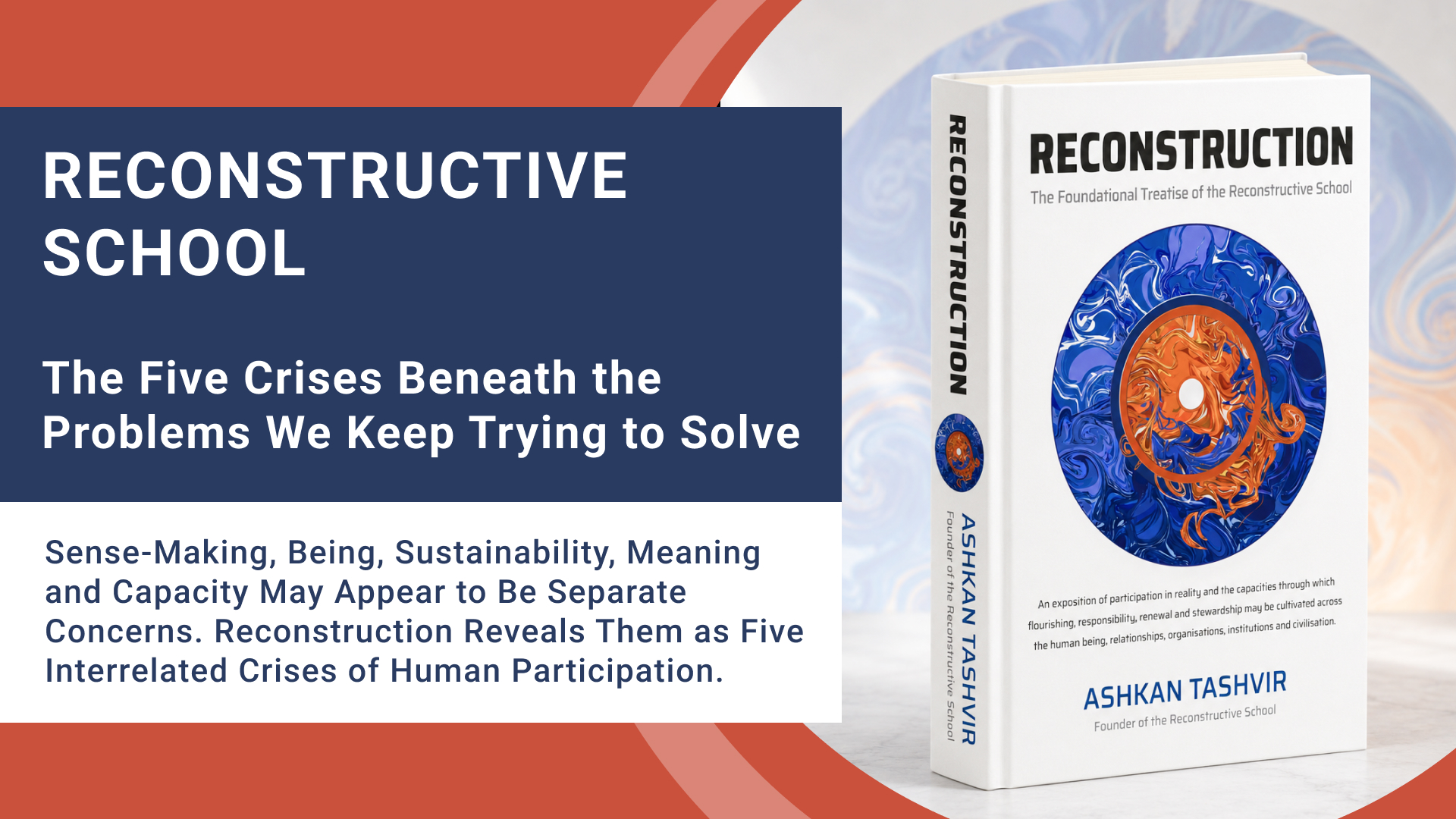

Why Reconstructive School Is Needed
We live in an age with an extraordinary capacity to intervene. We can gather information, modify behaviour, optimise organisations, redesign institutions, scale technologies and alter the conditions of human life. Yet our growing power to intervene has not necessarily strengthened our ability to discern what should be changed, what deserves to be preserved or what human beings must become capable of holding. Movement can easily be mistaken for progress. We have learned to alter the world faster than we have learned to participate responsibly in what our alterations produce.
Human difficulties have also been divided among increasingly specialised fields. Psychology examines the individual. Management studies organisations. Economics attends to incentives and resources. Politics concentrates on institutions and power. Sustainability considers continuity and consequence. Philosophy and spirituality ask questions of meaning, truth and human flourishing. Each perspective can reveal something important, but human beings do not experience their lives in neatly separated domains.
A breakdown in leadership may involve confused sense-making, an incongruent way of being, unsustainable organisational conditions, a loss of meaning and responsibilities that exceed present capacity at the same time. When these dimensions are treated separately, responses become fragmented. We provide more information to someone who cannot adequately interpret what is happening. We teach new behaviours without developing the way of being required to embody them under pressure. We introduce another productivity method into an already depleting system. We offer a new goal to someone who has lost contact with meaning. We encourage greater effort where the real limitation is capacity.
Any of these interventions may help, but they can also misidentify the structure of the problem. A visible symptom is addressed while the conditions producing it remain intact. The difficulty then returns, changes form or appears elsewhere in the individual or system.
The need for Reconstruction arises at this point. Before choosing another solution, method or model, a more fundamental question must be asked: what does it mean for human beings to participate in reality and what makes that participation more or less adequate?
The Reconstructive School begins from the recognition that human beings enter a world already underway. We receive languages, relationships, cultures, institutions, histories and material conditions that we did not choose. These inherited conditions shape us without completely determining what we become. Through how we perceive, make sense, choose, act and bear consequences, we participate in what those conditions become next.
A reconstructive approach therefore begins with actuality. It encounters what is present, investigates how it came to be and discerns what remains worth preserving, what no longer deserves to continue and what possibilities have not yet been realised. Reconstruction also asks what capacities individuals and systems must develop to participate responsibly in bringing those possibilities into existence. It is neither passive acceptance of inheritance nor the fantasy of constructing reality from a blank slate. It is responsible participation from within a reality that precedes us, exceeds us and is nevertheless altered through our participation.
This starting point distinguishes the Reconstructive School. Questions usually separated across different disciplines are brought into one philosophical architecture because they belong to the same prior question of participation. The five crises and five corresponding bodies of response emerge from this foundation. They reveal where human participation becomes obstructed and what must be understood, developed or reconstructed for a different future to become possible.
Although the Reconstructive School is new in its formal articulation, it has not appeared suddenly. It consolidates more than a decade of philosophical inquiry, published works, instruments, methodologies and practical application. Several of its bodies of response have already been substantially developed through Metacontent, the Being Framework and the work on authentic sustainability. Others, particularly Capacity and Minalogy, are still being elaborated and will be presented in greater detail in forthcoming works. Reconstruction serves as the School’s foundational treatise and overarching architecture: it brings these bodies of work into relation, establishes the account of participation from which they arise and clarifies how each responds to one of the five crises. The School is therefore being formally named now, but the work from which it is constituted has been developed, tested and refined piece by piece for more than a decade.
Problems That Look Separate
Many of the difficulties people face announce themselves as separate problems. We may struggle to make sense of growing complexity, conflicting information and rapidly changing circumstances. We may find it difficult to relate to what we encounter, act on what we know and participate meaningfully in life. A gap can emerge between what we understand, what we say matters and how we actually show up when pressure arrives.
We may produce results while becoming depleted, inconsistent or trapped in cycles of firefighting and burnout. We may pursue shortcuts and quick fixes that promise relief but do not work or cannot sustain themselves. We may remain active and informed yet feel confused about how to discover or form meaning from what we understand and how we participate. Or we may simply feel that we have too much on our plates, with the complexity, responsibility and demands before us overwhelming our available capacity.
These experiences may be felt as disorientation, incongruence, depletion, emptiness and overwhelm. These are only some of the many ways in which the underlying crises may manifest, and are used here as a select set of examples. In this article, the focus is on these select examples for illustrative purposes rather than as a comprehensive account. Each of these experiences tend to be located in a different part of life. Disorientation is treated as an information problem. Incongruence appears to be a behavioural or moral problem. Depletion becomes a performance or wellbeing problem. Emptiness is addressed as a problem of motivation. Overwhelm is framed as a problem of workload, effort or time management.
Those descriptions may sometimes be adequate. Not every difficulty has the same origin and no serious philosophy should reduce the complexity of human life to five convenient categories. At times, however, apparently separate struggles reveal deeper and recurring structures. What appears to be an information problem may involve sense-making. What looks like a failure to act may involve Being. What presents as inconsistent performance or burnout may involve sustainability. What appears to be lost motivation may involve meaning. What looks like insufficient effort or poor time management may involve capacity.
Reconstruction proposes that many familiar difficulties are shaped by five recurring crises in human participation: the Crises of Sense-Making, Being, Sustainability, Meaning and Capacity. These crises do not merely give new names to familiar symptoms. Each identifies a distinct way in which human participation can become obstructed, opens a territory of inquiry and calls for a corresponding body of response.
Participation in a World Already Underway
None of us begins with a blank page. We enter a world already shaped by languages, families, cultures, institutions, beliefs, technologies and systems. We inherit ways of working, leading, relating and living, along with assumptions about what is normal, possible, desirable and worth preserving.
One possible response is to live within that inheritance without examining it closely. We accept the conditions, reproduce established patterns and adapt ourselves to the world as it already exists. Another response imagines that we can stand outside our inheritance altogether and construct reality from scratch according to our own ideas, preferences and intentions.
Reconstruction begins from participation rather than choosing between those positions. Human beings are shaped by what they inherit, but inheritance never accounts for the whole of their participation. We also lack the sovereignty required to construct reality however we choose.
We encounter what has already been formed, perceive and interpret it, preserve parts of it, question parts of it and help shape what follows. We are neither completely determined by the world nor standing outside it. Our lives are not simply happening around us. We participate in their formation.
The relevant question, then, concerns the quality of that participation. How consciously, responsibly and fully do we meet what is already in front of us? The five crises identify recurring ways in which this participation becomes obstructed, fragmented or inadequate.
The following sections use recognisable experiences as entry points into the five crises, not as exhaustive definitions of them. Disorientation, incongruence, depletion, emptiness and overwhelm may reveal the Crises of Sense-Making, Being, Sustainability, Meaning and Capacity respectively. These manifestations are neither exhaustive nor exclusive: each crisis can appear in other forms, several crises may produce overlapping experiences and a crisis may already be operating before its effects become visible.
Five Recurring Crises in Human Participation
The experiences introduced below are recognisable manifestations of the five crises, not exhaustive definitions of them. Disorientation may reveal a Crisis of Sense-Making, incongruence a Crisis of Being, depletion a Crisis of Sustainability, emptiness a Crisis of Meaning and overwhelm a Crisis of Capacity. Each crisis, however, can manifest in other ways and may already be operating before the named experience becomes visible. The five crises identify deeper structures through which human participation can become obstructed, fragmented or inadequate.
The Crisis of Sense-Making
The Crisis of Sense-Making may be experienced through disorientation, but it is not limited to confusion or uncertainty. It can also appear through fragmentation, interpretive rigidity, false coherence or misplaced certainty. A person or system may feel well oriented while relying on an account of reality that is partial, distorted or no longer adequate to what is actually present.
We have access to more information than any previous generation, but an abundance of information does not necessarily produce understanding. Facts arrive without context. Interpretations compete for our allegiance. Different communities inhabit different accounts of the same events. Even accurate information can fail to provide orientation when we do not know how the parts relate, what deserves attention or what kind of situation we are facing.
Consider a leadership team confronting a sudden decline in performance. The team may collect more data, commission another report or ask for additional dashboards. If its members continue interpreting the evidence through an inadequate account of the problem, more information can reinforce the confusion rather than resolve it. They may disagree about solutions before they have adequately established what is happening. Alternatively, they may reach agreement too quickly because an inherited interpretation has prevented important possibilities from becoming visible.
When the crisis is experienced as disorientation, the difficulty is not always a shortage of facts. It may arise from an inability to determine what different signals mean, how competing interpretations should be evaluated or how the parts belong together. In other cases, the crisis may remain concealed by confidence, consensus or an apparently coherent explanation that fails to correspond adequately with reality.
The Crisis of Sense-Making asks how reality becomes intelligible enough for individuals and systems to orient themselves and participate meaningfully. It concerns the adequacy of the processes, distinctions and interpretive structures through which understanding is formed, not merely whether someone possesses enough information.
Metacontent and the Nested Theory of Sense-Making provide the corresponding reconstructive response. They examine the layers through which human beings perceive, interpret, organise and communicate what they encounter. In practice, such a response may begin by distinguishing observation from interpretation, identifying the inherited frames organising the available information and testing whether the resulting account remains adequate to what is actually present. The aim is not a final view from nowhere, but more responsible participation in how understanding is formed.
The Crisis of Being
The Crisis of Being may become visible through incongruence, but it is not reducible to a gap between what someone knows and how they behave. It concerns what is genuinely available to a person in how they perceive, relate, choose, act and participate. It asks whether the aspects of Being required by a situation have been developed, whether they remain available under pressure and whether they can be expressed with sufficient stability and coherence under real conditions.
Human beings can know a great deal without having that knowledge available in their conduct. We may understand our values, explain what good leadership requires and describe how we intend to behave. Under ordinary conditions, our account of ourselves can appear coherent. Pressure often reveals what that account leaves out.
A leader may sincerely value openness and invite disagreement, then become defensive when a colleague challenges a decision carrying personal or reputational stakes. The leader does not necessarily need another lesson about listening. The difficulty lies in the gap between what is intellectually understood and what remains available in the leader’s way of Being when the situation becomes demanding.
Fear, ambition, uncertainty, exhaustion or conflict can expose similar gaps. Knowledge, declarations and conduct cease to hold together. Incongruence names this separation without assuming that it is always deliberate or hypocritical. It is one recognisable manifestation of the Crisis of Being, but not its only form.
A person may behave consistently and still lack the presence, responsibility, care, courage, integrity or other aspects of Being that a situation requires. The crisis may appear through instability, withdrawal, reactivity, disconnection or the absence of capacities for relating and participating that have not yet been sufficiently developed. What matters is not only whether conduct matches a stated value, but whether an adequate way of Being is genuinely available.
The Crisis of Being therefore asks what becomes possible or impossible through the way a person is Being. The Being Framework™ provides the corresponding reconstructive response through an ontological account of the aspects of Being that enable participation. A reconstructive response does not merely correct visible behaviour. It examines what was absent, unstable or unavailable, then asks what would need to be developed, practised and stabilised for a different form of participation to become possible under real conditions.
The Crisis of Sustainability
The Crisis of Sustainability may eventually become visible through depletion, but it can already be operating before exhaustion or breakdown occurs. It may appear through fragility, inconsistency, displaced costs, deferred consequences, dependence on exceptional effort or the gradual erosion of the conditions supporting an outcome. A process can look successful in the present while consuming the foundations of its future.
Effectiveness can therefore conceal unsustainability. An individual or organisation may produce an impressive outcome without being able to produce it consistently or without damaging the conditions that make it possible. Results may depend on urgency, heroic effort, constant intervention or the exhaustion of a few responsible people.
Imagine a team that repeatedly meets its deadlines because people work late, senior leaders intervene at the last moment and unresolved problems are pushed into the next cycle. From the outside, the team appears effective. Internally, it moves from one emergency to another. The same problems return, shortcuts are sought where no genuine shortcut exists and periods of intense output are followed by fatigue, failure or recovery.
Depletion describes what happens when an outcome is produced by consuming the people, relationships, resources or systems upon which that outcome depends. A business can grow while becoming increasingly fragile. A leader can remain productive while approaching burnout. A society can preserve a standard of living while eroding its social or ecological foundations.
Yet depletion is only one manifestation of the crisis. Unsustainability may remain hidden because its costs have been delayed, transferred to others or absorbed by systems that have not yet visibly failed. A process may continue for a considerable period while losing its capacity for renewal, stewardship and adaptation.
The Crisis of Sustainability examines whether an outcome can continue to be produced without exhausting, degrading or destroying the conditions that sustain it. The Authentic Sustainability Framework, articulated through Sustainabilism, expands the inquiry beyond continuity alone. It asks whether the process, the outcome and the conditions upon which both depend can remain viable together over time.
In practice, a reconstructive response traces the full pattern through which effectiveness is being achieved. Hidden dependence on overtime, individual heroics, displaced costs, unrenewed resources and deferred consequences must become visible. The work then shifts from restoring performance after each breakdown to reconstructing the conditions and processes that repeatedly generate it.
The Crisis of Meaning
The Crisis of Meaning may be experienced through emptiness, but it is not limited to the absence of meaning. Meaning can become thin, inherited, fabricated, distorted or disconnected from the activities it is meant to orient. A person may also devote themselves to a shade of meaning: something that carries the appearance or emotional force of significance while distracting them from what is genuinely meaningful and consequential.
A life can contain increasing activity while becoming progressively thinner in meaning. We may continue doing what once mattered after losing contact with why it mattered. Goals inherited from family, profession, culture or a former self can remain in place long after their significance has faded. In other cases, the meaning may not have disappeared, but may never have been adequately examined, discovered or formed in the first place.
A founder, for example, may spend years building a company around a commitment that once felt deeply meaningful. As the organisation grows, the work becomes dominated by targets, administration and obligation. Success continues, but the founder no longer experiences a living relationship with what the enterprise was meant to serve. The original meaning survives as a story told to others while becoming less available in the founder’s own participation.
Emptiness does not always appear as despair. It may be experienced as flatness, indifference or a quiet hollowness beneath an otherwise functional life. Activity, progress and achievement remain, but the significance capable of orienting them has weakened. Yet the crisis may also appear through intense motivation directed towards something insignificant, inherited or fundamentally distracting. A person can feel purposeful while participating in a pattern that lacks genuine significance.
The Crisis of Meaning therefore asks more than whether meaning is present. It asks how something comes to matter, whether its significance is genuine, how meaning is discovered or formed and whether it can adequately inform direction and participation.
Minalogy provides the corresponding body of reconstructive work. It examines meaning as something to be discovered and formed, then carried into vision, mission, intention and action. Meaning added retrospectively to an already empty pattern of activity is unlikely to restore genuine participation. Equally, activity organised around an unexamined or shaded meaning may intensify commitment without improving direction. The relationship between significance and action must be established early enough to shape what is pursued and how it is pursued.
Minalogy remains to be elaborated in its dedicated works. Its place within the Reconstructive School is already necessary, however, because activity can multiply while direction disappears, motivation can intensify around what does not genuinely matter and achievement can grow while significance recedes.
The Crisis of Capacity
The Crisis of Capacity may be experienced through overwhelm, but it is not limited to the conscious feeling of having too much to manage. It can also manifest through reactivity, avoidance, immobilisation, excessive control, premature simplification or the transfer of responsibility and consequence to others. An individual or system may deny or conceal overwhelm while their participation reveals that the demands before them exceed what they can adequately hold and enact.
Sometimes the demands before us exceed what we have developed the capacity to hold. Quantity may contribute to the problem, but having too much on one’s plate is only one form of excess. A situation may require us to hold competing truths, remain present under pressure, make consequential decisions with incomplete information, bear responsibility for others or continue participating without immediate resolution.
Consider a capable manager promoted into an executive role. The new position does not simply add more tasks. It introduces ambiguity, interdependence, longer-range consequences and responsibilities that cannot be resolved through the methods that produced success at the previous level. The executive may work longer, increase control or make decisions more quickly in an attempt to regain certainty. These responses can temporarily reduce discomfort while revealing that the demand has exceeded present capacity.
When experienced as overwhelm, complexity collapses into noise and pressure narrows what remains available to us. Individuals and systems may become reactive, avoidant, controlling or immobilised. In other cases, the crisis may be concealed through overconfidence, denial, reckless simplification or the displacement of consequences onto other people. Advice to try harder or manage time more efficiently may help at the edges without developing what the situation itself requires.
The Crisis of Capacity asks whether we can encounter what is present, hold its complexity, metabolise the demand, respond adequately, bear the consequences and stabilise what has been learned. Capacity is distinct from intelligence, skill, effort, confidence and potential. It becomes visible in what an individual or system can actually carry and enact under real conditions.
The reconstructive account of Capacity examines how capacity is revealed, challenged and expanded through participation. A practical response brings a person into contact with an appropriately demanding situation, requires ownership of their participation and provides support without removing consequence. Experience then becomes available for learning, refinement and eventual stabilisation. The dedicated elaboration of this work is planned to follow Reconstruction, with the trilogy expected in 2027.
Why the Crises of Sustainability and Capacity Must Be Distinguished
The Crises of Sustainability and Capacity can produce overlapping manifestations, including pressure, exhaustion, diminished performance, reactivity and breakdown. Depletion is commonly associated with sustainability and overwhelm with capacity, but neither symptom belongs exclusively to one crisis. An unsustainable system can overwhelm otherwise capable people, while insufficient capacity can produce fragile, inconsistent and depleting ways of working. The two crises may therefore interact or occur simultaneously, but their organising questions remain distinct.
Sustainability concerns the pattern and conditions through which an outcome is produced. An organisation may possess sufficient capacity to reach its objective while relying on a method that is fragile, inconsistent or depleting. Firefighting may repeatedly restore effectiveness without altering the unsustainable structure that continues generating emergencies. The central question is whether the process, the outcome and the conditions supporting both can remain viable together over time.
Capacity concerns whether an individual or system can adequately hold and respond to the demand itself. The complexity, responsibility, ambiguity or pressure involved may exceed what has been developed, even when the surrounding process is otherwise sustainable. The central question is whether the participants can encounter what is present, hold what the situation requires, respond adequately and bear the consequences of their participation.
The distinction matters in practice. Rest may be prescribed where capacity needs to be developed, leaving a person refreshed but no more able to meet the demand. Greater resilience or effort may be demanded where the operating structure itself is unsustainable, enabling the system to consume more from its participants without changing. A process may also need to be reconstructed at the same time as the capacities of its participants are developed.
The distinction is therefore not a separation. The two crises can intensify one another and may require coordinated responses. The Crisis of Sustainability asks whether the way an outcome is produced can continue without consuming its foundations. The Crisis of Capacity asks whether the participants have developed what the situation itself requires.
Five Bodies of Response, One Architecture
Reconstruction does not merely identify five crises. The Reconstructive School brings together five interconnected bodies of work that respond to them. Each body responds most directly to a distinct crisis while contributing to a larger account of human participation:
Metacontent responds to the Crisis of Sense-Making by examining the layers through which human beings perceive, interpret, organise and communicate what they encounter. It asks how an intelligible account of reality is formed and whether that account remains adequate to what is actually present.
The Being Framework™ responds to the Crisis of Being by examining what is genuinely available to us in how we show up, relate, choose, act and participate, particularly when circumstances become demanding. It identifies the aspects of Being that must be developed and stabilised for a different form of participation to become possible.
The Authentic Sustainability Framework responds to the Crisis of Sustainability by examining whether the process, the outcome and the conditions supporting both can remain viable together over time. It asks whether meaningful outcomes can be produced without eroding the people, relationships, resources and systems upon which they depend.
Minalogy responds to the Crisis of Meaning by examining how meaning is discovered and formed, then carried into vision, mission, intention and action. It asks whether significance is genuine and whether it can adequately orient what is pursued and how participation unfolds.
The reconstructive account of Capacity responds to the Crisis of Capacity by examining what individuals and systems must develop to encounter what is present, hold its complexity, metabolise its demands, respond adequately, bear consequences and stabilise what has been learned.
These are not five disconnected responses, nor are they five tools to be mechanically applied to five symptoms. Better sense-making does not guarantee a way of Being capable of acting upon what has been understood. A more developed way of Being cannot, by itself, make an unsustainable process viable. Something can be sustained without being meaningful, allowing a pattern to continue that no longer deserves to exist. Meaning may provide direction without providing the capacity required to enact or bear the responsibility it creates.
Capacity itself can also be developed in service of outcomes that should never have been pursued. Without adequate sense-making, it may increase the ability to act on a mistaken interpretation. Without an adequate way of Being, it may strengthen control, ambition or effectiveness without responsibility. Without sustainability, it may enable people to endure damaging conditions for longer. Without meaning, it may expand what can be accomplished without answering whether the accomplishment genuinely matters.
Each body of response therefore supports, deepens and constrains the others. Together they form one reconstructive architecture concerned with the conditions through which more conscious, responsible, meaningful and sustainable human participation becomes possible.
A School More Than a Decade in the Making
The Reconstructive School has not appeared suddenly or been constructed around a single book. Its formal articulation is new, but the work from which it has emerged has developed for years through philosophical inquiry, published works, instruments, methodologies and practical application.
Different parts of the work initially took shape through their own questions and domains. Their relationship became clearer over time. The five crises reveal why these inquiries belong together and why none is sufficient in isolation.
Reconstruction is the foundational treatise of this school. It establishes its first principles, brings the five crises and corresponding bodies of response into a shared architecture and provides the overarching philosophical account under which the wider work can be understood.
The book does not claim to provide the final elaboration of every part of the school. Three principal bodies have already been articulated and published: Metacontent, the Being Framework™ and the Authentic Sustainability Framework presented through Sustainabilism. The dedicated work on Capacity is planned for 2027, with Minalogy to be developed more fully thereafter.
Rather than replacing these bodies of work, Reconstruction reveals their relationship, establishes their common foundations and articulates the larger school of thought of which they are part.
Seeing the Problem Differently
Once the structure beneath a struggle becomes visible, the struggle begins to look different. An information problem may involve disorientation and the Crisis of Sense-Making. A failure of intention may expose incongruence and the Crisis of Being. A productivity problem may be depletion generated through the Crisis of Sustainability. A lack of motivation may be emptiness arising through the Crisis of Meaning. What appears to require greater effort may instead be overwhelm revealing the Crisis of Capacity.
Recognition does not automatically resolve any of these crises. It changes the quality of the questions we can ask, the territory in which we intervene and the responses that become available. Sometimes progress begins with another answer. At other times, it begins by seeing more adequately what kind of problem is actually in front of us.
In Summary
To recap, in simple terms, the reconstructive approach begins with a distinctive claim: human transformation is neither a matter of simply accepting or restoring the world we inherit nor freely constructing a preferred reality from scratch. We are participants in a world already underway. We receive conditions we did not choose, but through how we perceive them, make sense of them, respond and bear consequences, we participate in what they become. Reconstruction therefore means encountering what is actually present, understanding how it came to be, preserving what remains worth preserving, changing what no longer deserves to continue and developing the capacities required to participate responsibly in what comes next. The five crises and five bodies of response arise from this prior account of participation. They reveal where our participation becomes obstructed and what must be reconstructed for more conscious, meaningful and sustainable participation to become possible.
Join the Global Launch of Reconstruction
On Friday, 25 September 2026, Ashkan Tashvir will introduce the foundations of Reconstruction and the Reconstructive School in a live global virtual event. The presentation will be followed by a moderated panel discussion and interactive Q&A.
Event details | |
|---|---|
Date | Friday, 25 September 2026 |
Time | 4:30 pm to 6:00 pm AEST, Sydney time (6:30 am to 8:00 am UTC) |
Format | Live global virtual event via Zoom |
Access | Free with registration |
Registration Link |
Join the launch and explore a new account of what it means to participate consciously, responsibly and meaningfully in a world already underway.