Reconstruction Book Launch
What if the Problems We Keep Struggling With Are Not Entirely Isolated Problems?
Disorientation. Incongruence. Depletion. Emptiness. Overwhelm. These are only some of the many ways in which deeper crises of modern life may manifest.
These experiences can appear to belong to different parts of life: work, leadership, relationships, institutions or ourselves. But what if, beneath some of these apparently separate struggles, there are deeper and recurring patterns?
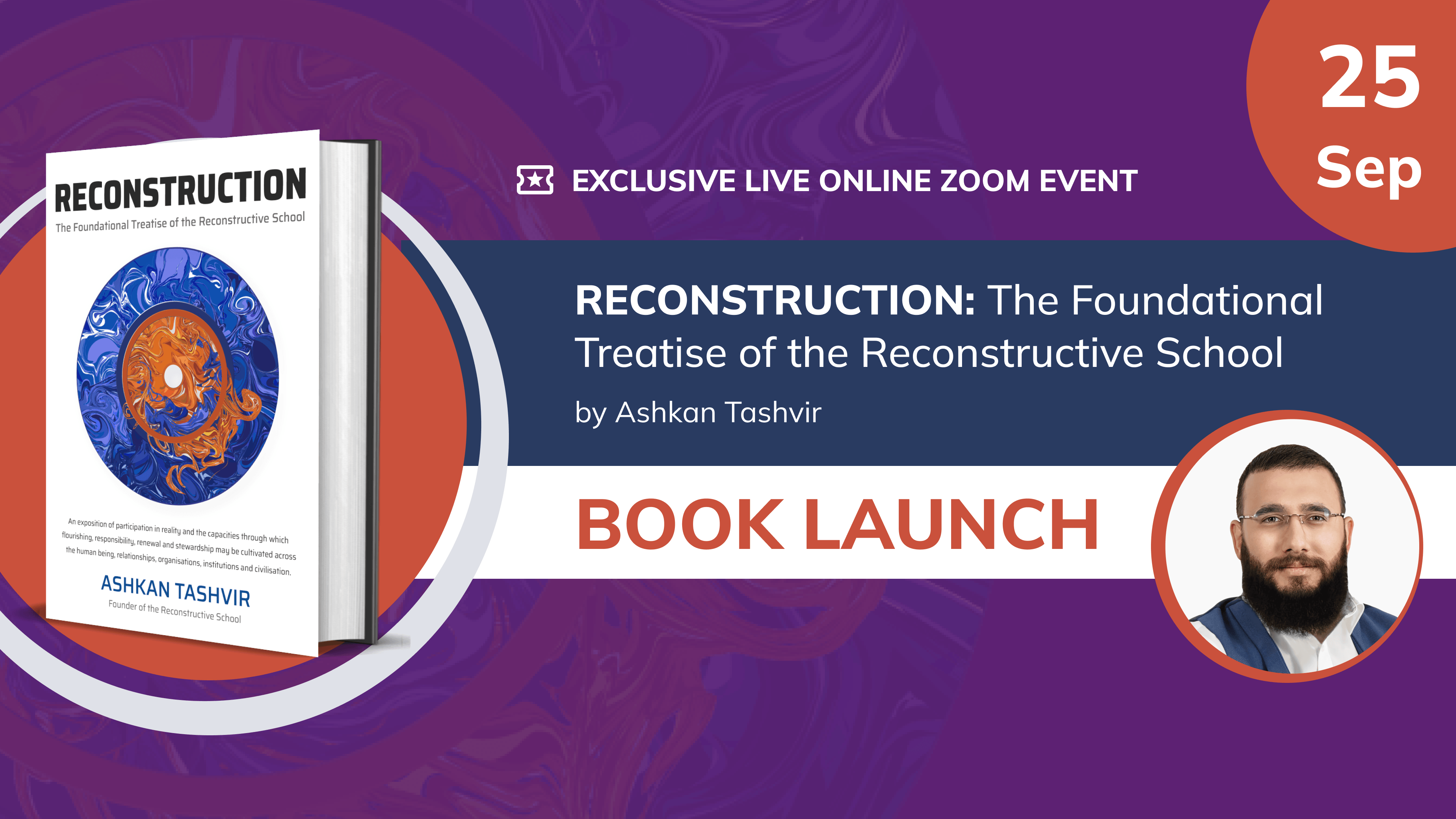
On Friday, 25 September 2026, join author Ashkan Tashvir for the global virtual launch of his new book, Reconstruction.
Reconstruction brings together more than a decade of philosophical development, published work and practical application into the foundations of the Reconstructive School. At its centre is a simple but demanding question:
What does it mean to participate fully, responsibly and meaningfully in a world already underway?
We Inherit More Than We Realise
None of us begins with a blank page. We enter a world already shaped by languages, families, cultures, institutions, beliefs, technologies, systems and established ways of understanding reality.
We inherit ways of working, leading, relating and living. We also inherit assumptions about what is normal, possible, desirable and worth preserving. Much of this inheritance precedes our conscious participation in it.
One response is to live largely within what we inherit. We accept the conditions, follow the established patterns and norms and adapt ourselves to the world as it already exists.
Another response is to imagine that we can stand outside this inheritance altogether and construct reality from a blank slate according to our own ideas, preferences and intentions.
Reconstruction begins elsewhere.
It does not treat human beings as merely products of what they inherit. Nor does it imagine them as sovereign creators who can construct reality however they choose.
It begins with participation.
We encounter what has already been formed. We interpret it, preserve parts of it, question parts of it and participate in shaping what comes next. We are neither completely determined by the world nor standing outside it.
The question is whether our participation is conscious or unexamined, responsible or careless, generative or destructive.
A New School of Thought, More Than a Decade in the Making
The Reconstructive School has not appeared suddenly or been constructed around a single book. Its formal articulation is new, but the work from which it has emerged has been developing for more than a decade.
Distinct parts of this work have gradually taken shape through the Being Framework™ presented in the books BEING and Human Being, Metacontent Discourse and its Nested Theory of Sense-making presented through the book Metacontent, the Authentic Sustainability Framework presented through Sustainabilism and the developing bodies of work on Capacity and Minalogy.
Each began by investigating a particular territory. Over time, their deeper relationship became increasingly visible. Together, they respond to five recurring crises that interfere with our ability to participate fully in our lives and the world.
Reconstruction is the foundational treatise of this emerging school.
It establishes its first principles, draws the five crises and five bodies of response into a shared architecture and provides the overarching philosophical account under which the wider work can be understood.
It does not suggest that every part of the school has now received its final elaboration. Three of its principal bodies of work, Metacontent, the Being Framew Still there what's easyork and the Authentic Sustainability Framework, have already been fully articulated and published. The dedicated work on Capacity is planned to follow in 2027, with Minalogy to be developed more fully thereafter.
Reconstruction reveals how these bodies belong together and the larger philosophical project of which they are part.
The Five Crises
The five crises are not simply new labels for old problems. They offer a way of recognising recurring structures that may otherwise be experienced only through their symptoms.
The Crisis of Sense-Making
We have greater access to information than at any previous point in history, yet more information does not necessarily produce greater understanding. We encounter competing interpretations, fragmented perspectives, contradictory claims and increasingly complex situations.
The challenge is not simply to know more. It is to make adequate sense of what we encounter so that we can orient ourselves and participate meaningfully within it.
The Crisis of Being
There can be a significant gap between what we know, what we say matters and what is actually available to us in the way we conduct ourselves.
We may understand our values and know how we intend to respond. Then fear, uncertainty, ambition, exhaustion or conflict arrives and exposes a different way of being. The question is not only what we know, but who and how we are when circumstances place demands upon us.
The Crisis of Sustainability
People, organisations and societies can produce remarkable outcomes while gradually consuming the conditions upon which those outcomes depend.
An organisation can grow while becoming increasingly fragile. A person can achieve more while becoming increasingly depleted. A system can appear successful while eroding the human, social or ecological foundations that sustain it.
The question is not simply whether an outcome can be produced. It is whether the manner of producing it can be sustained and responsibly stewarded over time.
The Crisis of Meaning
Activity can intensify while our connection to meaning becomes thinner. We can become extraordinarily busy while losing contact with why what we are doing matters. We can pursue something for years, finally achieve it and then encounter an unexpected hollowness.
The question is not merely whether our lives contain activity, progress or achievement. It is whether what we are participating in remains genuinely meaningful and significant.
The Crisis of Capacity
At times, what life asks us to hold exceeds the capacities we have developed. We encounter greater complexity, responsibility, ambiguity and competing demands, with more people and outcomes depending upon how we respond.
Trying harder may help temporarily, but effort and capacity are not the same thing. The question is whether we have developed what is required to meet the conditions now in front of us and bear the consequences of our participation within them.
Five Crises, Five Bodies of Response
Reconstruction does not merely recognise these crises. The Reconstructive School brings together five interconnected bodies of work that respond to them:
Metacontent responds to the Crisis of Sense-Making by examining how human beings perceive, interpret and organise what they encounter into an intelligible world.
The Being Framework™ responds to the Crisis of Being by examining what is genuinely available to us in how we show up, relate, choose and act, particularly when circumstances become demanding.
The Authentic Sustainability Framework responds to the Crisis of Sustainability by examining whether meaningful outcomes can be produced without eroding the conditions, relationships and systems upon which they depend.
Minalogy responds to the Crisis of Meaning by examining how meaning is discovered, formed, sustained and translated into direction, intention and participation.
The reconstructive account of Capacity responds to the Crisis of Capacity by examining what human beings must develop to encounter, hold, metabolise and respond to increasing complexity and responsibility.
These are not five disconnected responses. Each addresses a distinct crisis while remaining inseparable from the others. Better sense-making does not guarantee a way of being capable of acting upon it. Achievement is not sustainable merely because it is meaningful. Capacity without meaning can increase our ability to produce outcomes without answering whether they deserve to be pursued.
The Reconstructive School examines what becomes possible when these territories are understood together.
When the Structure Beneath a Struggle Becomes Visible
What appears to be an information problem may involve a crisis of sense-making. What appears to be a failure of knowledge or intention may expose a crisis of being. What appears to be a productivity problem may raise a deeper question of sustainability. What appears to be a lack of motivation may involve a loss of meaning. What appears to require greater effort may reveal a crisis of capacity.
Recognising the crisis does not automatically address the problem. It changes the quality of the questions we can ask and the responses that become available to us.
This is one of the central invitations of Reconstruction: before reaching for another answer, can we see more adequately what kind of problem is actually in front of us?
What You Will Explore at the Launch
During the event, Ashkan and the invited panel will explore questions including:
Why does greater access to information not necessarily help us make better sense of the world?
Why can we know how we want to behave and still respond differently under pressure?
How can people and organisations produce meaningful outcomes without exhausting the conditions that make those outcomes possible?
Why can success and achievement be followed by an unexpected sense of hollowness?
What happens when the complexity and responsibility before us exceed our present capacity?
How much of the way we live, work and relate has been inherited without examination?
What lies beyond the choice between passively preserving what exists and imagining that everything can be constructed from scratch?
What does responsible participation actually require of us?
The event will not reduce these questions to formulas or simple answers. It will introduce a different way of recognising what may be happening beneath many of the struggles we encounter and what a genuinely reconstructive response might require.
Who This Event Is For
The Reconstruction Book Launch is for anyone interested in understanding human beings and the systems in which we participate at a deeper level.
It may be especially relevant to founders, executives and business owners navigating increasing complexity and responsibility, as well as coaches, consultants, facilitators and practitioners working with human transformation. It also speaks to those working in leadership, education, organisational development, sustainability or community building.
Academics, intellectuals and thinkers interested in participation, human development, meaning and sense-making will encounter the foundations of a developing philosophical school. Those exploring personal growth, spirituality, responsibility or human flourishing may also recognise these crises within their own lives.
No previous knowledge of Reconstruction, the Being Framework™ or Ashkan Tashvir’s other bodies of work is required. The event is designed to provide an accessible introduction while retaining the depth of the philosophical questions from which the work emerged.
Recap
This excerpt is from the article: The Five Crises Beneath the Problems We Keep Trying to Solve.
To recap, in simple terms, the reconstructive approach begins with a distinctive claim: human transformation is neither a matter of simply accepting or restoring the world we inherit nor freely constructing a preferred reality from scratch. We are participants in a world already underway. We receive conditions we did not choose, but through how we perceive them, make sense of them, respond and bear consequences, we participate in what they become. Reconstruction therefore means encountering what is actually present, understanding how it came to be, preserving what remains worth preserving, changing what no longer deserves to continue and developing the capacities required to participate responsibly in what comes next. The five crises and five bodies of response arise from this prior account of participation. They reveal where our participation becomes obstructed and what must be reconstructed for more conscious, meaningful and sustainable participation to become possible.
About Ashkan Tashvir
Ashkan Tashvir is the author of Reconstruction, creator of the Being Framework™ and founder of Engenesis. His work explores being, human participation, responsibility, leadership and the structures through which people understand and participate in their lives and the world.
Reconstruction brings these longstanding inquiries into an overarching philosophical architecture, establishing the foundations of the Reconstructive School and the relationships between its five principal bodies of work.
Event Details
Date: Friday, 25 September 2026
Time: 4:30 pm to 6:00 pm AEST, Sydney time
Format: Live global virtual event via Zoom
Includes: Live presentation, speakers and Q&A
Access: Free with registration
Reserve Your Free Spot
Sometimes progress begins not with another answer, but with seeing the problem differently.
Join us for the global launch of Reconstruction and encounter a new account of what it means to participate consciously, responsibly and meaningfully in a world already underway.