
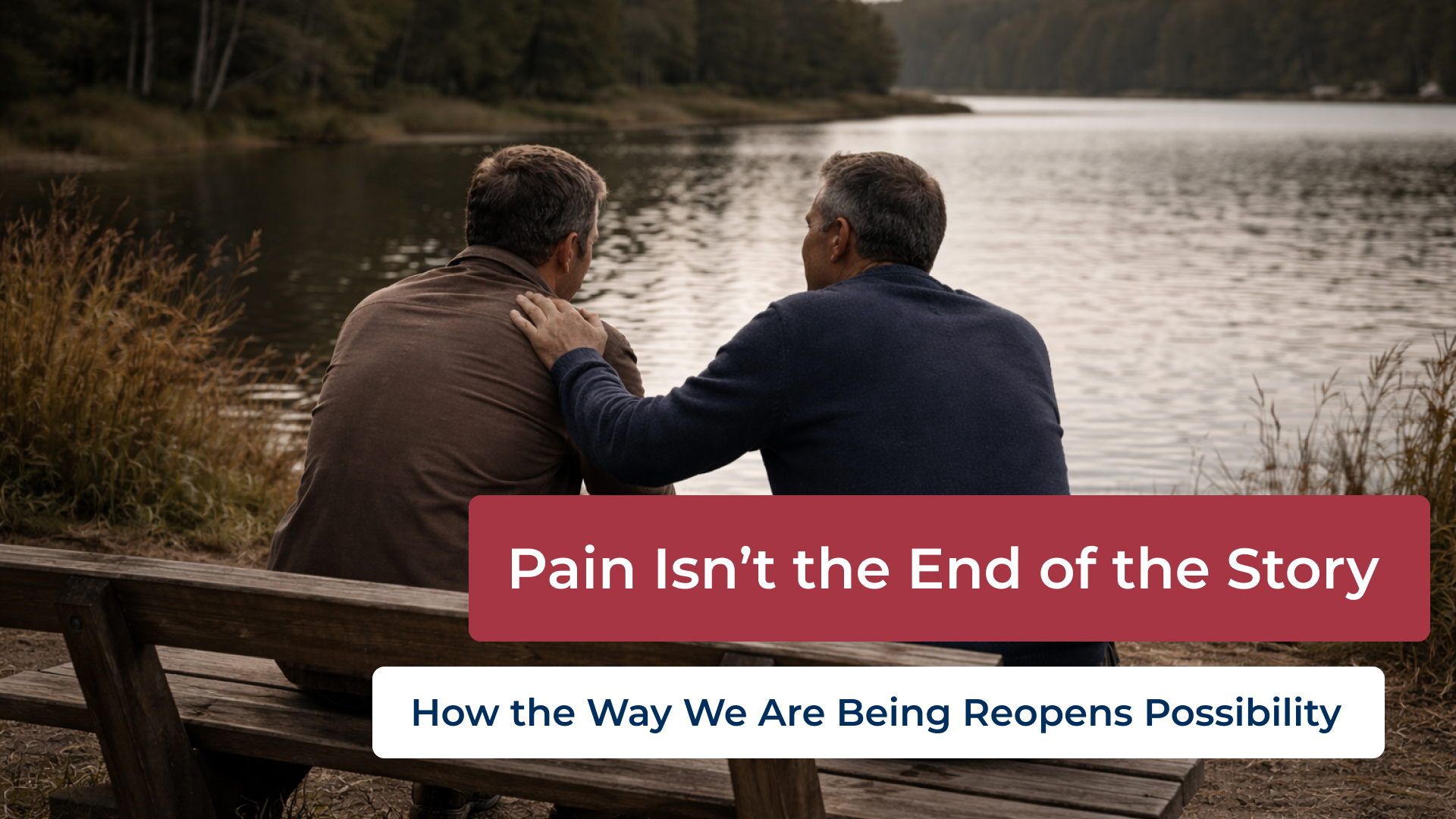

Mark had always been reliable. The one who showed up. The one others leaned on. Lately though, something had shifted. He was cancelling plans, avoiding calls, and saying yes to things he never followed through on. When asked if he was okay, he brushed it off. “Just tired. I’ll sort it.”
Nothing about who Mark was had changed. But how life was occurring for him had.
For many men, and for many people living with pain or limitation, struggle does not show up as collapse. It shows up as withdrawal, irritation, silence, or quiet resignation. The future begins to feel narrow. Options feel limited. Life becomes something to manage rather than participate in.
Pain has a way of doing that. It collapses how life feels possible.
When someone we care about is struggling, our instinct is often to fix, advise, or push forward. We want to help. Yet effective support does not begin with action. It begins with how we are being in relation to what is happening.
The Being Framework reminds us that outcomes in life are shaped not by who we are as fixed identities, but by how we are being in the world. When how we are being shifts, what becomes possible shifts with it.
This article explores how presence, awareness, integrity, and relatedness create the conditions for moving from pain to possibility.
Pain Changes How Life Is Experienced
Pain is not only something we feel. It changes how we experience ourselves, others, and the future. Energy drops. Motivation fades. What once mattered can start to feel distant or irrelevant.
For someone living with chronic pain, disability, or ongoing stress, life can quietly shrink. Tasks take more effort. Decisions feel heavier. Asking for help can feel like failure. None of this says anything about who the person is. It speaks to how life is currently occurring for them.
A man who once took pride in providing may now feel useless because his body no longer cooperates. A person who values independence may experience shame when support becomes necessary. These experiences are not character flaws. They are shifts in how life is being lived.
The Being Framework helps us hold this distinction clearly. Who we are is not the issue. How we are being is always available for influence.
Presence Before Prescription
One of the most powerful things we can offer someone who is struggling is presence. Presence is not advice or reassurance. It is a quality of being.
Imagine sitting with a mate who says, “I don’t see how this gets any better.” One response is to argue with that view or try to motivate them. Another is to slow down and say, “That sounds heavy. What’s it been like carrying that?”
That second response does not solve anything. What it does is create space. Space for the person to speak honestly. Space for their experience to be acknowledged without judgement. Space for awareness to emerge.
In the Being Framework, awareness is foundational. When awareness increases, so does choice. Presence supports awareness. It allows people to see their situation more clearly, often for the first time.
This is particularly important for men, who are often conditioned to deal with things privately and push through. Presence interrupts isolation without taking away autonomy.
Opening the Future Again
Pain tends to anchor people in the past. What they used to be able to do. What they have lost. What has not worked. In this state, the future can feel like a repetition of disappointment.
Possibility reopens the future.
Possibility is not a goal, a plan, or positive thinking. It is a future that does not yet exist, made available by a shift in how we are being in the present.
For example, someone living with ongoing limitations might say, “This isn’t the life I planned.” That may be true. When it becomes the whole story, the future closes. A different orientation might sound like, “I don’t know what this life looks like yet, but I want to find a way to live it with meaning.”
Nothing external has changed. Internally, something significant has.
That declaration changes how pain is held. It becomes part of a larger context rather than the defining feature of life.
Meaning Before Motivation
People often say they lack motivation. More often, what they lack is meaning.
Telling someone to try harder rarely works when life feels empty or overwhelming. What does work is reconnecting with what genuinely matters to them.
This might be being present for family, contributing in a way that still feels authentic, or standing for honesty rather than stoicism. When meaning is clear, effort becomes easier to access, even when pain remains.
In the Being Framework, this is where integrity comes in. Integrity is not about being perfect or strong. It is about alignment between what matters and how we are being.
When people act from this place, they experience coherence rather than self-judgement.
Commitment as Alignment
Once a possibility is named, commitment shows up as alignment, not pressure.
This might look like having an honest conversation that has been avoided. Asking for support without apology. Setting clearer boundaries. Completing something that has been draining energy.
For instance, someone might commit to one regular check-in with a trusted person rather than trying to handle everything alone. That action does not change who they are. It changes how they are participating in their life.
In the Being Framework, effectiveness emerges when awareness and integrity are present together. Actions taken from this place feel grounded and sustainable.
Holding Possibility in Relationship
Possibility is rarely sustained alone. It is strengthened in relationship.
When you sit with someone in pain, your role is not to rescue them or carry their future. It is to hold space for a future that is not yet clear, but not closed.
This might look like staying connected even when progress is slow. Remembering what matters to them when they forget. Being reliable without taking control.
This kind of relatedness respects independence while offering support. It creates a relational environment where responsibility and care can coexist.
Pain as an Invitation
Pain is not a verdict on who someone is. It is an invitation to pay attention to how life is being lived.
When met with presence, awareness, and integrity, pain can become a catalyst rather than a dead end. It can clarify values, deepen relationships, and open futures that would not otherwise be available.
The movement from pain to possibility is not about becoming someone else. It is about taking responsibility for how we are being and discovering that even in difficulty, something meaningful can still be created.
That is where real change begins.
A Simple Reflection Practice
Awareness, Integrity, Effectiveness
You can use this practice personally or with someone you are supporting.
Awareness
Ask:
What is actually happening for me right now?
How is life occurring for me, without judgement or fixing?
Integrity
Ask:
What matters to me here?
Where am I out of alignment between what I care about and how I am showing up?
Effectiveness
Ask:
Given what matters, what is one small action or conversation that would restore alignment?
Who could support me without taking this over?
Sit with each question. Do not rush to answers. Let clarity emerge.