
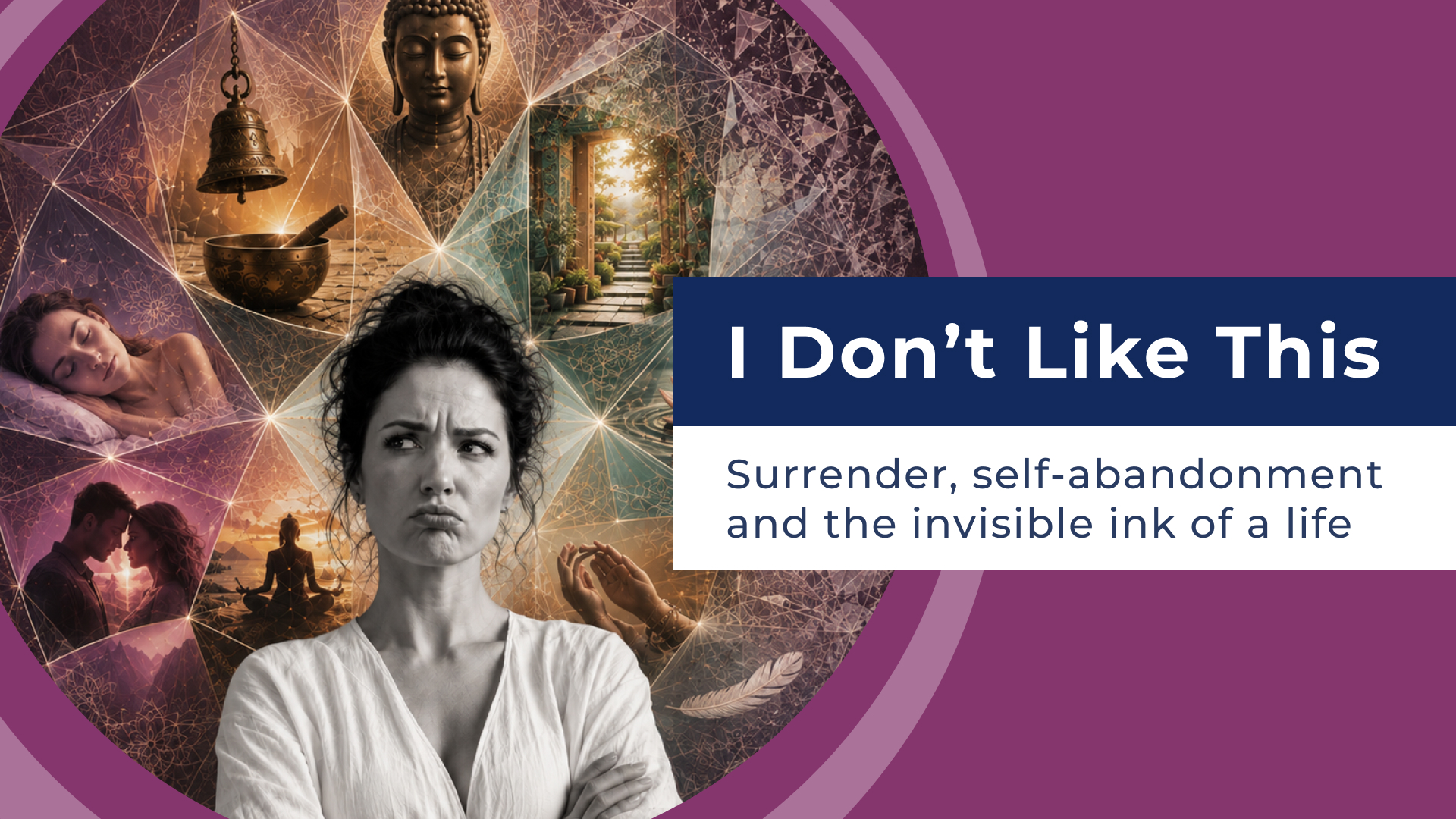

There are some things in life we seem to understand without ever having been taught. Falling asleep is one of them. We can prepare for sleep, make the room dark, put down the phone, count our breaths and buy increasingly expensive pillows, but there comes a point at which effort becomes counterproductive. Nobody has ever fallen asleep by trying harder. At some point, consciousness loosens its grip and we surrender to something we cannot entirely make happen.
Falling in love can be like that too. Even the language gives us away. We do not generally speak of strategically entering love. We fall. Something shifts beyond the reach of our careful management. Another person begins to matter in ways we did not entirely authorise. We become vulnerable to joy and, therefore, vulnerable to loss. However sensible, discerning or self-contained we may have been five minutes earlier, love has a rather disconcerting capacity to remind us that control was never quite as complete as we imagined.
Life is full of these small and enormous surrenders. Sleep asks us to relinquish consciousness. Love asks us to relinquish certainty. Grief eventually confronts us with what cannot be undone. Ageing makes its own negotiations with time, regardless of ours. Creativity frequently asks us to release the thing we intended to make so that something else can emerge. Parenthood offers the rather sustained revelation that another human being will not necessarily become the person we had in mind. Surrender is not one thing at all. Turn it slightly and another facet catches the light.
I have become increasingly interested in surrender because it sits strangely in our contemporary vocabulary. On one hand, it can sound like defeat. Armies surrender. People surrender their rights, their independence or their power. We are encouraged to persevere, overcome, push through and never give up. Surrender seems suspiciously like what happens when all the more admirable options have failed. And yet we seem equally fascinated by the possibility that surrender might set us free.
Entire shelves have been devoted to letting go, accepting what is, living in the present moment, releasing attachment and surrendering to life. Michael Singer went so far as to make surrender the organising experiment of his life, chronicled in The Surrender Experiment: what might happen if, rather than continually imposing his preferences on life, he allowed life to unfold and responded to what arrived? We meditate to practise non-resistance, travel to retreats to learn how to let go and borrow language from ancient religious, contemplative and contemporary spiritual traditions in an effort to loosen our grip on the world.
There is something almost paradoxical about how hard we are prepared to work at surrendering. Some of our oldest contemplative traditions point in almost the opposite direction. Surrender can mean releasing our insistence that life conform to our preferred version of it. Acceptance, non-attachment, compassion, loving-kindness, equanimity: these are not generally teachings about giving up on life. They are attempts to change our relationship with the fact that life will never be entirely ours to control. And somewhere between surrender as defeat and surrender as liberation lies a question I cannot quite leave alone: What if I don’t like this?
I don’t like this
I know, it sounds embarrassingly unsophisticated. After centuries of philosophy, spiritual teaching, meditation and contemplation, surely we can do better than I don’t like this. We can certainly make it sound better: I am experiencing some resistance. I am noticing attachment to a preferred outcome. I am being invited to practise acceptance. Give us enough spiritual vocabulary and we can become eloquent about an experience whose first language was simply: I don’t like this. What if that sentence is not evidence that surrender has failed? What if it is part of surrender?
What is I don’t like this, anyway? Resistance? Preference? Fear? Intuition? An old wound being touched? A limit being reached? A signal that something matters? Sometimes it is simply Tuesday and I am tired. The difficulty is that the sentence itself cannot tell us which. Surrender may not require us to know immediately. It may simply ask us to allow the experience to be present before deciding what it means.
It is worth trying the sentence for ourselves. What don’t I like? Not what needs fixing, what should change or what I am justified in rejecting. Simply: what don’t I like? Notice how quickly another voice may arrive to correct the answer. I don’t like my job. Yes, but you’re fortunate to have it. I don’t like getting older. Ageing is a privilege. I don’t like being around this person. Be compassionate; you don’t know what they’re going through. We can be remarkably quick to turn an experience into an argument. We are not only uncomfortable with dislike; we are suspicious of it. I don’t like this can sound ungrateful, immature, resistant, selfish, negative or insufficiently evolved. We are often far more comfortable talking about what we appreciate, accept, forgive, understand or are learning from. No wonder we become skilled at correcting dislike before we have even allowed ourselves to experience it.
If surrender asks us to stop resisting reality, then surely my experience is part of reality too. My disappointment exists. My anger exists. My preference exists. My longing, grief, boredom, envy and desire exist. I may decide that none of them should determine how I live, but denying their presence hardly seems like acceptance of what is. We cannot surrender to the fullness of reality while editing ourselves out of it. I don’t like this is itself one of the realities surrender asks us to stop resisting.
The problem is not always that I don’t like this represents resistance. Sometimes the greater resistance is our refusal to let I don’t like this exist at all. This becomes particularly interesting for women. Many women become extraordinarily skilled at understanding context. We learn to see another person’s point of view, accommodate competing needs, anticipate emotional responses, preserve relationships and make room. These can be beautiful capacities. They can also make the language of surrender feel remarkably familiar. Acceptance? I can do that. Compassion? Absolutely. Letting go? Working on it. Non-attachment? I shouldn’t want so much. Loving-kindness? Of course. Surrender? Maybe I simply need to stop resisting. There is nothing wrong with any of those teachings. The more interesting question may be: who is interpreting them?
Who goes on retreat?
We touched on this in Selective Hearing: eventually, when life becomes sufficiently noisy, many of us decide we need to reconnect with ourselves. If resources allow, we may even travel somewhere beautiful to do it. The phone disappears. Linen appears. There is meditation at sunrise, yoga, breathwork, massage, nourishing food and a sound bath in the afternoon. Yet changing the setting does not necessarily change the identity inhabiting it.
The People Pleaser can people-please at a monastery. The Responsible One can become responsible for everyone having the right meditation cushion. The High Performer can approach surrender with tremendous commitment and an unspoken desire to be exceptionally good at it. The emotionally intelligent woman can spend a loving-kindness meditation extending compassion toward every living creature and still somehow remain absent from the circle herself. The last possibility interests me enormously.
Loving-kindness practices, in their various forms, invite us to extend wishes for wellbeing and freedom from suffering beyond the narrow borders of our usual concern. We practise goodwill toward ourselves, those we love, those we find difficult and, ultimately, others more widely. There is something beautiful about that widening circle. But what happens when the self is technically included and experientially excluded?
What happens when I can sincerely wish peace for the difficult person while continuing to dismiss the part of me that finds them difficult? When compassion becomes another reason to understand somebody else’s behaviour before acknowledging its effect on me? When meditation becomes a way of regulating inconvenient responses rather than becoming curious about why they keep arriving? Can spiritual practice become another technology of performance identity? Can I become good at acceptance? Can I perform surrender? Can I become so skilled at observing my feelings without judgement that I quietly stop taking any interest in what they might be saying? This is not an argument against meditation, acceptance or loving-kindness. Quite the opposite. It is an argument for taking them seriously enough not to confuse them with disappearance.
Two things can be true
Part of the difficulty is our tendency to imagine acceptance and preference as opposites. If I have truly accepted reality, surely I should be at peace with it. If I still dislike it, perhaps I have more spiritual work to do. But two things can be true. This happened, and I wish it hadn’t. I love you, and I am angry with you. I am grateful for this life, and I want something different. I forgive you, and it still hurt. I understand why you did it, and I don’t like what you did. This is my life, and I don’t like this part of it. There is something profoundly spacious in allowing both statements to exist without demanding that one defeat the other. Acceptance does not require approval. Compassion does not require acquiescence. Non-attachment does not require the absence of desire. Peace is not necessarily resignation.
I have had to become increasingly curious about my own attraction to opposites. Right or wrong. Stay or leave. Grateful or ungrateful. Accepting or resistant. Strong or weak. Some of that comes from the beliefs we inherit long before we are old enough to examine them. In my family, as in many immigrant families, life was understood to be hard. You worked. You persevered. You were grateful for what you had. There is dignity in those beliefs; they helped people survive extraordinary things. But inherited beliefs can continue organising a life long after the circumstances that produced them have changed. And long before we make the decisions we later describe as life-changing, something quieter may already be being written through the things we repeatedly accept, resist, honour or override. Most of the time, we cannot yet read it.
The family is only one teacher. Religion teaches us what goodness looks like. Culture tells us what success looks like. Advertising shows us what happiness, marriage, motherhood, beauty and ageing are apparently supposed to look like. Spiritual traditions offer another set of ideals: acceptance, compassion, non-attachment, surrender. By the time we ask ourselves what I don’t like this means, there may already be a crowded room interpreting the answer.
Surrender may be less about erasing one side of our experience than relinquishing our insistence that reality become uncomplicated before we can inhabit it. That is why I don’t like this interests me. It is not necessarily a refusal. It is not a declaration of what should happen next. It may simply be an acknowledgement of what is happening now. Can I allow I don’t like this to be true without immediately turning it into either a problem to solve or a feeling to transcend?
The many faces of surrender
Could surrender be easier to understand when we stop trying to define it and notice where it already lives?
Every night, sleep asks for it. The harder we try to force sleep, the more elusive it can become. Eventually, if sleep comes, something in us releases its supervision of the world. Sleep sounds like the simplest surrender until life requires it on command. I once dated a pilot whose body was routinely expected to sleep when a roster said it should rather than when darkness, rhythm or tiredness naturally arrived. Shift workers know the problem well. Sometimes prescribed chemistry is recruited because surrender has a deadline. Few things expose the paradox of sleep quite like needing desperately to make it happen.
Grief asks for another kind. There are losses no amount of insight will reverse. At some point, surrender may mean allowing the irreversible to be irreversible, while still loving what has gone. I recently watched a dear friend remarry several years after losing her husband. Her happiness now does not erase her grief then, nor does loving again revise the significance of the person she lost. Perhaps grief’s surrender is not letting go of love, but relinquishing the idea that continuing to love what is gone prevents us from loving what is here.
Ageing asks us to surrender our claim on permanence. Our bodies change. Roles change. Possibilities narrow in some directions and unexpectedly open in others. Ageing becomes particularly painful when all our energy goes into negotiating with time about terms it has never agreed to. We speak about surrendering to time while spending billions trying to reverse its evidence. Creams, injectables, surgery, supplements, longevity regimes, hair dye, fitness, hormones, and filters all promise, explicitly or otherwise, to turn back the hands of time. It is almost literally the language of resistance. There is nothing inherently wrong with wanting to look younger, but what are we resisting when we do?
Creativity has its own surrender. Writers, artists, musicians and makers often describe the moment when the work stops being the thing they intended and starts revealing what it wants to become. Too much control can strangle it. Something has to be allowed. Reading Margaret Atwood’s memoir, I found myself imagining the peculiar surrender of the writer: sitting physically in one room while imaginatively inhabiting another. Attention itself becomes a form of surrender.
And then there is love. Falling in love may be one of the few occasions on which we willingly use the language of surrender without immediately imagining defeat. We fall because something happens that cannot be entirely reduced to decision. We relinquish some certainty. We permit another person to matter. We discover that openness and vulnerability are not unfortunate side effects of love but part of its architecture.
Love can also reveal. Sometimes we encounter a person, friendship, place, vocation, creative practice or way of living and something unexpectedly comes alive. Nothing was necessarily catastrophically wrong before. Life may have been perfectly functional. Then something applies heat to a part of us we did not realise had gone quiet. Oh. I wanted tenderness. Oh. I missed being seen. Oh. I can feel like this. Oh. I haven’t laughed like this for years. The revelation need not be an instruction, but rather something becoming visible.
Invisible ink
I keep returning to the image of invisible ink. As children, some of us experimented with writing messages in lemon juice and then holding the paper near heat to watch the words slowly appear. The page looked blank until it started to reveal what had been written there all along. I wonder whether lives can be like that. The strange thing about invisible ink is that the heat does not write the message. It reveals it. Falling in love may not create the longing. Grief did not create the love. Silence does not create the thought that keeps returning. The heat revealed something that had already been written. Surrender may sometimes be the moment we stop trying to rewrite the message before we have allowed ourselves to read it.
We tend to imagine our future lives being created through the large decisions we consciously make. Those decisions matter. But another life may be taking shape more quietly, written through what we repeatedly honour and what we repeatedly override. Every it doesn’t matter writes something. So does every preference we honour, every limit we acknowledge, and every truth we allow to exist without immediately explaining it away. The lives we eventually find ourselves living are written as much through these small acts of attention and inattention as through the enormous decisions we agonise over.
And then life applies heat. Grief. Ageing. Silence. Exhaustion. Creativity. Falling in love. Sometimes nothing more dramatic than lying awake in the dark when the managerial part of us has finally run out of things to organise. Slowly, something appears on the page. Some of life’s great moments of surrender may do the same: not create something that wasn’t there, but reveal what we had not yet been able to read.
Stop resisting
Maybe this is why surrender remains so difficult to understand. We associate it with yielding, and yielding with weakness. Or we spiritualise it until surrender becomes a serene state inhabited by people considerably calmer than ourselves. Yet surrender may be both more ordinary and more demanding. It asks us to relinquish our insistence that life must be different before we can meet it. But if we are to surrender to the fullness of what is, then surely we cannot keep excluding ourselves from reality.
Surrender asks us to orient ourselves towards what is here. Not the life I thought I would have, the person I believe I should be, the feeling I would prefer to be having or the spiritually evolved response I think I ought to produce. This life. This body. This love. This grief. This irritation. This gratitude. This inconvenient I don’t like this. Not one at the expense of another, but the untidy coexistence of all of it.
Self-abandonment sometimes begins when we make one part of our experience wrong in order to make another part right. Gratitude becomes right, so dissatisfaction must be wrong. Acceptance becomes right, so resistance must be wrong. Compassion becomes right, so anger must be wrong. Surrender becomes right, so I don’t like this must be something to overcome.
If surrender means meeting what is, surely we cannot practise it by making parts of what is unacceptable. The distinction I have been circling is this: surrender asks us to loosen our grip on how life must be. Self-abandonment asks us to loosen our grip on ourselves. They are not the same thing. The first can make more room for life. The second makes less room for the person living it.
So perhaps I don’t like this is not the opposite of surrender after all. Sometimes it is the gateway into a more complete version of it: a willingness to stop resisting not only the world as it is, but our own experience of being in it. Can we surrender to life without abandoning our experience of living it? And can I allow I don’t like this to be true without immediately turning it into either a problem to solve or a feeling to transcend?
Surrender does not always sound like yes.
Sometimes it sounds like: I don’t like this.
Sometimes we need to wait for the ink to reappear.
Maybe surrender simply makes room for both.
Dr Jordan Marijana Alexander is a writer, executive advisor and human systems strategist exploring how identity, place, culture and living systems shape participation in the modern world. She works alongside leaders, boards and organisations navigating complex questions of leadership, change and participation, and is the co-founder of RelateAble.Global. If this article has raised questions, sparked reflection or highlighted a decision you’re carrying, you’re invited to book a confidential conversation. You can follow DrJMA on LinkedIn and Engenesis for ongoing essays, reflections and research exploring leadership, identity, belonging and participation.