

The myth of structural stability
I grew up in a time when we gave people gold watches. Stay long enough, work hard, be loyal, move up through the ranks and perhaps one day there would be a retirement morning tea, a speech about your years of service and something engraved to take home. That version of organisational life was never quite as stable or universal as nostalgia might have us believe. Companies failed, factories closed, people were fired and entire industries disappeared. Nevertheless, stability was part of the psychological contract. The organisation was relatively permanent and, provided you did your job reasonably well, your place within it carried some expectation of permanence too. Change was the interruption.
I wonder whether we have fully grasped how profoundly that assumption has changed. Look at the world organisations now inhabit. Artificial intelligence and automation are reshaping work at extraordinary speed. Companies merge and acquire one another. Governments change and funding priorities move with them. Economic shocks, geopolitical instability, new regulation, climate events, technological obsolescence and changing consumer expectations can alter the assumptions underpinning an operating model remarkably quickly. New CEOs arrive with new strategies. Businesses enter and leave markets. Entire functions appear, transform and disappear.
Every senior leader I have worked with over the past five years has navigated some form of organisational restructure. Every single one. The pattern is not confined to corporations pursuing efficiencies or governments under fiscal pressure. Charities and non-profits have lived with structural fluidity for years. The mission may endure while the money supporting it can be remarkably temporary: grants begin and end, government contracts change, donor priorities move, programmes expand and contract. A small permanent workforce may sit alongside fixed-term employees, contractors and volunteers, with the configuration changing as funding does. In these environments, one person disappearing from a structure can take with them years of institutional memory, community trust, donor relationships and cultural knowledge that their FTE value could never adequately represent.
We still tend to approach restructuring as though it were an exceptional organisational event: something we announce, consult on, implement and eventually finish so everybody can get back to normal. What if there is no normal to get back to? What if we built our ideas about employment for a world in which stability was normal and restructuring was the interruption, and we are moving into one in which restructuring is normal and stability is the interval? If that is even partly true, we don’t simply need better ways to conduct restructures. We need a different conception of what restructuring is, what it asks of human beings and what capabilities organisations need to develop if they are going to keep doing it.
When the structure needs to move
I am not anti-restructure. I once restructured myself out of a CEO position. I was leading the New Zealand operation of a global franchised learning and development business working with major multinational organisations. Increasingly, our significant commercial opportunities were in Auckland while I was based in Wellington. Eventually the question became unavoidable: was the structure we had built still the structure the organisation needed? I didn’t think it was. And I could hardly argue for structural decisions based on what was right for the organisation everywhere except the box with my own name in it. My role went too, with considerable attention paid to creating soft landings for the people affected by the wider changes.
Sometimes positions should disappear. Sometimes an organisation genuinely cannot afford its existing cost base. Sometimes technology makes work redundant, mergers create duplication, management layers no longer add value, a strategy changes or a structure simply doesn’t work anymore. The responsible decision can be to remove a box even when there is a human being standing inside it. But removing the box and understanding what its removal does to the human system are two very different acts of leadership.
We are remarkably sophisticated at the first. We can model spans of control, FTE, reporting lines, functions, accountabilities, budgets, savings and implementation dates. We can centralise, decentralise, outsource, insource, create matrices, establish agile teams and move functions sideways across an organisational chart until the resulting PowerPoint looks beautifully clean. Nobody, however, actually works in an org chart.
We work in an invisible web of relationships, history, knowledge, reputation and trust. Belonging, memory, influence, favours, shortcuts and knowing who to call when something goes wrong contribute to our experience. The chart can tell me where Sarah sits and what Sarah costs. It cannot tell me that after twenty-two years Sarah knows why a process exists, which stakeholder will object if we change it, and who fixed it the last time it broke. Sarah knows which person in Finance will answer her call or which younger colleagues quietly come to her when they don’t know what to do. Sarah has value. Her position has a cost. Those are not the same thing.
Much of the conversation about restructuring understandably focuses on its human cost. There is one. Jobs are lost, people worry about mortgages and power bills, and those who remain can experience guilt and uncertainty. Leaders absorb enormous emotional pressure and productivity can fall. Cost is only half the conversation. Human systems also contain value. Trust, institutional knowledge, belonging and relationships have value. A functioning informal network has value. A leader willing to tell the truth upward has value. So perhaps the more useful question is not simply, What will this restructure cost our people? It is: What human value are we dismantling? And what human value are we creating?
Some things should be dismantled: obsolete capability, duplicated work, unnecessary hierarchies, entrenched power and bureaucracy that once served a purpose and now serves itself. Other things need protecting. Some need transferring. Some need to be consciously released. Some will need grieving. Entirely new forms of human value may need to be created. The structure may be temporary. The value doesn’t have to be.
Who gets to design the future?
There is another curious feature of modern restructuring. Organisations will sometimes spend considerable sums outsourcing the thinking about what their future organisation should look like, while simultaneously looking for savings from the people who currently work inside it. There can be very good reasons for bringing in external expertise. An outsider can see patterns that have become invisible to those living inside a system, challenge vested interests, bring comparative experience and ask questions that internal leaders have stopped asking. I work as an external advisor myself. I am hardly going to argue that organisations should never let outsiders through the door. But there is a paradox worth examining.
The future-state design is often constructed through interviews and workshops with the people inside the existing organisation. They explain where the work really happens, which processes fail and where decisions get stuck. Their knowledge of the existing system becomes raw material for designing its replacement, at precisely the moment they may be wondering whether there will be a place for them within it. There is something almost cannibalistic about the process when we get it wrong: the existing human system is consumed to produce the design of the next one.
The problem isn’t external advisers or structural change. It is what we perceive ourselves to be doing. If the exercise is primarily conceived as redrawing the boxes and finding the savings, people become positions to be assessed while their knowledge becomes data to be extracted. If we conceive it instead as designing the organisation’s next state, the questions become considerably richer. What do the people closest to the work know that cannot be seen from the top? What human value exists in the current system? Which relationships will the next organisation depend upon? What capability doesn’t exist yet? What should we stop doing? And how much genuine agency can people have in creating what comes next? That last question matters. Participation without agency can be worse than no participation at all. If I spend hours helping you imagine the future only to discover that the consequential decisions had already been made, you may not have increased my engagement. You may simply have taught me something about the value of my voice.
Even our language may give us away. We talk about designing the future state, as though somewhere out there is the perfect organisational configuration at which we will eventually arrive. Perhaps there isn’t a future state. Perhaps there is only the next state. That shifts the capability we need. It is no longer the ability to commission the perfect org chart every five years. It is the ability to continually perceive what is changing, understand the value already present in the system, decide what needs to move and reconstruct without destroying the human infrastructure required for whatever comes next.
The realities inside a restructure
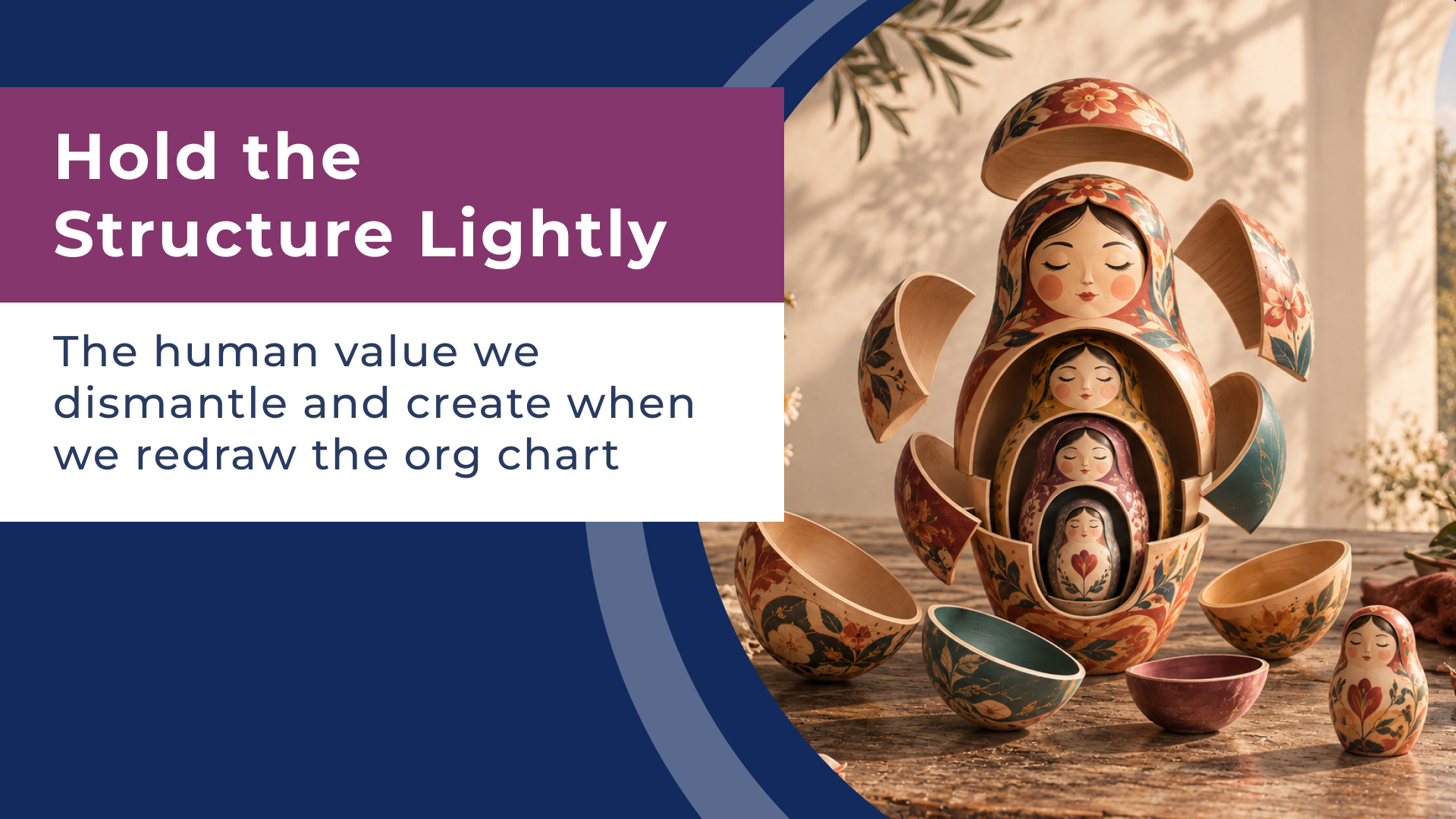
We tend to speak about the restructure as though everyone is experiencing the same event. They aren’t. There are multiple realities operating simultaneously: the context requiring movement; the structure being changed; the human value being dismantled, transferred or created; the relationships being disturbed; the reality the leader is carrying; and what the change activates in the individual. I think of these realities like a matryoshka. Open what appears to be one organisational problem and another sits inside it. The metaphor is not intended to suggest a sequence: these realities interact, overlap and move through one another. It is a way of making visible why something represented by a few boxes on an org chart can become so extraordinarily complicated for the humans living inside it.

The first reality is CONTEXT: Why are we moving? What is happening in the economy, technology, politics, geography, regulation, labour market, customer environment or competitive landscape that makes the existing arrangement less viable?
Then there is STRUCTURE: What is changing? Roles, FTE, reporting lines, teams, processes, accountabilities, technology, money and operating model. This is the reality we are already very good at seeing.
VALUE asks: What goes, what stays, what travels, and what must be created? Here sit knowledge, capability, relationships, trust, institutional memory, cultural strengths, networks and the informal infrastructure through which the organisation actually functions.
US asks: What is happening to us? This is belonging, loyalty, psychological safety, connection, conflict, survivor guilt and the sometimes startling speed with which we can become me and them.
LEADER asks: What am I being asked to hold? Responsibility, confidentiality, ambiguity, bad news, decisions I did not make, loyalty upward, care downward, other people’s anger and the expectation that I will somehow keep the whole thing productive.
And SELF asks: What is this activating in me? Identity, fear, security, control, grief, agency and possibility, but also the less comfortable parts of ourselves that uncertainty can wake up: the controller, rescuer, martyr, avoider, pleaser, perfectionist, cynic or victim.
These are not six stages to move through. They are six realities operating simultaneously, and the value of the map is not in making restructure simple. It is in helping us locate the reality—or combination of realities—we are actually dealing with. What presents as resistance to the new structure may be a legitimate concern about lost value, a rupture in us, a leader struggling with what they are carrying, or an individual trying to locate themselves after familiar landmarks have moved.
There is something else moving across all six: mood. Fear, suspicion, resignation, cynicism, hope and possibility can become organisational weather, changing how people interpret everything they see. A closed-door meeting becomes Who’s next? A delayed appointment means something’s going on. A bland executive email becomes what aren’t they telling us? The mood becomes a lens through which information is interpreted, which is one reason the human consequences of a restructure can persist long after the boxes have moved. The Realities of Restructure does not make the complexity disappear. It makes the complexity visible. And before leaders can respond intelligently, they need to know where they, and their people, actually are. Which brings us to orientation.
Leading when the landmarks move
One of the most striking things I see in my coaching work is how poorly equipped some very capable leaders are for the human work of restructuring.
I coached a senior leader in a major global technology company through a highly visible reorganisation. The changes were also playing out publicly, with extensive media coverage and commentary creating another layer of interpretation she had little ability to control. Her people weren't only responding to what the organisation was telling them; they were responding to what the world outside it was saying too. She was becoming physically unwell. People were looking to her for answers, reassurance and context, yet she had been given virtually no communication support. No meaningful narrative, no speaking points and little help making sense of what she could or should say. She wasn’t struggling because she lacked leadership capability. She had effectively been sent into one of the most emotionally consequential leadership situations of her career without the equipment to do the job. Our coaching became extraordinarily pragmatic. Before we could talk about her leadership response, we had to work through the actual communication. What did she know? What didn’t she know? What could she say? What was the broader context? How could she respond honestly when someone asked a question to which there simply wasn’t yet an answer?
I have seen versions of the same pattern in a large multinational that had experienced repeated restructures, mergers and acquisitions. The clearest narrative was financial while the wider context for the change remained poorly understood. Leaders were constrained in how far they could get into the detail but simultaneously expected to manage the emotional consequences for their people. It wasn’t quite a gag order, but for some it could feel perilously close: represent the change, don’t stray too far from the line, absorb what comes back, and please keep everyone productive. Then we wonder why the leader is struggling.
The leader gets restructured too. They may be worried about their own future while reassuring others about theirs, grieving colleagues while communicating the organisational case for their departure, or angry about decisions they didn’t make while being expected to represent them. They can know things they cannot disclose while people they’ve worked alongside for years plead with them for answers. Good leaders can take that responsibility deeply personally: What will happen to his family? I’ve failed them. They’re furious with me. If I were a better leader, I could somehow make this okay. The bearer of bad news becomes a convenient human location for anger at an abstract system. And because leaders don’t want to undermine senior management, they can respond by becoming less authentic, less empathetic, less human: stick to the facts; don’t make it personal; contain the emotion, the team, yourself. But depersonalising a restructure does not make it professional. It can create a double burden in which the leader is trying to contain the impact of the bomb while simultaneously containing their own response to the explosion. Eventually that pressure finds another outlet: control, avoidance, irritability, overwork, silence, rescuing, micromanagement or martyrdom.
There is an important distinction here between taking responsibility for people and taking responsibility to them. A leader is responsible for how they lead, what they communicate, whether they listen, whether they tell the truth, whether they advocate appropriately and how they help people navigate uncertainty. They cannot take responsibility for every emotion, financial consequence or life decision that follows from an organisational change they may not even have initiated. Perhaps the leadership task isn’t containment at all. Help people orient instead.
When certainty is genuinely unavailable, orientation is more useful than reassurance. Where are we? Why are we moving? What has changed? What remains true? What have we lost? What don’t we know yet? What can you influence? What can I influence? What needs protecting? What do we need to release? What are we trying to create? What do we need from one another now? That is not corporate spin, nor is it an invitation for leaders to dump their own emotions onto their teams. It is the deeply human work of helping people locate themselves when familiar landmarks have moved. It restores agency without pretending control exists where it doesn’t.
I have seen the difference when organisations take that work seriously. In significant public-sector integrations I have worked on in New Zealand, including work at Housing New Zealand Corporation and the Ministry of Business, Innovation and Employment, we paid deliberate attention to the value and cultural attributes being brought from the different parts of the system. Both involved bringing together multiple functions, capabilities and organisational histories into a new organisational whole. Strategic and policy intellect mattered. So did relationships with the third sector, economic disciplines, operational experience and different ways of understanding risk. The question was not simply which existing organisation would swallow the others, but what was worth carrying into the organisation being created.
The narrative mattered because integration is also an identity exercise. Bring together people whose professional histories have taught them different relationships with risk—one group oriented towards enabling economic activity, another towards preventing occupational harm, for example—and the question cannot simply be Who reports to whom now? It has to become Who are we now? Which instincts from our previous organisations should survive? What do we need to learn from one another? What does sensible risk mean here?
There is the old cynical line that there is no such thing as a merger because somebody is always being acquired. Sometimes this is true. But treating it as inevitable can become self-fulfilling. If we begin with the assumption that one identity must win and the others disappear, we should hardly be surprised when integration feels like conquest. The alternative is not endless consensus. It is deliberate reconstruction.
You can often hear whether that reconstruction has happened in the pronouns people use. Before the restructure there may be we. During it, attention understandably contracts towards me: What happens to my role? My team? My livelihood? After a poorly integrated restructure, another pronoun takes over: they. They decided. They don’t understand what we do. They got rid of everyone who knew anything. They say they consulted us. They expect us to do more with less. Interestingly, upstairs the language can sound remarkably similar. They aren’t embracing the new structure. They’re resistant to change. They need to move on. Both sides are talking about them. When that happens, the org chart may be finished. The restructure is not.
Reconstruction begins after go-live
There is grief in restructuring too. Not because losing a job is equivalent to bereavement, but because human beings grieve loss: status, identity, routine, colleagues, a boss who understood us, expertise that used to matter, a team we were proud to belong to, the organisation we thought we worked for and even the future we imagined we would have there.
The familiar movements of grief—disbelief, anger, bargaining, sadness and eventual acceptance or reorientation—can give us useful language, provided we don’t turn them into another neat corporate change curve. People do not move through organisational grief once, in order or together. The executive team may have been considering the proposed future for four months. A manager may have known for four weeks. An employee hears on Tuesday. Someone losing their position is bargaining, someone keeping theirs feels guilty, someone else is furious, another is secretly relieved, while the executive sponsor is already talking enthusiastically about the future. Everyone is attending the same meeting. They are not necessarily inhabiting the same reality. The people designing the future have often had months to leave the past. Everyone else gets Tuesday afternoon.
This is why our traditional definition of restructure completion is so inadequate. Organisations can spend months planning the structural change: business cases, cost models, consultation, role design, selection, appointments, reporting lines, delegations, systems and implementation. Eventually the new structure goes live and there is an understandable sense of relief. But we don’t stand amongst the rubble after a demolition and announce, “Excellent. The demolition phase has been successfully completed.” We start rebuilding. Yet organisations routinely declare victory at almost precisely the moment their human system is most disoriented.
A restructure is not finished when the ink on the new structure is dry. That is the moment reconstruction begins. Relationships have to reform. Trust has to be tested. New identities have to develop. People decide whether it is safe to invest themselves again. Eventually, us has to be rebuilt. So when productivity falls in the immediate aftermath and somebody asks why people haven’t “moved on” yet, perhaps the more useful question is what exactly we thought reconstruction was going to require.
For decades we have often used structure to create stability for humans. The hierarchy was relatively predictable. Your title told you something about who you were. Your team provided belonging. Your manager provided orientation. If structures are becoming increasingly fluid, we may need to invert that relationship. We need humans and human systems capable of creating stability while structures move. Not immovability. Orientation. I can know who I am even if my title changes. I can understand how I create value beyond a particular box. I can form relationships again, grieve what has been lost without being permanently defined by it, and distinguish between something happening to me and having no agency over what happens next.
There is something worth learning here from more adaptive organisational models. At its best, an agile team does not assume its current configuration is sacred. We tried this. The environment changed. This worked; that didn’t. We need another configuration. We went into one room, discovered there was no way out and tried another door. The structure is provisional. But holding structures lightly cannot mean holding people lightly. In fact, the more fluid our structures become, the more carefully we may need to hold the human infrastructure that allows people to operate within them. Trust and belonging matter more. Agency and knowledge transfer matter more. Leadership matters more precisely because the boxes themselves can no longer provide the stability they once promised. Hold the structure lightly. Hold the human value carefully.
Perhaps this is what organisational resilience needs to mean in the emerging era of restructure: not bouncing back to some imagined previous state, but developing the capacity to reconstruct. Can this human system lose something, grieve it, understand what happened, preserve what matters, transfer value, release what no longer serves, form new relationships, restore agency, create belonging and move again when the environment demands it?
Another wave will come. As long as there is a moon in the sky, there will be another wave. The goal cannot be to build an organisation so rigid that the water never moves it. Perhaps the goal is to build one that knows how to move without losing itself.
Five years from now, don’t show me only the implementation report, how many positions disappeared or how much money was saved. Show me what happened to the value. Where did the knowledge go? What happened to trust? How do decisions move? Do people speak when something is wrong? Can leaders care without carrying everyone? Did the people who stayed become stronger or merely more cautious? When the next wave arrived, did the organisation fracture again or did people know how to move together?
Listen carefully to its language. Are people still talking about them, or did they find their way back to us? Perhaps the real measure of a successful restructure isn’t the organisation we create when we redraw the boxes. It is the human system we leave capable of redrawing them again.
Dr Jordan Marijana Alexander is an executive advisor, human systems strategist and writer exploring how identity, place, culture and living systems shape participation in the modern world. She works alongside leaders, boards and organisations navigating complex questions of leadership, change and participation, and is the co-founder of RelateAble.Global. If this article has raised questions, sparked reflection or highlighted a decision you’re carrying, you’re invited to book a confidential conversation. You can follow DrJMA on LinkedIn and Engenesis for ongoing essays, reflections and research exploring leadership, identity, belonging and participation.