

About this Series
This article is part of a six-part series exploring why many inclusion, leadership, and transformation efforts stall despite good intent and significant investment. Working beneath behaviour and policy, the series examines how identity-level pressure quietly shapes who feels able to belong, lead, and contribute without adaptation. Across gender, age, culture, and place, it traces how legitimacy becomes conditional, how identity load accumulates, and why organisations often misread these signals as performance, engagement, or capability problems rather than systemic strain.
The Culture Fit That Calls for Identity Compression
There is a moment many people recognise at work, even if they have never named it. You are present. You are contributing. You are performing well. And yet you are not entirely at ease.
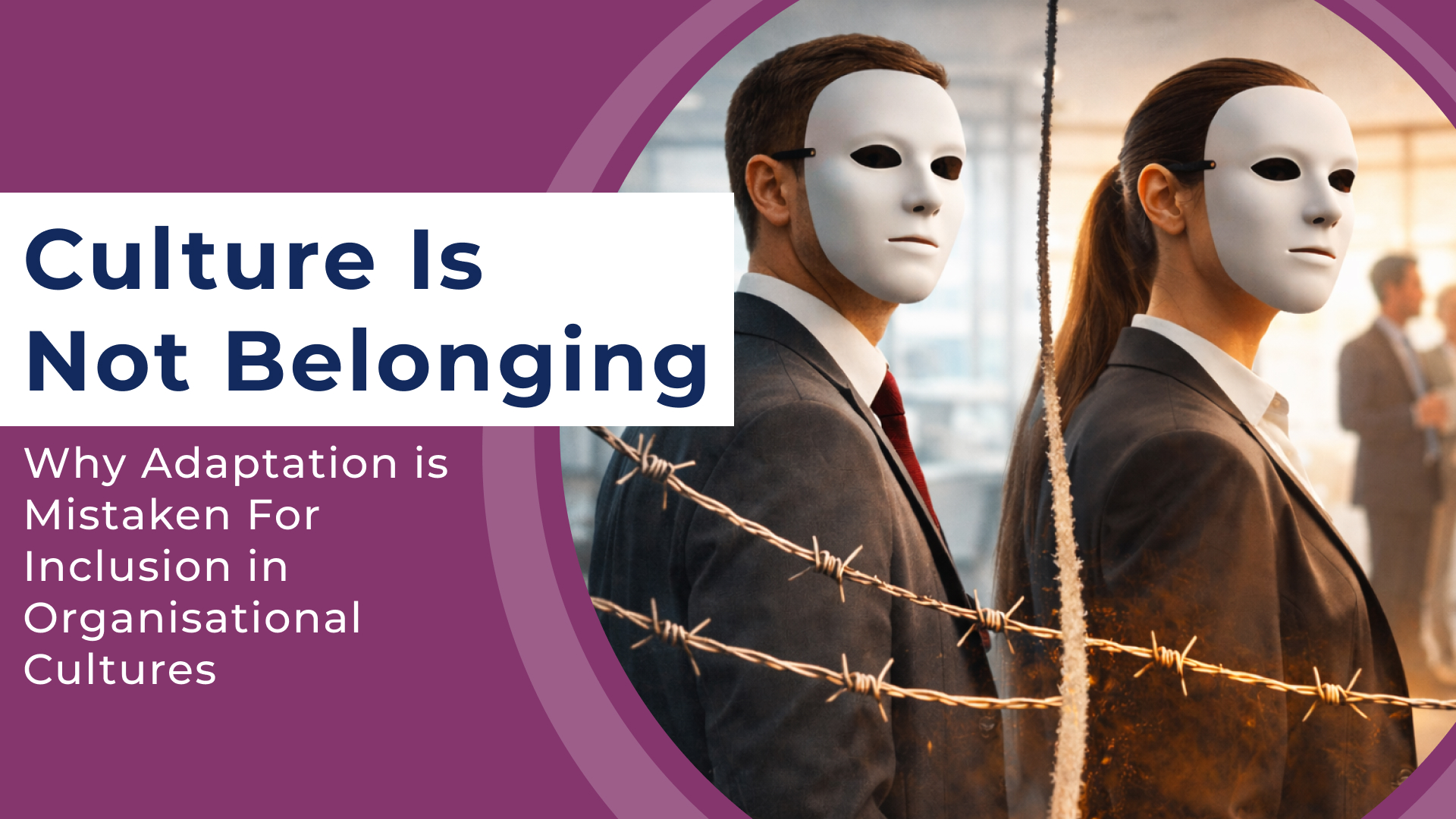
You are listening for cues. Monitoring tone. Adjusting language. Deciding what to say now, what to say later, and what not to say at all. You are translating yourself, quietly, into something more acceptable within the culture you are working in. From the outside, this often looks like professionalism. From the inside, it feels like sustained adjustment.
What is rarely recognised is that this adaptation is not simply a personal choice or interpersonal skill. It is a response to cultural signals about what is credible, appropriate, and safe. This is where many inclusion efforts stall. Not because people are excluded. But because adaptation is misread as inclusion.
When individuals successfully adjust to dominant norms, organisations often interpret the absence of friction as belonging. Smooth meetings, polite disagreement, and managed expression are taken as evidence that culture is working. What goes unseen is the identity-level work required to sustain that smoothness.
Belonging is not the ability to fit oneself to a system without disruption. It is the experience of being able to participate without constant self-translation. When organisations fail to recognise this distinction, they reward adaptation while mistaking it for inclusion, and the deeper cultural dynamics shaping who must adjust, and how often, remain unexamined.
Culture Operates Long Before It Is Discussed
Culture is one of the most referenced concepts in organisational life, and one of the least precisely understood. It is often treated as atmosphere. As values. As “how we do things here.” In practice, culture operates as a meaning system. It shapes how authority is expressed, how disagreement is handled, how emotion is regulated, and how risk is distributed. It determines whose communication style feels credible, whose silence feels suspicious, and whose confidence feels appropriate. Much of this happens before any conscious choice is made. People do not decide to adapt. They learn to.
Big C and Little c
Culture operates on at least two intertwined levels. There is Big C culture. The inherited worldviews shaped by language, nationality, religion, migration history, and collective memory. These influence how people relate to power, time, hierarchy, and belonging. And there is little c culture. The organisational norms that define how success is signalled, how feedback is given, how decisions are made, and how emotion is managed at work. These layers are symbiotic. Organisational culture can amplify or suppress cultural expression without ever naming that it is doing so. When the two align, people feel ease. When they do not, people adapt.
What Adaptation Actually Looks Like
Adaptation is often described as code-switching, but the term deserves more care than it usually receives. By adaptation, we mean the ongoing effort to adjust how one speaks, behaves, or presents in order to meet what feels acceptable in a given environment.
It can show up as softening directness. Suppressing emotion. Changing accent or tone. Avoiding certain topics. Translating one’s thinking before speaking. Working harder to pre-empt misunderstanding or to avoid being misread. None of this is inherently negative. Humans adapt all the time.
The cost emerges when adaptation becomes constant, unacknowledged, and unevenly distributed. When some people are required to translate themselves far more than others in order to be understood. What looks like smooth integration from the outside can feel like sustained self-monitoring on the inside.
When Inclusion Mistakes Comfort for Belonging
Many organisations interpret adaptation as success. Meetings run smoothly. Conflict is low. Communication feels polite. Cultural differences appear to have been absorbed. But comfort is not the same as belonging.
Belonging is not the absence of friction. It is the presence of safety. Safety to disagree without penalty. To speak without over-translation. To be misunderstood occasionally without identity cost.
When adaptation is mistaken for belonging, systems reward those who self-edit most effectively. Over time, this selects for people who can perform cultural fluency at the expense of coherence. The organisation appears inclusive. The human system grows guarded.
The Identity Cost of Constant Translation
The cost of cultural adaptation rarely shows up as failure. It shows up as fatigue. As narrowing contribution. As reluctance to take interpersonal risk. As a quiet withdrawal from influence. People become careful rather than curious. Skilled rather than expressive. Reliable rather than generative.
This is why inclusion initiatives often struggle to shift lived experience. Behaviour changes, but identity safety does not. People are present. They are capable. They are often high-performing. But they are not fully at home.
Why Leaders Misread This
From a leadership perspective, adaptation is easy to misinterpret. Those who adapt well are often seen as mature, flexible, and emotionally intelligent. They read the room. They manage themselves. They fit the culture. What is less visible is the load being carried to maintain that fit.
Leaders may genuinely believe inclusion is working because there is no overt conflict. Because people are polite. Because feedback is managed carefully. The signal that would reveal strain often arrives late, as burnout, disengagement, or attrition. By then, the cost has already been paid.
Culture Is Not Neutral
Cultural norms are not neutral. They privilege certain ways of being, communicating, and leading while rendering others less legible. This does not require ill intent. It requires only unexamined norms.
When organisations treat culture as a static backdrop rather than an active force, they miss how power operates through “normality.” Who feels free to speak spontaneously. Who prepares extensively before contributing. Who can express frustration without consequence. Who must remain composed to be credible. These patterns are not personal quirks, but rather cultural signals.
Multicultural Teams and the Illusion of Integration
This dynamic becomes most visible in multicultural teams. Global organisations often pride themselves on cultural diversity while quietly rewarding a narrow range of communicative norms. Teams span continents, languages, and histories, yet decisions are made through a dominant cultural logic that is rarely named. Much of the work of inclusion in these environments happens through adaptation rather than accommodation. Some team members translate constantly. Others are translated for.
Research on cross-cultural collaboration, including the widely referenced work of Erin Meyer, has helped leaders recognise differences in communication, hierarchy, and decision-making styles. This has been valuable. What it does not fully address is the identity cost of navigating those differences over time. Knowing that cultures differ does not remove the burden of having to adjust oneself repeatedly in order to be heard. Cultural fluency does not automatically produce cultural safety.
In many multicultural teams, inclusion is measured by participation, not by ease. People are present, contributing, and technically included, while quietly managing the risk of being misunderstood, dismissed, or reduced to stereotype. This becomes even more pronounced when Indigenous and settler worldviews intersect. In cultures where authority is relational and time is cyclical, adaptation to linear, performance-driven norms can feel less like collaboration and more like erasure.
The issue is not difference. It is who carries the work of translation, and at what cost.
Why This Matters Now
As organisations become more global, more diverse, and more psychologically demanding, the cost of cultural misreading compounds. Innovation depends on difference that can be expressed without penalty. Trust depends on safety that does not require constant self-regulation. Learning depends on friction that can be held without threatening legitimacy. When adaptation is mistaken for inclusion, all three are quietly undermined.
Organisations do not lose talent because people lack resilience. They lose talent because constant translation is exhausting. They do not struggle with engagement because people are unmotivated. They struggle because identity is being managed rather than inhabited. This is why so many inclusion efforts plateau. The structures are in place. The language is thoughtful. The behaviours appear aligned. And yet the human system remains guarded. What is being missed is not intent or capability. It is interpretation. Until organisations learn to recognise the difference between comfort and belonging, professionalism and protection, participation and safety, they will continue to reward adaptation while overlooking the identity-level work required to sustain it.
Culture, in this sense, is not neutral terrain. It is an active force shaping who must adjust, how often, and at what cost. This article does not argue for eliminating adaptation. Adaptation is part of being human. It argues for seeing it more accurately. Because when adaptation is no longer confused with inclusion, organisations can begin to notice where belonging is being supported, and where it is quietly being substituted.
In the next article, the focus will shift to place. Not as location, but as the ground beneath identity. The histories, geographies, and dislocations that shape what people believe they must carry, translate, or leave behind in order to belong.
Culture explains how adaptation operates. Place reveals where those expectations come from. And until both are seen clearly, inclusion will continue to operate at the surface, while identity remains under pressure.
Dr Jordan Marijana Alexander works at the intersection of identity, leadership, and organisational systems. She is the co-founder of RelateAble.Global