
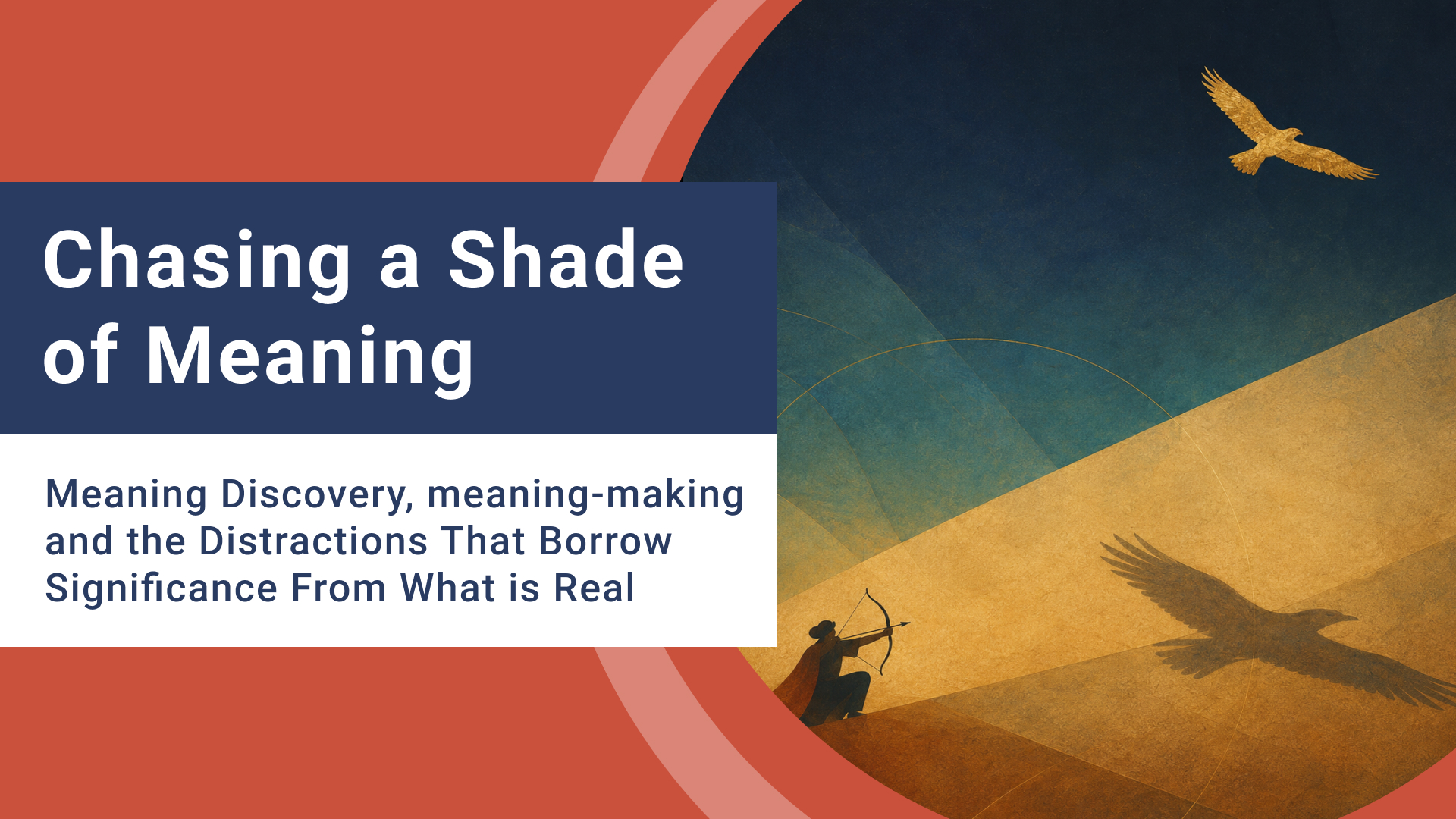

In the first book of the Masnavi, Rumi gives us the image of a bird flying high above the ground. Its shadow moves rapidly across the earth, taking the form of the bird that casts it. A hunter sees the movement below and begins to chase it. He runs until he is exhausted. He fires arrow after arrow at the dark shape sweeping across the ground until his quiver is empty. All the while, the bird itself remains in the air.
The hunter is not chasing nothing. The shadow exists. It moves. It resembles the bird. It is even caused by the bird. His mistake is subtler than pursuing a complete fiction. He is dealing with something real, but he has misunderstood what kind of reality it has. He mistakes an effect for its source, an appearance for what appears through it and a trace of something for the thing itself.
Human beings do this with meaning.
We devote ourselves to roles that resemble purpose, intensity that resembles intimacy, visibility that resembles recognition, activity that resembles contribution and certainty that resembles truth. We may spend years pursuing something that carries the outline of meaning without carrying its substance. Because it resembles what matters, it can command our attention. Because it cannot provide what the thing itself provides, it leaves us strangely unfulfilled. We then shoot another arrow.
The question is not simply whether something means something. Almost anything can be interpreted, narrated or made to mean something. The more demanding question is: What are you actually dealing with?
Are you dealing with something that is genuinely significant in relation to reality and human being? Are you dealing with something that you authentically find meaningful and can responsibly participate in? Or are you dealing with a shade of meaning, a derivative appearance of significance that has become a distraction from what actually matters?
What is a shade of meaning?
A shade of meaning is not the same as meaninglessness. Meaninglessness is an absence, collapse or void of meaning. A shade of meaning is more deceptive because something meaningful appears to be present.
It may be a sign, role, image, story, reaction, metric, status or symbolic object that has acquired the felt weight of something more substantial. It carries enough resemblance to meaning to attract commitment, but not enough substance to orient a life. It borrows significance from something real while drawing our attention away from its source.
A professional title may borrow significance from contribution. The wedding may borrow significance from partnership. Busyness may borrow significance from purpose. Public outrage may borrow significance from moral courage. Agreement may borrow significance from belonging. Suffering may borrow significance from depth. A large audience may borrow significance from genuine impact. The language of transformation may borrow significance from transformation itself.
None of these things is necessarily empty or false. A title can correspond to contribution. A wedding can express partnership. An audience can be affected. A public objection can be courageous. The issue is not the visible form itself. The issue is whether the form remains connected to the reality from which it draws its significance.
The shadow is not unrelated to the bird. It is produced by the bird. It can even alert us that the bird is there. But it cannot fly, be caught or become what the hunter seeks. A sign can disclose its source or distract us from it. Everything depends on whether we follow the sign towards what gives rise to it or mistake the sign for the destination.
This is why the term shade of meaning matters. It names a condition in which the felt presence of meaning survives while the source, substance or participatory demand of that meaning has been weakened, displaced or lost.
Three conditions of meaning
When we ask what we are dealing with, at least three conditions need to be distinguished.
The first is ontological significance. Something may matter because it bears upon the conditions, relations or consequences of human being whether or not we recognise it. Mortality is significant before a person has developed a philosophy of death. A broken promise alters a relationship even if the person who broke it refuses to acknowledge the breach. Power shapes what becomes possible whether or not those exercising it experience themselves as powerful. In such cases, significance is not created by our attention. Our attention may discover what is already consequential.
The second is authentically lived significance. Something may be deeply meaningful within a particular life without being equally meaningful for everyone. A craft, landscape, family practice, friendship or promise can acquire significance through the history, care and participation that connect a person to it. Its meaning is neither a universal property of the object nor a private fantasy. It is real within the relation being lived. Personal meaning does not become authentic because it is intense or sincere, but because the relationship it names is genuinely present and its demands are responsibly taken up.
The third is a shade of meaning. Here the experience of significance has become attached to a proxy, appearance or derivative object. The person may still feel sincerity and intensity, but the relationship that would give those feelings substance is absent, displaced or contradicted by participation.
These conditions are not always mutually exclusive. Something personally meaningful may disclose what is ontologically significant. A shade may serve as a clue that leads back to its source. The distinction matters because each condition asks something different of us. Ontological significance asks to be recognised. Personal significance asks to be owned and lived. A shade asks to be traced beyond itself.
Meaning comes after sense-making, but not always after words
Before we can responsibly determine what something means, we must make some sense of what it is.
Sense-making concerns intelligibility. What is happening? What am I encountering? How do the parts relate? What distinctions, histories, assumptions and contexts allow this to appear as the kind of thing I believe it to be?
Meaning concerns significance. Why does this matter? What does it disclose? What relationship does it establish? What does it make possible, require or call forth from me?
This is why meaning follows sense-making conceptually. If I have not adequately understood what I am dealing with, whatever meaning I assign to it is likely to be premature. Yet human experience does not unfold as a clean sequence in which we first produce a complete account of reality and only then begin to feel its significance. Something may matter to us before we can say what it is. A situation can carry a felt weight before language arrives. An encounter can unsettle, attract, repel or move us before it becomes conceptually clear.
This pre-verbal experience should not be dismissed. It may be the earliest disclosure of meaning. The body can register a breach, possibility, danger or significance before the mind has formed an explicit account. An initial insight may arrive as little more than a disturbance in what had previously seemed settled.
But a felt disclosure is not yet a finished meaning. It is an invitation to attend.
The failure occurs when we convert the first feeling into a final verdict, then organise our actions around it without doing the work of conception. The pre-verbal can disclose, but it cannot by itself justify every interpretation made in its name. Intuition may open inquiry. It should not automatically close it.
Meaning is neither merely found nor freely invented
Discussions about meaning often become trapped between two positions. One treats meaning as something already contained in the world, waiting to be discovered. The other treats it as something human beings create and project onto an otherwise indifferent reality.
Both positions notice something important. Neither is sufficient.
Meaning can be discovered. We encounter relationships, consequences, truths and possibilities that were not authored by our preferences. A diagnosis can disclose the significance of symptoms that existed before they were understood. The death of someone close can reveal the depth of a relationship that ordinary routines had concealed. An injustice can become visible even when those benefiting from it would prefer not to see it. Reality can correct, resist and exceed the meanings we attempt to impose upon it.
Meaning can also be made. Human beings interpret, name, select, connect, promise, organise and commit. We do not merely receive significance passively. We participate in its formation. The same event can be incorporated into a life as humiliation, instruction, rupture, liberation or responsibility. This does not mean that every interpretation is equally defensible. It means that what an event comes to mean is partly shaped through the form of participation we bring to it.
Meaning, then, is relational without being arbitrary. It arises in the relation between what is there, the structures through which it becomes intelligible and the participation through which its significance is taken up and lived.
Meaning discovery is the disclosure or recognition of significance that we did not simply choose into existence. Meaning-making is the interpretive and participatory work through which significance is articulated, organised and given a place in life. Discovery without making may remain an unintegrated insight. Making without discovery risks becoming projection.
The task is not to choose one and reject the other. It is to bring them into a responsible relation.
Where meaning enters
Meaning can become available at more than one stage of human participation. It may first appear within a pre-verbal experience. It may arrive as an initial insight. It may be perceived as a distinction, conceived as an intelligible possibility, enacted through a decision or embodied as a durable way of being.
These are not sealed compartments and they do not always unfold in a straight line. A later action may disclose something that was unavailable to thought alone. Embodiment may expose a contradiction in what we had conceived. A new perception may send us back to reconsider an earlier interpretation. Human participation is recursive.
Nevertheless, the movement can be described:
Experience is where something is registered before it is adequately verbalised.
Initial insight is where significance first begins to break through what had been taken for granted.
Perception is where a distinction becomes available and something can be noticed as something.
Conception is where the perceived is organised into an account that can be examined, questioned and related to context.
Enactment is where a meaning begins to author choices, commitments and conduct.
Embodiment is where repeated enactment becomes a disposition, identity, practice or way of being.
Meaning discovery can occur at any of these stages. We may discover significance in a feeling, a concept, an action or the consequences of an established way of life. Meaning-making can also occur throughout the movement, but it is not equally responsible at every stage.
Discovery is temporally open. Making must be temporally disciplined.
Too early: meaning before conception
When meaning is made before adequate conception, we commit ourselves to an interpretation before we have sufficiently understood what we are interpreting.
We may decide that discomfort means danger, attention means love, difficulty means misalignment, confidence means competence or disagreement means betrayal. The first available meaning closes the inquiry that should have followed the first perception.
This is premature meaning-making. It converts an impression into an explanation and an explanation into a reality. Once enacted, it begins producing evidence of its own. If I decide that another person's hesitation means rejection, I may withdraw or attack. Their response to my withdrawal then appears to confirm the meaning I assigned at the beginning. A shade acquires movement and I take its movement as proof that it is alive.
Contemporary life rewards this speed. Events are interpreted while they are still occurring. Motives are assigned from fragments. Identities are built around reactions. Organisations announce what a change means before they understand what has changed. The pressure to produce an immediate meaning is mistaken for the capacity to make sense.
The answer is not to distrust every early intuition. It is to treat early significance as provisional. What is felt may deserve attention without yet deserving allegiance. Conception creates the space in which an emerging meaning can encounter context, evidence, alternative interpretations and foreseeable consequences before it becomes action.
Meaning-making before conception is too early because it has not yet allowed reality enough participation in what the meaning will become.
Too late: meaning after enactment
At the other end, meaning may be manufactured after the decisive action has already been taken.
A person chooses a career for status, then later describes it as a calling. An organisation pursues a market opportunity, then writes a purpose statement that makes the decision appear mission-led. A government acts from expediency, then produces a moral story to legitimise what it has already done. Someone remains in a relationship from fear, dependency or habit, then retrospectively names endurance as devotion.
This is not meaning guiding enactment. It is enactment recruiting meaning.
When meaning is made only after action, it can become a form of retrospective authorship. We tell ourselves that the reason later discovered was the reason operating at the time. Meaning becomes a defence against seeing what actually moved us.
There is, however, an important distinction. Meaning can genuinely be discovered after an event. We often understand an experience only through its consequences. Grief, failure, migration, illness, parenthood, betrayal and achievement may disclose their significance over years. Later meaning can heal, educate and reconstruct a life.
But a meaning found afterwards cannot honestly be presented as what authored the original act. It can transform our relationship to what happened and shape what we do next. It cannot travel backwards and become the intention we did not have.
After enactment, meaning discovery remains possible. Responsible meaning-making must become reconstructive. Its task is not to justify the past, but to disclose it accurately enough that a different future can become possible.
Later still: meaning after embodiment
By the time a meaning has been embodied, it no longer operates only as an idea. It has entered posture, expectation, habit, relationship, institution and identity.
A person may not explicitly believe that worth depends on productivity, yet live as though rest requires moral justification. An organisation may publicly value candour while its embodied routines punish anyone who speaks plainly. A society may reject an old hierarchy in principle while continuing to reproduce it through what feels normal, credible and respectable.
At this stage, inventing a more attractive explanation is far too late. A new statement of meaning does not automatically displace an embodied order. The meaning already being lived is visible in repeated participation and consequences, not merely in declared intention.
Reconstruction is still possible, but it requires more than renaming. The existing meaning must be made visible, its enactments interrupted and another form of participation stabilised. What has become embodied must be worked through at the level at which it now exists.
We do not discover what we truly mean only by listening to what we say. We also discover it by examining what our participation repeatedly brings into being.
The structure of distraction
Distraction is often understood as an interruption of attention. A notification distracts us from a conversation. Entertainment distracts us from work. Noise distracts us from thought.
But the deeper distraction is not always trivial, pleasant or brief. It may appear serious, demanding and morally charged. It can organise an entire life.
A distraction, in this deeper sense, is a misdirection of participation from something significant towards a proxy that borrows its significance.
This is why shades of meaning are powerful distractions. They do not attract us by appearing meaningless. They attract us by carrying the contour, vocabulary or emotional force of what matters. They allow us to feel that we are participating in the real thing while avoiding some part of its demand.
The status of leadership can distract from responsibility. The language of authenticity can distract from the risks of telling the truth. Endless preparation can distract from the exposure of beginning. Self-analysis can distract from change. The demand to be understood can distract from the responsibility to communicate clearly. The defence of one's intentions can distract from the consequences one has produced.
Not every pleasure, diversion or pause is a distraction in this sense. Rest can serve participation. Play can disclose meaning. Temporary withdrawal can preserve the capacity to return. Something becomes a distraction not simply because it takes time, but because of what it persistently turns us away from and what it falsely allows us to believe we are already doing.
The hunter is intensely focused. His problem is not a lack of discipline. He runs, aims and spends every arrow he has. Concentration does not protect a person whose object has been misidentified. Efficiency only empties the quiver faster.
Borrowed, inherited and manufactured meaning
Not every shade of meaning is produced by an individual. Much of what appears meaningful reaches us already interpreted.
We inherit meanings through family, language, religion, education, culture and history. We borrow meanings from communities, authorities and people we admire. Institutions manufacture meanings around roles, products, achievements and approved forms of life. Repetition makes these meanings feel self-evident long before they have been examined.
Inherited meaning is not necessarily inauthentic. No human being begins outside history or language. We discover much of what matters through meanings carried by others. A tradition can preserve significance that one lifetime could not independently reconstruct.
The question is whether inherited meaning becomes consciously and responsibly ours through participation, or remains a borrowed script protected from encounter with reality.
A borrowed meaning becomes a shade when we retain its emotional or social rewards without entering the relation that once gave it substance. We repeat the language of service without serving, speak of community without bearing obligations to others or claim an identity whose practices and consequences we do not accept.
The issue is not originality. A meaning does not become authentic merely because it is novel or personally invented. The issue is whether it has been encountered, conceived, tested and lived rather than merely acquired.
How to tell the bird from its shadow
There is no view from nowhere and no procedure that removes interpretation from human knowing. We always encounter reality through bodies, histories, concepts, language and metacontent. The answer to a shade of meaning is therefore not the fantasy of perfectly unmediated access.
What is possible is more disciplined participation.
First, ask what gives the apparent meaning its weight. What is the source from which it borrows significance? If a role matters because it offers contribution, is contribution actually occurring? If recognition matters because it signals that one has made a difference, what difference has been made? If belonging matters because it provides mutual care and participation, are those relations present?
Second, distinguish the signal from its referent. An emotion, symbol, metric or social response may disclose something real without being identical to it. Anxiety can signal danger without proving danger. Applause can signal impact without measuring it. Conflict can signal a threatened relationship without proving that the relationship should be preserved.
Third, allow conception to interrupt momentum. Before firing the next arrow, ask what else could explain what is being perceived, what context is missing and what consequences will follow if this meaning is enacted.
Fourth, examine timing. Did this meaning become sufficiently clear to guide the action, or was it added afterwards to protect an action from scrutiny? An honest account of meaning includes when it appeared.
Fifth, examine participation. What does this meaning ask you to do, bear, stop, build or become? A meaning that grants identity while demanding no corresponding participation may be functioning as a shade.
Sixth, examine consequences. What kind of reality does repeated enactment of this meaning produce? Meaning is not validated by consequences alone, but a meaning that persistently produces the opposite of what it claims must be reopened.
Finally, ask what the pursuit is distracting you from. The shadow's power is not only that it occupies the hunter. It keeps his eyes fixed on the ground. Sometimes the most important question is not why we are pursuing a particular object, but what becomes visible if we stop.
Meaning must survive participation
Genuine meaning does not have to be universal to be real. Something may be deeply meaningful to one person without becoming a requirement for everyone. A craft, place, promise, relationship or form of service can carry authentic significance because of the particular history and participation through which a person stands in relation to it.
Nor does everything ontologically significant have to feel meaningful. Ageing, dependency, ecological limits, death, power and consequence matter regardless of whether we welcome them. Reality does not wait for our subjective investment before it becomes significant.
These two forms of significance can diverge. We may feel intensely attached to something that carries little enduring substance. We may remain indifferent to something that is transforming the conditions of our existence. The task is not to erase subjective meaning in favour of an impersonal account of reality. It is to bring felt significance, intelligible reality and responsible participation into a more coherent relation.
This gives us a reconstructive account of meaning. Meaning is not merely what is found inside an object. It is not merely what is projected by a subject. It is the significance that becomes available in the relation between reality, sense-making and participation.
Its authenticity is not secured by sincerity alone. A person can sincerely chase a shadow. Nor is it secured by external fact alone, because facts do not determine by themselves how a life should be organised around them. Meaning must be sufficiently answerable to reality, sufficiently owned by the participant and sufficiently enacted to become more than a story.
Meaning must survive participation.
If it disappears as soon as obligation, consequence, sacrifice, uncertainty or sustained practice enters, we may have been attached to the feeling of meaning rather than the meaning itself. If it becomes clearer, more coherent and more alive through responsible enactment, the shadow may have led us back to the bird.
Look up
Rumi's hunter exhausts himself because he never examines the ontological status of what he is chasing. The resemblance is enough. Movement is enough. The urgency of the pursuit becomes its own evidence.
There are many ways to empty a life while feeling intensely engaged. We can inherit meanings we never examine, manufacture meanings too early, attach meanings too late and embody meanings we continue to deny. We can become highly capable hunters of objects that cannot be caught.
The response is not to abandon meaning-making or wait passively for reality to hand us an unquestionable purpose. It is to become more responsible for how meaning emerges, when it is formed, what it is formed in relation to and what our participation makes of it.
Sometimes meaning is discovered before language. Let it call for attention.
Sometimes meaning must be made through conception. Let reality participate in its making.
Sometimes meaning is found only after action. Let it reconstruct the future without falsifying the past.
Sometimes what captivates us is only a shade of meaning. Let it become a clue rather than a destination.
Before spending another arrow, look up.
Source note
The image of the hunter chasing and shooting at a bird's shadow appears in Jalal al-Din Rumi's Masnavi, Book I, lines 417–423. The Persian passage is available through Ganjoor, with a scholarly English translation by Reynold A. Nicholson reproduced by Rumi's Circle.