
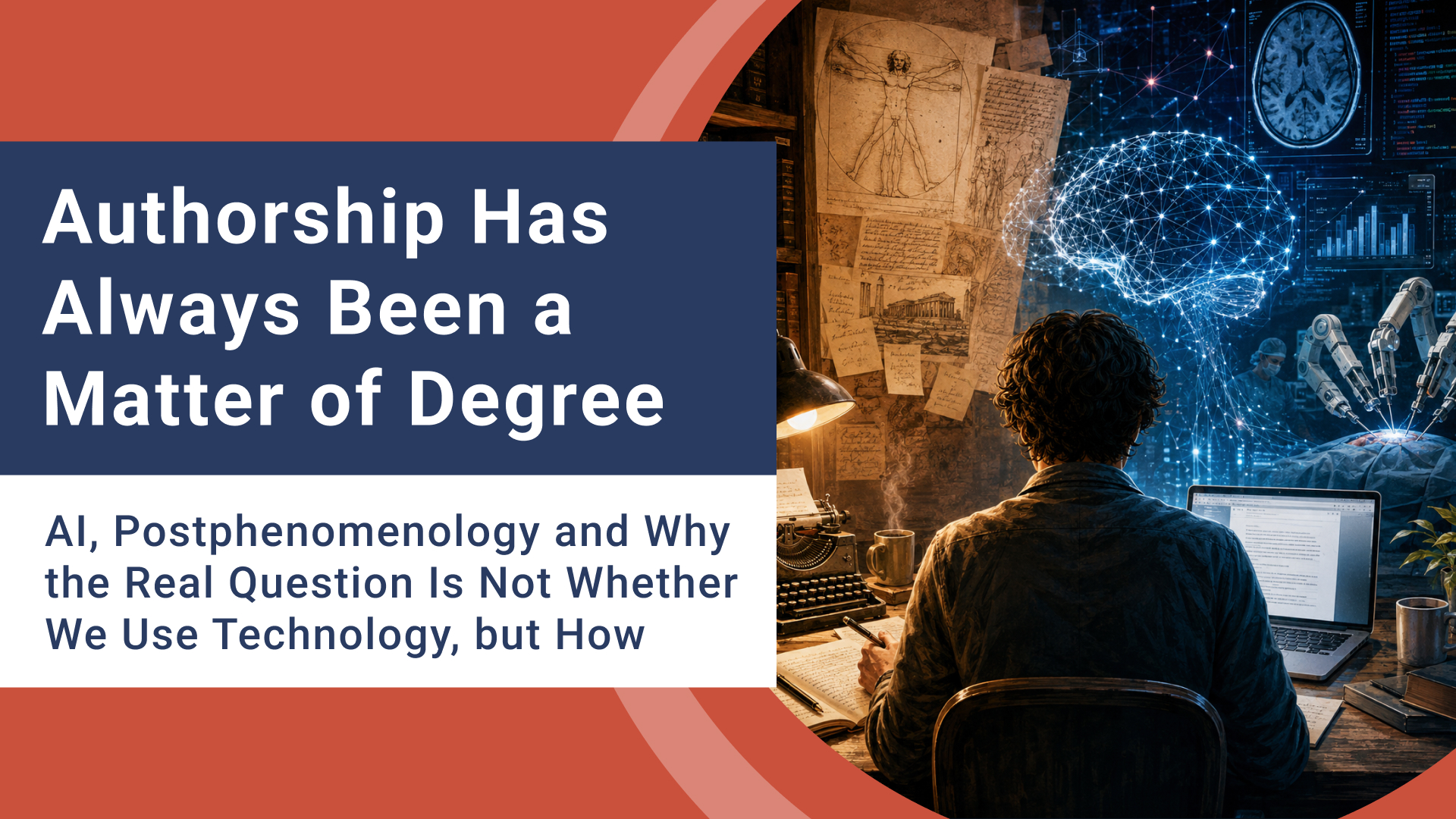

There is something strangely comforting about the accusation that something is ‘AI-generated’. The phrase appears to settle a matter before it has even been examined. A book used artificial intelligence. A software developer generated some code with an AI system. An image emerged through computational assistance. Therefore, something about its legitimacy, originality or authorship is presumed to have been diminished. But what exactly has been established? Very little. The expression identifies the presence of a technology while telling us almost nothing about the human agency surrounding its use. Generative AI is not merely a word processor with better manners. It can propose arguments, structures, formulations and alternatives that materially enter the creative process. Precisely for that reason, however, simply saying that ‘AI was used’ is analytically insufficient. The important question is how much of the work's intention, judgement, selection, testing, integration and responsibility remained with the human beings directing it.
The deeper problem is an impoverished conception of authorship. We sometimes speak as though genuine authorship means a solitary individual sitting in a room, producing every word, sentence, reference and revision unaided until a finished book somehow emerges. It is a romantic image and an extraordinarily poor description of how many serious books, films, research projects, software systems and other substantial works actually come into existence.
Authorship has always been a matter of degree. An author may originate a thesis, conduct months or years of research, discuss developing ideas with colleagues, test them with audiences, work through multiple drafts, receive substantial editorial criticism, employ researchers, use specialist reviewers, accept hundreds of editorial changes and eventually work with designers, proofreaders, indexers and typesetters. The finished work can nevertheless meaningfully remain the author’s work. That is not a contradiction. It tells us that authorship was never synonymous with performing every unit of labour personally. The arrival of generative AI has not created this problem. It has made it much harder to avoid seeing it.
The solitary author was always partly a myth
Books have authors, but books are also projects. A serious book can involve researchers, librarians, subject specialists, beta readers, developmental editors, copyeditors, proofreaders, designers, illustrators, indexers, typesetters, publishers and printers. Academic works may additionally pass through supervisors, research collaborators and peer reviewers. Even relatively independent authors often test arguments through conversations, lectures, seminars, programs, workshops or correspondence long before a manuscript reaches publication.
The existence of these contributors does not ordinarily cause us to conclude that nobody authored the book. Instead, we implicitly recognise something more sophisticated: the author is often the originating, directing, integrating and accountable centre of a larger process. The same distinction appears everywhere once we begin looking for it. The architect does not need to pour the concrete personally to remain the architect of the building. A film director does not become an impostor because somebody else operated the camera. A composer need not personally play every instrument in an orchestra. A chief software architect may meaningfully author the architecture of a platform while having written only a fraction of its source code.
We understand these distinctions perfectly well until AI enters the room. Then a peculiar standard of monastic self-sufficiency sometimes appears. Apparently the respectable author must have conceived the argument, conducted the research, remembered every source unaided, produced every sentence manually, edited every paragraph, checked every reference, designed the pages and perhaps, if we follow the principle to its logical conclusion, felled the tree from which the paper was eventually made. The absurdity helps reveal the category mistake. Authorship is not the absence of assistance. It concerns the nature, extent and location of agency within the creation of a work.
Authorship is an agency gradient
It is therefore more useful to understand authorship as an agency gradient than as a binary condition. At one end, a person may contribute little more than an instruction such as ‘write me a book about leadership’, accept whatever emerges and publish the output without substantial understanding, direction or revision. Their claim to substantial intellectual authorship would understandably be weak.
At another point on the gradient, someone may spend years developing a theory, build its conceptual architecture, collect observations, run programs in which its propositions encounter reality, take extensive notes, discuss the ideas with practitioners, challenge them through specialist review and use AI intensively throughout the process for analysis, comparison, criticism, research assistance, drafting, rewriting and conceptual testing. That person may have used AI thousands of times while nevertheless exercising profound authorship over the resulting work.
Between those extremes are countless variations. The meaningful questions concern intention, origination, judgement, selection, direction, integration, transformation, understanding and responsibility. Who determined why the work should exist? Where did its governing questions and distinctions originate? Who selected between competing possibilities? Who recognised when something was wrong? Who forced the work through successive rounds of improvement? Who integrated its parts? Who can explain and defend what eventually appears under their name? No single answer determines authorship by itself, but together they tell us considerably more than the statement that ‘AI was involved’. Manual production and authorship are not the same variable. That distinction is load-bearing for everything that follows.
We repeatedly confuse labour with authorship
There is genuine value in making certain things by hand. A hand-knotted Persian carpet is not interchangeable with a machine-produced carpet merely because both can cover a floor. Part of the value of the former resides precisely in its making: accumulated craftsmanship, individual variation, tradition, time and physical participation. The same applies to many arts and crafts. A hand-thrown ceramic vessel, a hand-carved piece of furniture or a handwritten manuscript may possess forms of value partly constituted by the process through which it came into existence.
But it does not follow that greater manual labour is therefore the universal measure of authorship or quality. A book is not more insightful because somebody endured the unnecessary physical production of every component. Software is not more reliable because a developer refused useful libraries and rewrote basic functionality from scratch. A statistical argument does not become more valid because its calculations were performed with pencil and paper.
We need to distinguish craftsmanship, labour, provenance, originality, intellectual contribution and authorship. They can overlap, but they are not synonyms. Sometimes difficulty produces skill and depth. Sometimes difficulty is part of the meaning of the work. Sometimes, however, difficulty is simply friction wearing a very flattering hat. That distinction matters enormously in the age of AI.
We have been here before, although never quite like this
Suspicion of technologies that alter human intellectual activity is not new. Plato’s Phaedrus famously contains Socrates’ discussion of writing and the concern that reliance upon written words could create the appearance of wisdom without the corresponding development of understanding. There is an enduring irony in the fact that the warning survives because Plato wrote it down. That irony should not dismiss the concern, because the concern was partly perceptive. Externalising memory changes how human beings relate to knowledge. The important historical lesson is not that previous technological anxieties were always foolish, but that technologies can simultaneously expand human capacities and generate new forms of dependence, displacement and superficiality.
Printing created another profound displacement. Manuscript production had depended heavily upon hand-copying by scribes, while movable-type printing progressively altered the economics, scale and organisation through which texts could circulate. Yet the printed book did not render the writer less of an author because somebody stopped manually reproducing every copy.
Photography generated its own dispute over the relationship between machinery and artistic creation. Alfred Stieglitz became a major advocate for photography as a medium capable of artistic expression comparable with painting and sculpture. What subsequently became obvious was that a machine could perform an indispensable part of the causal process without exhausting the question of artistic agency.
Software development gives us an even clearer example. Programming has repeatedly moved human work towards higher levels of abstraction. Grace Hopper’s A-0 system is often identified as an early compiler, part of the historical movement towards enabling programmers to express intentions in forms that machines would translate into lower-level operations. Imagine insisting today that a programmer using a compiler has not genuinely programmed because they did not personally produce the machine instructions. Extend that argument and modern software development collapses almost immediately. Developers routinely rely upon programming languages, operating systems, frameworks, libraries, APIs, databases and code written by people they will never meet.
We call this civilisation when we like the abstraction and cheating when the abstraction is unfamiliar. That should at least make us suspicious of our instincts.
Medicine has never demanded technological purity
Medicine provides an especially revealing case because the consequences of getting the relationship between human expertise and technology wrong are considerably more serious than bruised literary pride. Modern medical practice is deeply technologically mediated. A radiologist does not demonstrate greater professional integrity by refusing digital imaging. A cardiologist does not become less of a physician because an electrocardiogram, echocardiogram or other instrumentation makes physiological phenomena perceptible in ways unaided senses cannot. Surgeons routinely work through imaging, endoscopic systems, computer-assisted instrumentation and increasingly sophisticated robotic platforms.
What is commonly called ‘robotic surgery’ provides an almost perfect illustration of the agency problem. The US Food and Drug Administration describes robotically assisted surgical systems as systems through which the surgeon uses computer and software technology to control and move surgical instruments. The technology changes the surgeon’s capabilities and the form through which action occurs, but the surgeon remains the directing human agent. The robot, despite the branding, has not quietly completed medical school.
This matters conceptually. We do not ordinarily ask whether the surgery was ‘human-generated’ or ‘machine-generated’. We ask whether the intervention was appropriate, whether the practitioner was competent, whether the technology performed reliably, whether appropriate safeguards existed and whether responsibility was properly located.
AI is now adding another layer. The FDA maintains a continuously updated list of AI-enabled medical devices authorised for marketing in the United States, illustrating that machine-learning systems have already moved from speculative discussion into regulated clinical technologies. Pattern recognition is particularly significant because medicine contains enormous quantities of data whose relevant features may be visual, statistical or multidimensional. Recent clinical studies have examined AI-supported interpretation in areas including mammography and endoscopic cancer detection. A randomised controlled trial has, for example, evaluated an AI diagnostic system for detecting oesophageal squamous cell carcinoma in clinical practice, while large trials of AI-supported mammography have investigated the relationship between algorithmic assistance, detection performance and clinicians’ workload.
The responsible conclusion is not that artificial intelligence should diagnose everyone while the doctors go fishing, nor that medical expertise should preserve its dignity by refusing computational assistance. The relevant question is how expertise and technology should be configured together. When should the practitioner defer to an instrument? When should they override it? How is disagreement between machine output and clinical judgement resolved? What constitutes sufficient validation? What happens when populations differ from the data on which a system was developed? How should performance drift be detected? Who remains accountable when recommendations are generated through increasingly complex systems?
Regulators are already confronting precisely these questions. The FDA’s recent work on AI-enabled medical devices emphasises lifecycle management, evaluation, safety, effectiveness and the possibility that performance needs continuing scrutiny after deployment. Medicine therefore points towards a more mature technological ethic: professional excellence does not require technological abstinence. It requires the capacity to incorporate technologies without surrendering judgement, competence or responsibility. That is almost exactly the problem now facing authors, programmers, educators, researchers, designers and many other professionals.
AI is not merely another typewriter
None of this means generative AI should be treated as though nothing genuinely new has occurred. A word processor does not normally propose an argument. A calculator does not usually challenge the assumptions behind your thesis. A traditional compiler translates according to established rules rather than producing substantial candidate solutions in the manner of generative systems.
Contemporary AI can generate prose, code, images, interpretations, summaries, hypotheses, counterarguments and alternative structures that the user did not explicitly specify beforehand. That difference matters. AI can therefore contribute at levels previously associated much more closely with human intellectual activity. It can also generate confident nonsense, flatten distinctive voices, fabricate references, reproduce conventional assumptions and allow someone who understands almost nothing to produce material that superficially resembles competence.
These are serious concerns, but they are arguments for disciplined use, not technological abstinence. The important distinction is between leveraging a capability and surrendering agency to it. AI can replace thinking, but it can also provoke substantially more thinking than would otherwise have occurred. It can eliminate judgement, but it can also increase the number of alternatives over which judgement becomes possible.
AI can make a person intellectually lazy. It can also allow an intellectually demanding person to become substantially more demanding because the cost of testing, comparing, restructuring and challenging ideas has fallen dramatically. The technology does not settle which of these occurs. The manner of participation does.
‘AI-generated’ tells us remarkably little
Consider three hypothetical authors. The first asks an AI system for a book on organisational leadership, receives chapter after chapter, performs superficial edits and publishes the result despite possessing little command of the underlying arguments.
The second has spent fifteen years developing a distinctive theoretical system. Throughout the process, ideas have been developed through professional practice, conversations, programs, observations, notebooks and repeated encounters with difficult cases. AI is then used heavily to interrogate arguments, explore counterpositions, locate conceptual relationships, restructure chapters, compare terminology, generate candidate formulations and accelerate revisions. The author repeatedly rejects suggestions, modifies others, verifies claims, tests important propositions with people in the relevant field and subjects the manuscript to specialist and editorial scrutiny.
The third avoids AI completely, manually writes every sentence and largely restates familiar ideas without substantial originality, critical engagement or independent judgement. The label ‘AI-generated’ would separate the first two people from the third. An authorship analysis might place the second person considerably above both others. That is why the binary fails. The presence of AI tells us something about the production process, but it does not, by itself, tell us enough about authorship.
From a purity test to an integrity test
A better response is to replace the purity test with an integrity test. Purity asks whether assistance occurred. Integrity asks what happened to human agency, understanding and responsibility because of that assistance.
Did the creator understand what was ultimately published? Were consequential claims verified? Could important propositions survive challenges from knowledgeable people? Were sources checked rather than merely generated? Did the work encounter reality outside the author-AI conversation? Did specialists examine material where specialist competence mattered? Were disagreements preserved where they could not honestly be resolved? Did an editor encounter the manuscript as an actual reader rather than merely as another predictive system? Did the author remain prepared to reject fluent material that happened to be wrong?
This changes the conversation radically. Someone can use very little AI with poor integrity, while someone else can use AI extensively with extraordinary integrity. The relevant issue is no longer technological chastity. It is the quality of the developmental process.
What authorship with integrity can actually look like
The confusion surrounding AI partly arises because people imagine only the visible moment of generation. They picture someone typing a prompt, receiving a paragraph and pasting it into a manuscript. That certainly happens, but it is an extraordinarily narrow representation of what AI-assisted intellectual production can become.
A serious authorship process can instead operate through repeated movements between conception, technological assistance, human interaction, reality testing, verification and professional scrutiny. A useful integrity template might involve the following sequence.
1. Origination and conception. The project begins with a problem, question, experience, observation, theory or creative intention for which the author assumes intellectual responsibility. AI may help interrogate or articulate the emerging idea, but there needs to be a meaningful centre of intention from which the project is being directed.
2. Exploration and adversarial development. Ideas are expanded, compared with alternatives and deliberately challenged. AI can be particularly valuable here because counterarguments, conceptual tensions and possible structures can be generated cheaply and repeatedly. The objective should not be to find a machine that agrees. A machine that agrees with everything is intellectually about as useful as a dinner guest who nods enthusiastically while asleep.
3. Encounter with real people. Important ideas should leave the closed circuit between author and machine. They can be discussed with colleagues, practitioners, students, clients, readers or carefully selected closed groups. Questions that appear elegant on a screen can behave very differently when confronted by a confused human being who has the inconvenient habit of asking what they actually mean.
4. Practice and field testing. Where the subject permits it, propositions can be explored through programs, workshops, professional practice, prototypes, experiments or other forms of application. This produces a different kind of feedback from textual criticism. Reality is a notoriously unsympathetic reviewer, which is precisely why its comments are valuable.
5. Observation and disciplined note-taking. Reactions, anomalies, repeated misunderstandings, unexpected outcomes and practical difficulties should be captured. These observations can then return to the conceptual work rather than being treated as distractions from a theory that has already decided it is correct.
6. Repeated refinement. The emerging work passes through multiple cycles of clarification, restructuring, subtraction and reconstruction. AI can dramatically accelerate this stage, particularly when comparing versions, identifying duplication, testing terminology or exploring alternative explanations. Speed here should enable more refinement rather than provide an excuse to stop refining.
7. Reference verification and evidential checking. Citations, quotations, historical claims, statistics and technical propositions need to be checked against actual sources. AI can help discover material and identify possible connections, but consequential claims should not survive merely because an AI produced a plausible-looking reference. A fabricated citation wearing italics remains fabricated.
8. Specialist challenge and peer engagement. In highly specialised domains, knowledgeable people remain indispensable. Lawyers should examine consequential legal arguments, clinicians medical claims, historians contested historical interpretations and domain specialists technical assertions requiring expertise. Formal peer review provides one mechanism in academic settings, while serious informal specialist review can reveal weaknesses invisible to both author and machine.
9. Professional editing and human proofreading. Once the argument and structure have matured, professional editorial work becomes crucial. Structural editing, developmental editing, stylistic editing, copyediting and proofreading involve different forms of intervention and should not be collapsed into ‘checking the spelling’.
10. Production and final responsibility. Design, typesetting, indexing, proofreading and final production transform a manuscript into a finished publication. The author remains responsible for deciding what is ultimately allowed to appear under their name.
This process remains authorship. In fact, it can embody a considerably more serious form of authorship than the romantic image of someone working entirely alone and trusting whatever first sounded convincing.
Editors matter more than punctuation
The role of the editor deserves particular attention because public imagination often reduces editing to grammar, spelling and punctuation. In this caricature, an editor wanders through the manuscript carrying a red pen, searching for commas that have escaped supervision. The actual contribution can be much more substantial.
A strong editor can work at the level of structure, conceptual sequence, language, tone, accessibility, continuity, pacing, emphasis, audience and coherence. They can notice that an argument arrives two chapters too early, that an explanation assumes knowledge the intended reader does not possess or that two independently strong sections undermine one another when placed together. They can notice that a voice has become strangely clinical, that one chapter no longer sounds as though it belongs to the same author, that an explanation is technically correct but almost impossible to care about or that a writer has become so familiar with an idea that they can no longer experience it from the reader’s position.
Editors can detect excessive abstraction, unnecessary repetition, abrupt transitions, conceptual overreach, unexplained terminology and moments when the author’s private understanding has outrun what actually appears on the page. They can also guard something more difficult to formalise: the human presence of the work. Humour, vulnerability, cultural texture, rhythm, personality, restraint, timing, relatability and even productive irregularity can all matter to whether an argument reaches another person.
That becomes particularly important in AI-assisted writing. Generative systems can produce highly competent prose while gradually sanding away precisely those irregularities through which an author’s personality becomes recognisable. The unusual metaphor, unexpected turn of phrase, culturally situated observation or sentence that technically should not work but somehow does can disappear beneath relentless optimisation.
AI will become increasingly useful to editors themselves. It can compare terminology, identify inconsistencies, surface repetitions, examine structure and generate alternatives. That does not mean the editor disappears. Indeed, some editorial functions may become more valuable precisely because automated language becomes more capable. When acceptable prose becomes cheap, judgement about which prose deserves to remain becomes more important. Even writers need readers, especially writers with very enthusiastic computers.
Human proofing still matters
Proofreading can similarly be underestimated. It is not simply another round of creative rewriting, but a final quality-control encounter with the work after substantial editorial and production decisions have already occurred. Every transformation of a manuscript creates possibilities for new errors. References can become detached from claims, captions can cease matching images, headings can become inconsistent, formatting can distort hierarchy and typesetting can introduce problems absent from the editable manuscript.
A human proofreader therefore encounters something slightly different from the author and editor. They encounter the near-final artefact with the specific responsibility of finding what everyone else has gradually become blind to. Again, machines can and will perform more of this work. The larger principle remains unchanged: quality emerges through layers of scrutiny, not ritual allegiance to one particular means of production.
Specialised work requires specialised challenge
The same principle becomes more important as the stakes rise. A philosophical proposition can be interrogated philosophically. An empirical assertion needs evidence. A historical claim needs historical support. A legal interpretation may depend upon jurisdiction and current law. Medical, engineering and scientific claims can require highly specialised expertise.
AI can provide extraordinary assistance across these domains, but fluent interdisciplinarity should not be mistaken for unlimited competence. A system capable of sounding equally confident about Aristotle, oncology and New Zealand tax law has not thereby acquired three professional registrations. A serious author therefore needs to know where their own competence ends. That recognition does not diminish authorship. It is part of responsible authorship.
Seeking specialist review is not an admission that the author did not write the work. It is evidence that the author cared more about producing something defensible than maintaining the theatrical appearance of solitary omniscience.
Authorship is therefore a project, not a keystroke count
Once these pieces are brought together, authorship begins to look very different. A substantial work may move repeatedly between one person and many others, between reflection and conversation, between field experience and conceptualisation, between AI interaction and human challenge, between research and rewriting and between specialist criticism and editorial reconstruction.
The project can remain meaningfully authored because authorship resides partly in maintaining the coherence and direction of that movement. The author determines what the project is becoming, carries decisions across its history and recognises when an apparently attractive suggestion would violate something established elsewhere. They decide which criticism reveals a genuine weakness and which reflects a different philosophical commitment. They integrate discoveries that could not have been anticipated at the beginning and determine when a revision improves the work or merely makes it different.
Most importantly, the author ultimately stands behind the work. That final responsibility cannot simply be prompted away.
Postphenomenology: technology does not merely assist experience
There is a deeper philosophical reason why the question of technology cannot be reduced to whether we ‘use’ it. Postphenomenology, associated particularly with Don Ihde and later developed through thinkers such as Peter-Paul Verbeek, examines the relations between human beings, technologies and the world. Rather than treating technologies simply as neutral objects positioned between an already complete human subject and an already given reality, postphenomenological approaches investigate how technologies mediate the ways reality becomes experienced, interpreted and acted upon.
Consider spectacles. Once incorporated into ordinary experience, we do not usually experience ourselves as examining a technological artefact positioned several centimetres in front of our eyes. We experience the world through it. A microscope similarly does not merely save the scientist some effort. It makes phenomena available to perception that unaided human vision cannot disclose. Medical imaging renders internal structures interpretable without opening the body. Navigation systems reorganise how people encounter unfamiliar space. Search engines alter the practical relationship between memory and retrieval. Smartphones change the temporal relationship between communication, presence, documentation and availability.
Technologies therefore do more than perform tasks for us. They can participate in the formation of the field within which we perceive, interpret and act. Verbeek’s account of technological mediation develops precisely this point. Human action and experience are often technologically mediated, meaning that technology participates in shaping both how the world appears and how people are able or inclined to act within it. His work extends this argument even into questions of moral subjectivity and decision-making.
This matters enormously for AI. If AI were merely a faster mechanical pencil, the ethical and philosophical questions would be comparatively straightforward. But AI can mediate what information we encounter, which alternatives become salient, how problems are formulated, which patterns become visible, what forms of language become available and even what questions occur to us as worth asking. AI therefore does not simply sit outside human thinking as an optional attachment. In many contexts, it can become part of the architecture through which thinking occurs.
This is neither an argument for embracing AI without restraint nor for rejecting it. Postphenomenology gives us a much more demanding position than either response because the relevant task is to understand the mediation. What does a technology amplify? What does it reduce? What becomes newly visible and what becomes obscured? Which forms of action become easier? Which capacities might weaken through disuse? What habits does the technology cultivate? What dependencies does it create? What kinds of person, practice or institution become more likely to develop around it? These questions are more useful than asking whether technology is intrinsically good or bad.
From adoption to technological participation
This leads to a broader problem than authorship. Modern life is already deeply technologically mediated. We wake according to clocks, travel through engineered transport systems, communicate through telecommunications infrastructure, see through medical and optical devices, outsource portions of memory to digital systems, navigate through satellite positioning and increasingly encounter institutions through algorithmically organised interfaces.
There is no technologically untouched vantage point to which modern civilisation can simply return. Even the person announcing online that humanity must reject technology has usually required a rather impressive technological stack to distribute the announcement. The serious question is therefore not simply whether to ‘embrace technology’. That phrase is too indiscriminate to be useful. One can embrace something foolishly. Nor is the serious alternative to ‘reject technology’. Technologies are too differentiated and too deeply embedded in human practices for such a general position to provide much guidance.
The problem is how human beings should participate with technology. At the individual level, this means asking how technologies should enter one’s way of living. Which capabilities should be delegated and which deliberately retained? Which tools extend capacity and which begin to atrophy it? When should friction be removed and when should it be intentionally preserved? Where does convenience become dependency? Where does technological mediation expand one’s range of participation and where might it narrow attention, patience, memory, judgement or interpersonal presence?
At the organisational level, the same questions become questions of systems and governance. Where should AI advise, where should it decide and where should it not be present at all? What forms of human review are required? What expertise must remain internally available even when tasks can be automated? How should errors be detected, challenged and learned from?
At the societal level, the questions become larger still. Institutions need frameworks for accountability, access, transparency, education, professional standards, technological concentration and the protection of forms of human capacity that may remain socially important even when machines can perform corresponding tasks more efficiently. The debate therefore needs to move from adoption to participation. Adoption asks, ‘Should we use this?’ Participation asks, ‘What relationship with this technology are we constructing?’ The second question is considerably more important.
The How Principle
This brings the argument back to its central proposition. The legitimacy of technological assistance should be judged less by whether technology participated and more by how human agency, understanding, judgement and responsibility were exercised through it. Call this the How Principle.
The question therefore changes from Did you use AI? to How did you use AI? Did it substitute for understanding or deepen understanding? Did it generate conclusions the user accepted passively or alternatives the user subsequently interrogated? Was it used to avoid reading sources or to identify sources that were then examined? Did it replace engagement with people or allow ideas to become sufficiently developed that engagement with people became more productive? Was it asked merely to agree or systematically used to attack the emerging position?
Did the creator become less capable of explaining the work as AI use increased, or more capable because hundreds of possible objections had already been encountered? Did automation eliminate a capacity worth preserving, or release time from repetitive work so that more demanding human capacities could be exercised? These are questions worth asking. Increasingly, ‘Was AI involved?’ is not.
The confusion is partly about what AI actually is
Much of the present debate is conducted as though ‘using AI’ described one activity. It does not. Someone might use AI to correct spelling. Another might use it to locate possible literature. Another may have it explain an unfamiliar concept. A programmer may use it to generate unit tests. A researcher may use it to identify patterns in material. An author may use it as an adversarial interlocutor.
A medical specialist may work with AI-assisted imaging. A surgeon may operate through sophisticated computer-mediated instrumentation. A product designer may generate hundreds of visual alternatives. A philosopher may use AI to expose contradictions across a body of work too large to hold simultaneously in working memory. A software architect may move between system design, code generation, debugging, documentation and testing. Someone else may type ‘write my assignment’ and go to lunch.
Calling all these things ‘AI use’ and treating them as intellectually equivalent is not serious analysis. It is categorisation at approximately the sophistication level of describing both neurosurgery and juggling as ‘things people do with their hands’. AI is not one practice. It is a class of capabilities capable of entering many practices at many different levels. Our vocabulary has not yet caught up.
Some established institutions will resist this longer than others
Established professions rarely greet technologies that rearrange their practices with complete equanimity. Editors, academics, publishing houses, educational institutions, software organisations and professional associations are currently negotiating not only what AI can do but what its capabilities mean for established roles, standards and responsibilities.
Some caution will prove justified. Some resistance will protect things worth protecting and some restrictions will expose genuine problems that enthusiasts ignored. Some resistance will also simply be resistance. Those categories should not be collapsed. It would be as simplistic to assume that technological novelty makes a practice superior as it is to assume that technological assistance makes a practice corrupt.
Traditional editors, publishing houses and other established institutions will therefore respond unevenly. Some will integrate new capabilities quickly, others will move cautiously and some practices may eventually prove worth retaining almost unchanged. Let that process occur. Every significant technological transition involves a period in which yesterday’s expertise, today’s uncertainty and tomorrow’s norms occupy the same room and attempt awkward conversation. We are inside that period now.
Refusing leverage is not automatically virtuous
There will continue to be excellent reasons to work manually. Writers may write longhand because slowness changes the quality of reflection. Artists may paint because physical engagement with materials is part of the work. Programmers may deliberately build systems from first principles because doing so develops understanding. Craftspeople may preserve methods whose value is inseparable from tradition and process. These practices deserve preservation, but preserving craftsmanship is different from universalising it.
There is nothing inherently noble about spending six hours performing an activity that could responsibly be completed in twenty minutes if the remaining time could be devoted to deeper research, more experimentation, additional conversations, stronger criticism or another round of refinement. Nor does efficiency automatically justify automation. Sometimes the friction is educational. Sometimes the friction is contemplative. Sometimes the friction produces mastery. And sometimes we are simply using a teaspoon to empty a swimming pool because our grandparents owned an excellent teaspoon. Wisdom consists partly in knowing which situation we are actually in.
AI raises the premium on judgement
The arrival of AI moves the scarce resource upward. When producing competent prose becomes easier, deciding what deserves to be said becomes more important. When generating code becomes easier, architectural judgement becomes more important. When finding possible arguments becomes easier, distinguishing strong arguments from attractive rubbish becomes more important.
When hundreds of designs can be produced in minutes, selection becomes more consequential. When enormous quantities of information become accessible, epistemic discipline matters more. When AI can produce polished language almost instantly, knowing when that polished language is subtly wrong becomes a higher-order competence.
This is why AI does not necessarily diminish human contribution. At its best, it changes its location. Less human effort may be required for certain forms of production while more human capacity becomes available for conception, discernment, integration, challenge, judgement and refinement. That transition will certainly make some existing skills less scarce. It will make others considerably more valuable.
Authorship after AI
AI has not destroyed authorship. It has exposed how simplistic some of our assumptions about authorship already were. Human creation has never occurred in isolation. It emerges through inherited languages, accumulated knowledge, technologies, institutions, conversations, collaborators, critics, editors, readers and communities of practice. The author was never a sealed cognitive container.
What AI changes is the scale, speed, responsiveness and breadth of assistance available within that ecology. One individual can now work with something capable of functioning, imperfectly and variably, as researcher, critic, coding assistant, language editor, translator, brainstorming partner, conceptual challenger and analytical instrument. Of course this changes authorship. It would be astonishing if it did not.
But the mature response to that change is neither blind enthusiasm nor nostalgic refusal. It is a more demanding account of authorship, one capable of distinguishing assistance from abdication, leverage from dependence and extensive technological use from the surrender of intellectual responsibility.
Postphenomenology helps us see that the issue is larger still. Technologies do not merely change what human beings can produce. They participate in changing how human beings encounter and interpret the world within which that production occurs. The challenge ahead is therefore not merely to decide which technologies humanity will permit itself to use. That framing is already too shallow. The challenge is to develop increasingly sophisticated ways of deciding how technologies should participate in human life.
That requires frameworks at the level of individuals, professions, organisations and societies. It requires us to preserve capacities worth preserving, extend capacities worth extending and recognise forms of dependence before they become invisible simply because they have become normal. The same principle applies to the author working with an AI system, the surgeon working through computer-assisted instruments, the radiologist interpreting machine-supported imaging, the programmer working through increasingly abstract layers of computation and the ordinary person navigating a technologically saturated life.
The question is not technological purity. It is responsible participation. Authorship has always been a matter of degree because authorship has always involved a distribution of contribution across people, tools, traditions and institutions. The emergence of generative AI makes that distribution more visible and more complicated, but not unintelligible.
The person who presses every key is not necessarily the author in the deepest sense. The person who uses the most technology has not necessarily surrendered authorship. The person who refuses technology has not thereby demonstrated originality, understanding or integrity. The better questions concern agency. Who originated? Who understood? Who questioned? Who tested? Who listened? Who verified? Who changed their mind? Who integrated the parts? Who sought criticism? Who rejected what failed? Who refined what survived? Who ultimately accepts responsibility for the finished work?
Those questions can tell us something meaningful. That is why the defining question of authorship in the age of AI should no longer be Did you use it? It should be the question that increasingly confronts us far beyond authorship as well:
How did you use it?
References
Computer History Museum (n.d.) ‘Grace Hopper completes A-0’, Timeline of Computer History. Computer History Museum.
Editors Canada (2024) Professional Editorial Standards 2024. Toronto: Editors’ Association of Canada.
Eisenstein, E.L. (1979) The Printing Press as an Agent of Change: Communications and Cultural Transformations in Early-Modern Europe. Cambridge: Cambridge University Press.
Gommers, J. et al. (2026) ‘Interval cancer, sensitivity, and specificity comparing AI-supported mammography screening with standard double reading without AI in the MASAI study: a randomised, controlled, non-inferiority, single-blinded, population-based, screening-accuracy trial’, The Lancet, 407(10527), pp. 505–514.
Ihde, D. (1990) Technology and the Lifeworld: From Garden to Earth. Bloomington: Indiana University Press.
Plato (1995) Phaedrus. Translated by A. Nehamas and P. Woodruff. Indianapolis: Hackett Publishing Company.
Rosenberger, R. and Verbeek, P-P. (eds) (2015) Postphenomenological Investigations: Essays on Human–Technology Relations. Lanham, MD: Lexington Books.
US Food and Drug Administration (2022) ‘Computer-Assisted Surgical Systems’. Silver Spring, MD: US Food and Drug Administration.
US Food and Drug Administration (n.d.) ‘Artificial Intelligence-Enabled Medical Devices’. Silver Spring, MD: US Food and Drug Administration.
Verbeek, P-P. (2005) What Things Do: Philosophical Reflections on Technology, Agency, and Design. University Park, PA: Pennsylvania State University Press.