
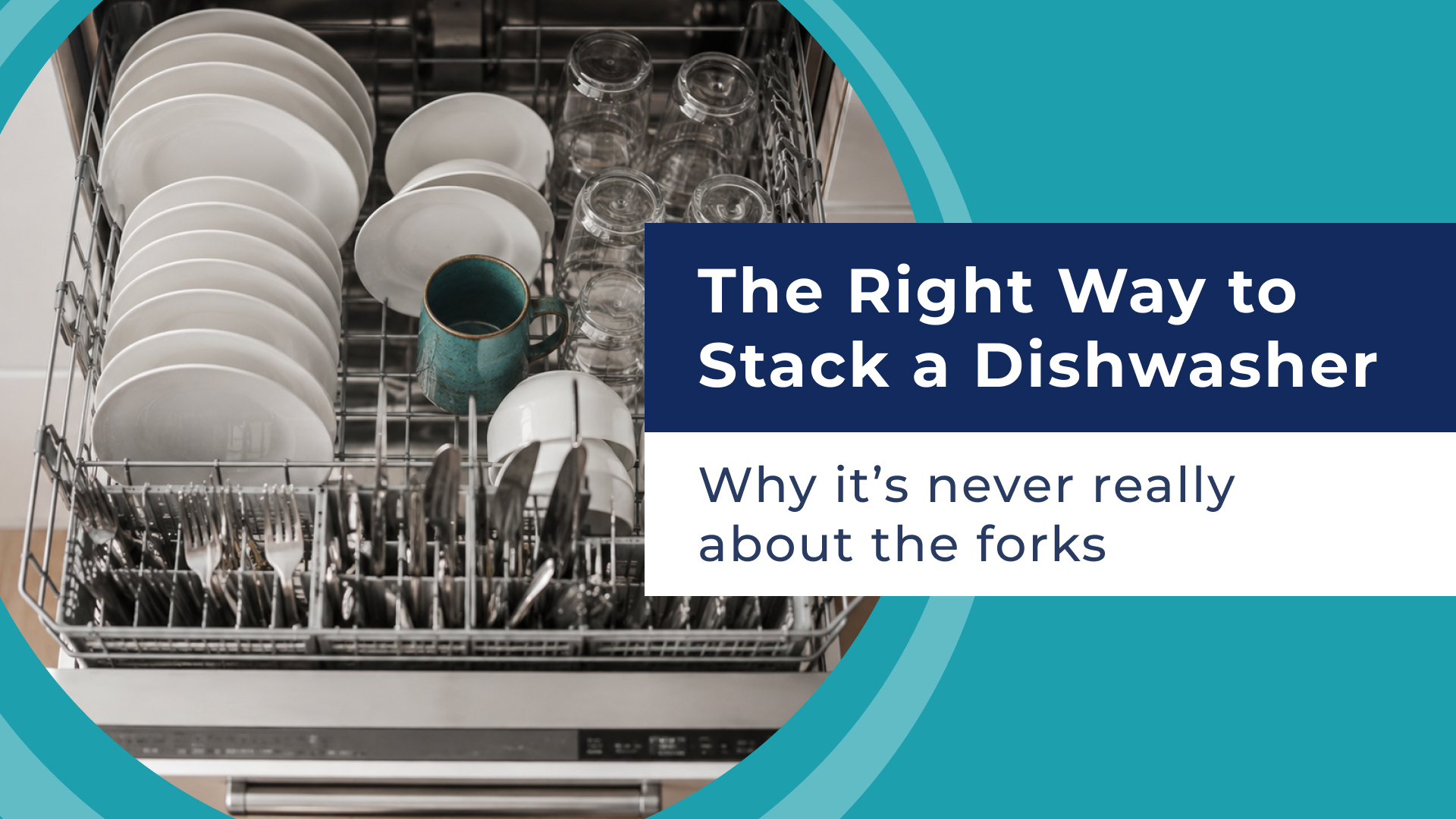

Is anything wrong with this picture?
If artificial intelligence were quietly studying humanity, I suspect it would become fascinated by one particular household appliance. Not because of its engineering, nor because of its remarkable ability to wash dishes while we sleep, but because of the curious behaviour of the humans standing around it. Imagine the report:
Observation One: Humans invented a machine designed to reduce domestic labour. Excellent.
Observation Two: Humans now spend astonishing amounts of time debating how the machine should be loaded. Interesting.
Further observations reveal elevated emotional responses to bowls placed in the “wrong” position, coffee mugs blocking the spray arm, whether plastic belongs on the top shelf, and an apparently unresolved international dispute concerning the peaceful coexistence of forks and spoons. Despite extensive monitoring, no evidence has been found that the dishwasher itself cares where the cutlery goes. The appliance appears highly effective at washing dishes. It appears considerably less effective at improving human relationships.
Before we go any further, I’d like you to stop for a moment and picture your own dishwasher. Think about how you load it. Do the dinner plates always go in the same place? Are the bowls carefully arranged or optimistically squeezed into whatever space remains? Do forks and spoons happily share a compartment, or must they be permanently segregated? Are you prepared to press Start with only half a load, or do you experience a small, slightly smug satisfaction when, after careful calculation, one final cereal bowl slides perfectly into place and the door closes with a reassuring click? Have you ever stopped to ask yourself why? Most of us haven’t. We simply load the dishwasher as though our approach is obvious, sensible and, if we’re completely honest, the correct one. Somewhere along the way, “this is how I do it” quietly became “this is the right way.”
I reflected on ‘dishwasher-stacker characters’ I’ve encountered over the years. Which best describes you? The Curator carefully composes every plate, bowl and mug into an orderly symphony of water flow. The Compression Engineer remains convinced there is always room for one more saucepan. The Chaos Wrangler trusts optimism more than geometry. The Pre-Washer treats the dishwasher as an expensive drying rack, while The Restacker waits patiently until everyone has left the room before reorganising someone else’s contribution. If you’re smiling, you’ve probably recognised yourself, or someone you’ve argued with about stacking.
When preference becomes principle
For years, I belonged firmly in the camp of The Curator. My dishwasher wasn’t simply loaded; it was composed. Plates stood in descending order. Bowls leaned at carefully considered angles. Glasses were grouped by height. Forks stayed loyally with forks. Spoons fraternised exclusively with spoons. Every item had earned its rightful place in what I genuinely believed was the most efficient use of both space and water. Closing the dishwasher door produced a strangely satisfying feeling that suggested, however briefly, the universe had returned to its proper order. Unfortunately, not everybody shared my enthusiasm.
Over the years I’ve had more disagreements than I care to admit about the correct way to stack a dishwasher. Not dramatic, relationship-ending arguments, but those wonderfully ordinary domestic negotiations that somehow carry far more emotional weight than they deserve. Someone would load it “incorrectly”. I would quietly rearrange everything after they left the room. They would notice. I’d defend myself with an earnest explanation about spray arms, water circulation and getting the best wash possible. They would accuse me of being controlling. We’d both insist we were simply trying to help. Looking back now, it’s difficult not to laugh.
The dishwasher was invented to save us time. Yet many households have probably spent more collective hours discussing how to load the thing than they have ever saved by owning it. Before dishwashers, there was often a small domestic choreography to the end of the day. One person washed. Another dried. Tea towels passed from hand to hand. Conversations wandered from school to work to what was happening tomorrow. Nobody thought of it as quality time. It was simply part of living together.
Somewhere between technological innovation and everyday life, we quietly relocated the labour. We no longer stand shoulder to shoulder at the sink. Instead, we negotiate bowl placement, chopping board orientation and whether one more frying pan can be persuaded into the remaining two centimetres of available space. Had we simply washed everything by hand, we might already have finished dessert.
The dishwasher changed more than how we cleaned the dishes. It quietly reshaped the social architecture of the kitchen. Washing and drying naturally invited participation. Loading a dishwasher, by contrast, often becomes a one-person optimisation problem, subtly changing how we contribute, collaborate and even disagree. The technology did exactly what it promised: it made cleaning more efficient. What it couldn't know was that it might also change one of the small rituals through which families shared everyday life. Perhaps we gained time, but lost tiny moments of conversation that technology was never designed to replace.
My fascination with orderly dishwashing may have started much earlier than I realised. As a Brownie, I proudly earned my housekeeping badge. We learned that glasses were washed first because they were the cleanest, pots were washed last because they dirtied the water, and there was, apparently, a correct sequence for almost everything. Looking back, I don’t remember anyone saying, “Here’s one possible way to do it.” The lesson was simply, “This is how you do it.”
We inherit ways of doing things long before we inherit reasons for doing them. Families, schools and cultures quietly pass along countless ordinary rituals that become so familiar we stop seeing them as choices at all. Preference slowly hardens into principle. It isn’t until someone does it differently that we discover how quickly this is how I do it has become this is how it should be done. In that moment, we realise we were never simply defending a method. We were defending a way of seeing the world.
When persistence becomes persuasion
A few years ago, I found myself thinking about a Christmas when I was still a child. My father bought my mother a dishwasher. At the time, it seemed like a generous gift. Dishwashers were still something of a luxury, and everyone admired the promise of a machine that could take over one of the most repetitive household jobs. Yet even then, something about it unsettled me. Not because dishwashers aren’t wonderful inventions—they are—but because, without anyone saying it aloud, I’d already understood whose work the dishwasher was supposed to reduce. The gift quietly revealed an assumption about care. The dishes belonged to my mother.
As children, we absorb these assumptions long before we have language for them. We notice who cooks, who clears the table, who remembers the dishwasher tablets, who empties the clean load before breakfast and who quietly reloads it because someone else “didn’t do it properly”. These are rarely explicit rules. They become part of the emotional climate of a household, so familiar that we stop noticing them altogether. It is why what begins as a disagreement about cutlery is often a negotiation about something much deeper. Underneath the forks and bowls sit questions that have very little to do with crockery. How much care is enough? What counts as helping? What does responsibility actually look like? Does contribution mean efficiency, thoroughness, consideration or simply noticing that something needs doing? And perhaps most interesting of all, who gets to decide?
This is where I think the dishwasher becomes surprisingly revealing. In Being: The Source of Power (2021), Ashkan Tashvir describes persistence not as stubbornness but as remaining committed to something that genuinely matters. Healthy persistence keeps us aligned with what matters. Unhealthy persistence begins when commitment quietly hardens into insistence. Somewhere between the forks and the spoons, healthy persistence slips into persuasion. We’re no longer trying to clean the dishes; we’re trying to recruit agreement. The discussion is no longer about water circulation or spray arms. It’s about whose way of seeing the world will prevail. Perhaps that is why dishwasher conversations can become strangely emotional. What we’re defending isn’t the upper rack. We’re defending ourselves.
The right way
Step back for a moment and imagine looking down on the world from above. Eight billion people. Hundreds of cultures. Millions of households. Countless kitchens, each shaped by different histories, different family traditions and different assumptions about work, care and responsibility. Now imagine peering through every kitchen window at exactly the same moment. Some people rinse every plate before loading the dishwasher; others don’t rinse at all. Some run the dishwasher every evening regardless of how full it is. Others wait until loading it becomes an engineering achievement before it goes on. Some stack knives blade down. Others insist on blade up. Some happily mix forks and spoons together, while others separate them with the quiet conviction that civilisation itself depends upon it. From that distance, the certainty begins to dissolve. How extraordinary that so many of us have become convinced of our particular household routine. The one we inherited, copied, improvised or simply stumbled into. It is not merely our way, but the way.
What we’re organising inside the dishwasher is more than crockery. We’re organising our relationship with care, responsibility, contribution, fairness and one another. The dishes simply provide the stage upon which those invisible relationships play out. Once we recognise that, it becomes surprisingly difficult not to see it elsewhere. Familiarity stops masquerading as truth to become visible again as one possible way among many.
We carry these ways of seeing into our workplaces, organisations, communities and public conversations. Every disagreement isn’t about bowls and mugs, but there is an underlying pattern that is remarkably similar. We become attached to methods, traditions and routines until they feel less like choices and more like facts. Some inherited ways deserve protecting. They have been refined through generations of experience and wisdom. Others deserve another look. The dishwasher reminds us how certainty often arrives through repetition, one ordinary habit at a time. Then, one day we start saying, “This is the right way.”
Closing the dishwasher door
Before we close the dishwasher door, there is one final question: When you use toilet paper, do you fold it or scrunch it? If you smiled, you’re probably already aware that this is another one of those wonderfully ordinary human conversations. Ask a group of friends and you’ll quickly discover that many people have surprisingly strong opinions about something they have never consciously examined. Most of us simply adopt a method, repeat it often enough and quietly conclude that it is “right”. So perhaps this is what the dishwasher has been trying to teach us all along. The most interesting question isn’t whether there’s a right way to stack it. It’s how quickly we become convinced that our way is the right one.
There almost certainly are more efficient ways to arrange dishes, just as there are better ways to sharpen knives, plant tomatoes or build a bridge. Experience and expertise matter. Learning from those who have gone before us matters too. But if we pause long enough, interesting questions appear: How easily do we mistake familiarity for truth? How often do we inherit a way of doing something without ever realising we inherited it? How often do we defend a habit as though it were a principle, or a preference as though it were a universal law? And how often do we spend our energy persuading one another that our way is the right way, when the conversation we really need to have is about what we’re trying to achieve together? Here, I find curiosity is more useful than certainty. Curiosity asks, “I wonder why you do it that way?” Certainty declares, “Let me show you the correct way.” One opens a conversation. The other usually ends one.
I still load my dishwasher carefully. Old habits don’t disappear overnight. I still feel a quiet satisfaction when everything fits perfectly and the door closes with a perfectly stacked load. Every now and then, I even catch myself resisting the urge to rearrange someone else’s enthusiastic attempt before pressing Start. Not always. But more often than I used to.
The older I get, the less interested I become in proving that I’m right and the more interested I become in understanding why another way might also work. Perhaps that’s the real invitation. To hold our methods lightly enough that we never lose sight of the people beside us. Because in the end, it’s never really about the forks.
Dr Jordan Marijana Alexander is a writer, executive advisor and human systems strategist exploring how identity, place, culture and living systems shape participation in the modern world. She is the co-founder of RelateAble.Global. If this article has raised questions, sparked reflection, or highlighted something you’re navigating as a leader or in your personal life, you’re invited to book a conversation to explore it further. You can follow DrJMA on LinkedIn and Engenesis for ongoing insights, research, and practical resources.