

About this series
Don’t Take Health Personally is a six-part series exploring a difficult possibility: that health is not primarily personal, but systemic. Beneath behaviour, wellness culture, and individual choice lie deeper forces – identity pressure, conditional care, and inherited value systems that shape how bodies adapt over time. Across gender, culture, place, and work, the series traces a quiet exchange: bodies stabilise systems long before systems learn how to care for bodies. It asks why health continues to deteriorate despite unprecedented medical knowledge and wellbeing investment – and what becomes visible when love is treated as optional, belonging must be earned, and the body carries what systems refuse to hold.
Why good intentions rarely change lived experience
Health has become one of the most discussed topics in organisational life.
Wellbeing strategies are everywhere. Mental health days are formalised. Leaders are trained to “check in”. Psychological safety is named as a priority. Inclusion frameworks promise belonging, care, and support.
And yet bodies continue to struggle.
People remain exhausted in organisations that speak fluently about wellbeing. Burnout shows up not at the margins, but among those who are most committed, capable, and conscientious.
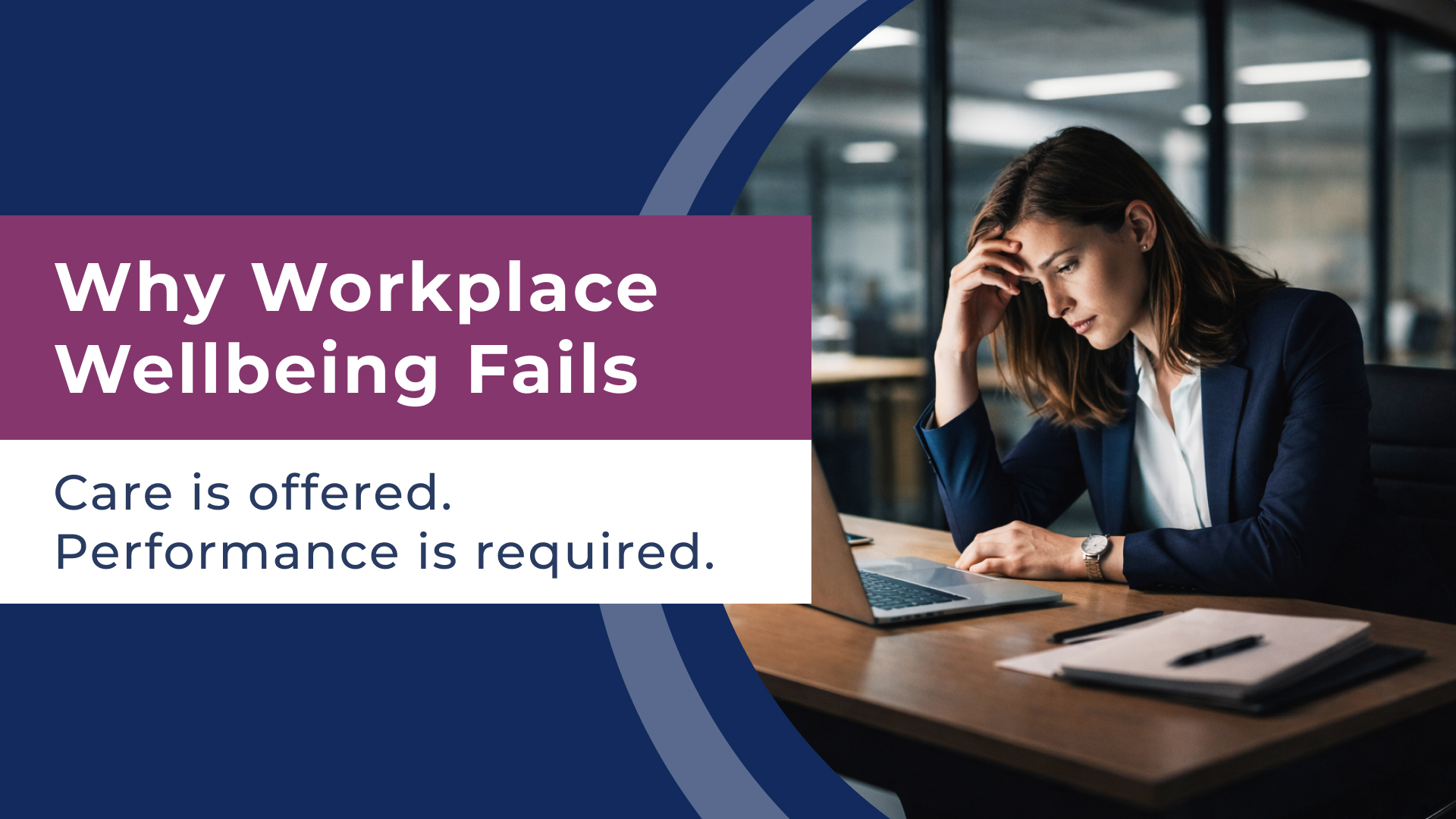
This is not because these initiatives are cynical. It is because they are often operating at the wrong layer. Workplaces have become very good at performing care. They are far less skilled at structurally holding it.
Care that lives on paper, not in the body
Most organisational wellbeing and inclusion efforts focus on permission rather than conditions. They tell people they are allowed to care for themselves, to speak up, to rest, to set boundaries. But they rarely change the systems that determine when doing so is actually safe.
Bodies do not respond to permission. They respond to consequence.
If taking a mental health day subtly stalls progression, bodies notice. If speaking honestly increases relational risk, bodies adapt. If slowing down threatens relevance, bodies compensate.
The organisation says: You matter. The system says: Not at the cost of output.
Bodies believe the system.
What organisations are already training
Organisations are not neutral environments into which wellbeing initiatives are introduced. They are already shaping bodies through cadence, urgency, escalation norms and decision speed. Expectations are visible. The conditions train nervous systems on a daily basis.
People learn:
how fast they must move to be taken seriously
how available they must be to be trusted
how composed they must remain to be seen as capable
These lessons are absorbed.
By the time wellbeing enters the conversation, the body already knows what is safe.
The gap between inclusion and embodiment
Inclusion promises belonging, but belonging is not a cognitive agreement. It is a bodily experience.
A body feels included when it can:
relax vigilance
express uncertainty without penalty
exist without constant self-adjustment
Many inclusion strategies focus on representation, language, and behaviour. These matter. But they do not automatically produce identity safety. People can be included on paper and still feel unsafe in their bodies.
They can be welcomed into the room and still brace themselves inside it.
I’ve been in rooms that celebrate diversity, while nothing in how people listen, decide, or share space actually changes.
Bodies that stabilise systems
Every organisation has bodies that quietly stabilise it. They absorb tension. They smooth conflict. They repair relational breaches that would otherwise escalate.
This is often praised as leadership, but it has a physiological cost.
When people are required to regulate the system emotionally while also meeting performance demands, their bodies carry dual loads. Cognitive effort and relational vigilance compound. Recovery becomes difficult because the nervous system never fully disengages.
From the outside, they look calm and capable. From the inside, their systems are under strain.
This is not a personal failure. It is a structural one.
When wellbeing becomes performance
There is an unintended cruelty in some wellbeing discourse. When organisations promote resilience, self-care, and regulation without changing conditions, they shift responsibility back onto individuals. If you are still exhausted, anxious, or unwell, the implication is subtle but clear: you are not doing wellbeing correctly.
So people adapt again.
They perform wellness on top of performing competence. They speak the language of balance while privately compensating. Bodies do not resolve this contradiction. They absorb it.
Support without change
Support is often offered without redistribution. Flexible work exists, but expectations do not shift. Wellbeing resources are available, but workloads remain inflated. Psychological safety is encouraged, while authority remains conditional.
This is performative care. It signals concern without altering the dynamics that create strain. Bodies recognise the mismatch. When care is symbolic, bodies adapt instead of trust.
Health is a lagging indicator
Health does not collapse suddenly. It erodes.
By the time burnout is visible, adaptation has been occurring for years. By the time illness interrupts performance, the body has already been compensating beyond sustainable limits.
I’ve experienced this directly, not recognising the cost until the body had already reached its limit, and leaving became the only viable option. This is why organisations misread health. Symptoms look individual, unpredictable, even inconvenient. But they are patterned.
The question organisations avoid
Most organisations ask: “How do we support our people better?” A more accurate question is: “What are we asking bodies to absorb in order for this system to function?” Until this question is faced, wellbeing remains cosmetic.
Why this matters
This is not just a health issue. It is also a leadership issue. An inclusion issue. A sustainability issue.
Bodies that are perpetually adapting cannot innovate freely.
People who are managing themselves cannot fully contribute.
Systems that rely on adaptation erode human capacity to the point of eventually exhausting the very people they depend on.
What comes next
In the next article, we move deeper from workplaces into the body itself.
We will look at how identity pressure becomes biological reality and how stress embeds itself in tissue, rhythm, and regulation. This is ultimately where the cost of misaligned systems becomes undeniable.
Because the body is not the problem. It is the place where the truth lands.
Dr Jordan Marijana Alexander works at the intersection of identity, leadership, and organisational systems. She is the co-founder of RelateAble.Global.