

About this series
Don’t Take Health Personally is a six-part series exploring a difficult possibility: that health is not primarily personal, but systemic. Beneath behaviour, wellness culture, and individual choice lie deeper forces — identity pressure, conditional care, and inherited value systems that shape how bodies adapt over time. Across gender, culture, place, and work, the series traces a quiet exchange: bodies stabilise systems long before systems learn how to care for bodies. It asks why health continues to deteriorate despite unprecedented medical knowledge and wellbeing investment — and what becomes visible when love is treated as optional, belonging must be earned, and the body carries what systems refuse to hold.
Identity pressure in the flesh
Some bodies stabilise systems. Others are stabilised by them.
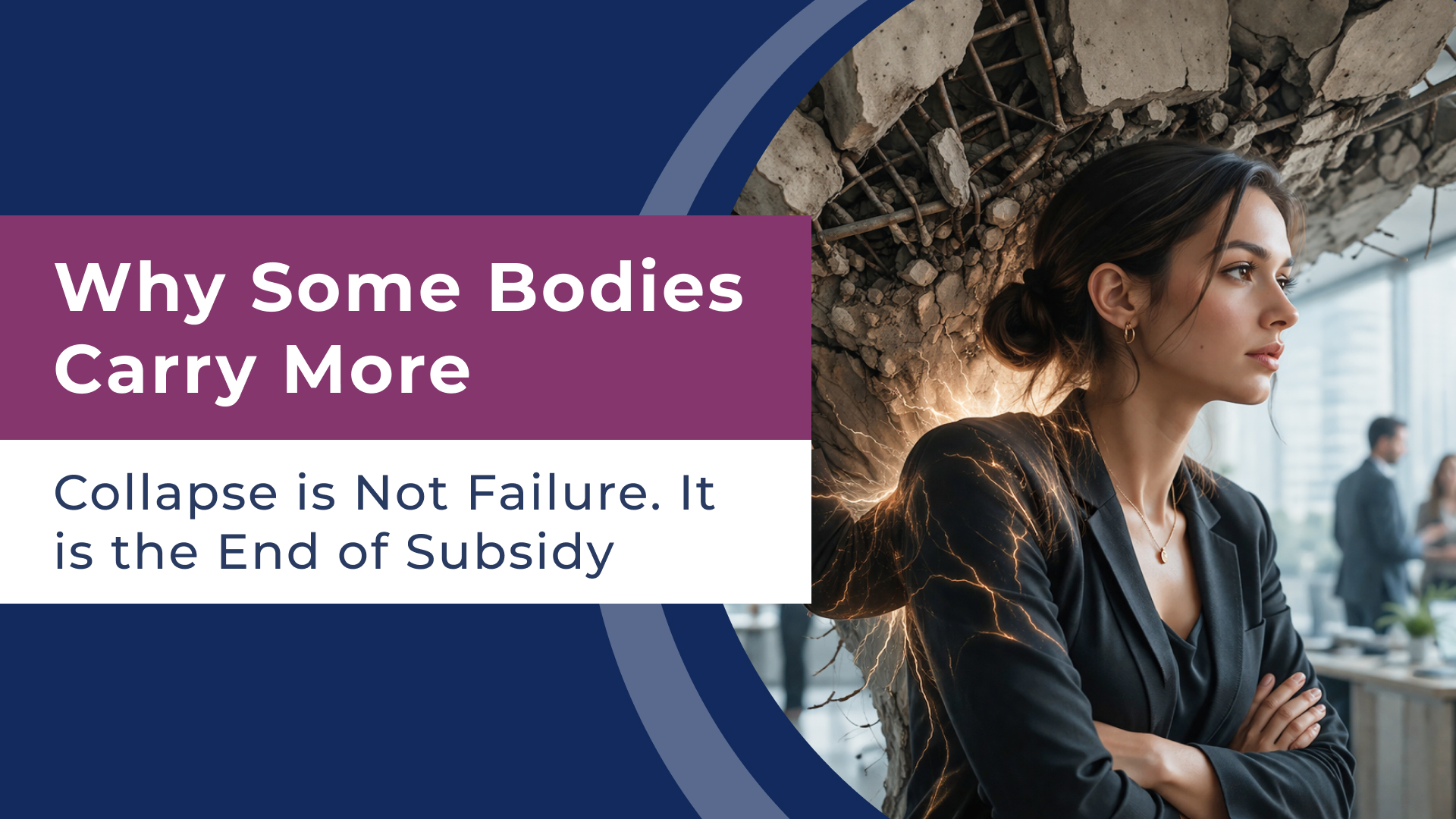
There is a category of bodies that rarely appear in strategy documents, organisational charts, or economic models, yet without them, systems would falter quickly. These are the bodies that adapt first. The bodies that absorb disruption quietly. The bodies that regulate tension so others can keep functioning.
They stabilise everything.
And over time, they pay.
Adaptation is not neutral
From a biological perspective, adaptation is the nervous system’s primary job.
The human body constantly assesses threat, safety, connection, and belonging. When environments are stable and care is reliable, the system regulates efficiently. When environments are volatile, demanding, or conditional, the system adjusts. Heart rate shifts. Hormones recalibrate. Muscles hold. Attention narrows. Immune responses change. These adjustments are not signs of pathology. They are signs of intelligence.
Over time, what looks like resilience becomes strain. When bodies adapt for too long without relief, it is misread as failure.
Who becomes the shock absorber?
In every system, some bodies are positioned closer to risk. Not always by design. Often by inheritance.
Gender is one of the clearest mechanisms through which this plays out, but it is not the only one. Bodies shaped by race, class, migration, sexuality, disability, or age often occupy similar roles. What they share is not identity alone, but exposure.
They are more likely to:
manage emotional labour without recognition
absorb uncertainty on behalf of others
smooth conflict rather than escalating it
remain reliable even when depleted
This reliability is often praised. It is also biologically expensive.
These are not just capable people. They are overexposed systems.
Gender as a biological load-bearer
Gendered expectations have trained many women’s bodies, in particular, to function as stabilising infrastructure. From an early age, girls are more often socialised to monitor relationships, anticipate needs, and maintain harmony. These are not just social patterns. They shape nervous system development.
Attunement becomes vigilance. Care becomes responsibility. Reliability becomes identity.
In adulthood, this pattern translates seamlessly into work. Women are expected to notice what others miss, to hold emotional context, to adapt without complaint. Their bodies learn that rest must be earned, and that visibility carries risk.
Menopause does not create this pattern. It reveals it. What surfaces in midlife is often the cumulative cost of decades spent regulating environments rather than being regulated by them. Menopause is not the issue. It is the moment the body stops honouring a contract it never consented to.
This is not just about women
To frame this solely as a women’s issue would miss the point.
Men whose identities are tied to provision and stoicism often carry the same physiological costs. Emotional suppression, long hours, and restricted vulnerability show up as cardiovascular strain, sleep disruption, and chronic stress.
Migrant bodies adapt through gratitude and compliance. Racialised bodies adapt through hyper-awareness and restraint. Queer bodies adapt through constant safety scanning. Working-class bodies adapt through physical risk and endurance. The common thread is not gender. It is exposure.
Some bodies are required to perform stability so that systems do not have to change.
When bodies become the site of repair
One of the defining features of modern systems is how often repair is displaced. Rather than redesigning structures, we rely on individuals to compensate. Rather than questioning pace, we reward endurance. Rather than addressing relational fracture, we promote resilience.
The body becomes the site where unresolved tension is processed. Stress becomes inflammation. Suppression becomes illness. Adaptation becomes exhaustion.
At the extreme edges of this same logic, bodies are no longer just strained but consumed, treated as assets, labour, or collateral. This is visible globally in contexts of exploitation and violence. We do not need to explore those realities here to recognise the pattern. When value systems lose their relationship to care, embodiment always pays.
What happens in workplaces is a quieter version of the same dynamic.
Why don’t interventions reach the body?
Most health interventions focus on behaviour: Move more. Eat better. Sleep longer. Manage stress. These recommendations are not wrong. But they are not where the problem begins. Bodies do not struggle because they lack strategies. They struggle because they are operating inside conditions that require constant adaptation.
A nervous system that has learned it must stay alert to remain included will not switch off because a tool has been introduced. It will continue to prioritise safety over recovery.
This is why so many people do everything “right” and still become unwell. Their bodies are not failing to respond. They are responding accurately to the environments they inhabit.
The biology of holding it together
When a body is consistently tasked with stabilisation, specific patterns emerge. The stress response remains partially activated. Cortisol rhythms flatten. Sleep becomes lighter. Inflammatory markers increase. Digestive function shifts. Immune resilience weakens. These changes are subtle at first. They allow performance to continue.
Over time, they compound. This is why so many health conditions emerge after periods of sustained responsibility rather than acute crisis. The body has been working overtime to keep things functional. Symptoms appear not at the moment of stress, but at the moment the system can no longer compensate.
This is the point where the system can no longer be subsidised.
Why is this hard to see?
The people whose bodies are carrying the most are often the ones still performing best.
Still delivering. Still reliable. Still holding others together.
This is why the pattern remains invisible. Adaptation looks like success. Until it doesn’t.
Organisations read this as capacity rather than cost. The system remains unexamined. And when health deteriorates, the body is blamed for reacting. Not only is this inaccurate, but it is also dangerous.
What the body is actually showing
When we look more closely, a different pattern appears.
Health is not random. It reflects:
who has been holding tension
who has been absorbing instability
who has been required to remain reliable without recovery
The body does not miscalculate. It reveals.
Why this matters
Some bodies carry more. Not because they are stronger, but because the system requires them to.
The question is not how to make bodies hold more. It is whether we are willing to see what they have already been carrying.
What comes next
In the next article, we will examine how culture shapes what health looks like, which bodies are expected to adapt, and how belonging, rhythm, and care are organised differently across societies. Because the body does not adapt in isolation. It adapts inside meaning systems. And until we see those systems clearly, health will continue to collapse in the places that claim to value it most.
Dr Jordan Marijana Alexander works at the intersection of identity, leadership, and organisational systems. She is the co-founder of RelateAble.Global.