

About this Series
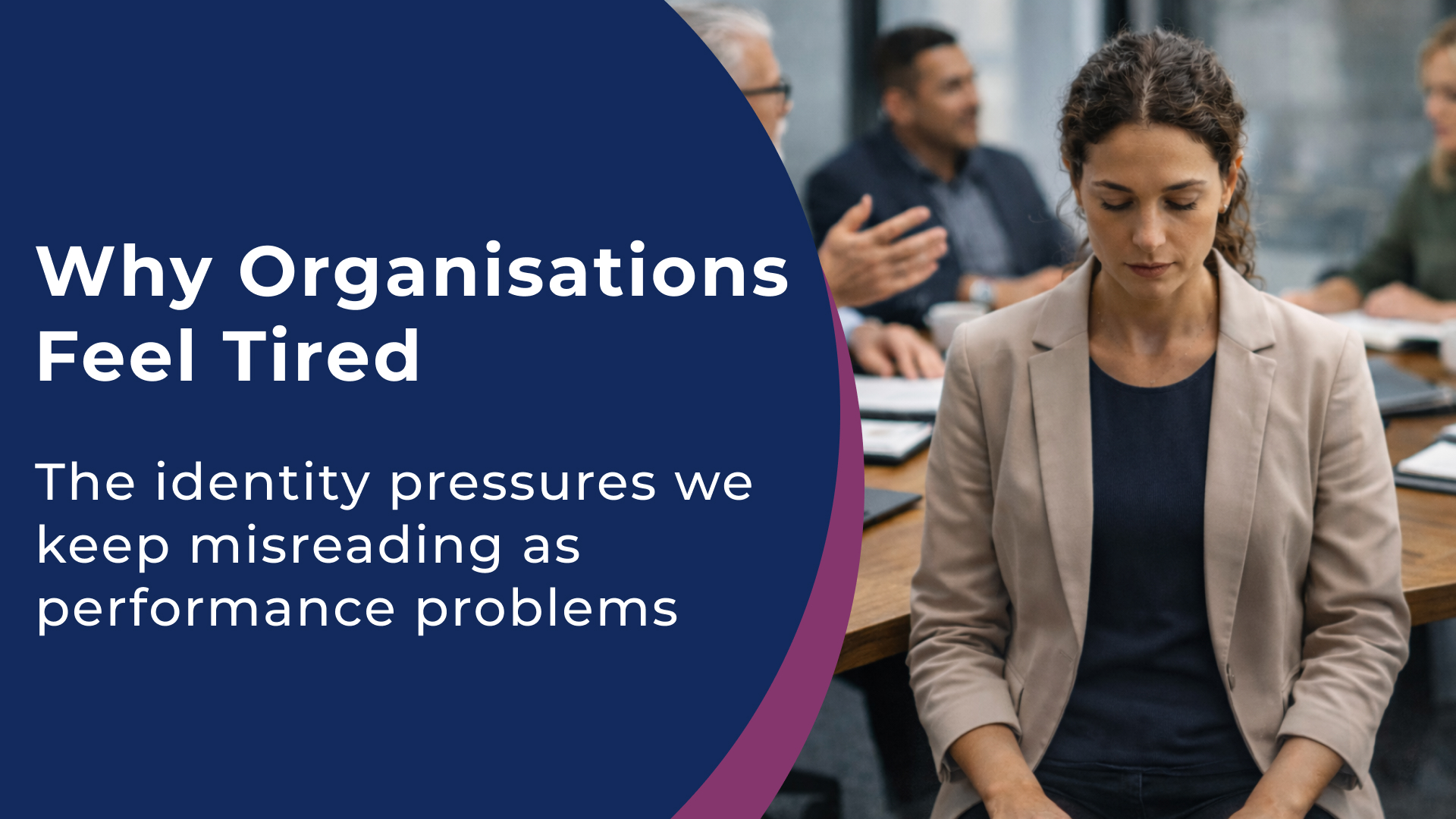
This article is part of a six-part series exploring why many inclusion, leadership, and transformation efforts stall despite good intent and significant investment. Working beneath behaviour and policy, the series examines how identity-level pressure quietly shapes who feels able to belong, lead, and contribute without adaptation. Across gender, age, culture, and place, it traces how legitimacy becomes conditional, how identity load accumulates, and why organisations often misread these signals as performance, engagement, or capability problems rather than systemic strain.
The Pressure Beneath Performance That Makes Organisations Feel Tired
Burnout is one of the most overused and under-explained words in organisational life. It is treated as an individual condition. A capacity problem. A resilience gap. Something to be managed with better boundaries, wellbeing initiatives, or time away from work. And yet many of the people most affected by burnout are capable, committed, and often deeply invested in their organisations. They are not disengaged. They are not failing. They are holding too much. What we call burnout is often the visible outcome of something far more subtle and far more structural. It is identity load made chronic.
The Pattern Beneath the Symptoms
Across the previous articles in this series, a consistent pattern has emerged.
In gendered environments, reliability becomes a tax.
Across age, legitimacy becomes conditional.
Within culture, adaptation replaces belonging.
Through place, displacement and inheritance shape who must translate themselves to be heard.
Each of these dimensions operates quietly. None of them requires overt exclusion. None of them announces itself as harm. But together, they create a system in which many people must continuously manage who they are in order to remain credible, safe, or acceptable.
This is identity load.
It is the cognitive, emotional, and relational effort required to monitor, edit, and protect one’s identity in environments where belonging is not fully settled. Unlike workload, identity load is rarely visible. It does not appear in job descriptions or performance reviews. It often masquerades as professionalism, adaptability, leadership maturity, or resilience. And yet it draws from the same finite human capacity.
Why Leadership Fatigue Looks Like Strength Until It Doesn’t
Leadership fatigue is often misread as a personal limitation.
Leaders are encouraged to develop greater emotional intelligence, stronger presence, or better self-regulation. These skills matter. But they cannot compensate for systems that quietly demand constant identity management.
Many leaders who experience fatigue are not overwhelmed by tasks. They are exhausted by vigilance.
By reading rooms.
By managing perception.
By holding authority carefully.
By absorbing relational risk so others do not have to.
This is especially true for leaders who sit at the intersection of multiple identity dimensions. Those whose gender, age, culture, or place does not align neatly with dominant norms. From the outside, they often look composed, competent, and reliable. From the inside, they are running hot.
Organisational Drag Is a Human Signal
When identity load accumulates, organisations experience drag. Decisions take longer. Innovation slows. Meetings feel cautious. Agreement replaces alignment. People hedge rather than challenge. Energy dissipates in self-management rather than contribution. This drag is often attributed to complexity, change fatigue, or market conditions. Rarely is it understood as a signal from the human system.
When people cannot fully inhabit their role without managing who they are, the organisation loses access to their full intelligence. Not because they are unwilling, but because the cost of expression feels too high. Over time, the system becomes stable but brittle.
Why Inclusion Efforts Plateau
This is why many inclusion efforts stall despite good intent and significant investment. Structures are put in place. Policies are updated. Leaders are trained. Language evolves. But the work often stops at behaviour. What is left untouched is the identity-level reality of how safe it feels to belong without adaptation.
As long as inclusion focuses on access without addressing identity load, people will continue to adapt. And organisations will continue to mistake performance for wellbeing. Inclusion will look successful on paper while quietly draining the system.
The Quiet Agreement We Don’t Name
Most organisations operate under an unspoken agreement. You are welcome here, as long as you manage the parts of yourself that disrupt the norm.
This agreement is rarely articulated. It is enforced through subtle signals. Through who advances, who is heard, who is described as “difficult,” “polished,” “ready,” or “not quite there yet.” People learn quickly what is rewarded. And because the rewards are real, adaptation becomes rational. The cost is paid later.
Why This Is Not a Motivation Problem
Identity load is not a lack of engagement. It is not resistance to change. It is not a mindset issue. It is what happens when people care enough to keep adapting, even when the system does not adapt in return.
This is why burnout often affects high performers. The people most invested in doing good work are the ones most willing to carry the extra, invisible load. They do not leave because they lack resilience. They leave because they are tired of being careful.
What Becomes Possible When Identity Settles
When identity load reduces, something shifts.
People speak earlier rather than later.
Disagreement becomes cleaner.
Authority is exercised without armour.
Learning accelerates because uncertainty can be named.
This is not because everyone feels comfortable all the time. It is because the cost of being oneself decreases.
Organisations often search for this outcome through culture initiatives, leadership models, or engagement strategies. The shift they are seeking is deeper. It occurs when belonging no longer requires constant self-monitoring.
This Is a Leadership Issue, Not a Wellbeing One
Burnout, leadership fatigue, and organisational drag are not peripheral concerns. They are signals that identity-level strain has become systemic. Addressing them requires more than individual coping strategies or better self-care. It requires leaders and organisations to see beneath behaviour to the conditions that shape it. To ask different questions.
Not “How do we make people more resilient?”
But “What are we asking people to carry in order to belong here?”
Not “Why are they disengaged?”
But “Where does legitimacy still feel conditional?”
Not “How do we increase performance?”
But “Where is identity being managed rather than inhabited?”
Seeing More Accurately
This series has not offered tools or solutions. It has offered a way of seeing.
Gender, age, culture, and place are not problems to be solved. They are dimensions of identity that reveal where systems quietly demand adaptation. When these demands remain invisible, organisations pay the price in burnout, fatigue, and drag. When they are recognised, something else becomes possible.
Not perfection.
Not comfort.
But coherence.
The kind that allows people to bring their full intelligence to the work without carrying themselves all the time. That is not a soft outcome. It is a strategic one. Because organisations cannot sustain performance by exhausting the identities that produce it.
A Final Word
Burnout is not the failure of individuals to cope. It is the signal that identity load has exceeded capacity. Leadership fatigue is not a weakness. It is the cost of holding authority in systems that have not yet learned how to distribute legitimacy.
Organisational drag is not inefficiency. It is the friction created when people must translate themselves in order to contribute.
Until these signals are read accurately, organisations will continue to optimise at the surface while leaking energy beneath it. And until identity can be inhabited rather than managed, inclusion will remain incomplete. Seeing clearly is not the end of the work. But it is where the real work begins.
What This Series Has Been Pointing To
Much of what feels like generational tension, gender friction, or cultural misunderstanding is not conflict at all, but identity pressure misread through simplified stories about difference. This series has not been an argument for more inclusion work. It has been an invitation to see what is already happening.
Across gender, age, culture, and place, the same pattern appears. People adapt not because they are fragile, but because they care. Systems stabilise not because they are healthy, but because identity is being quietly managed to keep things moving.
The cost of this arrangement is rarely visible at first. It shows up later as fatigue, drag, caution, and loss of vitality. Not because people have failed, but because identity has been carrying what structures have not yet learned to hold.
Nothing here requires blame. But it does require honesty.
Until organisations can see the difference between performance and protection, engagement and safety, professionalism and identity load, they will continue to optimise around the very pressures that exhaust them.
Seeing clearly does not fix everything. But it does change where responsibility sits.
And that is where real leadership begins.
Dr Jordan Marijana Alexander works at the intersection of identity, leadership, and organisational systems. She is the co-founder of RelateAble.Global.