
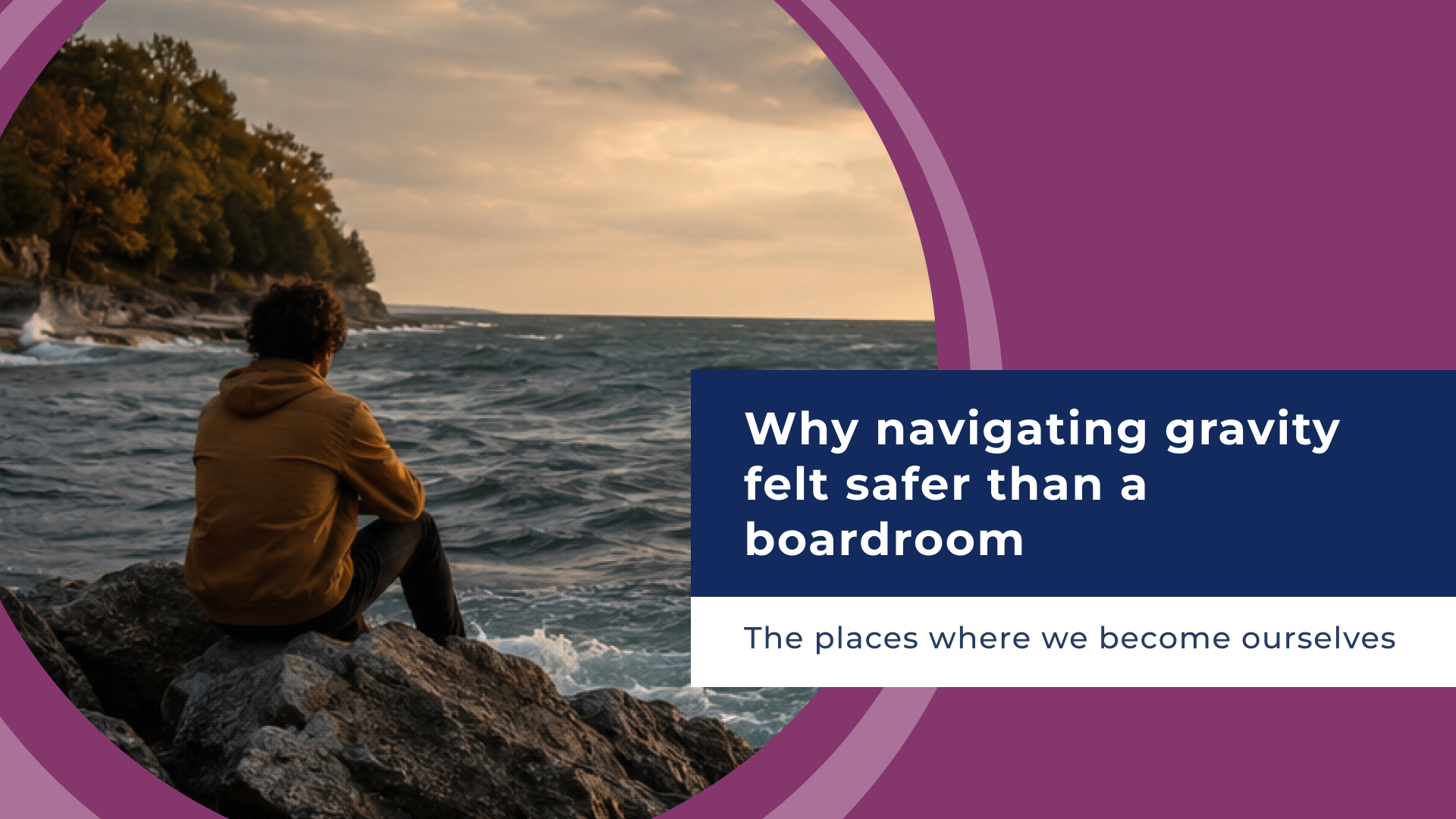

The lake
As a child, I used to sit beside Lake Ontario. Not on a postcard beach or a carefully designed waterfront, but on the rocks, close enough to hear the waves crash against the shoreline and feel the spray in the air. Sometimes I would take a small Coleman stove with me and cook scrambled eggs while watching the water. Looking back, it was not an obviously safe place. The lake could be fierce. Storms rolled in quickly. Waves crashed against the rocks with enough force to command respect. Yet it felt safer than many of the places I was supposed to call home.
For years I thought this memory was about childhood. Now I think it was about something much deeper.
The lake wasn’t asking me to be anyone. It wasn’t evaluating me or deciding whether I was enough. It wasn’t criticising, controlling, manipulating, rewarding or withholding. It wasn’t asking me to perform. It wasn’t asking me to earn my place. It simply allowed me to exist. In return, I could become more fully myself. The memory has stayed with me for decades because it reveals a paradox we rarely talk about.
Why can a child feel safer beside a wild lake than inside a family home? Why can an adult feel safer standing on the edge of a bungee platform than walking into a boardroom? Why can we willingly jump out of aeroplanes, raft through rapids, climb mountains and surf enormous waves, yet feel anxious sending an invoice, speaking in a meeting, walking into a job interview or presenting to a senior leader? The paradox becomes stranger the longer we sit with it.
Over the years I have become increasingly interested in the relationship between people and place. Not because landscapes are beautiful or geography is inherently interesting, but because some places seem to allow us to become more fully ourselves than others. The lake beside which I sat as a child was one of those places. At the time, I would not have had the language to explain why. I only knew that I felt different there. I was calmer, more present, less guarded and somehow more myself.
The boardroom: risks that don’t make the register
I still remember standing on the edge of a platform in Queenstown preparing to bungee jump. The river below seemed impossibly far away. Every part of me knew there was risk involved. My heart was racing. My senses were heightened. My body was fully awake. I wasn't afraid in the way we normally mean.
The platform wasn’t judging me. Gravity wasn’t evaluating me. The river below wasn’t deciding whether I belonged. The risk was visible. The relationship was honest. I knew exactly what I was negotiating. The same has been true while rafting through white water. The river demands your attention. The waves do not care about your qualifications, status, title or insecurities. You are simply another human being navigating a powerful landscape. The danger is real. The relationship is clear.
Now consider a boardroom. It was my first board meeting as a director. I was appointed as part of a desire for greater diversity around the table. Before I spoke my first words, I had already been categorised. The introduction in the organisation’s magazine focused on the gender story while barely mentioning decades of advisory work, executive leadership and experience working alongside ministers and senior leaders. The room was physically safe. Relationally, it felt very different. In one environment I was negotiating gravity. In the other I was negotiating legitimacy. The distinction matters more than we realise.
When organisations talk about risk, they tend to focus on what can be measured. Yet some of the most powerful risks shaping human behaviour never make the register. The fear of humiliation. The fear of exclusion. The fear of not being enough. The fear of speaking honestly. The fear of losing belonging.
These invisible risks shape who speaks and who remains silent, who contributes and who withdraws, who challenges and who complies. Perhaps this is why many of us have sat in perfectly safe rooms while feeling profoundly unsafe, and stood in wild places feeling completely at ease. Maybe safety is not simply the absence of danger, but the absence of fragmentation. Perhaps safety is the experience not having to become someone else.
The kitchen table
A few years ago I sat around a kitchen table listening to my cousin talk about her experience with breast cancer. On another occasion, a close friend shared the impact of her husband’s diagnosis. There were no experts in the room. Nobody was trying to fix anything. The conversation simply expanded to hold whatever was present: fear, uncertainty, grief, love and vulnerability. What struck me was not what was said. It was what wasn’t required. Nobody had to earn acceptance. We weren’t negotiating for belonging. The relationship was strong enough to hold the truth. The space widened around it.
I have witnessed similar moments while facilitating gatherings of women. Last year, at a local International Women’s Day event, dozens of women came together: mothers, daughters, migrants, refugees, leaders, and carers. Each brought different stories and life experiences. As the conversations unfolded, something shifted. The armour began to come off. People spoke more honestly. Stories surfaced. Tears appeared. Laughter appeared. Recognition appeared. The room stopped being a venue. It became a place.
We often treat safety as a feature of a place when it may be a quality of relationship. A boardroom, kitchen table, classroom, or family home becomes fundamentally different depending on how people are able to be within it. When organisations talk about psychological safety, they often ask whether people can speak up, challenge ideas or admit mistakes. These are important questions. Yet beneath them sits a deeper one: Can people remain themselves here?
A person can comply without participating. They can contribute without belonging. They can perform without flourishing. The deeper question is whether the environment requires them to fragment themselves in order to succeed. Maybe this is why so many people feel exhausted. The effort is not always the work itself. The effort is maintaining the distance between who they are and who they feel they need to be.
The gift of place
Looking back now, I think the lake felt safe because there was no negotiation. No negotiation for belonging, acceptance, worthiness or even the right to exist. The waves would crash whether I was confident or insecure, whether I succeeded or failed, whether I arrived with certainty or confusion. The lake never granted anything. It simply allowed me to be. For a long time I thought of this as a personal story. Now I wonder whether it reveals something more universal. Places do more than surround our lives. They participate in them.
Modern theories of identity spend a great deal of time asking who we are. They spend far less time asking where we became who we are. Yet every one of us carries places within us: the neighbourhood where we grew up, the street where we learned independence, the sports field where we discovered confidence, the river where we went to think, the grandparents’ garden where we felt accepted, or the mountain track where we realised we were stronger than we thought.
The places themselves are visible. What they gave us is often invisible. This is one reason I became fascinated by the relationship between the visible and the invisible. The visible landscape tells a story about the invisible one. Cities reveal priorities, schools reveal values, workplaces reveal assumptions and homes reveal relationships. The visible reveals the invisible.
When I work with leaders now, I am rarely interested only in their CV. I find myself wondering where they grew up, what stories were told around the dinner table, and what success meant in the households that raised them. I want to understand what was already taking shape long before they acquired authority, influence or responsibility.
Places are not merely locations. They are participants in our becoming. And if that is true, the relationship runs both ways. People shape places. Places shape people. The communities we create shape the people who inhabit them, and the people who inhabit them shape the communities in return. Both are continually becoming through the relationship.
Place belongs in workplace conversations. Take psychological safety. We often focus on whether people can speak up, challenge ideas or admit mistakes. These are important questions. Yet beneath them sits another: what is it about some environments that allows people to remain themselves while others encourage performance, compliance or self-censorship?
The challenge is not simply creating safer workplaces. It is creating places where people can remain whole. Places where curiosity is safer than certainty, disagreement is safer than silence, authenticity is safer than performance, and participation does not require self-abandonment.
I no longer think I returned to the lake because it was safe. The waves were risky. I think I returned because for a few hours, I did not have to negotiate for my place in the world. This is the gift of place. Perhaps it is a gift we owe one another. So I’ll leave you with a question: What was the first place that allowed you to be fully yourself?
Notice how quickly a place comes to mind. Notice how physical the memory is. And then how invisible the reasons are. We are closer to place than we think. Perhaps some of our most important lessons about being human have been waiting for us there all along.
Dr Jordan Marijana Alexander explores how identity, place, culture, and human systems shape participation in modern life. She is the co-founder of RelateAble.Global. If this article has surfaced questions for you as a leader, within your organisation, or your own life, she welcomes thoughtful conversation or inquiry. You can follow DrJMA on LinkedIn and Engenesis.