

The transformation zone
There is a famous New Zealand television advertisement that asks one of life’s most ridiculous questions. At what exact point do swimming togs become underwear? The commercial follows a man walking away from the beach. As long as he can still see the water, everyone agrees he is wearing swimwear. A little further down the road, someone hesitates. Another few steps and the verdict is unanimous.
“Togs, togs, togs... undies.”
Nothing about the garment has changed. The fabric is the same. The body inside it is the same. The only thing that has changed is where he is standing. Somewhere around three hundred metres from the shoreline, we have collectively agreed that swimwear undergoes a magical transformation into underwear. It is absurd, which is precisely why the advertisement is so funny. Yet the more I thought about it, the more I wondered whether we have created another transformation zone.
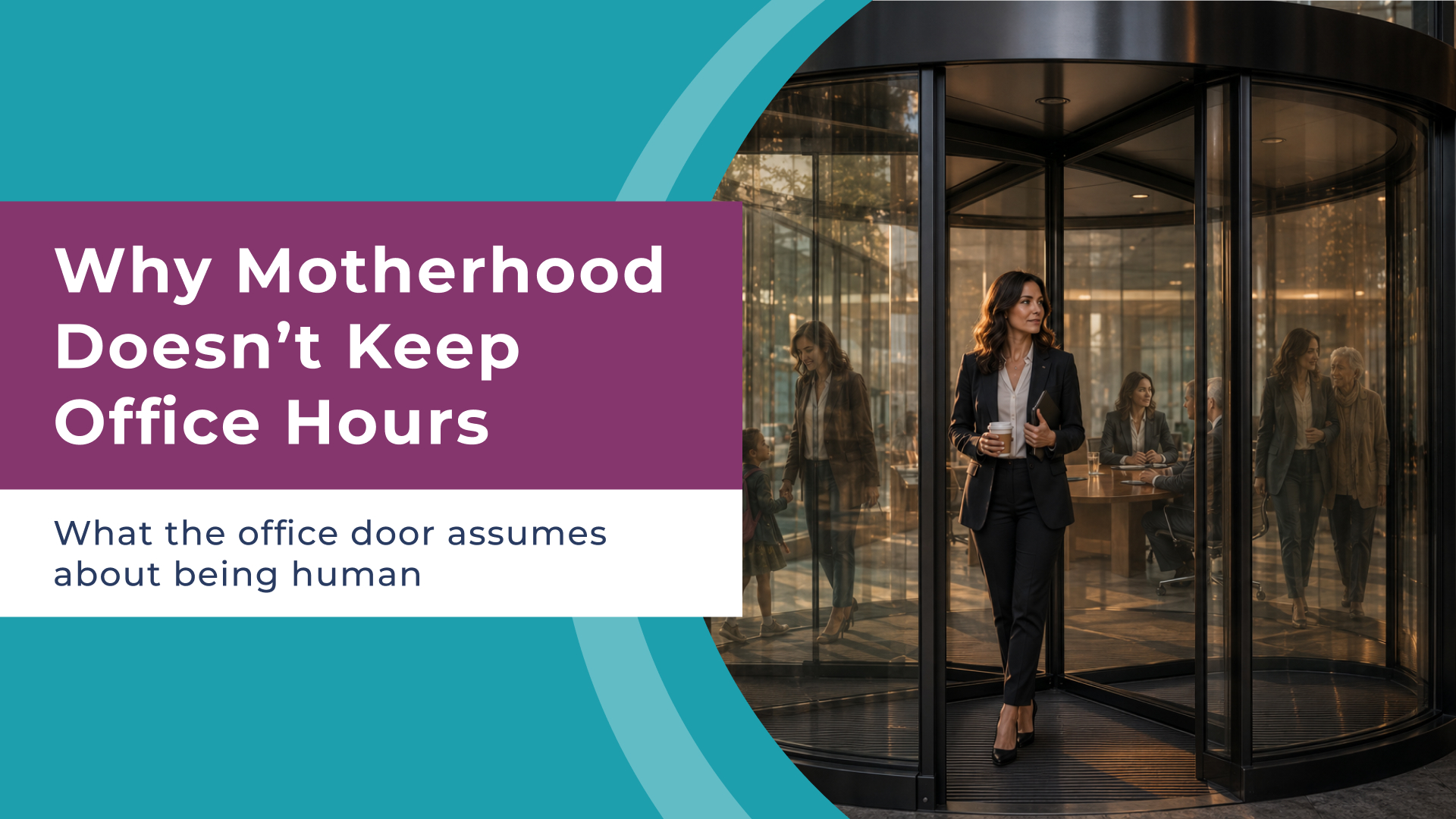
The office door. What exactly do we imagine happens at nine o’clock each morning? A woman packs school lunches, signs a permission slip, searches for a missing shoe and reminds her daughter not to forget her trumpet. She kisses everyone goodbye, drives to work, walks through the revolving doors and arrives at her desk. What changed? Did the mother disappear? Did the executive arrive? Or did the same person simply continue participating in a different part of her life?
We rarely ask the question because the answer feels so obvious. Of course she is still a mother. Of course she is still someone’s daughter. She may also be someone’s partner, sister, friend, neighbour, mentor or carer. None of those relationships cease to exist because the workday begins. Still, much of modern organisational life quietly behaves as though something important has happened at the office door.
It seems we have inherited our own version of Cinderella’s midnight. The clock strikes. The carriage becomes a pumpkin. The mother becomes an executive. The son becomes a policy adviser. The father becomes a general manager. At five o’clock, the spell reverses and everyone returns home to become fully human again. Different stories. The same logic. Nothing has actually changed except the context.
This became obvious to me long before I had children of my own. Early in my career, I worked with a woman I’ll call Sally. Every so often Sally would leave work unexpectedly because her son Billy was sick. I remember feeling quietly frustrated. We all had deadlines. We all had commitments. Why was she leaving again? Years later, I became Sally. The phone would ring. A child was unwell. The school needed someone to collect them. In that instant, every meeting, every deadline and every carefully planned day rearranged itself without discussion. Not because I had become less committed to my work, but because I had never stopped being a mother.
Later, as a senior executive at Housing New Zealand Corporation, I worked with a remarkably forward-thinking chief executive to introduce a six-week paid parental leave top-up as an internal workplace benefit, well before New Zealand’s national scheme came into effect. It wasn’t designed because I was pregnant. It was designed because we believed becoming a parent was one of life’s significant transitions and that progressive organisations should recognise that reality. Life has a wonderful sense of irony. I became the first employee to use the policy.
A few months later, I found myself expressing breast milk in an airport toilet, carefully packing bottles into a small lunchbox with ice before boarding a flight to another city for executive meetings. At the time it felt completely ordinary. Looking back, I realise I was living between two different assumptions about being human. The organisation had made room for me to return to work. It had not yet fully imagined that motherhood would return with me. Motherhood is simply where many of us first discover that being human doesn’t keep office hours. Perhaps it’s because the modern workplace inherited a much older story. Not simply about work, but about people.
Every norm has a biography
Every norm has a biography. The forty-hour working week did not emerge by accident, nor was it handed down as some timeless truth about human flourishing. It was one of the great social achievements of the industrial age. At a time when twelve and fourteen-hour workdays were commonplace, limiting labour to eight hours represented enormous progress. It protected workers, created greater predictability and helped shape the modern economy. Like all successful innovations, it solved the problems of its time.
Nine o’clock feels inevitable until we remember that it isn’t. Someone invented it. Someone decided schools would begin at one hour, offices at another, childcare at another, trains at another. None of these arrangements descended from nature. They were negotiated, revised and inherited. Like all human systems, they solved particular problems for particular moments in history. The difficulty with successful solutions is that we often forget they were solutions at all. Over time they begin to feel inevitable. We stop asking where they came from because we assume they have always been there. The question is not whether the forty-hour week was right or wrong. It transformed millions of lives. The more interesting question is what assumptions about being human travelled with it.
Much of twentieth-century organisational life evolved around a relatively stable image of the worker. Someone would leave home, travel to work, complete a day’s labour and return home again. Care happened somewhere else. Children were looked after elsewhere. Meals appeared. Elderly parents were cared for. The countless acts that sustain society largely existed outside the economic model itself. This was never universally true. Mothers have always worked. Human lives have never been as tidy as our institutions imagined.
The biological impossibility
Maybe that is why we continue to speak about "work-life balance" as though work and life are two separate territories requiring careful negotiation. The language itself reveals the model. Work occupies one side of the equation. Life occupies the other. Yet work has always been part of life. The distinction only makes sense if we first imagine that a person can somehow divide themselves into compartments. The curious thing is that our organisations already know this is not how people actually live.
Nobody questions an executive reading board papers on a Sunday evening. No one raises an eyebrow when a chief executive answers emails late at night, thinks about strategy while walking the dog or wakes at three in the morning with the solution to a difficult problem. We describe this as commitment, leadership or professionalism. When a child becomes unwell, an ageing parent needs help, a school calls or a baby needs feeding, we begin talking about interruptions, competing priorities and work-life conflict. Yet the board papers read on Sunday evening were never described as an interruption to family life. The boundary appears strangely porous in only one direction. Professional identity is permitted to flow into personal life. Human identity is expected not to flow back into work. That asymmetry has stayed with me.
I once worked with a policy adviser whom I’ll call Henry. Every Tuesday morning he spent an hour speaking with his elderly mother. Everyone knew. Meetings were scheduled around it. Deliverables were met. National strategy continued to move forward. Without ever discussing it, we quietly acknowledged that Henry had never stopped being someone’s son.
More recently, a client smiled as she told me that members of her executive team have a running joke. “How long before he mentions his sons?” she laughed. Everyone knows he will. The comment fascinated me, not because it was unkind, but because it revealed an assumption I suspect many of us carry without noticing.
Why should it be surprising that a father speaks about his children? Every person sitting around that executive table is somebody’s child. Many are somebody’s parent. Some are caring for ageing parents. Others are navigating illness, grief, friendships, marriages or communities that long predate their current job title. Before we become employees, executives or leaders, it is biologically impossible not to be somebody’s son or daughter.
Employment is one form of participation. It is rarely the most enduring one. Professionalism has changed dramatically over the past century. Men no longer wear hats to the office. Women no longer resign when they marry. Tattoos have become commonplace. Hybrid work has emerged. Mental health is discussed openly. Dress codes have relaxed and organisational hierarchies have flattened. Professionalism has evolved repeatedly. Yet beneath all of these visible changes, one assumption seems remarkably persistent: that somewhere near the office door something fundamental happens to the person walking through it.
Being human continues
The difficulty lies in the way we have come to think about work itself. For generations we have spoken about professional identity as though it were something we put on each morning and take off again at the end of the day. We describe people as becoming managers, directors, executives or leaders, and there is truth in that. Roles do shape us. They ask things of us. They require us to develop new capabilities and shoulder new responsibilities. But perhaps we have quietly mistaken roles for identities.
A role has boundaries. It begins with an appointment and ends with a resignation or retirement. It exists within a particular organisation, carries a defined set of responsibilities and belongs to a moment in time. Relationships are different. They are not things we perform between certain hours. A daughter remains a daughter whether she is in a board meeting or sitting beside her mother’s hospital bed. A father does not cease being a father because he is presenting the annual budget. A mother does not become less of a mother when she walks through the office door. The context changes, but the relationship endures.
Our language reflects the same assumption. We speak about balancing competing identities or bringing our whole selves to work, as though only part of us arrived each morning. These expressions are useful shorthand, but they also reveal a deeper assumption: that human beings move through the world one identity at a time.
My experience has been quite different. The older I become, the less convincing those neat divisions appear. I have never stopped being my parents’ daughter, even though both have shaped my life in profoundly different ways. I never stopped being Canadian when I became a New Zealander, nor Croatian and Ukrainian by inheritance. Becoming a chief executive did not replace being a mother, just as becoming a writer did not erase the years I spent in governance, strategy or public service. Each new experience added another layer of participation without removing what had come before.
It seems closer to how human beings actually develop. We do not become entirely different people as we cross the thresholds of our lives. We accumulate relationships, responsibilities and ways of participating in the world. Some become more visible in certain contexts than others, but they do not disappear. They continue to shape how we notice, decide, care and lead, even when they remain unseen.
Seen this way, motherhood is not an interruption to professional life. Nor is fatherhood, caring for aging parents or remaining deeply connected to our communities. They are not competing with work from outside the system. They are part of the very fabric from which judgement, wisdom and leadership emerge. Which perhaps explains why our contemporary debates about flexible working so often feel incomplete. We argue about buildings, office days and productivity, but rarely stop to ask a more fundamental question. Who do we imagine is doing the work? Every generation inherits questions its predecessors could not yet see. Perhaps this is one of ours.
Walking through the office door
Perhaps we are beginning to recognise that human beings have never lived compartmentalised lives. We have always inhabited multiple relationships at once. We have always carried our histories, our families, our responsibilities and our hopes across every threshold we have crossed. The office door never possessed the power to transform us. We simply behaved for a long time as though it did.
When I think back to that old New Zealand advertisement, I still smile. Somewhere between the beach and the car park, swimwear supposedly becomes underwear. We laugh because we recognise the absurdity of imagining that a change of location can alter the nature of the thing itself. Perhaps the office door deserves the same gentle smile.
Nothing magical happens at nine o’clock in the morning. The mother who walked into the building is still a mother. The son is still a son. The daughter is still a daughter. The executive remains an executive. The manager remains a manager. The leader remains a leader. And each remains, wonderfully and inconveniently, human.
The threshold changes. The person does not.
Dr Jordan Marijana Alexander is a writer, executive advisor and human systems strategist exploring how identity, place, culture and living systems shape participation in the modern world. She is the co-founder of RelateAble.Global. If this article has raised questions, sparked reflection, or highlighted something you’re navigating as a leader or in your personal life, you’re invited to book a conversation to explore it further. You can follow DrJMA on LinkedIn and Engenesis for ongoing insights, research, and practical resources.