

About this series
Don’t Take Health Personally is a six-part series exploring a difficult possibility: that health is not primarily personal, but systemic. Beneath behaviour, wellness culture, and individual choice lie deeper forces — identity pressure, conditional care, and inherited value systems that shape how bodies adapt over time. Across gender, culture, place, and work, the series traces a quiet exchange: bodies stabilise systems long before systems learn how to care for bodies. It asks why health continues to deteriorate despite unprecedented medical knowledge and wellbeing investment — and what becomes visible when love is treated as optional, belonging must be earned, and the body carries what systems refuse to hold.
Why health is the signal we keep misreading
We are living longer than ever. Life expectancy has increased dramatically over the past century. Medical knowledge has expanded at a pace no previous civilisation could have imagined. We know more about biology, nutrition, neuroscience, trauma, stress, and disease than at any other point in human history. We track our sleep, hormones, steps, moods, calories, and productivity. And yet, by almost every meaningful measure, we are not healthier.
Chronic illness is rising. Mental health conditions are accelerating. Autoimmune disorders are increasing. Loneliness is endemic. Burnout has become normalised. Health systems are overwhelmed. Wellbeing initiatives multiply.
Advice is endless.
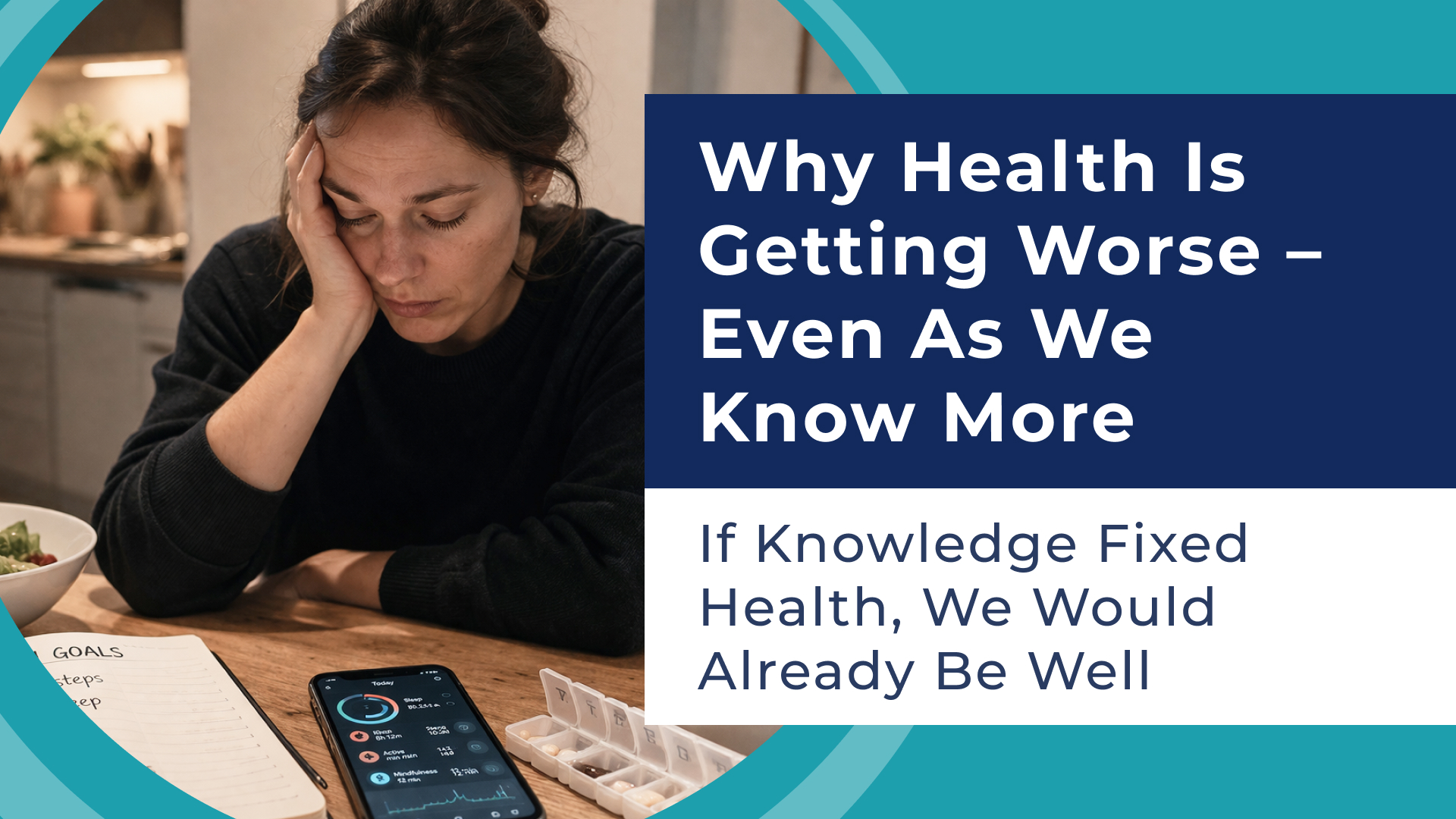
If knowledge fixed health, we would already be well. That single fact should stop us in our tracks.
How bodies learn what is safe
To understand why health is failing despite unprecedented knowledge, we need to be clear about one thing. Bodies are not oriented toward happiness. They are oriented toward safety.
From the earliest moments of life, the human nervous system is learning what conditions allow connection, care, and survival. Long before language, belief, or identity, the body is reading the environment and asking a single, continuous question: What do I need to do to stay connected here?
This learning is not abstract, but rather physiological. When care is predictable, bodies soften. When belonging is stable, systems regulate. When love is experienced as reliable rather than conditional, the body does not need to perform to remain included. When care is inconsistent or approval must be earned, the body adapts accordingly. If belonging depends on utility, compliance or self-erasure, the body will tighten, monitor and prepare.
This is not dysfunction. It is intelligence.
The problem arises when what keeps us safe in the short term often becomes costly in the long term.
A child who learns to be “easy” in order to be loved may grow into an adult whose body never fully rests. A professional who learns to be endlessly reliable may develop a nervous system calibrated to vigilance rather than ease. A culture that equates worth with productivity teaches bodies that stillness is dangerous.
Over time, these adaptations settle in. They become posture. Breathing patterns. Hormonal rhythms. Immune responses. Sleep cycles. What looks like health in early life (i.e., resilience, endurance, capacity) quietly becomes strain. This is why so many people say, often with confusion and shame, “I did everything right, and my body still broke down.”
The body did not break down. It kept going long after it should have been allowed to stop.
Why wellness culture keeps missing the point
Modern wellness culture largely ignores this reality. It treats health as something to be achieved through discipline, optimisation, and self-management. It assumes that if individuals just tried harder, knew more, or cared more, their bodies would cooperate. But bodies do not respond to effort alone. They respond to conditions.
You cannot supplement your way out of chronic vigilance, nor meditate away conditional belonging, any more than you optimise a way out of the environments that exhaust you.
A nervous system that has learned it must perform to be safe will not stop performing with a nutrition hack. This is why so many health interventions produce temporary relief but not lasting change. They address symptoms without touching the conditions that created them.
The deeper issue is not behaviour. It is the relationship between the body and the world it inhabits. When love is conditional and when care depends on usefulness, compliance, performance, or silence, the body absorbs that logic. It becomes the site where the cost is paid. This is how identity pressure becomes biological reality.
Health as a record, not a moral scorecard
Health is not a moral achievement or a personal failure. It is a record.
It records what was required to belong. What had to be managed. What could not be expressed. In this way, health functions as a kind of ledger tallying adaptation. When the list grows too long, the body begins to speak. Do we hear it accurately or read the symptoms as betrayal and just push harder?
The question we keep avoiding
The dominant explanation for declining health is individual failure. A lack of discipline, resilience or commitment. They are not informed enough. What if these explanations are fundamentally wrong?
What if bodies are not failing because people are weak…
But because bodies are doing exactly what they are designed to do?
Respond to conditions.
The body is not a machine that breaks when used incorrectly. It is a relational system that adapts to what is required of it. The body is not breaking down. It is adapting. And adaptation always has a cost.
A global pattern we struggle to explain
When demographers and public health researchers study populations with the longest health spans, they consistently observe a pattern. The healthiest cultures are not the most medicalised or the most obsessed with wellness.
The healthiest cultures organise around:
belonging rather than performance
rhythm rather than acceleration
contribution without self-erasure
care that is assumed, not negotiated.
People move, but not to punish their bodies. They eat, but not to control themselves. They rest, but not as recovery from overload. These elements are embedded in social structures where usefulness does not require exhaustion.
This way of being contrasts with many of the most information-rich, productivity-driven societies that are experiencing declining vitality despite increasing lifespan. We live longer. But we do not live better. This is not coincidence. It is a pattern.
From wealth to health: where the cost lands
In the previous series, More Than Money, we examined how narrow definitions of wealth quietly organise power, value, and legitimacy. We traced how systems reward extraction, speed, and performance while outsourcing care, repair, and sustainability. Health is where that cost lands.
The body becomes the place where:
Identity pressure turns into stress
Vigilance becomes inflammation
Over-functioning becomes fatigue
Conditional belonging becomes disease
No amount of money can buy health when the systems producing that money erode the conditions required for regulation, rest, and connection. Health is not separate from wealth. It is the embodied consequence of how value is defined.
When external value overrides embodied intelligence
While writing this series, I remembered something from my final year of high school geography. We studied the global spread of powdered milk into parts of Africa. New mothers were encouraged to replace breastfeeding with a “modern”, “scientific” alternative. Once lactation stopped, dependency was created. Nutrition declined. Health outcomes worsened. This was not about malicious intent. It was about authority overriding embodiment.
The same pattern repeats whenever:
expertise silences lived knowledge
efficiency overrides rhythm
performance overrides care
appearance overrides vitality.
Bodies adapt. And adaptation always has a cost.
Love as the missing balance
Identity does not form in isolation. What it is asked to carry depends on the conditions surrounding it. The reliability of care, the stability of belonging, the quiet assurance that one’s presence does not need to be earned.
When those conditions are uncertain, the body compensates. It braces, overfunctions, and adapts in order to remain included. Over time, health begins to reflect what identity has been required to carry.
Where identity must self-edit, the body tightens. If care is uneven, stress becomes chronic. Where worth is conditional, regulation falters. And where rest feels unsafe, exhaustion accumulates. These are relational signals, not behavioural failures. One of the most damaging confusions in modern culture is our treatment of love as optional, soft, or private.
From an ontological perspective, love is not romance or niceness. It is the experience of being connected without condition. It is the sense that one can belong, contribute, rest, and express without disappearing. When love becomes conditional, bodies adapt. Quietly. Reliably. At a cost. Health is what happens when identity no longer has to perform to belong.
This is not about philosophy. It is biology.
What this changes
If health is not primarily personal, then much of what we have been taught to believe about it must be reexamined. It is not simply about discipline, optimisation, or behaviour alone. Health begins to look different when seen as something to read, not to fix or perfect, or to keep score on.
Health is a signal of the conditions we are living inside - an expression of how care, belonging and value are organised around us.
As longevity increases, the question is no longer how long we live, but how. How do we live without disappearing inside symptoms that carry relational signals of safety, coherence, and care?
What comes next
In the articles that follow, this question will be taken seriously rather than symbolically.
We will look at how different cultures organise health through belonging rather than control, how some bodies are asked to carry more than others, and how workplaces perform care while structurally undermining it. We will see how what we call “health” is shaped long before behaviour ever enters the frame.
The body is not the problem. It is the place where the truth lands.
Dr Jordan Marijana Alexander works at the intersection of identity, leadership, and organisational systems. She is the co-founder of RelateAble.Global.