
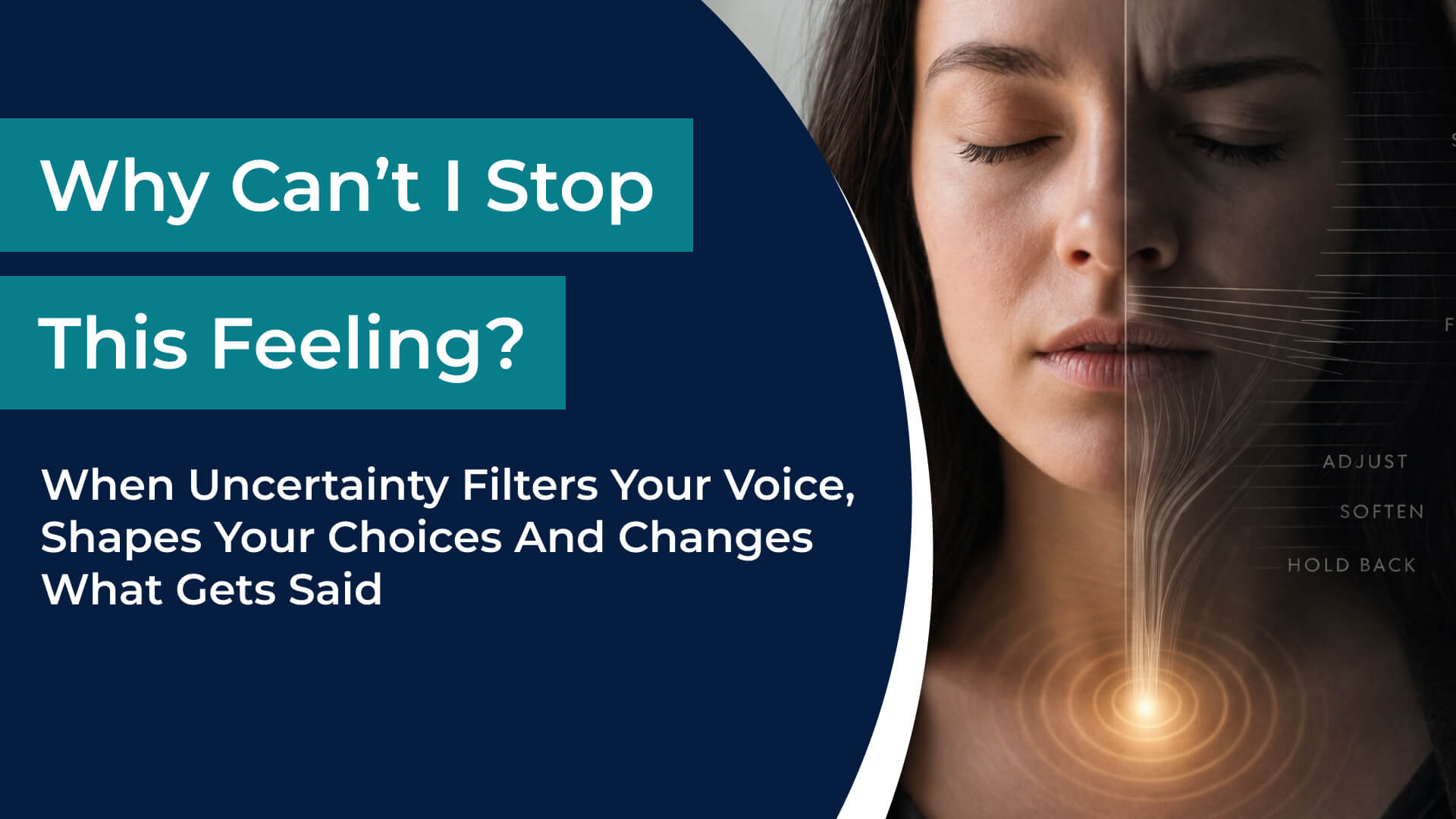

Series – Legitimacy Under Uncertainty
Leadership frequently involves navigating uncertainty, disagreement, and unpredictable human behaviour. When anxiety rises, attempts to manage or control others can feel like the safest response. This series examines how anxiety can reshape leadership behaviour in subtle ways. Control may appear as organisation, planning, or careful management, yet it can also restrict the openness necessary for leadership to function effectively. By recognising these patterns, leaders can begin to see how anxiety influences how they relate to uncertainty and authority.
The Pull to Certainty
As I’m writing this introduction, I can feel the pull to seek certainty. How will this land? How will she read it? Will she be able to connect to the words on the page? Writing, like any creative practice done for an audience, is shaped by how we think it will be perceived.
Will they like it? Will they reject it? Two extremes created through our own meaning-making process. What does this say about me? What do I make it mean about me? Who am I to these strangers who suddenly land upon this article, not necessarily by choice? Who do I want them to be for me?
If you have ever created something in the quiet, peaceful environment of your own home, just for yourself, then someone asks you to create something for them, you will know the feeling. Something changes. There is a sense of being seen. A sense that what you produce now carries consequence.
Like any exposure, the system moves to protect. The piece changes. It becomes more careful, more shaped, more aware of how it will be received. The original movement is still there, but it no longer moves with the same ease. What you were about to say begins to shift. Self-expression narrows.
For women, here lies the familiar response to exposure. Something has been felt, and something else has moved in to manage it, shaping voice and choice before they are even fully expressed.
Certainty Seeking Moves
Uncertainty is inherent to life. As hard as we try, we cannot ever fully predict outcomes. Although we know this as part of life itself, our desire to experience calm and comfort can pull us toward resisting that reality because it feels so uncomfortable.
So what sits in the background, shaping how we think, speak, and relate, are certainty-seeking moves. The system starts reaching for something to settle what is being felt. It can happen out of conscious awareness. We may sense discomfort but miss naming it. This is the trap of certainty-seeking moves.
We experience different bodily sensations: Tightness, tension, butterflies, heat, blood rising, tingling, and quickening pulse. This is our body's way of signalling to us that there is something to take care of, and yet, the urge to remove the discomfort of the signal can be so strong.
This is not limited to extreme or high-stakes situations, and it’s not random. It can be deeply patterned around historical narratives of self-monitoring, especially for women: how we look, how we come across, how what we are about to say will be received. It is learned, reinforced, and normalised.
Even in moments of injustice, when we are organised around keeping the peace and being seen as nice, our response will follow that pattern.
Before words are spoken, how you use your voice may already be shaped to come across in an acceptable manner. Voice is not freely available at that moment because it has already been shaped by a deeper pattern. Think of that pattern as a filtering system, where what is considered unacceptable is held back and what feels acceptable is allowed through. Expression, tone, and volume are organised before they appear.
At the same time, everything around you can be taken in as yours to monitor, to take responsibility for, and to regulate. When you are highly attuned to the environment, tone, expression, posture, the way someone shifts in their seat, the pause before a response, the energy in the room, these signals are read quickly, often before you are even aware of it.
While thoughts are forming, adjustments are being made; voice shaped to remain acceptable, sentences softened, tone adjusted, what you can already see clearly is held back. Filter. Adjust. Redirect. Autonomy and choice are hijacked.
Layered on top of this is how we want to be seen. Professional, on trend, artistic, easygoing, the girl next door, younger, older, prettier. And somewhere underneath all of that, a quieter question sits. What would I say, or choose, if I was not monitoring myself at all?
This self-monitoring does not switch on and off. It runs alongside feelings, moods, and body tension, shaping how each moment unfolds. Over time, it becomes so familiar that it is rarely noticed as something separate. It simply feels like being thoughtful, careful, or aware. As if there is an unspoken agreement to always be switched on and always be adjusting.
Uncertainty In The Body
The body registers uncertainty as a lack of control or predictability before the mind has language for it. It does not wait for an explanation. The nervous system predicts and responds before we are aware of it. What cannot be known or settled is felt in the body as tension, shifts in posture, changes in breath, heart rate, and adrenaline.
As this happens, the system moves toward certainty. Sensations begin organising the next move. Deny, deflect, ignore, protect, avoid. It can feel like a rush to the head, a tightening in the chest, a flutter in the stomach, a bracing of the jaw, or a subtle shift in posture.
And from here, expression changes. When anxiety is organising the body, expression becomes less precise, less fluid, and less you. Words come out differently. Timing shifts. What you can already see clearly is softened, filtered, or held back. Choices that once felt available begin to narrow. Think of a singer. The moment anxiety takes hold of the body, the voice tightens.
Now come back to you.
Where does this show up in the moments that matter? Not only in obvious pressure, but in everyday interactions where something is at stake. A conversation. A decision. A response that carries consequence. You might notice it in how you speak. Words become more careful. Tone softens. Timing shifts. What you were about to say changes slightly, just enough to reduce risk. Self-expression becomes managed rather than natural. It is no different to a singer trying to stay in tune while their breath is tight, or a performer attempting to move fluidly while their body is braced. Something is still being expressed, but it is no longer free. It is being controlled.
And this is where it becomes difficult to see.
Certainty-seeking moves can feel like the right move in the moment. They bring a sense of relief. A sense that something is being handled. But if they are pulling you away from your natural self-expression, and organising the body around control rather than responsiveness, they are no longer serving you. They may settle the discomfort briefly, but they come at a cost.
Because what is being shaped in that moment is not just what you say or do, but how you are able to be, and the voice and choices that follow.
The Body and Self-Image
What is felt in the body does not simply pass. Tension can remain. Adrenaline can stay active. The system can hold a level of activation long after the moment has moved on. When uncertainty is held in the body, through tension, adrenaline, and a system that stays switched on, self-monitoring intensifies. Attention turns inward. You become more aware of yourself in the moment. How you are coming across. Whether what you are saying is landing. Whether you are getting it right. Self-judgement becomes louder. Stronger. More convincing. What you see about yourself in that moment can feel real and immediate, even when nothing has actually changed.
Self-image can be hijacked quickly.
What you know becomes harder to access. What you were about to say becomes less certain. Your voice begins to filter. Your choices begin to narrow. You hesitate. You adjust. You hold back. Something in you is now organised around how you are being perceived. And in that shift, your influence reduces. You may still speak. You may still act. What comes through is more controlled, more careful, shaped by self-monitoring and filtered through self-judgement. Over time, this has a cost.
It impacts how fully you express yourself, how clearly you decide, and how much of you is available in the moments that matter.
Closing Reflections
There is a moment in all of this that often goes unnoticed. Something is felt, the body responds, and before the next move is made, there is a brief opening. A moment to see what is happening. To notice the pull, the pattern, and how quickly it begins to organise you.
What happens in that moment matters. Not because it needs to be fixed, but because it is already shaping what comes next. The way you think, the way you speak, and the choices you make are not separate from what is being felt. They are part of the same movement.
When that moment is not seen, the pattern continues. What feels like a reaction becomes the way you relate to yourself, to others, and to what is happening around you. Over time, it can become difficult to distinguish between what is actually there and what is being shaped through tension, self-monitoring, and the need to manage uncertainty.
When it is seen, even briefly, something shifts. Not because the uncertainty disappears, but because your relationship to it begins to change. What was automatic becomes visible. What was organising you begins to loosen. From there, your voice and your choices have a different starting point.
Continue the Conversation
If you recognise this experience, you are not alone in it. These patterns are often present but rarely examined while they are happening. You can continue the conversation with Jeanette Mundy on LinkedIn, where she explores how awareness, perception, and internal experience shape the way we relate to ourselves and what we experience as possible.
RelateAble Global
This work sits at the centre of RelateAble Global’s approach to leadership and organisational development.
RelateAble Global works with leaders and organisations to examine the conditions that shape behaviour, decision-making, and relationships under pressure. Rather than focusing on surface-level skills, the work brings attention to the underlying patterns that organise how people show up, particularly in moments of uncertainty, visibility, and responsibility.
You can learn more or connect with us at RelateAble.Global.