

Series 3 - Legitimacy & Care
Care sits at the centre of how human beings organise their lives. It determines what we pay attention to, what we give time and energy to, and what we move toward or away from. What we care about becomes what we prioritise. What we prioritise becomes what we act on. In this sense, care is not simply a feeling or a value. It is the organising force behind how life is lived. What receives care grows, develops, and is sustained. What is not included gradually diminishes.
Yet care does not always operate with clarity. It can become diffused, overextended, or shaped by expectations that are not consciously chosen. Attention can be pulled in multiple directions. Responsibility can be taken on beyond what is ours to hold. What matters most can lose its place. This series explores how care, when it loses its structure, begins to organise experience in ways that impact wellbeing, decision-making, responsibility, and the ability to have meaningful influence. It invites a closer look at how we come to relate to what matters, and what becomes possible when care is grounded in a clear sense of value.
The Quiet Pull of What Matters
There is what life asks of you, and there is what matters most to you. Most of the time, those two are interwoven. The responsibilities of daily life, the people who rely on you, the work that needs to be done, the commitments that hold relationships, families, organisations, and communities together all require care, attention, and ongoing participation. Women are highly skilled at responding to these demands. They carry responsibility, support others, solve problems, anticipate needs, and hold things together in ways that are often invisible to the people around them.
None of this is inherently problematic. In many ways, it reflects care in action. Care shapes what we pay attention to, what we prioritise, what we protect, and what we give our time and energy to over time. It influences how we make decisions, how we respond to pressure, and what we choose to sustain. A caring life is not the issue being explored here.
What is easier to lose connection with are the deeper things that give life meaning. Beneath the movement of everyday life sits something quieter but deeply significant: what you genuinely care about at a deeper level. What has meaning for you beyond obligation and expectation. What you are drawn toward over time. What feels like it is yours to express, contribute to, build, protect, or move toward in your life.
For some women, this may relate to creative expression, leadership, contribution, service, or a future vision that has remained present for years. For others, it may be a way of living that feels more truthful, more aligned, or more fully their own. These deeper orientations are not always loud or urgent, which is partly why they are so easily overtaken by the immediacy of everyday demands.
The question is not whether daily responsibilities matter. They do. The question is whether the life being lived still holds a meaningful relationship with what matters most to the person living it.
Sometimes those two layers of care remain closely connected. A woman may experience effort, responsibility, and full days while also feeling a clear sense of direction and meaning in the life she is building. Even when things are difficult, there is still a sense that what she is giving herself to is hers.
At other times, life can continue functioning well while internally something no longer feels fully alive within it. A low-level tension. A tiredness that rest does not fully resolve. A sense of being pulled without clarity. Irritation, grief, or frustration that does not entirely make sense in the context of what otherwise appears to be a good life.
What deeply matters to a person but is no longer being lived in alignment with does not simply disappear. It remains present in the background of experience, even when it has lost space, expression, or priority within everyday life. Over time, the distance between how a woman is living and what she deeply cares about begins to register internally, whether she has language for it or not.
Remaining Connected to What Matters
Life asks many things of us. Relationships ask things of us. Children ask things of us. Work asks things of us. Stability, responsibility, health, ageing parents, financial pressure, unexpected circumstances, and the practical realities of everyday life all require care, attention, energy, and ongoing participation. Many women become highly organised around responding to these demands. They support, provide, solve problems, hold things together, and continue showing up through periods of life that require enormous amounts of responsibility and commitment.
At the same time, what feels most meaningful to her also asks something of us.
What we deeply care about pulls for attention, expression, movement, and space within the life we are living. Sometimes that is connected to leadership, creativity, contribution, spirituality, family, adventure, service, or a way of living that feels deeply aligned with who we are. Sometimes it appears as a quieter but persistent sense that something important wants more room, more expression, or more deliberate attention within our lives.
A woman can be living a full, meaningful, responsible life while also trying to remain connected to what matters most deeply to her. These are not opposing realities. In many cases, the responsibilities she carries are deeply meaningful and fully aligned with what she values. The issue is not responsibility itself. The issue is whether, within the movement of daily life, she is still able to recognise, honour, and remain connected to the parts of herself that also require care and expression.
When that connection remains present, responsibility can feel purposeful, chosen, and deeply worthwhile, even when life is demanding. There is effort, sacrifice, and pressure, but also a sense of meaning within what is being carried. At other times, something can begin to feel less settled internally. Not necessarily because life is wrong, but because the relationship between how a woman is living and what deeply matters to her no longer feels as connected, deliberate, or fully alive.
Often, this does not register immediately as a clear thought. It is felt first. A subtle tension. A tiredness that rest does not fully resolve. A sense of disconnection that is difficult to explain because life may still appear full, functional, responsible, and even successful from the outside. She is still contributing, caring, responding, solving problems, and showing up for what matters. And yet, somewhere underneath all of that, something important to her may no longer be receiving the same level of attention, intention, or expression within the life she is living.
The Cost of Leaving Yourself Behind
Sustainable care and authentic service cannot exist if she becomes absent from the centre of her own life. The relationship she has with herself is not separate from how she cares for others; it is foundational to it. If she consistently places everyone else ahead of herself, disconnects from what matters deeply to her, or excludes herself from her own care, life can slowly shift from meaningful contribution into disconnection and sacrifice.
The deeper cost is that when meaning becomes harder to access, she can slowly lose connection to herself and, with it, her sense of value and place within her own life. Losing connection to herself changes the way she experiences her own life.
When meaning is no longer central, life itself can begin occurring primarily through obligation, expectation, responsibility, and the constant pressure of what needs to be dealt with next. The responsibilities themselves are not the problem. Life will always ask things of us. But without a deeper connection to meaning, purpose, and self, life can slowly begin feeling reduced to pressure, maintenance, survival, and carrying what everyone and everything else requires.
This is where many women begin quietly asking questions they may not even fully say out loud. Where am I in all of this? What has my life become? Why does everything feel so heavy? Why does life feel like something I am constantly managing rather than consciously living?
As this continues, it becomes harder to distinguish between conscious responsibility and automatic obligation. The lines between responsibility, obligation, care, guilt, expectation, and genuine choice begin to blur. She says yes without fully considering whether she wants to. She takes things on before reflecting on whether they are actually hers to take on. Much of life begins being lived through automatic patterns of responsibility rather than conscious intention.
This is where many women begin describing themselves as living on autopilot. Life becomes centred around responding, managing, organising, supporting, fixing, and keeping things functioning. There is very little space to pause and ask deeper questions about what genuinely matters, what feels aligned, what is sustainable, or what they themselves truly want.
She may continue functioning as highly capable, caring, and responsible while internally feeling increasingly organised around patterns of obligation, expectation, and responsibility that no longer feel fully conscious or freely chosen. What makes this difficult to recognise is that many of these patterns become morally reinforced over time. Obligation can begin feeling synonymous with care. Self-sacrifice can feel virtuous. Over-functioning can feel responsible, necessary, or even morally good. Saying no, stepping back, or choosing differently can begin carrying guilt, discomfort, or a sense that she is somehow failing the people and responsibilities around her.
When connection to what deeply matters begins fading into the background of life, the distinction between conscious choice and automatic obligation can become less clear. She may still care deeply about the people and responsibilities within her life, yet increasingly participate through pressure, expectation, guilt, habit, or the need to keep everything functioning smoothly around her.
Obligation can begin feeling like love. Guilt can feel like responsibility. Self-sacrifice can feel virtuous. Over-functioning can feel necessary. Automatic yeses can feel like care. Maintaining everything can slowly become part of identity itself.
These patterns are often reinforced and rewarded. Women are frequently valued for being endlessly capable, emotionally available, accommodating, and selfless. As a result, it can become difficult to recognise when care is no longer being consciously chosen, but instead driven by obligation, pressure, resentment, fear of disappointing others, or deeply ingrained ideas about who she believes she should be.
This is where life can begin feeling increasingly heavy. Not because responsibility itself is wrong, but because she is no longer consciously participating in how responsibility is being lived, expressed, or carried within her life.
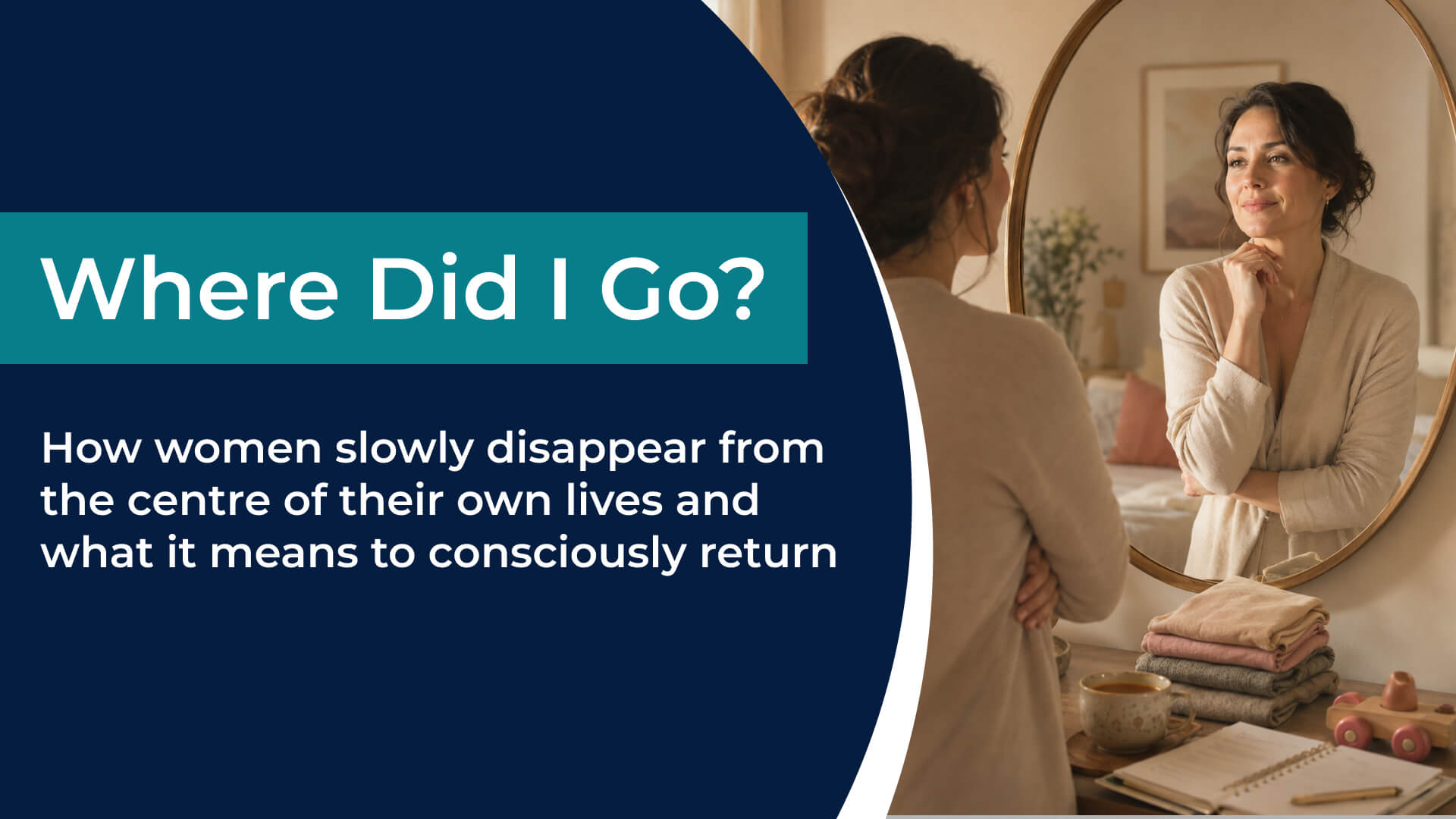
Where Did I Go?
Eventually, the life that once felt meaningful can begin feeling strangely empty from the inside.
Restlessness, flatness, emotional heaviness, grief, or a quiet sense of disconnection can emerge that is difficult to explain, particularly when life on the surface still appears functional, meaningful, or even successful. Questions can begin surfacing internally: What happened to me? Why doesn’t this feel like enough anymore? Why can’t I feel myself clearly within my own life?
The question itself is the doorway. It marks the moment where something deeper begins asking to be seen, acknowledged, and brought back into conscious relationship with the life she is living.
What many women begin recognising at this point is that what looks like being highly capable and highly functional is often a deep adaptation to the life around them. They know how to function, cope, support others, carry responsibility, manage pressure, and keep moving forward regardless of what is happening internally. They know how to meet expectations, maintain stability, and continue showing up for the people and responsibilities that depend on them.
What becomes less clear is their relationship with themselves outside of those roles and responsibilities. What do I actually want? What genuinely matters to me now? What brings me alive? What would I choose if I were not organising myself around expectation, pressure, guilt, or who I believe I should be?
This is where the loss begins to feel more existential than practical. Life may still be functioning externally, yet internally there can be a growing recognition that survival, responsibility, and adaptation have slowly replaced a deeper sense of meaning, aliveness, and conscious participation in life.
Much of this is done with genuine care and good intention. She keeps relationships functioning, responsibilities moving, and life held together for the people who matter to her. Yet gradually, life can begin feeling more like something to sustain than something consciously and meaningfully experienced from within.
This is where many women begin realising they have become deeply responsible for maintaining life while feeling increasingly absent from fully experiencing it themselves. Creativity. Desire. Curiosity. Playfulness. Expression. Vision. Contribution. Adventure. Purpose. Voice. Stillness. Parts of themselves that once brought energy, meaning, vitality, and a sense of being deeply connected to life.
Somewhere along the way, these parts can become harder to access. The grief many women feel is not always for what they have lost externally, but for the growing distance between who they are and the life they are now living. Most women recognise this experience at some point in their life, yet many feel they have so little space, energy, or connection to themselves left that they no longer know how to begin reconnecting with what truly matters to them.
This is one of the most difficult parts for many women to reconcile. The growing sense of emptiness or disconnection they feel can seem unjustified, particularly when they have spent years being responsible, caring for others, and building a life that appears meaningful and successful from the outside.
As a result, the experience often becomes moralised internally. Many women judge themselves for feeling this way. They tell themselves they should be more grateful, less restless, less affected, or more satisfied with the life they already have. They may question whether wanting more meaning, space, expression, or aliveness is selfish, unrealistic, or unfair to the people around them.
Yet responsibility alone cannot sustain a human life emotionally, existentially, or spiritually over time. Responsibility can maintain the structure of life. It cannot fully animate the person living inside it.
Remaining Included in Your Own Life
It is possible to spend years caring for life while remaining increasingly absent from yourself within it.
This can happen in any season of life. During the years of raising children, building a career, supporting relationships, caring for family, creating stability, surviving difficult periods, or carrying the practical responsibilities that life genuinely asks of us. It can also emerge later, once the intensity of certain responsibilities begins to shift and there is finally space to notice what has quietly been happening underneath it all.
This recognition is not a sign that life has been wrong. It does not erase the love, meaning, care, sacrifice, or genuine devotion that may have been present throughout those years. Much of what she gave herself to may have mattered deeply. She may not wish to undo it. What begins to change is the recognition that she was not equally included within the life she was caring for.
The grief is often not for the life itself, but for the growing distance between the self and the life being lived.
The timing matters, but it does not define the possibility. Some recognise the drift while there is still space to make small, conscious adjustments. Others recognise it after years, even decades, of adapting to what life required of them. By then, the recognition can carry grief. There may be sadness for what was not expressed, for what was delayed, or for the parts of themselves that were not fully included in the life they were living.
For younger women, this recognition can interrupt the drift earlier. For women in midlife, it can open a more honest relationship with the life already lived and the life still available. For women later in life, it can bring language to a grief that may have been carried quietly for years.
That distinction matters.
The point is not to judge the life that has been lived, but to become more conscious of the relationship now being held with it. Is she still present within it? Is what deeply matters to her still participating in how life is being shaped? Is her care still connected to meaning, or has it gradually become organised around obligation, expectation, identity, and the belief that she should continue carrying what life has asked of her?
This is one of the reasons the experience can feel so confronting. The realisation may arrive alongside thoughts such as: I should be grateful. I should be more appreciative. Other people have it harder than me. It’s too late now anyway. For some, the only visible solution becomes trying to manage life more effectively, cope better, or place stronger boundaries around the same patterns that created the disconnection in the first place.
Yet something important changes the moment the drift becomes visible. Recognition restores the ability to consciously participate again.
She can notice. She can discern. She can consciously include herself within the life she is living. She can begin reorienting toward what deeply matters now, within the season of life she is actually in. Not by abandoning responsibility or walking away from the people she loves, but by remaining connected to herself while fully participating in the life she is living.
In this sense, conscious reconnection is an act of self-love. Not self-love as self-focus or self-protection, but the willingness to remain connected to herself, to meaning, and to the parts of life that require conscious participation in order for her to feel fully alive within it.
True North is not about abandoning responsibility or escaping the realities of life. It is the ongoing willingness to remain consciously connected to what deeply matters while fully participating in the life being lived. It is recognising that meaning, care, responsibility, and self are not separate from one another.
In every season, the recognition matters because it brings something essential back into view: she must remain included within the life she is caring for.
Perhaps the deeper invitation is not to abandon the life she has built, but to stop leaving herself behind within it.
Jeanette Mundy is a leadership coach (PCC), Senior Coach within the Engenesis community, Accredited Being Profile® Practitioner, and co-founder of Relateable.Global. Her work explores identity, self-leadership, and the hidden patterns that shape how women relate to themselves, responsibility, and meaning throughout their lives.
Follow Jeanette on Engenesis for more writing on self-leadership, identity, care, and conscious participation in life and leadership.