

About this series
More Than Money explores how definitions of wealth are shaped by identity, power, and history, and why what we choose to value determines who thrives, who pays the invisible cost, and what becomes sustainable over time. Moving beyond money as the sole measure of success, the series examines how gender, culture, time, and place influence value systems globally, organisationally, and personally.
The value system organisations rarely name
Most organisations do not explicitly talk about wealth. They talk about performance, efficiency, growth, talent, and results. Beneath these conversations sits a very clear, rarely examined logic about what counts: Who is valuable? What is rewarded? Which contributions matter? Which costs are acceptable? This logic shapes decision-making far more than strategy documents or values statements ever will.
In most modern organisations, a particular wealth logic has become the default organising principle. Not wealth in the narrow sense of money alone, but in how value is defined, accumulated, protected, and distributed. Once you see this, many familiar organisational patterns begin to make sense.
The quiet translation of economic value into human value
In organisational life, economic metrics like revenue, utilisation, growth targets and headcount ratios are often treated as neutral. They appear objective, rational, and necessary. What is less visible is how easily these metrics slide into judgments about people.
High performers become “valuable.” Roles tied directly to revenue-gain status. Work that cannot be easily measured is quietly deprioritised. Care becomes invisible. Maintenance recedes into the background. Relational labour is absorbed rather than recognised. This translation does not mean leaders are indifferent or unethical. It is because systems tend to reward what they can see. Over time, economic value becomes a proxy for human worth. Not explicitly, or intentionally, but structurally.
When wealth logic outsources care
One of the clearest signals that our dominant wealth logic is strained is how often care is now outsourced. As inequality widens and public systems thin, we increasingly rely on private wealth to step into social roles once held collectively. Billionaires fund education initiatives. Foundations address global health. Philanthropy fills gaps left by policy. On the surface, this appears generous. Structurally, it reveals something else.
When wealth accumulation and social repair are split across different actors, the system normalises extraction first and restoration later. Value is created in one place. Cost is absorbed elsewhere. Inside organisations, the same pattern appears. Performance is rewarded. Care is assumed. Repair is reactive.
Leaders and teams quietly take on the emotional, relational, and ethical labour required to make systems function humanly, without that labour being recognised as value-producing. This is not to critique philanthropy or purpose-led initiatives. It is a recognition that when systems cannot hold care internally, they push it to the margins. And those margins are almost always populated by people, roles, and identities with less formal power.
What organisations optimise for, and what they miss
Most organisations are excellent at optimising for outputs. They design incentives. They track performance.
They manage risk. But they are far less skilled at seeing what is being spent to sustain those outputs. The identity load, relational strain and emotional labour are adaptation costs carried quietly by individuals and teams. These costs do not show up on balance sheets. They show up later as fatigue, caution, disengagement (often difficult to explain), and leadership exhaustion that appears disproportionate to workload. What looks like a performance issue is often a value issue. The system is working exactly as designed. It is just optimising for a narrower definition of wealth than it realises.
Power, proximity, and the geography of value inside organisations
Power inside organisations tends to cluster around what the system defines as wealth-producing. Functions closest to revenue, growth, or strategic visibility gain influence. Functions associated with care, continuity, or long-term stability are often treated as support.
This pattern mirrors global economic systems. Value flows upward and outward. Cost is absorbed locally and quietly. Those closest to power experience optionality. Those further away experience pressure. This is not about hierarchy alone. It is about proximity to what the system rewards. Over time, this creates predictable distortions.
People adapt toward visibility rather than usefulness. Decisions privilege speed over sustainability.
Short-term wins are celebrated while long-term costs accumulate. The organisation may appear successful while slowly exhausting the very conditions that make success possible.
Why leaders feel heavy, even when things are “working”
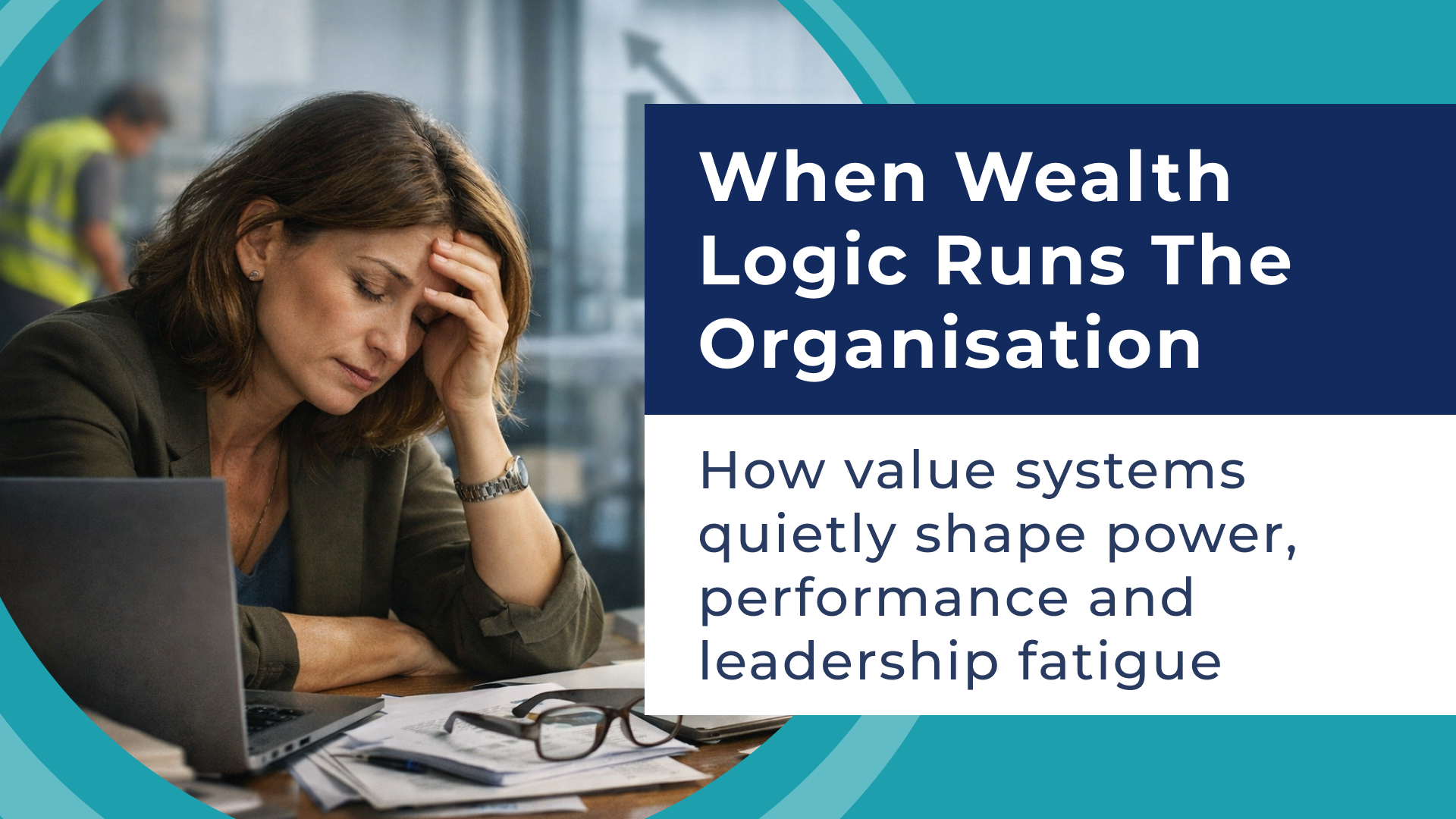
Leadership fatigue is often misread as a personal issue. We talk about the need for better boundaries, more resilience and improved time management. But many leaders are not tired because of volume. They are tired because they are holding contradictions the system cannot reconcile. Those contradictions do not disappear; they are carried by people.
They are asked to drive growth and protect people. To move fast and still care deeply. To optimise performance and absorb human costs. When wealth logic dominates, leaders become translators between what the system rewards and what people require. This translation is emotionally expensive.
Especially when leaders themselves sit at the intersection of identities that carry higher adaptation costs. From the outside, we may read it as composure, but inside, it feels like dead weight.
Who decides what counts as wealth
Most organisational measurement systems did not emerge from neutral observation. They were designed in specific historical and economic contexts: industrial production, shareholder capitalism, and efficiency-driven growth models. These frameworks supported what could be standardised, scaled, and quantified. Time became money. Output became proof. Speed became a virtue. What they struggled to measure was continuity. Continuity supported by relational trust, contextual judgment and long-term stewardship.
As organisations globalised, these measurement systems travelled, often without adaptation. What counted as “value” in one cultural or geographic context was exported as universal. Local ways of working were reframed as inefficiencies. Relational approaches were labelled informal. Care was treated as secondary.
Inside multinational organisations, this creates layered tension. Different geographies carry different understandings of wealth. Different cultures hold different relationships to time, risk, and continuity. Different organisational forms value different kinds of contribution. And yet a single metric system is often used to evaluate them all. The result is not alignment, but distortion.
The organisational cost of narrow wealth definitions
When wealth is defined narrowly, organisations pay for it in ways that are difficult to trace. Innovation slows because risk becomes personal. Trust erodes because care is unevenly distributed. Learning shrinks because uncertainty feels costly.
People begin to protect themselves rather than contribute fully. Not because they are disengaged. But because the system has taught them what is safe. Over time, the organisation becomes efficient but fragile. Productive, but brittle. Successful, but tired. And tired systems do not hold indefinitely.
Geography, organisation type, and the shape of value
Not all organisations experience wealth logic in the same way.
Public institutions, non-profits, global agencies, and mission-driven organisations often operate under competing value systems. They are asked to demonstrate impact using metrics borrowed from market logic, while holding mandates rooted in care, preservation, or equity.
Global bodies decide which landscapes are worth protecting. Which cultures are preserved? Which futures are funded? These decisions are framed as technical. They are deeply value-laden.
Within organisations, similar dynamics play out. Some roles exist to grow. Others exist to sustain. When growth metrics dominate, sustainability roles are perpetually underfunded, under-recognised, or framed as constraints rather than assets. This is not because leaders do not care. It is because the system has taught them what wealth looks like.
Why this tension is reaching a breaking point
The tension between narrow wealth definitions and human sustainability is no longer theoretical. It is showing up as leadership fatigue and disengagement that cannot be fixed with incentives. Cultures may look successful but feel like they might shatter.
In a world shaped by climate instability, technological disruption, and social fracture, systems optimised solely for extraction struggle to adapt. They move quickly, but not wisely. They scale, but not coherently.
The question organisations now face is not whether wealth matters. It is whether their understanding of wealth is accurate enough for the world they are operating in.
Why this is not a moral argument
This is not an argument against profit, performance, or growth. It is an argument for accuracy. Organisations are already operating within a value system. The question is whether that system is fully seen. When leaders believe they are making neutral decisions, they often miss the identity-level consequences of what they reward. What gets recognised becomes normal. What remains invisible becomes expensive.
Seeing wealth logic more clearly
To see how wealth logic operates inside an organisation is not to dismantle it overnight. It is to notice:
What kinds of work are celebrated?
Whose effort is assumed.
Where cost accumulates without acknowledgement.
Who adapts, and who benefits from that adaptation?
These patterns are not accidental. They are signals. This kind of seeing does not immediately change outcomes, but does change responsibility. Once accurately placed, responsibility becomes a leadership act.
What comes next
In the final article of this series, the lens turns inward. Away from systems and structures toward the individual experience of living inside these value logics. Wealth, power, and sustainability are not abstract concepts. They are felt daily in bodies, relationships, and choices. And until we understand how identity absorbs what systems ignore, we will continue to misread exhaustion as weakness and adaptation as success.
Dr Jordan Marijana Alexander works at the intersection of identity, leadership, and organisational systems. She is the co-founder of RelateAble.Global If this series has surfaced questions for you or your organisation, she welcomes thoughtful conversation and inquiry.