

About this series
More Than Money explores how definitions of wealth are shaped by identity, power, and history, and why what we choose to value determines who thrives, who pays the invisible cost, and what becomes sustainable over time. Moving beyond money as the sole measure of success, the series examines how gender, culture, time, and place influence value systems globally, organisationally, and personally.
Leadership at the intersection of wealth and responsibility
Leadership does not happen in a vacuum. Every leader arrives at work already shaped by an inherited understanding of wealth. Formed by family, culture, class, geography, and early experience, this understanding shapes what success feels like, what safety looks like, and what sacrifice seems reasonable.
Organisations have their own wealth logic. What they reward. What they measure. What they make visible.
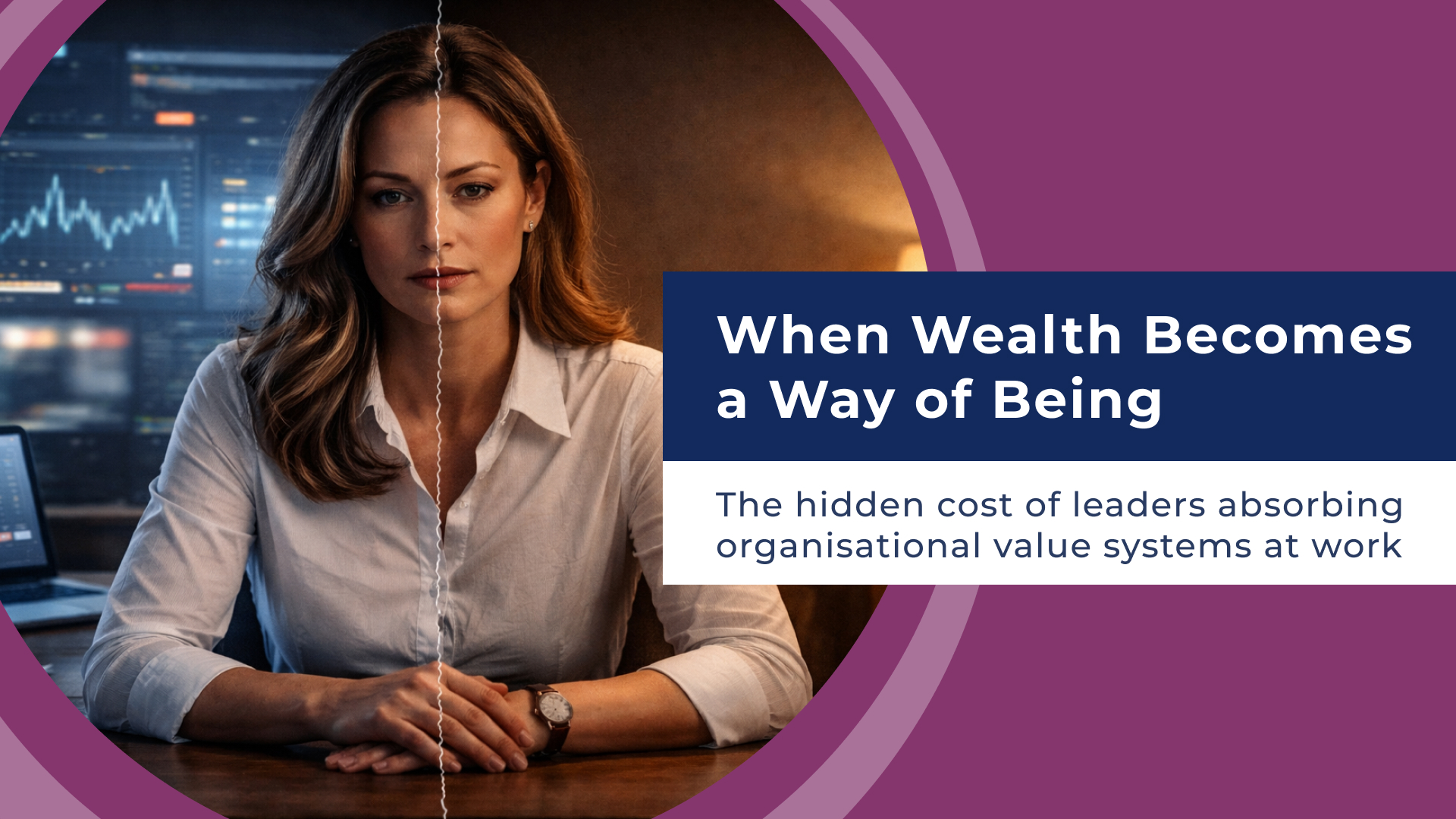
Leadership happens at the intersection of these two systems. Fatigue emerges not because either system is wrong, but because they quietly conflict over time. By the time wealth shows up in leadership, it rarely looks like money. It looks like pace, pressure, or the unspoken sense that stopping is risky. Rest must be justified, and worth proven through motion.
Most leaders do not wake up thinking about wealth. They wake up thinking about responsibility. This looks like delivering results, holding people together, and keeping momentum alive. It is staying relevant. Not dropping the ball. And yet the way wealth has been defined in the systems they lead is already shaping how they move through their days, their decisions, and often their bodies. Not consciously. But constantly.
Living inside two economies
Every leader lives inside at least two economies at once. There is the external economy of targets, incentives, performance metrics, visibility and growth. There is also the internal economy of energy, attention, meaning, relationship and coherence.
Trouble begins when these economies fall out of alignment and leaders are expected to compensate. When the external system rewards speed but the internal system requires recovery. When performance is visible but care is not. When saying yes is applauded and saying no feels like a risk.
Over time, leaders adapt. They compress their calendars. They shorten their breath. They carry pressure as normal and make trade-offs quietly. This adaptation is rarely framed as wealth-related. It is framed as leadership.
Success as vigilance
Many leaders experience success not as fulfilment, but as alertness. Being on. Being available. Being responsive. Being across everything. This is not ambition. It is vigilance. A learned attentiveness to what might slip, stall, or disappoint.
In value systems where wealth is associated with constant optimisation, leaders internalise the idea that stillness is unproductive and satisfaction is premature. Enough is never quite enough. Not because leaders are greedy, but because the system has taught them that stopping is unsafe.
How leaders absorb organisational wealth logic
Over time, leaders do not simply work inside organisational value systems. They absorb them. The organisation’s definition of success reshapes internal pacing. What is rewarded externally becomes what feels necessary internally. What is invisible organisationally becomes privately managed.
This process is rarely conscious. It happens through promotion signals. Through what is praised and what is ignored. Through who advances and who quietly carries.
Leaders become translators between what the system rewards and what people require. This translation is emotionally expensive. Especially for leaders whose identities already carry adaptation pressure.
Who carries the invisible load
The cost of this absorption is not evenly distributed:
Women leaders who have learned to be reliable before being authoritative.
Leaders shaped by cultures where contribution is relational rather than transactional.
Those carrying migration histories, class transitions, or dislocation from place over time.
For them, wealth as a way of being often looks like holding more than is visible. More emotional labour and relational repair. More self-monitoring and internal negotiation. They do not only manage performance. They manage perception. From the outside, we may see composure. From the inside, it feels heavy.
When gratitude silences misalignment
There is a quieter distortion that often accompanies success: Gratitude.
Leaders are reminded how fortunate they are to have influence, opportunity, to have made it.
Gratitude, when weaponised, discourages questioning. It teaches people to tolerate strain because others would gladly take their place. “You’re lucky to have a job.” They override discomfort because it feels ungrateful to want alignment. They silence fatigue because success is supposed to feel satisfying. This is not humility but a subtle form of containment.
Revaluing wealth as coherence
There is another way to understand wealth, rarely legitimised in organisational life: Wealth as coherence.
Coherence refers to the alignment between what you value and how you live. Between what you ask of others and what you ask of yourself. Between the pace you set and the future you are trying to build.
In this sense, wealth is not about accumulation. It is about leakage. How much energy is lost to self-monitoring? How much meaning is eroded by misalignment? How much vitality is spent holding contradictions the system refuses to resolve? This kind of wealth cannot be hoarded. It must be cultivated.
The quiet revaluation
Leaders who begin to revalue wealth rarely announce it. They do not resign dramatically or reject ambition outright. They do something subtler. They notice where effort exceeds meaning. They distinguish responsibility from over-functioning. They stop confusing endurance with impact. They choose fewer symbolic sacrifices. They make fewer hollow trades. From the outside, this can look like slowing down. From the inside, it often feels like returning to oneself.
Why this matters now
In a world shaped by volatility, climate pressure, technological acceleration, and social fracture, leadership that is depleted cannot sustain what it builds.
Systems that reward extraction without renewal eventually consume their own capacity. Revaluing wealth at the level of being is not a retreat from responsibility. It is a recognition that leadership is not only about outcomes. It is about what kind of human presence those outcomes require.
A different measure
If wealth were measured differently, leaders might ask different questions.
Not “How much more can I carry?”
But “What am I no longer willing to trade away?”
Not “What does success look like next?”
But “What does it cost to live this way?”
Not “How do I keep going?”
But “What would allow me to stay whole?”
These are not indulgent questions. They are sustainability questions.
Sitting with the questions
For many leaders, these questions do not land immediately. They surface later. In the pause between meetings. In the body at the end of the day. In the quiet sense that something no longer quite fits.
Why the delay? Because leaders are rarely given permission to ask the questions. Most environments reward answers, not inquiry. Movement, not reflection. Certainty, not calibration. Over time, this trains people out of noticing the internal signals that indicate misalignment.
And yet the questions persist. Not as abstractions, but as sensations. Tightness in the chest when another commitment is added. Irritation that appears disproportionate to the moment. Fatigue that does not resolve with rest alone. These are not signs of weakness. They are data. They are the internal economy responding to the external one. They tend to surface when performance is still intact, but coherence is not.
For a leader, asking different questions is not an intellectual exercise. It is a practice of attention.
Try these:
What am I currently trading energy for that no longer returns meaning?
Where am I carrying responsibility that the system has quietly offloaded onto me?
Which parts of my leadership are driven by fear of loss rather than clarity of purpose?
What would change if I measured success not only by outcomes, but by coherence?
These questions ask for honesty. In environments shaped by narrow value systems, this takes courage. To ask them is to notice fatigue is not a personal failure, but a signal that something in the exchange shifted.
Why leaders rarely ask them alone
It is also important to call this out. Most leaders cannot ask these questions in isolation. They have been socialised to interpret discomfort as inadequacy, not information. The practice is to resolve tension by working harder rather than seeing differently, or to adapt rather than recalibrate.
This is why revaluing wealth as a way of being is rarely a solo act. It is not about withdrawing from responsibility. It is about redistributing it more accurately. That redistribution often begins not with change, but with recognition.
A closing note for the series
This series has not argued against money, ambition, or success. It has asked what we are actually measuring, and who pays the invisible cost when value systems remain unexamined.
Leaders live at the intersection of two value systems. When those systems quietly conflict, fatigue is the signal.
Revaluing wealth does not begin with new metrics. It begins with noticing what you are already paying for, and whether the exchange still makes sense.
Dr Jordan Marijana Alexander works at the intersection of identity, leadership, and organisational systems. She is the co-founder of RelateAble.Global If this series has surfaced questions for you or your organisation, she welcomes thoughtful conversation and inquiry.