

If what follows is reduced to a “pro” or “anti” stance, it will not be because the argument is partisan, but because the reading has already collapsed into it.
A Children’s Story That Was Never Just for Children
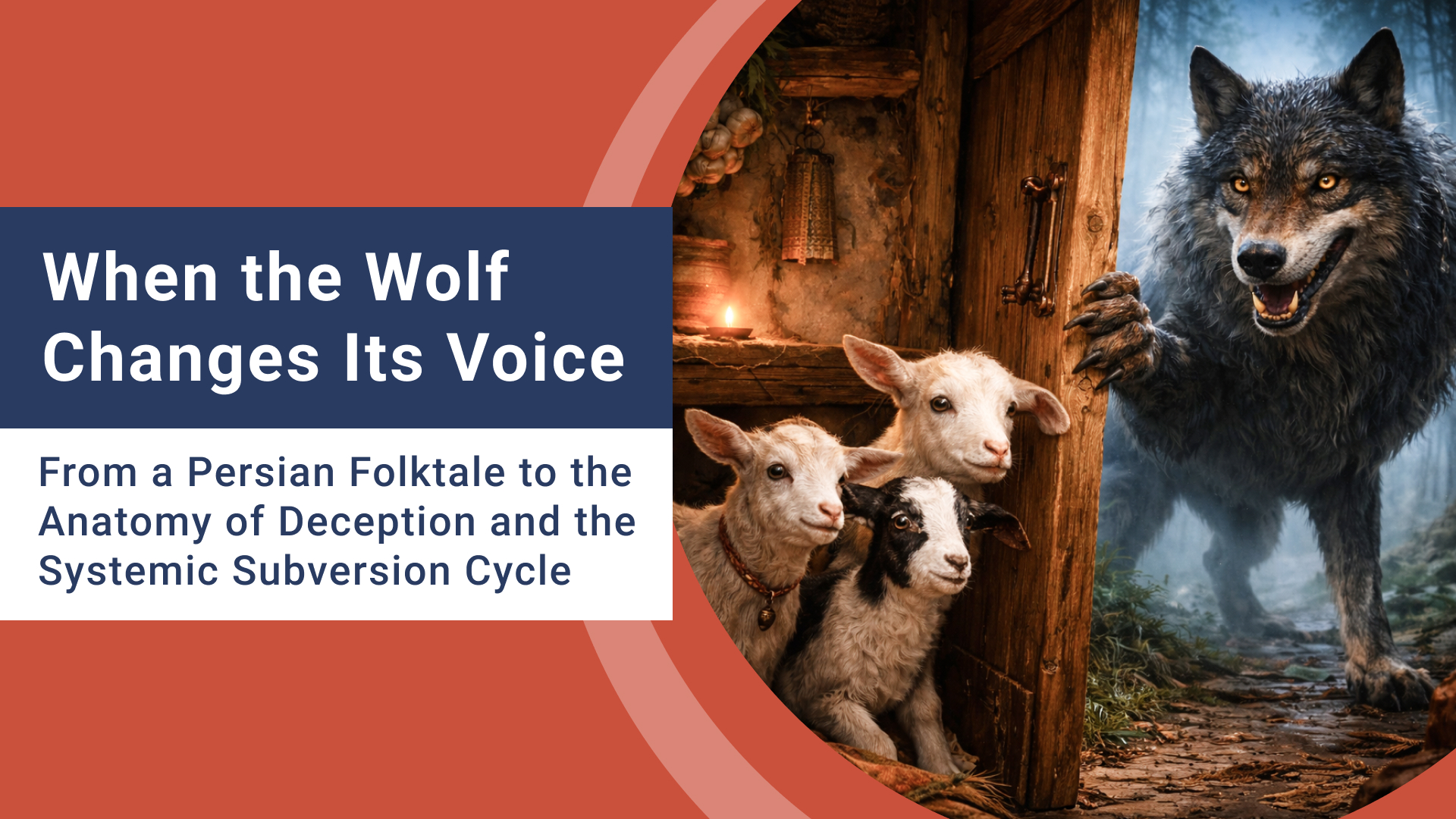
In Persian folklore, there is a story that almost every Iranian grows up with. It is told in homes, repeated in classrooms, and remembered long after childhood. The story is known as Boz-Boz-e Ghandi (the Sweet Mother Goat) and her three young baby goats, Shangool, Mangool, and Habbeh Angoor. At first glance, it appears simple, even innocent. A mother leaves her children at home. A wolf comes. Something goes wrong. Something is learned. But beneath that simplicity sits a structure that is far more enduring than the characters themselves.
Before leaving, the mother does not rush. She gathers her children and gives them a clear, deliberate instruction. Close the door behind me. Do not open it for anyone. Not for a voice, not for a claim, not for a promise. Only open the door when you are certain it's me. This is not merely a warning about danger. It is a warning about misrecognition. She is not telling them that something will try to break in. She is telling them that something will try to be mistaken for what it is not.
The three children receive this moment differently, even if nothing is said explicitly. Shangool listens, but with a lightness that carries curiosity more than caution. Mangool listens more carefully, trying to hold onto the instruction and make sense of it. Habbeh Angoor listens quietly, but with a depth that does not show itself outwardly. The same words land, but not in the same way.
After the mother leaves, the house becomes quiet. The children remain inside, holding onto what they have understood, each in their own way. Then comes the knock. The wolf does not arrive with force. He does not attempt to break the door or expose himself as a threat. Instead, he calls out in a softened voice, stretching his tone in an attempt to resemble the mother. He asks to be let in.
The reaction inside the house is not uniform. Shangool moves closer to the door first, drawn by the familiarity of the voice. Mangool hesitates and pulls back slightly, uncertain but attentive. Habbeh Angoor does not move immediately. There is a pause, not of fear, but of holding.
Something is not right. They do not immediately comply. Mangool is the one who speaks first. There is hesitation in the room, but it is Mangool who gives it form. He does not open the door, but he does not remain silent either. Show us your paw.
The wolf slides his paw under the door. It is dark, rough, and unconvincing. The difference is visible. Mangool leans in to inspect it more closely. Shangool, who had moved forward, now pulls back. Habbeh Angoor does not change position. The conclusion is shared, but not reached in the same way. They refuse. The door remains closed.
At this point, the story could have ended. The threat was recognised. The boundary held. But the wolf does not leave defeated. He leaves to refine himself. He studies the gap between what he is and what he needs to appear to be. In some versions of the story, he goes to a miller and coats his paw in flour so it becomes pale and soft. In others, he focuses on perfecting the tone of his voice, making it warmer, more familiar, less strained. He returns not as he was, but as a closer approximation of what the children are willing to trust.
He knocks again.
Three Baby Goats, Three Ways of Engaging Reality
What is often overlooked in the telling of this story is that the three baby goats are not identical in how they receive, perceive, and conceive what the mother tells them. The instruction is the same. The words are the same. The warning is the same. But the way it is taken in, processed, and held is not.
Before going further, it is worth pausing briefly on what is meant here. When engaging with reality, especially when that reality carries deception, three layers are always at play. Reception is what one allows in, what is heard, noticed, or registered. Perception is how what is received is seen, filtered, and prioritised. Conception is how what is perceived is organised, interpreted, and made into meaning. Deception does not only act at the surface. It can enter through any of these layers, shaping what is taken as real without appearing false.
This is where the story becomes more than a narrative about deception. It becomes an anatomy of how different ways of being shape the response to deception.
Each of the three baby goats, Shangool, Mangool, and Habbeh Angoor, receives the instruction, perceives the situation, and forms a conception of what is happening in a different way. And that difference becomes decisive when the wolf arrives.
Shangool can be understood as the one whose reception is partial, whose perception remains close to the surface, and whose conception is easily influenced by immediate signals. The instruction is heard, but not fully integrated. The warning is registered, but not stabilised. When the wolf returns with a softened voice and a modified appearance, Shangool is more inclined to accept what is presented because the resemblance is sufficient to override the initial caution. Here, perception is vulnerable to appearance, and conception adjusts quickly to what seems plausible in the moment.
Mangool operates at a different level. The reception is stronger, the instruction is held with more structure, and there is an attempt to evaluate what is happening. There is hesitation, there is questioning, and there is a degree of resistance. But the perception is still influenced by what is externally presented, and the conception, while more developed, is not fully anchored. When the wolf refines his imitation, Mangool’s internal framework begins to negotiate with what is seen and heard. The resistance weakens, not because of absence of thought, but because thought itself becomes a space of compromise.
Habbeh Angoor represents a more grounded mode of being. The reception of the instruction is deeper. It is not merely heard, but internalised. The perception is less easily swayed by surface resemblance, and the conception is not rapidly reconfigured under pressure. There is a stronger continuity between what was understood initially and what is being evaluated in the moment. This does not mean immunity, but it does mean a higher threshold for being convinced. The response is not driven by what appears acceptable, but by what remains aligned with what was recognised as true.
What becomes evident here is that the difference is not in access to information. All three received the same instruction. The difference lies in how that instruction is held within their being, and how that shapes their engagement with what follows.
This is precisely where the earlier structure becomes operational. Reception determines what is taken in. Perception determines what is noticed and prioritised. Conception determines how what is perceived is organised and interpreted. And across these three layers, distortion can enter at multiple points.
In the presence of deception being devised by the enemy by the wolf, these differences are not theoretical. They are lived. They determine whether resemblance is accepted as reality, whether hesitation is sustained or abandoned, and whether the boundary holds or collapses.
The story, in this light, is not simply about a wolf becoming more convincing. It is about how different ways of receiving, perceiving, and conceiving reality respond to that increasing sophistication. And that is where its relevance extends far beyond the tale itself.
The Pattern Behind the Story
What appears in that folktale is not a moral anecdote for children. It is a structural map of how deception operates across reality. The wolf does not begin with force because force is inefficient when access can be granted voluntarily. He studies, adapts, refines, and returns closer to what the children are prepared to trust. The mechanism is not aggression. The mechanism is alignment with expectation. And that is precisely what makes it dangerous. When something is clearly hostile, resistance is straightforward. When something resembles what is safe, resistance requires discernment.
This pattern extends far beyond folklore. In real life, deception rarely introduces itself as deception. It does not announce its intent, nor does it rely on obvious falsehood. Instead, it borrows signals that already carry legitimacy. It adopts the language of care, the posture of morality, the vocabulary of justice, and the tone of sincerity. It learns what people associate with truth and then positions itself just close enough to that signal to pass initial scrutiny. The more refined the deception, the less it looks like a lie and the more it looks like a slight variation of truth. This is why the most effective forms of deception are not crude distortions. They are subtle misalignments embedded within something that appears coherent.
There is also an iterative intelligence in deception that is often underestimated. The wolf does not fail once and abandon the attempt. He analyses why he was rejected. He identifies the gap between appearance and expectation. He modifies his approach. He returns improved. This iterative refinement is not unique to a story. It is present in political narratives, media framing, ideological persuasion, and even interpersonal manipulation. What fails once is repackaged, reworded, softened, and reintroduced until it crosses the threshold of acceptance. Over time, the deception becomes more sophisticated, not less, because it is shaped by feedback.
At this point, the challenge is no longer about identifying something that is obviously wrong. It becomes a question of sensitivity to nuance. Can one detect a misalignment when the surface appears correct. Can one sense that something is off when all visible indicators suggest otherwise. This is where the limits of surface-level perception become clear. If one relies only on what is immediately visible or audible, then the second version of the wolf will always be more dangerous than the first. The first was rejected easily. The second enters because it operates within the margin of doubt.
This is also where the illusion of safety emerges. When something passes initial checks, there is a tendency to relax. The presence of resemblance creates a false sense of certainty. The mind begins to fill in the gaps, assuming continuity where there may be none. It is not that the children became careless. It is that the resemblance reached a point where their criteria for recognition were no longer sufficient. The system they relied on to distinguish truth from imitation had been outpaced by the refinement of the imitation itself.
And this is precisely why the story matters. It reveals that the central problem is not simply the existence of deception, but the evolving sophistication of it. It shows that resistance cannot remain static while deception continues to adapt. It also shows that what protects at one stage may become inadequate at the next. The first refusal was correct. The second acceptance was understandable. The difference between them was not intention. It was the increasing precision of the imitation.
At a deeper level, this exposes something fundamental about human vulnerability. People do not usually fall for what is clearly false. They fall for what is almost true. They do not open the door to the wolf as wolf. They open the door to the wolf as something that has successfully approximated what they trust. And once that threshold is crossed, the consequences unfold from within, not from an external breach.
This time the voice is more convincing. The tone carries less tension. The paw, now white and softened, aligns more closely with what the children expect to see. The difference is no longer obvious. It is subtle. It sits in the space where certainty becomes fragile.
The children hesitate again, but not in the same way. The earlier clarity has been replaced by ambiguity. The resemblance is now strong enough to invite doubt. And it is within that doubt that the door is opened.
The wolf enters.
What follows is not the result of force imposed from the outside. It is the result of access granted from within. The boundary did not fail because it was broken. It failed because it was reinterpreted under the influence of a convincing imitation. This is the core of the story, and it is why it endures. The wolf did not succeed because he was stronger. He succeeded because he became convincing enough.
The Anatomy of Deception
What has been unfolding through the story is not incidental. It follows a structure. Deception, especially in its more refined forms, operates through a discernible anatomy.
Deception is the presentation of misalignment as alignment with reality, often through resemblance, in a way that allows it to be accepted without immediate resistance. It does not rely on obvious falsehood. It operates through what is almost right, close enough to be trusted, yet misaligned enough to distort.
Deception is composed of identifiable elements that work together. At its core, it relies on resemblance, presenting itself as something that is almost right, close enough to pass initial scrutiny. Within that resemblance sits a gap, a subtle but decisive misalignment between what it is and what it appears to be. To bridge this gap, deception borrows signals that already carry legitimacy, whether through tone, language, symbols, or moral framing. It then refines itself iteratively, learning from rejection and returning closer to acceptance each time. This continues until it reaches a threshold where doubt collapses and acceptance occurs. From that point, deception is no longer external. It is internalised, and begins to operate from within.
It begins, then, with resemblance. Deception presents itself as something that is almost right, close enough to pass initial scrutiny. The wolf does not arrive as a wolf. He arrives as a modified version of what is trusted, aligning himself just enough with expectation to be considered plausible.
It evolves through iteration. Failed attempts are not abandoned. They are studied. Gaps are identified. Signals are refined. Each return is closer to acceptance than the last. Deception learns from resistance, and over time, becomes increasingly difficult to distinguish from what it imitates.
From there, it engages the human interface. It enters through reception, shapes perception, and stabilises through conception. What is taken in, what is noticed, and how it is interpreted become the pathways through which distortion is introduced. When these layers are not grounded, the misalignment does not appear as such. It is experienced as coherence.
At the centre of this anatomy sits a threshold. The moment of entry. The door does not need to be broken. It needs to be opened. And once opened, the nature of the interaction changes from external pressure to internal consequence, where what was once outside begins to reorganise what is within.
If not interrupted, this process scales. What begins as an instance becomes a pattern. What is accepted once becomes easier to accept again. Over time, this leads into systemic subversion and, at scale, into collective distortion, where the misalignment is no longer questioned but normalised.
This is the anatomy of deception. Not a singular act, but a sequence. Not force imposed from the outside, but alignment achieved from within.
When the Door Was Not Opened
What appears in the story is not confined to fiction. It unfolds, in different forms, in the real world. Now the story bends, and it bends in a way that exposes something many were not prepared to confront.
In the recent imposed war against Iran, there was a widespread expectation, particularly among external analysts and certain intellectual circles, that the population would fracture, align with externally framed narratives, or at the very least become susceptible to messaging packaged as rescue, liberation, or moral necessity. The assumption was not only geopolitical. It was epistemic. It assumed that with enough pressure, enough repetition, and enough refinement of narrative, the door would open.
That expectation did not fully materialise.
A significant portion of the population did not open the door. Not uniformly, not perfectly, but decisively enough to disrupt the anticipated outcome. The softened voices, the moral framings, the carefully constructed narratives did not translate into widespread internalisation. Something resisted, and that resistance was not merely political. It was perceptual and, more importantly, existential.
This is where the contrast becomes uncomfortable.
There is a prevailing assumption that those who are more educated, more intellectually trained, and more conceptually equipped are better positioned to recognise deception. In theory, that should be true. In practice, it is far more complicated. Many who operate under the identity of “intellectual” possess highly developed conceptual frameworks. They analyse, they critique, they construct arguments with precision. They are fluent in abstraction. Yet when deception is not presented as a concept but as a lived, embodied phenomenon, something often breaks down.
Because the problem is not only about thinking. It is about contact.
One can think clearly and still fail to see accurately. One can build coherent arguments and still misread reality. One can critique power structures in theory and still become susceptible to the very mechanisms one claims to understand. In fact, the more refined the conceptual apparatus, the easier it can become to rationalise what should be resisted, especially when the deception aligns with one’s existing frameworks or ideological leanings.
This is where the distinction must be drawn with precision.
At one level, there is immature perception or superficiality and initial insight. This is where judgment is formed at the level of the surface. Tone is taken as truth. Language is taken as intention. Appearance is taken as substance. This level is easily deceived because it does not interrogate what lies beneath resemblance.
At another level, there is conceptual intelligence, built through intellect and rationality. This level can analyse, deconstruct, and model. It is capable of identifying inconsistencies and constructing counterarguments. But when it becomes detached from lived reality, it risks turning into an engine of justification. It can explain away discomfort. It can reframe misalignment. It can make deception appear reasonable, even necessary.
And then there is a third level, which is far less discussed and far less cultivated: authentic existential awareness. This is not merely seeing or thinking. It is a grounded, lived relationship with reality that allows one to sense misalignment even when all external indicators appear coherent. It is not dependent on eloquence. It is not dependent on formal education. It is dependent on a kind of internal clarity that is developed through lived engagement, through exposure, through friction with reality itself.
Many highly educated individuals operate strongly in the second domain. But in moments where deception is refined, adaptive, and embodied, the absence of the third becomes visible. And this is why some of the most formally educated can be the most elegantly deceived, while others with far less formal training remain resistant. This is not an argument against intellect. It is an argument against intellect without grounding. And this is where the provocation must land without dilution.
Life is not a philosophy class. Reality is not a controlled environment for testing ideas. War is not a theoretical construct. Deception is not an abstract category. Engagement with the world is not a seminar. It is direct, it is consequential, and it does not reward conceptual sophistication if that sophistication is not anchored in reality.
This is where purification or refinement, known in Islamic philosophy as tazkiyah, becomes unavoidable. Not as a theological formality, but as an existential necessity. It is the process through which distortion is reduced, one’s relationship with reality is clarified, and the gap between perception and reality is narrowed.
Without this, intellect becomes ornamental. Worse, it becomes complicit. It begins to serve the very forces it believes it is critiquing. It becomes capable of defending deception in language so refined that it becomes difficult to detect. And this is precisely where the earlier story reveals its deeper relevance.
The children did not fail because they were unintelligent. They failed because the criteria they relied on were no longer sufficient for the level of deception they were facing. In the present case, what is striking is that many did not repeat that failure. The door, in many instances, remained closed, not because of superior analysis, but because of a form of awareness that could not be easily manipulated. That is the twist. And it is not a comfortable one.
Beyond Iran: A Universal Phenomenon
What becomes clear at this point is that this is not a story about Iran, nor is it confined to a particular conflict, geography, or moment in time. What has been described is a recurring human pattern. The actors change, the language shifts, the contexts evolve, but the underlying mechanism remains consistent. Deception enters through resemblance. It learns, adapts, refines itself, and presents in a form that is acceptable enough to pass through the gates of perception and the filters of reason.
Across societies, the points of failure tend to follow a familiar structure. Some remain at the level of surface perception, where appearances carry too much authority and signals are taken at face value. Others move beyond the surface but become entangled in abstraction, constructing models and arguments that, while internally coherent, lose contact with the immediacy of reality. In both cases, something essential is missing. Either the capacity to question what is seen, or the capacity to remain grounded while interpreting it.
What is less frequently acknowledged is that failure does not only occur through ignorance. It can also occur through overconfidence in one’s own frameworks. When conceptual systems become too dominant, they can begin to filter reality in ways that favour consistency over accuracy. At that point, what matters is not whether something is true, but whether it fits. And when that happens, deception no longer needs to hide. It only needs to align itself with what is already believed.
This is why the question is not simply about how much one knows, but about how one relates to what is real. Authentic awareness is not an accumulation of information. It is a quality of contact. It determines whether one can remain sensitive to misalignment, even when everything appears structured, justified, and well-presented. It is what prevents resemblance from being mistaken for reality.
From here, the role of the crowd must be reconsidered. The ordinary crowd is often framed as passive, uninformed, or easily influenced. It is measured in terms of what it lacks, whether that be institutional power, formal education, or access to platforms. Over time, this framing becomes internalised. People begin to assume that they are inherently at a disadvantage in the face of larger systems and more organised forces.
But this assumption does not always hold.
A crowd that can discern deception carries a form of power that is frequently overlooked. It may not command armies, control media networks, or produce dominant narratives, but it possesses the capacity to resist internal capture. It can refuse to grant legitimacy. It can withhold acceptance. It can maintain a boundary that cannot be easily breached, precisely because it is not based on external enforcement but on internal clarity.
This form of power is subtle, but it is not insignificant. It does not operate through imposition. It operates through non-compliance with what is misaligned. It is the power of not opening the door, even when the knock sounds familiar, even when the voice is convincing, even when the appearance is carefully prepared.
History has shown that when this capacity is present at scale, outcomes shift. Expectations fail. Predictions collapse. Systems designed to influence and redirect populations encounter resistance that is not easily measurable through conventional metrics. And in those moments, it becomes evident that power is not only located in what can be done to people, but also in what people refuse to accept.
Perhaps the most persistent miscalculation made by dominant forces is to evaluate populations solely through external indicators. Resources, infrastructure, compliance rates, visible alignment. These metrics matter, but they do not capture the full picture. They do not account for discernment. They do not account for the internal threshold beyond which acceptance does not occur.
And that threshold is decisive.
Because in the end, the wolf does not always fail because it lacks strength. It fails when its refinement is not enough to cross that threshold. It fails when resemblance no longer convinces. It fails when, this time, the door remains closed.
And when that happens, the balance shifts in ways that are often recognised only after the fact.
The Cycle: When Deception Becomes Systemic
Up to this point, what we have been looking at may still appear as a story, a pattern, or even a moment of resistance. But what sits beneath all of this is not episodic. It is systemic. It is cyclical. What we are witnessing is not isolated deception, but part of a recurring structure through which systems are gradually subverted, destabilised, and reshaped from within. This is what, within the Authentic Sustainability Framework, is described as the Systemic Subversion Cycle (SSC) .
If we return to the folktale, the wolf is not simply an opportunistic predator who tries his luck and fails. He is the initiator of a process. His first attempt does not work because the resemblance is not convincing enough. The door remains closed. But he does not withdraw. He studies, refines, and returns closer to what will be accepted. The moment the door opens, even slightly, something far more significant than a single act of deception begins to unfold. That moment is not just entry. It is the beginning of subversion.
From there, a sequence begins to take shape. What starts as a point of access gradually becomes a process of internal destabilisation. The SSC makes this visible by showing how systems move through identifiable stages, each building on the previous one and reducing the system’s capacity to resist further distortion.

Crisis Trigger: A moment of pressure, real or constructed, that creates urgency and lowers the threshold for scrutiny. In the story, it is the absence of the mother. In reality, it may be war, instability, economic pressure, or social disruption. Under these conditions, people become more receptive, not because they are irrational, but because they are forced to respond.
Structural Breakdown: Once entry is granted, coherence begins to weaken. Shared understanding fragments, and trust starts to erode. The system does not collapse immediately, but its internal alignment begins to deteriorate in ways that are often subtle at first.
Displacement and Resource Strain: Attention is diverted, energy is consumed in reactive responses, and priorities become unstable. Resources, whether cognitive, emotional, or material, are stretched, and with that strain comes a diminished capacity for discernment.
Escalation and Fractures: Divisions deepen, internal tensions surface, and what was once a unified field becomes segmented. At this stage, the system is no longer dealing only with external pressure, but with internal fragmentation that amplifies that pressure.
Exploitation and Entrenchment: Actors operating in bad faith begin to leverage the instability. Influence becomes embedded. What entered as narrative or suggestion takes structural form and positions itself within the system.
Institutional Inertia and Inaction: Systems that should respond fail to do so effectively. Decision-making slows, becomes compromised, or collapses into paralysis. The issue is no longer invisibility of the problem, but loss of coherence required to address it.
Self-Perpetuation and Recurrence: Distortion becomes normalised. What was once abnormal becomes accepted, even defended. The system begins to reproduce its own dysfunction, carrying the subversion within itself without requiring continued external force.
This is the Systemic Subversion Cycle, and critically, it depends on one thing at the beginning. The door opening.
If we now return to the recent imposed war against Iran, what becomes visible is not merely a geopolitical event, but an attempted entry into this cycle. Crisis conditions were present, pressure was real, and narratives were refined and deployed with the expectation that they would translate into internalisation, fragmentation, and the early stages of structural breakdown.
But where the door did not open, the cycle could not properly initiate. This is the point that is often missed in conventional analysis. The failure to internalise deception is not just a rejection of a narrative. It is an interruption of a systemic process. It prevents the transition from influence to infiltration, from infiltration to distortion, and from distortion to entrenched dysfunction. What appears as resistance is, in reality, structural immunity at the level of entry.
This brings us back to the three baby goats. Their differences are not symbolic in a superficial sense. They represent different thresholds at which this cycle can either begin or be stopped. Where reception is shallow, perception is surface-bound, and conception is unstable, the system becomes highly permeable. Where these are grounded and coherent, the threshold rises significantly, making entry far more difficult, even for a sophisticated adversary.
At this point, the SSC must be understood not as a technical model, but as a diagnostic lens. It allows one to see through what has been happening, not only at the level of events, but at the level of structure. It reveals that what often appears as chaos is patterned, that what appears as isolated crises are interconnected, and that what appears as failure is often the result of a cycle that has already progressed beyond its early stages. This is where its relevance becomes universal.
The same cycle is not confined to wars or geopolitics. It is present in organisations, institutions, communities, and even intimate relationships. A breakdown in trust, a misalignment in values, or a moment of crisis, if not recognised and addressed, can move through the same sequence. What begins as disruption can become embedded dysfunction if the early stages are not interrupted. Which is why this is not merely a theoretical construct. It is a tool to see through what has been happening so that one can make best decisions and prepare appropriate response.
Because once the cycle advances beyond a certain point, intervention becomes exponentially more difficult. But at the beginning, at the level of entry, at the moment where the door is either opened or remains closed, the leverage is highest. And that brings us back, once again, to the simplicity of the story. The wolf does not need to overpower the system. He only needs to be accepted into it.
When this cycle is not interrupted, it does not remain structural. It becomes lived and shared.
When Distortion Scales: The Emergence of Collective Psychosis
What begins as distortion at the level of reception, perception, and conception does not remain confined to individuals. When repeated, reinforced, and shared across groups, it begins to take on a different quality. It becomes collective. At this point, what is misperceived is no longer experienced as misperception. It is normalised, validated, and defended. This is where the phenomenon can be understood as collective psychosis.
This is not a clinical statement, but an ontological one. It does not refer to individual pathology, but to a condition in which groups of people come to participate in a shared misalignment with reality while experiencing that misalignment as coherence. The distortion is no longer felt as distortion. It becomes the frame through which everything else is interpreted.
In such conditions, reception becomes selective. What enters awareness is filtered in advance. Perception becomes patterned. Only certain signals are noticed, while others are ignored or dismissed. Conception becomes self-reinforcing. Interpretations are built not to discover what is true, but to sustain what has already been accepted. At this stage, deception does not need to impose itself. It is maintained from within.
This is precisely where the refinement of deception finds its most fertile ground. When a population is already operating within a distorted frame, even weak signals can be amplified, and even obvious inconsistencies can be absorbed. The wolf no longer needs to perfectly resemble the mother. The threshold of discernment has already shifted.
This is also where the Systemic Subversion Cycle moves from entry into entrenchment. Once distortion is internalised across enough individuals, it begins to stabilise at the level of the system. Narratives harden, divisions deepen, and attempts to reintroduce alignment are resisted, not because they are false, but because they threaten the coherence of the constructed frame.
What makes this particularly significant is that individuals within such a condition often experience themselves as informed, rational, and even morally justified. The presence of intellect does not prevent this. In many cases, it reinforces it. Sophisticated conception can construct elaborate justifications for what has already been misaligned at the level of perception.
This is where the earlier distinction becomes critical. The issue is not the absence of intelligence, but the absence of grounded contact with reality. Without that grounding, reception, perception, and conception can become aligned not with what is, but with what is collectively sustained.
In contrast, a population that has not internalised the distortion does not enter this state. Even if it lacks institutional power, even if it appears fragmented or ordinary, it retains a form of clarity. It does not participate in the same reinforcement loop. It does not stabilise the deception.
This is why the moment of entry remains decisive. If the door is not opened, the cycle does not fully take hold. And if enough individuals hold that boundary, what could have become collective psychosis remains contained.
Being, Power, and the Door That Does Not Open
At its deepest level, what this entire movement reveals is that the question is not merely about knowledge, information, or even intelligence. It is about Being. Not in an abstract philosophical sense, but in the most practical and consequential way. How one is in relation to reality determines what one can perceive, what one can interpret, and ultimately, what one can resist.
Two individuals can be exposed to the same message, the same narrative, the same carefully constructed deception, and arrive at entirely different responses. One analyses, rationalises, and accepts. The other hesitates, senses misalignment, and withholds. The difference is not simply cognitive capacity. It is ontological. It is grounded in the way they are present to what is unfolding.
This is where the illusion around intellect becomes particularly dangerous. Intellect can organise thought, but it does not guarantee alignment with reality. It can refine arguments, but it does not ensure that those arguments are anchored in what is true. It can even create the impression of clarity while quietly distancing the individual from direct contact with what is actually happening. And when that occurs, intellect no longer functions as a tool for discernment. It becomes a mechanism for sophisticated error.
Which brings us back, once again, to refinement. To purification. To what has been described in different traditions as a necessary clearing of distortion from one’s way of being. This is not about moral posturing or ideological positioning. It is about removing the internal noise that interferes with perception, that distorts conception, and that weakens awareness. Without this process, the individual becomes increasingly susceptible to what is polished, persuasive, and well-packaged, regardless of its alignment with reality.
This is also where the role of the collective must be understood differently. A crowd is not merely a collection of individuals. It is a field of Being. When that field is fragmented, confused, or detached, it becomes highly permeable to external influence. But when that field carries a degree of clarity, even if imperfect, it develops a form of coherence that is not easily penetrated. The power of such a collective does not come from uniformity or blind agreement. It comes from a shared capacity to recognise misalignment and refuse it.
This is why the earlier assumption, that power is determined primarily by material dominance, is incomplete. Material power matters. Institutional power matters. Narrative power matters. But beneath all of these sits something more fundamental. The relationship between people and reality itself. If that relationship is distorted, then power can be exercised over them with relative ease. If that relationship retains a degree of clarity, then even significant external force encounters limits.
And this is where the final inversion occurs.
It is often assumed that those with greater resources, greater control, and greater influence hold the decisive advantage. But when deception becomes the primary tool, the advantage shifts. It shifts toward those who cannot be easily deceived. Toward those who do not confuse resemblance with reality. Toward those who do not grant access simply because something appears acceptable. Because in the end, the decisive moment is not when the wolf arrives.
It is when the door is opened. Or not.
And when, at scale, that door does not open, something far more powerful than force comes into play. A form of resistance that does not need to announce itself, does not need to organise visibly, and does not need to dominate. It simply needs to hold.
And that is often enough.